

You can take penalty-free distributions from a traditional gold IRA once you reach age 59½, and those withdrawals are taxed as ordinary income in the year you receive them, following IRA distribution rules rather than a separate rate for precious metals. Required minimum distributions still apply on a set schedule, and RMDs cannot be rolled over. Early withdrawals before 59½ can trigger an additional 10% tax on top of what you already owe.
TL;DR:
- Delaying your first required minimum distribution until April 1 requires another by December 31, potentially placing two taxable withdrawals in one tax year.
- A Roth gold IRA distribution is generally tax free only after age 59½ and five years have passed since your first Roth contribution.
- Recognized exceptions can remove the 10% additional tax on early withdrawals, but ordinary income tax remains and Form 5329 may be required.
- A direct custodian transfer avoids personal possession, the 60 day rollover deadline, and mandatory 20% withholding on certain rollover distributions.
- When you receive metal rather than cash, the custodian reports its distribution date value to you and the IRS on a tax form.
Table of Contents
- Withdrawal Eligibility and Timing: What Counts as a Qualified Distribution
- Required Minimum Distributions: Start Age, Calculation, and Timing Pitfalls
- Tax Treatment and Reporting: Ordinary Income and Form 1099-R
- Early-Withdrawal Penalties and the Exceptions That Can Avoid Them
- Rollovers, Trustee-to-Trustee Transfers, and the 60-Day Rule
- Custody and Eligible Metals: Fineness Standards and Storage Rules
- A Practical Checklist for Taking a Gold IRA Distribution
- How GoldRock Supports Compliant Gold IRA Distributions
- Impact of Beneficiary Designations on Gold IRA Distributions
- Rules and Procedures for Inherited Gold IRA Distributions
- Options and Rules for Taking Distributions Upon Permanent Disability
- State-Specific Considerations in Gold IRA Distribution Rules
- The Distribution Timeline: From Request to Completion
- Three Takeaways for Planning a Gold IRA Distribution
- Request a Free Precious Metals Consultation
- FAQ
- Sources
Withdrawal Eligibility and Timing: What Counts as a Qualified Distribution
Age 59½ is the line the IRS draws for penalty-free access to a traditional gold IRA. Before that age, a withdrawal is generally treated as an early distribution and may trigger the additional tax discussed later in this guide, unless an exception applies. After 59½, you can withdraw without that added tax, though ordinary income tax still applies to traditional account distributions.
Roth gold IRAs work differently. A qualified distribution requires both reaching age 59½ and satisfying a five-year holding period measured from your first Roth contribution. Meet both conditions and the distribution is generally tax-free; miss either one and part of the withdrawal may be taxable.
A few examples make the distinction concrete:
- A 62-year-old taking cash from a traditional gold IRA: ordinary income tax applies, no additional tax.
- A 45-year-old taking a distribution with no exception on file: ordinary income tax plus the 10% additional tax.
- A 61-year-old withdrawing from a Roth gold IRA opened eight years ago: generally tax-free.
Required Minimum Distributions: Start Age, Calculation, and Timing Pitfalls
RMDs follow a structured timeline, and physical metals add a valuation step that paper assets don’t require.
- Your RMD start age and first deadline are set by IRS Publication 590-B, which also allows you to delay your very first RMD until April 1 of the year after you reach that age.
- Every subsequent RMD is due by December 31 of each year.
- Your custodian calculates the RMD using the account’s fair-market value as of the close of business on December 31 of the prior year, which for physical metals means a documented valuation of your holdings.
- Missing an RMD can trigger an excise tax on the shortfall, so timing matters as much as the math.
If you delay your first RMD to April 1, you’ll owe a second RMD by December 31 of that same year, potentially pushing two years of taxable withdrawals into one tax year. This first-RMD timing rule, explained in Publication 590-B, is one of the most common planning missteps among new RMD takers.
Tax Treatment and Reporting: Ordinary Income and Form 1099-R
A gold IRA distribution is taxed under IRA rules, not under the capital-gains treatment sometimes applied to collectibles held outside a retirement account. Under 26 CFR §1.408-4, amounts distributed from an IRA are generally included in your gross income for the year you receive them, whether you take cash or the metal itself.
When you request an in-kind distribution, meaning you receive the physical coins or bars rather than cash, your custodian assigns a fair-market value to that metal on the distribution date. That value is reported to you and the IRS on Form 1099-R.
A few reporting basics worth knowing before you file:
- Form 1099-R shows the gross distribution amount and any federal tax withheld.
- Distribution codes on the form indicate whether the IRS already expects an exception to the additional tax or whether you’ll need to document one yourself.
- Form 1099-R’s distribution code is the control point that determines whether you need to file additional paperwork to claim an exception, according to the IRS instructions for Form 1099-R.
Early-Withdrawal Penalties and the Exceptions That Can Avoid Them
The 10% additional tax described in IRS Topic No. 557 is charged on top of ordinary income tax, not instead of it. A withdrawal taken before 59½ without a qualifying exception is taxed twice over: once as income, once as a penalty.
Common exceptions that may avoid the additional tax include:
- Permanent disability, as defined by IRS rules.
- Certain unreimbursed medical expenses above a percentage of adjusted gross income.
- A series of substantially equal periodic payments.
- Death of the account owner.
Pro Tip: If your Form 1099-R distribution code doesn’t already reflect your exception, you’ll need to file Form 5329 to claim it when you file your return.
Rollovers, Trustee-to-Trustee Transfers, and the 60-Day Rule
Moving retirement funds into or between gold IRAs can happen two ways, and the difference affects your tax exposure.
- A trustee-to-trustee transfer moves funds directly between custodians, you never take possession, and the 60-day rollover clock never starts. Our IRA rollover vs. transfer guide walks through how custodians coordinate this.
- A 60-day rollover means you receive the funds yourself and must redeposit them into a qualifying retirement account within 60 days, or the amount becomes taxable. IRS private letter rulings show the IRS may waive this deadline in narrowly defined, fact-specific equitable circumstances, but a waiver isn’t something to count on.
- Requesting a direct transfer instead of a personal distribution check also avoids the mandatory 20% withholding that applies to certain rollover distributions, a detail covered in our 60-day rollover withholding guide.
Our IRA rollover timeline and checklist lays out each step in sequence for readers planning a move.
Custody and Eligible Metals: Fineness Standards and Storage Rules
Not every coin or bar qualifies for a gold IRA. IRS guidance on collectibles and qualifying bullion sets minimum fineness standards and requires that an approved trustee or custodian hold the metal, not the account owner personally.
- Eligible coins and bullion must meet IRS fineness thresholds and be held by an approved custodian or trustee.
- Home storage of IRA-owned metal is not a recognized custody arrangement and can cause the IRS to treat the metal as distributed, triggering tax consequences.
- Because physical metal can’t be fractionally withdrawn like cash, satisfying an RMD often requires planning ahead for either a partial sale or an in-kind valuation your custodian can document.
Our eligibility and custodian requirements guide and our depository versus home storage comparison go deeper into how approved storage actually works.
A Practical Checklist for Taking a Gold IRA Distribution
- Decide whether you want cash or an in-kind distribution of the physical metal, and confirm your custodian’s procedure for each.
- Request distribution paperwork early and confirm the valuation date your custodian will use.
- Review your withholding election before the distribution is processed.
- Keep your 1099-R, custody statements, and any sale receipts for your tax records.
Pro Tip: Spacing distributions across tax years, where it fits your RMD schedule, can help avoid stacking two years of taxable income into one filing.
How GoldRock Supports Compliant Gold IRA Distributions
We provide personalized guidance through a dedicated in-house IRA department built around rollovers, transfers, and distributions. Our team coordinates with approved depositories and offers insured private delivery for clients who choose an in-kind distribution, and we help walk through the paperwork, valuation timing, and sale-versus-delivery decision at each step.
Impact of Beneficiary Designations on Gold IRA Distributions
Your beneficiary designation determines who receives your gold IRA and under what distribution schedule, independent of what your will says. A current, correctly filed beneficiary form generally overrides outdated instructions elsewhere.
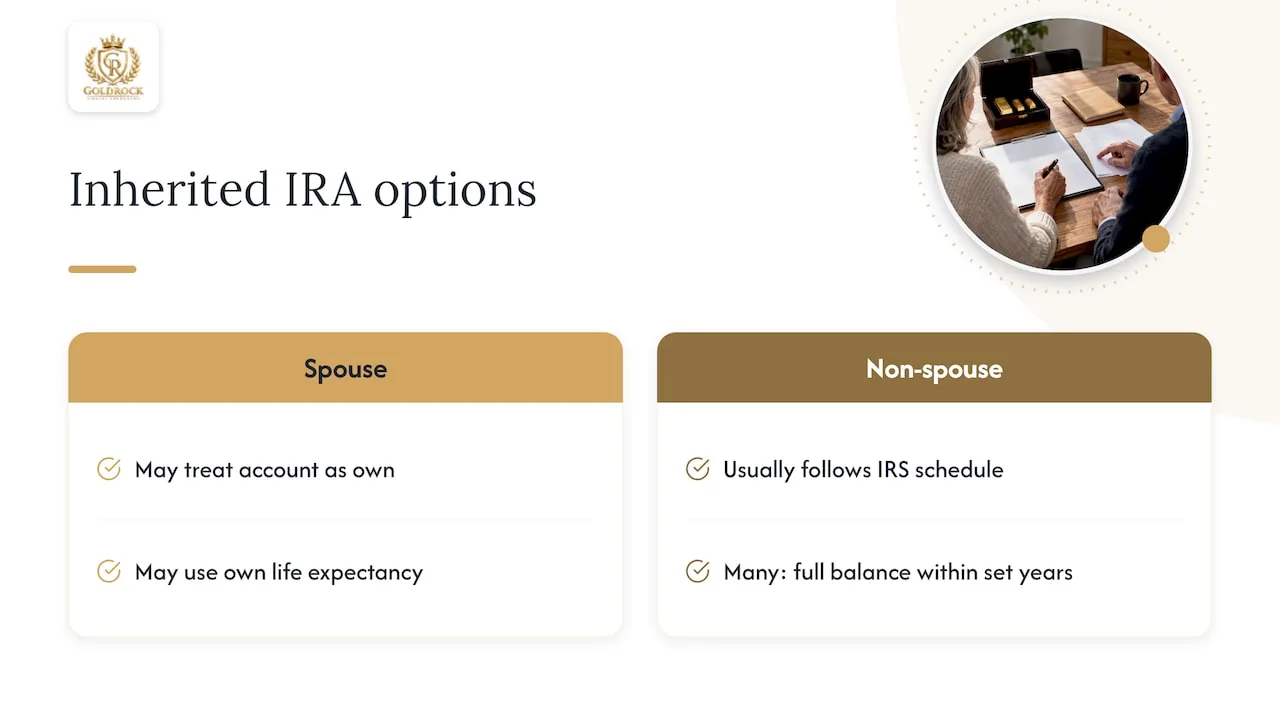
Naming a spouse as beneficiary typically offers the most flexibility: a surviving spouse can often treat the inherited IRA as their own, rolling it into an existing or new IRA and following their own RMD timeline. A non-spouse beneficiary, such as an adult child, usually faces a different and more compressed distribution schedule.
Because the account may hold physical metal rather than cash or securities, a beneficiary inheriting a gold IRA needs to understand early whether the custodian will distribute the metal in-kind or expects a sale to meet distribution requirements. That decision affects both the beneficiary’s tax timing and what they end up holding.
Keeping beneficiary designations current after a marriage, divorce, or birth in the family matters here as much as it does for any other retirement account. An outdated form can send a gold IRA to an unintended recipient regardless of other estate planning documents. Reviewing designations periodically, and confirming your custodian has the most recent version on file, is a simple step that prevents a complicated dispute later. Our gold IRA rules overview covers how custodians typically document these designations.
Rules and Procedures for Inherited Gold IRA Distributions
Inherited gold IRA rules depend heavily on your relationship to the original account owner and the type of IRA involved. A surviving spouse generally has the most options, including treating the account as their own or taking distributions based on their own life expectancy.
Non-spouse beneficiaries typically must follow a distribution schedule set by current IRS rules, which for many beneficiaries means the full account balance needs to be distributed within a set number of years after the original owner’s death rather than being stretched over a lifetime. The specific timeline depends on factors like whether the beneficiary is a minor child, disabled, chronically ill, or not more than ten years younger than the original owner, categories the IRS treats differently.
For a gold IRA specifically, the inherited account still holds physical metal, so the beneficiary’s custodian needs to confirm whether distributions will be in cash from a sale or in-kind delivery of the metal itself. That decision should happen early, since the beneficiary is working against a defined distribution window rather than an open-ended timeline.
Because inherited IRA rules involve multiple beneficiary categories and exceptions, and because a mistake can be difficult to unwind, a beneficiary working through this process benefits from reviewing their specific case with a tax professional and their custodian before taking any distribution.
Options and Rules for Taking Distributions Upon Permanent Disability
Permanent disability is one of the recognized exceptions to the 10% additional tax on early distributions, as outlined by the IRS. The IRS applies a specific definition of disability for this purpose, generally requiring that you be unable to engage in substantial gainful activity due to a medically determinable physical or mental condition expected to result in death or to last indefinitely.
Meeting this standard doesn’t eliminate ordinary income tax on the distribution, it only removes the additional 10% tax that would otherwise apply to an early withdrawal. You’ll still need documentation supporting the disability claim, and depending on how your Form 1099-R is coded, you may need to file Form 5329 to formally claim the exception when you file your return.
For a gold IRA, the same custody and valuation mechanics apply as with any other distribution: you’ll work with your custodian to decide between a cash distribution from a sale or an in-kind transfer of the metal, and that choice affects how quickly funds or assets become available. Given the documentation requirements involved in proving disability status to the IRS, this is an area where working closely with both your custodian and a qualified tax professional helps avoid a coding error that could delay recognition of the exception.
State-Specific Considerations in Gold IRA Distribution Rules
Gold IRA distributions are governed primarily by federal rules under the Internal Revenue Code, which apply uniformly regardless of which state you live in.
Where state rules enter the picture is state income tax. Some states tax IRA distributions as ordinary income similarly to the federal treatment, some offer partial exemptions for retirement income, and a handful have no state income tax at all. Because this varies and changes periodically, the amount of state tax withheld or owed on a gold IRA distribution depends entirely on your state of residence at the time of the distribution.
Sales tax treatment for precious metals purchases, separate from IRA distribution rules, also varies by state, though that affects acquisition costs rather than the distribution itself. Given how much this varies by jurisdiction and how often state rules change, confirming your specific state’s treatment with a tax professional before taking a distribution is the most reliable way to know what you’ll actually owe.
The Distribution Timeline: From Request to Completion
A gold IRA distribution typically moves through several stages, and knowing the sequence helps you avoid a rushed decision near a deadline.
First, you contact your custodian and specify whether you want a cash distribution or an in-kind delivery of the physical metal. Second, your custodian confirms the fair-market valuation date that will apply, which for physical metal usually means pricing the specific coins or bars as of a set date. Third, you complete distribution paperwork, including your withholding election and, if the distribution is being reported against a known exception to the additional tax, any supporting documentation.
Fourth, if you’ve chosen a cash distribution, the custodian arranges the sale of the metal and processes payment. If you’ve chosen in-kind delivery, the custodian arranges insured shipment of the physical metal to you. Fifth, your custodian issues Form 1099-R early the following year, reflecting the distribution amount, withholding, and the relevant distribution code.
The entire process, from initial request to funds or metal in hand, commonly takes anywhere from a few business days for a straightforward cash distribution to a couple of weeks when in-kind delivery and insured shipping are involved. Planning your request a few weeks ahead of any deadline, particularly an RMD deadline, gives your custodian room to handle valuation and logistics without a last-minute scramble.
Three Takeaways for Planning a Gold IRA Distribution
Plan RMD timing carefully to avoid stacking two distributions into one tax year. Use trustee-to-trustee transfers when moving funds, and confirm valuation procedures before taking an in-kind distribution. Document everything, and talk to a tax professional about your personal situation.
— Blake
Request a Free Precious Metals Consultation
If you’re managing a distribution or rollover, or want guidance through forms and deadlines, we have an in-house IRA department available to assist.

We provide insured private delivery and coordination with approved depositories to help navigate custody requirements. If retirement income planning is also on your mind, readers sometimes explore using a reverse mortgage for retirement income alongside their IRA strategy, or, for those managing a disability claim, understanding how SSDI interacts with retirement savings.
Request a Free Precious Metals Consultation or call (888) 859-0978 to speak with our team, or visit our Precious Metals IRA page to see how we can help with your next distribution or rollover.
This article is general information, not a substitute for advice from a qualified financial advisor. Consult a qualified financial professional about your own circumstances before acting on anything here.
FAQ
What is the downside of a gold IRA?
A gold IRA involves custody and valuation steps that cash or securities accounts don’t, since physical metal must be held by an approved custodian and valued for RMD purposes. Distributions are taxed as ordinary income under standard IRA distribution rules, and improper home storage can trigger unintended distribution treatment.
Is it better to have physical gold or a gold IRA?
The choice depends on your goals: physical gold held outside a retirement account isn’t subject to IRA distribution or RMD rules, while a gold IRA offers retirement tax treatment but requires custodial storage and follows IRA withdrawal timing. A tax professional can help you weigh which structure fits your personal retirement plan.
Does the IRS know if you buy gold?
Routine retail gold purchases outside a retirement account generally aren’t individually reported to the IRS, though certain large cash transactions carry separate reporting requirements under existing law. Gold held inside an IRA is reported differently, through custodian records and Form 1099-R when distributions occur.
How do I convert my IRA to gold without penalty?
Moving existing retirement funds into a gold IRA without triggering tax consequences generally means using a trustee-to-trustee transfer, where funds move directly between custodians and you never take personal possession. If you instead receive a distribution yourself, you have 60 days to redeposit it into a qualifying account under the 60-day rollover rule to avoid it becoming taxable.
Sources
- 26 CFR §1.408-4 – Individual retirement accounts: distributions
- Topic No. 557 — Additional tax on early distributions from traditional and Roth IRAs