

You have exactly 60 days from the day after you receive an IRA distribution to redeposit it into another qualified retirement account. Miss that window and the IRS treats the entire amount as taxable income, with a possible 10% early-withdrawal penalty if you’re under 59½. The safer route skips the clock entirely: a direct, trustee-to-trustee transfer moves your funds without ever passing through your hands.
TL;DR:
- A trustee-to-trustee transfer avoids the 60-day deadline and withholding issues, making it the safest and fastest method for IRA rollover.
- Indirect rollovers trigger a strict 60-day window to redeposit funds, with delays from mailing or processing eating into that deadline.
- Missing the 60-day window converts the full amount into taxable income, and penalties may apply if under age 59½, with relief options limited.
- You can only perform one indirect IRA-to-IRA rollover per year; subsequent rollovers must use direct transfers to avoid taxes and penalties.
- Initiating rollovers early and requesting direct transfers helps prevent delays, missteps, and potential tax consequences.
Table of Contents
- How Long Does an IRA Rollover Take?
- Direct Vs. Indirect Rollovers: What Actually Changes
- What Happens If You Miss the 60-Day Deadline?
- The One-Rollover-Per-Year Rule You Might Not Know About
- Missed the Deadline? Here Are Your Recovery Options
- Tax Forms You’ll Need: 1099-R and Form 5498
- A Practical Checklist for a Compliant Rollover
- Special Cases: Inherited IRAs, Roth Conversions, and Disaster Relief
- How GoldRock Metal Exchange Supports a Compliant Rollover
- What the Rules Actually Reward: Speed and Simplicity
- Request a Free Precious Metals Consultation
- Sources
How Long Does an IRA Rollover Take?
The timeline depends entirely on which method you choose. A direct transfer, where one custodian sends funds straight to another, has no IRS deadline attached because the money never becomes a distribution to you. An indirect rollover works differently: you receive a check or deposit, and the 60-day clock starts ticking the day after you get it.
Processing speed varies by institution. Electronic trustee-to-trustee transfers can settle in days. Paper-check transfers or rollovers from an employer plan typically take 2 to 4 weeks to complete, according to guidance from Vanguard on 401(k) rollovers. That gap matters because every day a check sits in the mail or a plan administrator delays processing eats into the 60 days you actually have to work with.
A few realities to plan around:
- Direct transfers: no 60-day limit, typically faster, minimal paperwork risk.
- Indirect rollovers: 60-day hard deadline, starts the day after you receive funds.
- Employer plan distributions often arrive by check, adding mail time you can’t get back.
- Some custodians take longer than others to release funds, regardless of method.
60 days. That’s the entire window the IRS gives you for an indirect rollover, and it doesn’t pause for weekends, holidays, or slow mail.
Direct Vs. Indirect Rollovers: What Actually Changes
The IRS draws a hard line between these two methods, and the difference isn’t just paperwork. In a direct transfer, your old custodian sends the funds directly to the new one. You never touch the money, so the 60-day rule doesn’t apply at all. In an indirect rollover, the check or deposit comes to you first, which starts the clock and introduces a withholding trap most people don’t see coming.
Here’s the trap: if you’re rolling over funds from an employer plan like a 401(k) using the indirect method, the plan is required to withhold 20% for taxes before sending you the balance. To complete a full rollover, you have to replace that withheld 20% out of your own pocket, or the missing portion counts as a taxable distribution.
Before you initiate any transfer, ask your plan administrator:
- Will this be processed as a direct or indirect rollover?
- Is 20% mandatory withholding going to apply?
- How will funds be delivered, and how long will that take?
Pro Tip: Always request a direct trustee-to-trustee transfer by name. Some plan administrators default to indirect processing unless you specifically ask otherwise.
What Happens If You Miss the 60-Day Deadline?
The 60-day clock starts the day after you physically receive the distribution, not the day it was issued. If a check gets mailed and sits in your mailbox for a week before you notice it, those days still count against you. Bank processing delays don’t extend the deadline either.
If you fail to roll over the money within the 60-day window, the IRS treats the full amount as ordinary taxable income for that year, as explained in detail in Tax on Super Withdrawals: What You’ll Actually Pay. If you’re under 59½, a 10% additional tax often applies on top of the regular income tax owed.
That’s the core mechanic behind the IRS rollover rule, and it applies whether the missed deadline was one day or one month past the limit.
Roth conversions add a wrinkle worth flagging separately. Converting a traditional IRA to a Roth IRA is a taxable event by design, and it isn’t governed by the same 60-day mechanics as a standard rollover between like accounts. A “completed rollover” in the IRS’s eyes means the full gross amount, including any withheld taxes you had to replace, landed in the new account within the deadline. Partial completion still leaves the shortfall exposed as a distribution.

The One-Rollover-Per-Year Rule You Might Not Know About
The IRS limits you to one indirect IRA-to-IRA rollover per individual in any rolling 12-month period. This isn’t a calendar-year rule. It’s measured 12 months from the date of your first rollover, regardless of how many separate IRAs you own.
What counts toward the limit, and what doesn’t:
- Counts: an indirect rollover from one IRA to another IRA.
- Does not count: direct trustee-to-trustee transfers between IRAs.
- Does not count: rollovers from an employer-sponsored plan into an IRA.
If you’re consolidating multiple retirement accounts, use direct transfers for every leg beyond the first indirect rollover you attempt. Violating this limit turns the second rollover into a taxable distribution, and potentially an excess contribution if you deposited it into another IRA.
Missed the Deadline? Here Are Your Recovery Options
Missing the 60-day window isn’t automatically fatal. The IRS provides three paths for relief, though each comes with real conditions attached.
- Automatic waiver. This applies in specific situations, such as an error made by the financial institution handling your funds, or a federally declared disaster that disrupted normal processing.
- Self-certification. You can use a model letter under Revenue Procedure guidance to certify that your situation qualifies for a waiver, without applying for a formal IRS ruling first.
- Private letter ruling. For situations that don’t clearly fit the self-certification categories, you can request a ruling directly from the IRS. If granted, it effectively opens a new window to complete the rollover.
Self-certification is convenient, but it carries audit risk. If the IRS later reviews your return and your stated reason doesn’t hold up, the rollover can be disqualified retroactively.
Pro Tip: Keep every piece of correspondence tied to the delay, bank error notices, disaster declarations, plan administrator emails, in case you ever need to defend a self-certified rollover.
Tax Forms You’ll Need: 1099-R and Form 5498
Two forms drive how the IRS verifies your rollover, and understanding their timing prevents a lot of unnecessary confusion during tax season.
- Form 1099-R reports the distribution from your original account, usually issued by the end of January.
- Form 5498 reports the rollover contribution received by the new custodian, typically issued in May, since it covers contributions made up until the tax filing deadline.
When you file, report the distribution on Form 1040 and write “Rollover” next to the line where it appears. That single annotation signals to the IRS that the distribution wasn’t a cash-out, which reduces the odds of an automated notice questioning unreported income. Keep account statements, transfer confirmations, and any self-certification letters for at least three years, longer if you’ve used a waiver, per guidance in IRS Publication 590-A. These two forms are what the IRS cross-checks against each other, so a mismatch between what one custodian reports and what the other confirms is the most common trigger for a follow-up letter.
A Practical Checklist for a Compliant Rollover
Work through these steps in order, and you’ll eliminate most of the risk baked into the 60-day rule.
- Open and confirm the receiving IRA account before requesting any distribution, so funds have somewhere to land immediately.
- Request a direct trustee-to-trustee transfer whenever the option exists, since it removes the deadline and the withholding issue entirely.
- If a direct transfer isn’t available, note the exact date you receive the funds and deposit the full gross amount, replacing any withheld taxes from your own funds, within 60 days.
- Save every confirmation, statement, and email tied to the transfer, and set a calendar reminder well before the deadline.
- If you realize you’re going to miss the window, start the self-certification or private letter ruling process immediately rather than waiting.
Pro Tip: Set your deadline reminder for day 50, not day 60. That buffer gives you time to fix a bank delay before it becomes an IRS problem.
A full-service dealer that coordinates trustee transfers as part of an IRA rollover can also help track these dates on your behalf.
Special Cases: Inherited IRAs, Roth Conversions, and Disaster Relief
A few situations don’t follow the standard timeline at all, and assuming they do can create expensive mistakes.
- Inherited IRAs: Non-spouse beneficiaries generally cannot use the 60-day indirect rollover option at all. Trustee-to-trustee transfers, along with beneficiary-specific distribution rules, are the only path available.
- Roth conversions: These are taxable events reported separately from standard rollovers, and they don’t share the same 60-day timing logic since the funds are meant to change tax character, not just custodians.
- Plan loan offsets and disaster relief: Certain qualified disaster distributions come with an extended repayment window, sometimes up to three years, rather than the standard 60-day rule.
If any of these apply to you, treat the standard timeline guidance above as inapplicable until you confirm the specific rule for your situation.
How GoldRock Metal Exchange Supports a Compliant Rollover
Coordinating a rollover into a self-directed precious metals IRA involves the same IRS deadlines and paperwork covered above, and getting the sequencing wrong is where most delays happen. GoldRock Metal Exchange’s in-house IRA department works directly with custodians to help structure transfers as trustee-to-trustee whenever possible, which keeps the 60-day clock from ever becoming a factor. The team also maintains documentation tied to insured delivery and account setup, so records line up cleanly with what your custodian reports on Form 5498. Before reaching out, gather your most recent account statement and any prior rollover history, since that history determines whether the one-per-12-months rule affects your options. Working with a dealer that has direct experience moving retirement funds into physical metals tends to reduce the back-and-forth that eats into your available time.
What the Rules Actually Reward: Speed and Simplicity
The conventional advice on IRA rollovers treats the 60-day rule like a puzzle to be managed carefully. It isn’t. It’s a deadline that rewards avoiding it altogether. Every source, IRS guidance included, points to the same conclusion: trustee-to-trustee transfers make the entire timeline question disappear, so the real skill here isn’t tracking days on a calendar. It’s recognizing early that you should never have started the clock in the first place.
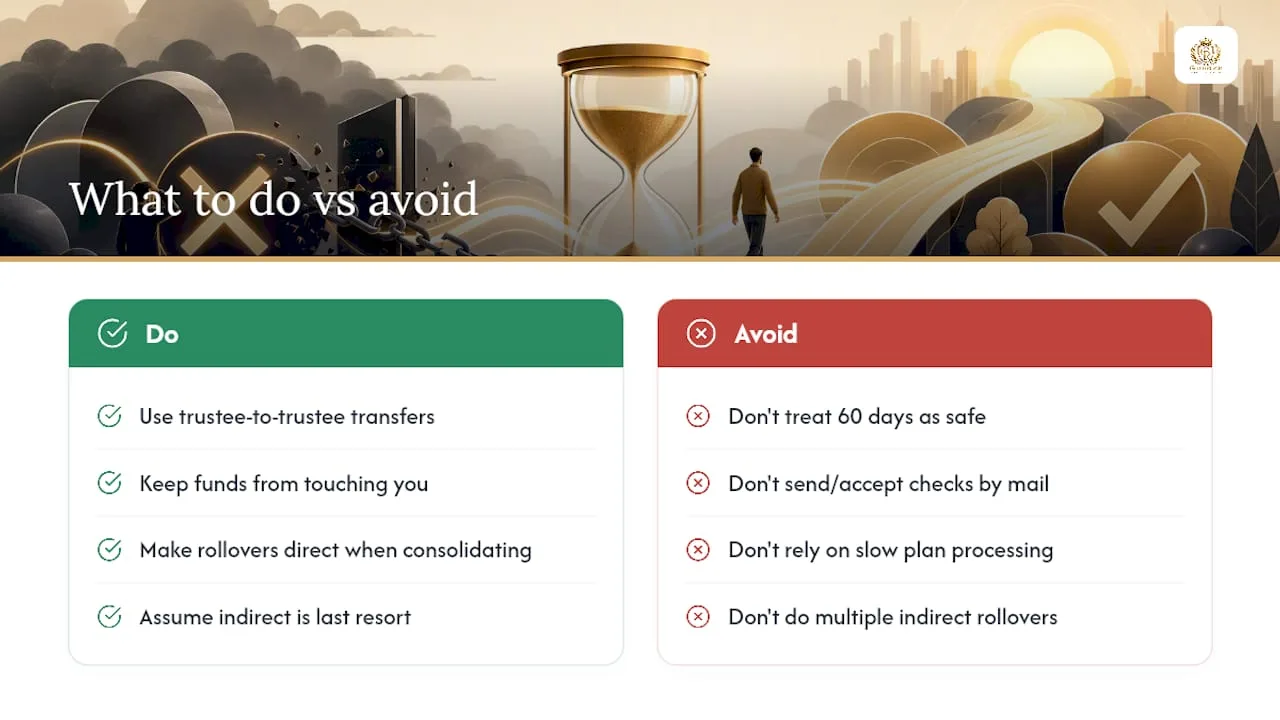
Where I think most guides undersell the risk is mail and processing delays. People assume the 60 days is theirs to control, but a slow check or a lagging plan administrator eats into that window before you’ve made a single decision. If you’re initiating any rollover, the first question shouldn’t be “how do I track 60 days?” It should be “can I make sure this money never touches my hands at all?”
The one-rollover-per-12-months rule gets overlooked constantly, especially by people consolidating several old employer accounts at once. That’s the mistake I’d flag hardest: assume every rollover you do this year, beyond the first indirect one, needs to be a direct transfer, full stop.
— Blake
Request a Free Precious Metals Consultation
If you’re planning to move retirement funds into physical gold, silver, platinum, or palladium, GoldRock Metal Exchange handles the coordination that keeps a rollover on schedule, from setting up a self-directed account to arranging insured private delivery once your metals are purchased. Unlike managing a transfer solo and hoping your former custodian processes paperwork quickly, GoldRock’s in-house IRA department works the phones and forms directly with both custodians so the transfer stays on a direct, trustee-to-trustee track whenever that option exists.

Before you call, pull together your most recent statement from the account you’re rolling over and any records from prior rollovers in the past 12 months. Then request a free consultation by calling (888) 859-0978 or starting online through the Precious Metals IRA page. A short conversation now can tell you exactly which transfer method fits your accounts before you initiate anything with your current custodian.
This article is for educational purposes only and does not constitute personalized tax, legal, or investment advice. Consult a qualified tax professional or financial advisor about your specific situation.
Sources
- Rollovers of retirement plan and IRA distributions (IRS)
- Understanding 401(k) to IRA rollover rules (Vanguard)
This article is general information, not a substitute for advice from a qualified financial advisor. Consult a qualified financial professional about your own circumstances before acting on anything here.