

Yes, you can move retirement funds into a gold IRA using the 60-day rollover rule, but the IRS treats direct and indirect rollovers differently. A direct trustee-to-trustee transfer is the cleaner path because it skips the 60-day clock entirely. An indirect rollover works too, but it exposes you to mandatory withholding, a strict deadline, and a once-per-12-month limit that can undo the tax-free treatment if you miss a step.
TL;DR:
- Using a direct trustee-to-trustee transfer avoids the 60-day deadline and mandatory withholding risks inherent in indirect rollovers.
- Most retirement accounts, including traditional IRAs and 401(k)s, qualify for rollover into a gold IRA, but RMDs and certain withdrawals cannot be rolled over.
- Confirm eligibility, payee wording, and metals qualifications in writing with both plans and custodians before initiating the transfer process.
- The full transfer process typically takes two to four weeks with direct transfers, while indirect rollovers are faster but risk more errors and penalties.
- Missing the 60-day window can sometimes be waived with IRS-approved reasons or self-certification, but proper documentation and professional advice are essential.
Table of Contents
- Direct trustee-to-trustee transfers vs. indirect 60-day rollovers: which to choose and why
- What can be rolled into a gold IRA and what cannot
- A step-by-step checklist and realistic timeline for moving retirement funds into a gold IRA
- Common pitfalls when converting to a gold IRA and how to prevent them
- Missed the 60 days? How waivers and self-certification work
- Tax reporting: forms, timing, and what happens if the rollover fails
- How GoldRock Metal Exchange supports compliant gold IRA transfers
- Why direct transfers are the practical default for precious metals IRAs
- How GoldRock Metal Exchange can help you complete a compliant gold IRA transfer
- Sources
- FAQ
Direct trustee-to-trustee transfers vs. indirect 60-day rollovers: which to choose and why
A direct transfer moves money straight from one custodian to another. You never touch the funds. The distributing plan wires the balance to your new self-directed IRA custodian or cuts a check made payable to that custodian, not to you personally. Because the money never passes through your hands, the IRS confirms this method avoids the 60-day deadline altogether.
An indirect rollover is different. The distributing plan sends the funds to you, and the clock starts on the date you receive them. You then have 60 days to deposit the full amount into an eligible retirement account. Miss that window, and the distribution becomes taxable income, plus a possible early withdrawal penalty if you are under 59½.

The complication is withholding. When an employer plan like a 401(k) pays a distribution directly to you, federal law requires the plan to withhold 20% for taxes. That means if you request a distribution from an employer plan, the plan is required to withhold 20% for taxes. To roll over the full distribution amount and avoid tax on the missing portion, you need to come up with the withheld portion from other funds and deposit the complete amount within 60 days.
Before initiating any distribution, confirm the exact payment wording with the distributing plan:
- Ask whether the check can be made payable directly to your new custodian, not to you.
- Request wire instructions instead of a paper check whenever the plan allows it.
- Get the payee language in writing before the distribution is processed.
What can be rolled into a gold IRA and what cannot
Most retirement accounts qualify for rollover into a self-directed precious metals IRA, including traditional IRAs, 401(k) plans from a former employer, 403(b) plans, and other qualified employer plans. Roth accounts can move into a Roth-structured self-directed IRA, though the tax treatment differs from traditional accounts.
Not every distribution qualifies for rollover treatment, though. Required minimum distributions are the most common exclusion. Once you reach the age where RMDs apply, that portion of your distribution cannot be rolled over into any IRA, gold or otherwise, because Publication 590-B treats required distributions as ineligible for rollover. Certain hardship withdrawals and a handful of other distribution types carry similar restrictions.
Before you move a dollar, confirm eligibility directly with the plan administrator and your receiving custodian:
- Ask the distributing plan whether the specific funds you want to move are RMD-eligible or excluded.
- Confirm with your new custodian which metals qualify for IRA storage and which forms or coins do not.
- Get the eligibility confirmation in writing, not just a verbal assurance from a call center representative.
Custodians, not the metals dealer, ultimately determine which storage arrangements and metal products satisfy IRA rules. That confirmation should happen before you authorize any distribution from your existing account.
A step-by-step checklist and realistic timeline for moving retirement funds into a gold IRA
Moving funds into a gold IRA follows a predictable sequence. Here is the order that keeps you inside IRS rules and avoids surprises:
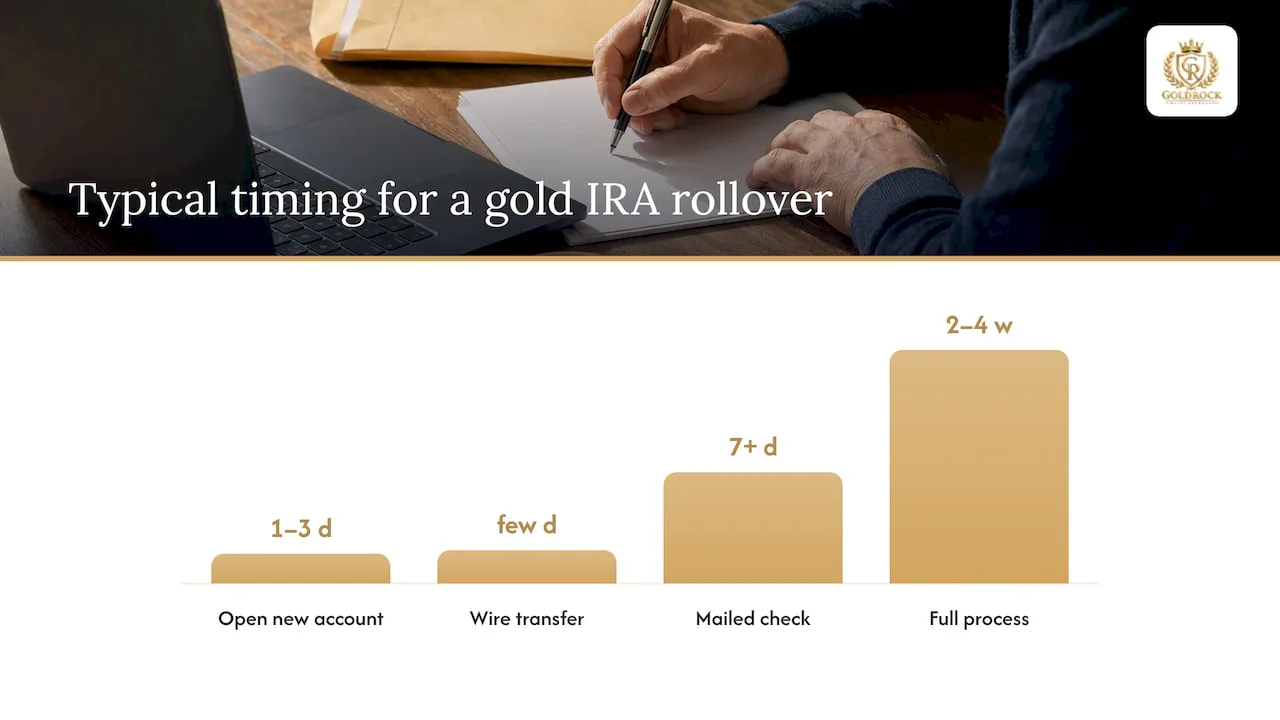
- Open your self-directed IRA account and provide the new account information to your current plan administrator. This typically takes one to three business days once paperwork is signed.
- Confirm rollover eligibility with both the distributing plan and the receiving custodian, and separate out any required minimum distribution amounts that cannot be rolled over.
- Request a direct trustee-to-trustee transfer, either by wire or by a check made payable only to the receiving custodian. Wires often settle within a few business days; mailed checks can add a week or more.
- If the distributing plan insists on paying you directly, note the date you receive the funds immediately. That date starts your 60-day clock, and you will need to plan how to replace any amount withheld for taxes.
- Once the receiving custodian confirms funds, authorize the purchase of IRA-qualifying metals and confirm your depository and storage arrangement.
- Keep every confirmation, wire receipt, and piece of correspondence. This paperwork is your evidence if the IRS ever questions the rollover.
Pro Tip: Call your new custodian before you call your old plan, so you have exact wiring instructions and account numbers ready the moment the distributing plan asks for them.
The full process, from opening the new account to holding metals in storage, typically runs two to four weeks when everything goes through a direct transfer with no delays. Indirect rollovers can move faster on paper but leave far less room for error given the fixed 60-day deadline. For a closer look at the paperwork involved, see our checklist for moving a gold IRA and a timeline built around each stage of the transfer.
Common pitfalls when converting to a gold IRA and how to prevent them
If your old 401(k) withholds $10,000 from a $50,000 distribution, you must deposit the full $50,000 into your new IRA within 60 days to avoid tax on the shortfall, which means finding $10,000 from savings or another source to cover the gap.
The one-rollover-per-12-month rule catches many people off guard. According to IRS Publication 590-A, you can only complete one indirect IRA-to-IRA rollover in any 12-month period, regardless of how many IRAs you own. Trustee-to-trustee transfers are not subject to this limit, which is one more reason to favor them.
A second common error involves check wording. A check made payable to you personally, even if you intend to deposit it into your new IRA within days, is treated as an indirect rollover subject to the 60-day rule and withholding. A check payable to your custodian, referencing your new account, is treated as a direct transfer.
Safeguards worth building into every transfer:
- Get payee instructions in writing before the distribution is processed.
- Confirm your new custodian’s exact procedures for accepting incoming transfers.
- Default to direct trustee-to-trustee transfer whenever the distributing plan allows it.
- Document every call, confirmation number, and mailed form.
Our guide on 401(k) rollovers into metals walks through these payment mechanics in more detail.
Missed the 60 days? How waivers and self-certification work
Missing the deadline does not automatically mean a taxable event, though it does mean extra work. The IRS outlines three paths for late rollovers caused by circumstances beyond your control.
- Automatic waiver: applies in narrow situations, such as a financial institution error or a federally declared disaster that delayed the deposit.
- Self-certification: lets you use a model letter to tell your custodian the delay met one of the IRS-recognized reasons, allowing the custodian to accept the late rollover.
- Private letter ruling: a formal request to the IRS for a ruling on your specific situation, generally reserved for cases where self-certification does not apply, and one that involves a user fee and a multi-month wait for a response.
Self-certification is convenient, but it is not a guarantee. The IRS is explicit that self-certification allows a custodian to accept the rollover; it does not bind the IRS to accept that treatment if your return is examined later. Keep every piece of documentation that supports why the deadline was missed, bank statements, hospital records, correspondence with the distributing plan, and talk with a tax professional before relying on self-certification for a significant rollover amount.
Tax reporting: forms, timing, and what happens if the rollover fails
Expect two forms tied to any rollover. The distributing plan issues Form 1099-R reporting the distribution, and your receiving custodian issues Form 5498 reporting the rollover contribution. These typically arrive by the following January and May, respectively.
On your Form 1040, a properly completed rollover is reported but excluded from taxable income, as long as the full eligible amount, including any withheld portion you replaced out of pocket, made it into the new account within the required window.
If the rollover fails, whether from missing the 60-day deadline or from a payee-wording error that reclassified a transfer as a distribution, the consequences follow standard distribution rules:
- The distributed amount becomes taxable income for the year received.
- If you are under 59½, a 10% early distribution tax generally applies on top of ordinary income tax.
- Any withheld amount you did not replace is treated as taxable and cannot be recovered by transferring the remaining balance alone.
How GoldRock Metal Exchange supports compliant gold IRA transfers
GoldRock Metal Exchange’s in-house IRA department works directly with custodians and distributing plans to keep paperwork accurate and payee instructions correct from the start. That kind of hands-on coordination matters most in the exact spots where rollovers go wrong: check wording, wiring instructions, and custodian confirmation timing.
- Coordinates directly with your new custodian to confirm wiring instructions and payee language before funds move.
- Helps confirm which metals and storage arrangements satisfy your custodian’s IRA requirements.
- Provides insured private delivery for metals purchased outside a retirement account.
- Offers ongoing consultation as you move through each stage of a transfer.
Request a Free Precious Metals Consultation or call (888) 859-0978 to talk through your specific rollover before you initiate a distribution.

This article is educational and general in nature. It is not personalized investment, tax, or legal advice, and you should consult a qualified tax professional or financial advisor about your specific situation.
Why direct transfers are the practical default for precious metals IRAs
Having walked through the mechanics of both paths, my view is straightforward: unless a distributing plan makes a direct transfer genuinely impossible, there is little reason to choose the indirect route for a gold IRA. The 60-day deadline, the withholding shortfall, and the one-rollover-per-12-month limit are all avoidable friction points that a trustee-to-trustee transfer simply does not create. If you take one thing from this article, let it be this: ask for the direct transfer first, and only consider the indirect route as a fallback.
— Blake
How GoldRock Metal Exchange can help you complete a compliant gold IRA transfer
A self-directed Precious Metals IRA service with an in-house IRA department is available to handle the paperwork side of rollovers or transfers, along with insured private delivery for metals purchased outside a retirement account.
- Confirms payee wording and wiring instructions with the distributing plan before funds move.
- Coordinates with custodians on eligible metals and storage requirements.
- Provides ongoing consultation through each stage of the transfer.
Request a Free Precious Metals Consultation at Goldrockmetalexchange or call (888) 859-0978. A tax advisor should review your specific rollover for personalized tax guidance.
This article is general information, not a substitute for advice from a qualified financial advisor. Consult a qualified financial professional about your own circumstances before acting on anything here.
FAQ
How many 60-day rollovers are allowed in a year?
You are generally limited to one indirect IRA-to-IRA rollover in any 12-month period, according to IRS Publication 590-A. Trustee-to-trustee transfers are not counted against this limit, so multiple direct transfers in one year are permitted.
How do you count the 60 days in a 60-day rollover?
The 60-day period begins on the date you actually receive the distribution, not the date it was requested or mailed. You must deposit the full eligible amount into another retirement account or IRA within that window, as described in IRS guidance on rollovers.
Why would someone choose an indirect 60-day rollover?
Some people use an indirect rollover when a distributing plan cannot process a direct transfer quickly enough, or when they need brief access to the funds before redepositing them. The tradeoff is exposure to mandatory withholding and the strict 60-day deadline, so most investors moving funds into a gold IRA prefer a direct transfer when it is available.
How do I report a 60-day rollover on my tax return?
Your distributing plan reports the distribution on Form 1099-R, and your receiving custodian reports the rollover contribution on Form 5498. On Form 1040, a properly completed rollover is reported but excluded from taxable income as long as the full eligible amount was deposited within the required timeframe.
What happens if a rollover into a gold IRA fails?
A failed rollover, whether from missing the deadline or from payee-wording issues, is treated as a taxable distribution for that year. If you are under 59½, a 10% early distribution tax generally applies in addition to ordinary income tax on the amount.