
The core trade-off is timing: a Roth gold IRA taxes your contributions now so qualified withdrawals come out tax-free later, while a traditional gold IRA lets you defer tax today and pay ordinary income tax on distributions in retirement. Both structures can legally hold IRS-eligible gold, silver, platinum, and palladium, though custody and purity rules still apply either way. The sections below walk through contribution limits, required minimum distributions, eligible metals, setup steps, costs, and a simple framework for deciding which wrapper suits your situation.
TL;DR:
- Contributions to a Roth gold IRA are non-deductible and grow tax-free, while traditional gold IRAs accept pretax funds with taxable withdrawals.
- Converting traditional to Roth gold IRA triggers a taxable event in the year of transfer, which may affect your current tax bracket.
- Contribution limits for 2026 are $7,500 (or $8,600 if age 50 or older), with income-based eligibility restrictions applying to Roth contributions.
- RMDs start at age 73 for traditional IRAs, creating taxable income, whereas Roth IRAs do not require minimum distributions during the owner’s lifetime.
- Only IRS-approved metals held in custodial storage qualify, and buying disallowed coins or taking possession of IRA metals often results in a taxable distribution.
Table of Contents
- Tax treatment: how Roth and traditional IRAs differ for gold holdings
- Contributions, limits, and Roth income eligibility for 2026
- Withdrawals and required minimum distributions: timing and consequences
- IRS eligibility and custody rules for holding physical gold and other metals in an IRA
- Practical setup checklist and typical costs for a self-directed gold IRA
- Decision framework: matching your priorities to Roth or traditional
- How GoldRock Metal Exchange helps you set up a Roth or traditional metals IRA
- Tax implications of withdrawals tied to gains on precious metals
- Penalties for early withdrawals: Roth vs traditional gold IRAs
- Scenarios for converting traditional gold IRA funds to Roth
- A practical take on choosing between the two wrappers
- Start a Precious Metals IRA with GoldRock Metal Exchange
- Sources
- FAQ
Tax treatment: how Roth and traditional IRAs differ for gold holdings
The tax mechanics separate these two accounts more than anything else. A traditional gold IRA generally accepts pretax contributions (deductible depending on income and workplace coverage), and every dollar you withdraw in retirement counts as ordinary income. A Roth gold IRA uses after-tax contributions or a taxable conversion, and qualified distributions come out tax-free once you meet the five-year holding period and a qualifying event such as reaching age 59½, according to the IRS.
Converting a traditional account to a Roth IRA is not a simple transfer. It creates taxable income in the year of conversion, and the transaction is reported on Form 1099-R.
- Traditional contributions may be deductible, but every withdrawal is taxed as ordinary income.
- Roth contributions are never deductible, but qualified withdrawals avoid federal tax entirely.
- Roth ordering rules generally release contributions first, then converted amounts, then earnings, each with its own tax and penalty treatment.
A Roth conversion is a taxable event in the year it happens, reported to the IRS on Form 1099-R. Treating a conversion as if it were a tax-free rollover is one of the most common mistakes investors make when moving a precious metals IRA between wrappers, according to IRS Publication 590-B.
Contributions, limits, and Roth income eligibility for 2026
For 2026, total contributions across all your traditional and Roth IRAs cannot exceed $7,500, or $8,600 if you are age 50 or older, according to the IRS. That cap applies to the combined total, not to each account separately, so splitting contributions between a Roth and a traditional gold IRA still counts against the same limit.
Roth eligibility phases out at higher income levels, and phase-out ranges adjust periodically, so check the current thresholds against your filing status before contributing directly. Workplace retirement plan coverage can also limit how much of a traditional contribution you’re allowed to deduct.
- Confirm your 2026 income against the current Roth phase-out range for your filing status.
- Consider converting only part of a traditional account in a given year to manage the tax bill.
- Ask your custodian whether a rollover or transfer, rather than a new contribution, is the right funding method.
Verify these figures against your own tax situation, since limits and phase-outs shift with filing status and income.
Withdrawals and required minimum distributions: timing and consequences
Required minimum distributions shape long-term strategy more than most investors expect. Traditional gold IRA owners must generally begin taking RMDs by April 1 of the year following the year they turn age 73, and each distribution is taxed as ordinary income, according to IRS Publication 590-B. Original-owner Roth IRAs carry no lifetime RMD requirement at all, though inherited Roth accounts follow separate distribution rules for beneficiaries.
Early withdrawals before age 59½ are generally taxable and may trigger an additional 10% tax unless an exception applies. Roth withdrawals follow ordering rules that distinguish contributions, conversions, and earnings, each treated differently for tax and penalty purposes.
- Traditional RMDs force taxable income on a schedule you don’t control, which can push you into a higher bracket.
- Roth accounts let you leave metal holdings untouched indefinitely if you don’t need the funds.
- Early withdrawals from either wrapper deserve a careful look at available exceptions before you act.
Model how RMDs would affect your taxable income in retirement before locking in a wrapper, since a traditional account’s forced distributions can compound with other income sources.
IRS eligibility and custody rules for holding physical gold and other metals in an IRA
Not every coin or bar qualifies. The IRS carves out a collectibles exception that allows certain gold, silver, platinum, and palladium coins and bullion into an IRA, provided the metal meets specific fineness standards and is held by a qualified trustee or custodian rather than the account owner, according to IRS guidance on collectibles in retirement accounts.
Acquiring a metal product that doesn’t meet these standards can be treated as a distribution, taxed as ordinary income even if you never intended to withdraw it. Taking personal possession of IRA-owned metal, rather than leaving it with an approved custodian, typically triggers the same result.
- IRA-owned metal must sit in custodial storage, separate from any metal you buy for private delivery to your home.
- Confirm product-level eligibility before purchase rather than after the metal arrives.
- “Roth” and “traditional” describe the tax treatment; “gold IRA” describes the asset and custody arrangement, and the same eligible coin or bar can sit under either wrapper.
Pro Tip: Check a product’s eligibility against IRS fineness requirements before you buy, not after, since correcting a disallowed purchase after the fact is far harder than avoiding it up front.
Our guide to investing in IRA-eligible coins and our gold IRA eligibility page walk through product-specific rules in more detail.
Practical setup checklist and typical costs for a self-directed gold IRA
Setting up a precious metals IRA follows a fairly standard sequence regardless of which wrapper you choose, according to Investopedia’s overview of gold IRAs.
- Decide between Roth and traditional tax treatment based on your income and retirement timeline.
- Confirm your contribution room and any income-based eligibility limits.
- Open a self-directed IRA with a qualified custodian that handles precious metals.
- Fund the account by direct contribution, rollover, or trustee-to-trustee transfer.
- Purchase IRS-eligible metal through the IRA rather than buying it personally first.
- Arrange approved storage through the custodian’s designated depository.
Fees vary by custodian and should always come in writing before you commit.
- Account setup and annual administration fees.
- Custody and secure storage fees.
- Insurance on stored metal.
- Dealer spread between buy and sell prices.
- Liquidation fees if you sell metal out of the account.
Trustee-to-trustee transfers avoid triggering a taxable event, while rollovers can create one if not completed within the required window. Our gold IRA fees page and our guide on moving a 401k into gold without a penalty cover typical timing and paperwork in more depth.
Decision framework: matching your priorities to Roth or traditional
Five factors drive most decisions: the value of a deduction today, your expected tax rate in retirement, how much you want to avoid RMDs, your tolerance for holding costs and liquidity constraints, and whether your income falls within Roth limits.
- Choose traditional if you expect a lower tax bracket in retirement and want the deduction now.
- Choose Roth if you expect a higher future tax bracket or want to skip RMDs entirely.
- Choose a partial conversion if you want to spread the tax cost across several years.
Someone in their peak earning years with a high current tax bracket often leans traditional. Someone earlier in their career, expecting income and tax rates to rise later, often leans Roth. Someone with a large existing traditional balance and RMDs looming often considers a partial conversion to manage future distributions.
Pro Tip: Ask any custodian how they report conversions and transfers to the IRS, and ask a tax professional to model the conversion’s effect on your specific bracket before you sign anything.
How GoldRock Metal Exchange helps you set up a Roth or traditional metals IRA
GoldRock Metal Exchange offers personalized guidance and an in-house IRA department that assists with the transfer of retirement accounts into precious metals, paired with insured private delivery for metal held outside an IRA.
- We help coordinate paperwork between your existing custodian and the new account.
- We help arrange approved storage for IRA-owned metal.
- We provide ongoing consultation as your account and goals change.
Request a Free Precious Metals Consultation by calling (888) 859-0978 or visiting our Precious Metals IRA page. This is general educational information, not personalized tax or legal advice, so consult a qualified tax professional before converting or funding an account.
Tax implications of withdrawals tied to gains on precious metals
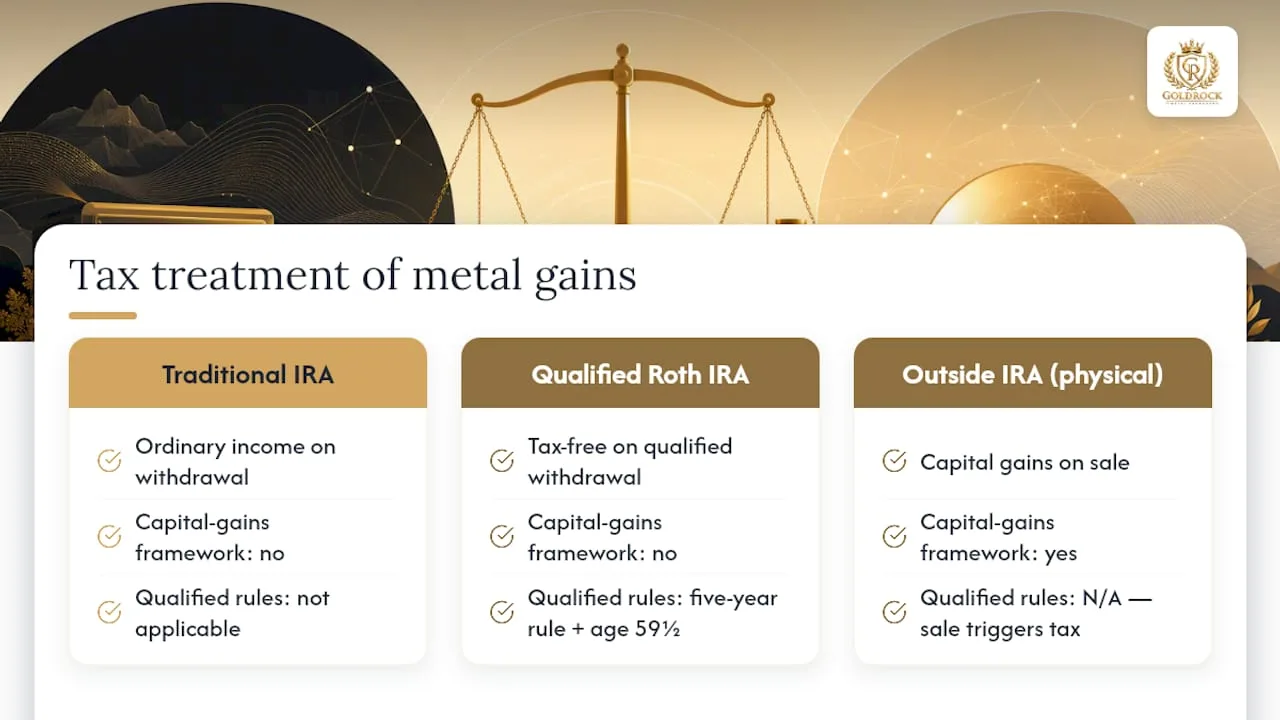
Gains on precious metals held inside an IRA don’t get taxed the way gains on metal held outside an IRA do. Inside a traditional IRA, any appreciation in your gold or silver holdings is never taxed at a separate capital gains rate. Instead, the entire withdrawal, original contribution and gain combined, is taxed as ordinary income when you take it out, according to IRS Publication 590-B.
Inside a Roth IRA, the treatment is different. If your withdrawal is qualified, meaning you’ve met the five-year rule and a qualifying condition like reaching age 59½, the appreciation on your metal comes out completely tax-free. That includes any gain from a rising gold or silver price over the years you held the account.
This is a meaningful distinction from owning physical metal outside a retirement account, where a sale typically triggers capital gains tax calculated on the difference between your purchase price and sale price. Inside an IRA, that capital gains framework doesn’t apply at all. The IRA’s tax wrapper, not the nature of the asset, determines how the eventual withdrawal gets taxed.
This is also why the choice between Roth and traditional matters more for an asset like gold than for many other holdings. Metal itself doesn’t generate dividends or interest along the way, so the entire return shows up as price appreciation, and that appreciation inherits whichever tax treatment your wrapper assigns to withdrawals.
Penalties for early withdrawals: Roth vs traditional gold IRAs
Both wrappers can hit you with the same additional tax, but the way it gets calculated and which dollars are exposed differs.
Because contributions were pretax, the entire withdrawal amount is exposed to both ordinary income tax and the additional penalty.
A Roth gold IRA works differently because of its ordering rules. Withdrawals are treated as coming out in a specific sequence: original contributions first, then converted amounts, then earnings. Because you already paid tax on your original contributions, withdrawing that portion early triggers no additional tax and no 10% penalty. Withdrawing converted amounts or earnings before meeting the five-year rule and a qualifying condition is where the tax and penalty exposure shows up, according to IRS Publication 590-B.
This ordering rule is one of the more misunderstood parts of Roth accounts. Many investors assume any early Roth withdrawal triggers a penalty, when in fact only the earnings and certain converted portions typically do. That said, the specifics depend on how long each conversion has been in the account and whether an exception applies, so this is exactly the kind of situation where a tax professional’s input is worth the conversation before you initiate any withdrawal.
Scenarios for converting traditional gold IRA funds to Roth
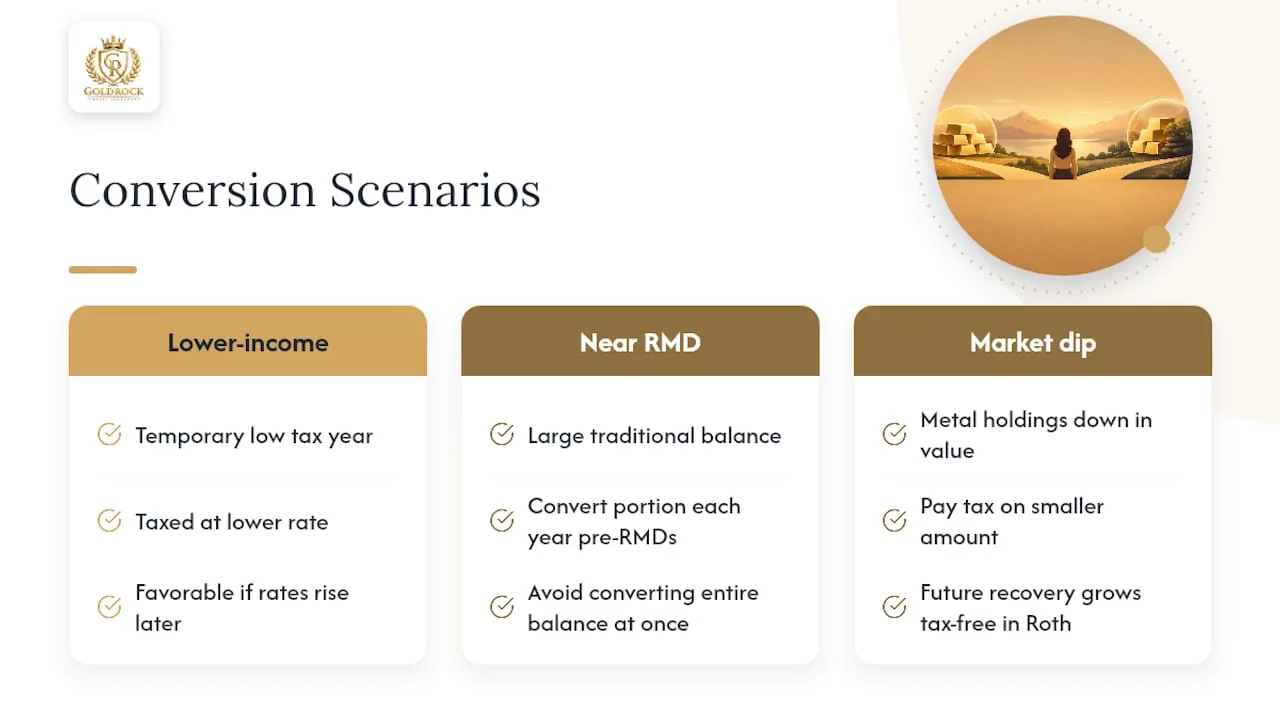
A conversion makes sense in some situations and backfires in others. Three scenarios illustrate the difference.
A lower-income year. Say you’re temporarily between jobs or took unpaid leave, putting you in a lower tax bracket than usual. Converting traditional gold IRA funds to Roth in that year means the taxable conversion income gets taxed at your temporarily lower rate, a favorable trade if you expect higher rates later.
A large traditional balance nearing RMD age. If you’re in your late 60s with a substantial traditional gold IRA, converting a portion each year before RMDs begin can reduce the size of future mandatory distributions and the tax bracket pressure they create. Converting the entire balance at once, however, could push you into a much higher bracket for that single year.
A market downturn in metal prices. Converting when your metal holdings have temporarily dropped in value means you pay conversion tax on a smaller taxable amount. If the price recovers afterward, that future appreciation grows inside the Roth wrapper and can eventually come out tax-free.
Conversions generally work against you when you’re in your peak earning years and already in a high bracket, when you’ll need the converted funds within the next few years and can’t wait out the five-year rule, or when you can’t cover the conversion tax bill without pulling money out of the IRA itself.
A practical take on choosing between the two wrappers
Tax timing decides most of this choice, not the metal itself. What makes a metals IRA different from a paper IRA is the added layer of custody and eligibility rules, which means the wrapper decision and the product decision have to be made together, not separately. Confirm eligibility and fees before you commit to either path, and talk to GoldRock if you want help executing the setup.
— Blake
Start a Precious Metals IRA with GoldRock Metal Exchange
GoldRock Metal Exchange offers personalized guidance and a dedicated in-house IRA department that simplifies the transfer of retirement accounts into precious metals, along with insured private delivery for metal you hold outside an IRA.

- We coordinate custodian paperwork so your transfer or conversion stays on track.
- We help arrange insured, approved storage for IRA-owned metal.
- We provide ongoing consultation as your goals or tax situation change.
Request a Free Precious Metals Consultation by calling (888) 859-0978 or starting at our Precious Metals IRA page. Review your custodian’s fee disclosures and consult a tax professional before you convert or fund an account.
Sources
For the rules themselves, rely on primary sources rather than secondhand summaries: IRS Publication 590-A and Publication 590-B cover contributions and distributions, the IRS collectibles guidance covers eligible metals, and the IRS newsroom posts current contribution limits. Investopedia offers useful background, but the IRS remains the primary authority for how these rules actually apply to your account.
This article is general information, not a substitute for advice from a qualified financial advisor. Consult a qualified financial professional about your own circumstances before acting on anything here.
FAQ
Is a gold IRA better than a Roth IRA?
This compares two different things: a gold IRA describes the asset held, while Roth describes the tax treatment. You can hold IRS-eligible gold inside either a Roth or a traditional IRA, so the real decision is which tax wrapper fits your income and retirement timeline, according to Investopedia.
What if I invested $10,000 in gold 20 years ago?
The outcome would depend entirely on the specific purchase price, storage costs, and sale timing, none of which can be stated as a general figure. Past metal price movements don’t predict future returns, and this article makes no claim about historical or future performance.
Why does Dave Ramsey say not to invest in gold?
This article doesn’t cover the views of specific commentators or personalities. The general principle worth focusing on instead is that any asset, including metals, carries price risk and holding costs, and a decision should rest on your own goals and a licensed professional’s input.
At what age is Roth not worth it?
There’s no single age cutoff, since the answer depends on your expected tax rate, how long the money can stay invested, and whether you’ll meet the five-year rule before withdrawing. A Roth conversion late in life can still make sense if you don’t need the funds soon and want to avoid future RMDs, according to IRS Publication 590-B.
Can I hold both a Roth and a traditional gold IRA at the same time?
Yes, you can hold both, but your total contributions across all traditional and Roth IRAs combined still cannot exceed the 2026 limit of $7,500, or $8,600 if you’re 50 or older, according to the IRS. Many investors use both to diversify their future tax exposure rather than betting entirely on one bracket assumption.