

Discreet, insured home delivery of gold is possible for U.S. investors, but it depends on choosing the right carrier service, buying full declared-value insurance, and using neutral packaging that does not advertise the contents. The main mechanisms are USPS Registered Mail and insured carrier services, both of which require accurate recipient information. IRA-owned metals follow a separate set of custodial rules that override any personal shipping plan.
TL;DR:
- Discreet shipping means packages appear unremarkable but require accurate recipient info for tracking and insurance purposes.
- Use tamper-evident packaging, remove identifying materials, and photograph the shipment before handing it over to the carrier.
- USPS Registered Mail offers the highest security with slow transit and up to $50,000 insurance, while private carriers balance speed and coverage.
- Insure for the full declared value, keep proof of mailing and photographs, and file claims promptly within the carrier’s stated window.
- IRA-owned metals require custodial approval, with delivery instructions confirmed through the custodian to avoid taxable distributions.
Table of Contents
- What discreet shipping actually means for U.S. shipments
- Step-by-step packaging and prep checklist for discreet gold shipping
- Carrier options in the U.S.: registered mail, insured mail, and private carriers
- How insurance, declared value, and claims work
- Tracking, signatures, and the records checklist to keep after delivery
- IRA-owned metals: why custodian rules change how you accept delivery
- Tips for verifying the identity and reliability of carriers or intermediaries
- Best practices for handling customs duties or taxes if applicable
- GoldRock’s view on when managed delivery makes sense
- How GoldRock can help with private delivery and IRA rollovers
- Sources
- FAQ
What discreet shipping actually means for U.S. shipments
Discreet gold shipping means the package looks unremarkable from the outside, not that the shipment is anonymous. A plain box with no metal dealer logos, no mention of contents, and a generic return address accomplishes the privacy goal most investors actually want.
True anonymity is not available and should not be the target. Carriers require an accurate name, delivery address, and, for higher-value shipments, a signature on delivery. These requirements exist to protect both the sender and the recipient: they create the paper trail that makes an insurance claim possible if something goes wrong in transit.
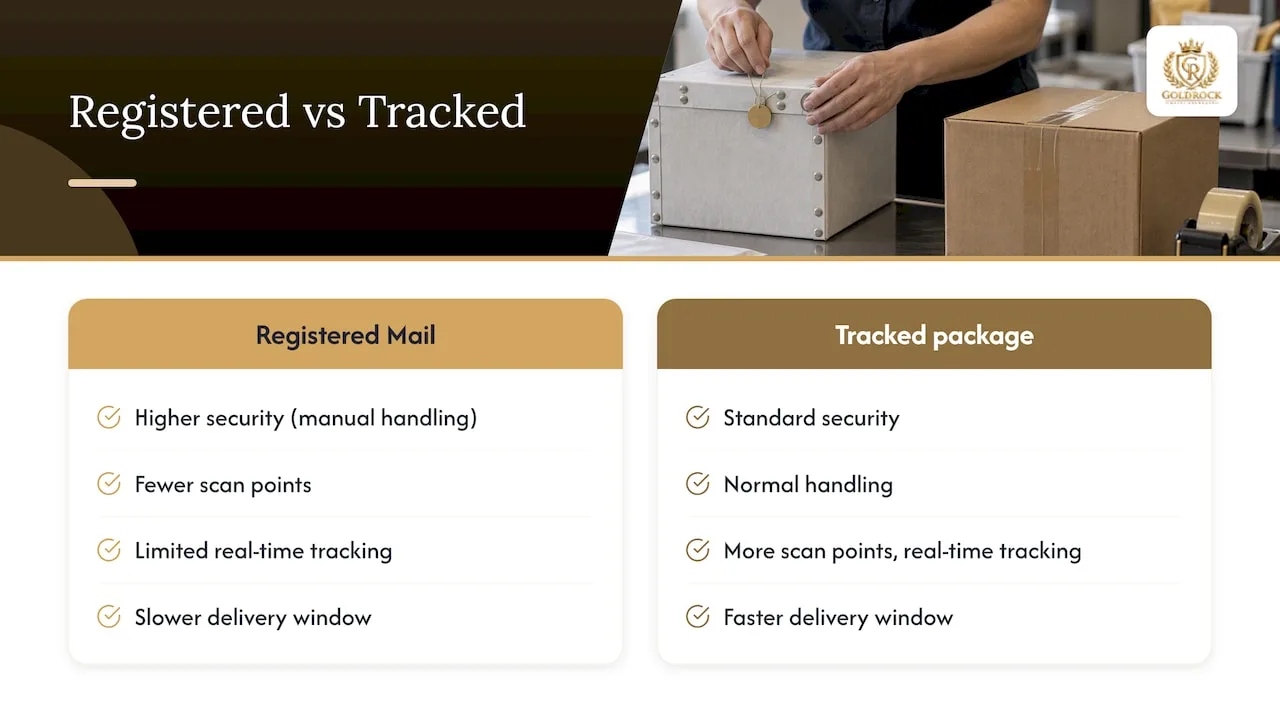
There is a real trade-off here. The manual handling that makes Registered Mail one of the most secure domestic options also means fewer scan points and a slower delivery window than a standard tracked package. Investors who want the tightest security should expect to give up some speed and some real-time tracking detail in exchange.
Step-by-step packaging and prep checklist for discreet gold shipping
Good packaging protects the metal, hides the contents, and preserves your ability to file a claim if the shipment is lost or damaged. Work through these steps in order before you ever hand the package to a carrier.
- Wrap each coin or bar individually in tamper-evident packaging and pad it so pieces cannot shift or rub against each other.
- Remove any dealer paperwork, boxes, or marketing inserts that would identify the contents if the package were opened.
- Seal the wrapped metal inside an inner box, then place that box inside a larger, unmarked outer box with additional padding between the two.
- Use a neutral, accurate description on the shipping label and any required customs or declared-value forms, since misdescribing contents can void insurance coverage.
- Photograph the metal, the inner packaging, and the sealed outer box before you leave for the carrier, and keep both digital and printed copies.
Pro Tip: Bring a witness, or record a short video, when you hand a high-value package to a carrier agent so you have evidence of the package’s condition at the moment of acceptance.
The goal is a package that raises no questions at a glance while giving you everything you would need to prove what was inside if a claim ever becomes necessary.
Carrier options in the U.S.: registered mail, insured mail, and private carriers
U.S. investors generally choose between three types of service, and each handles security and insurance differently.
- USPS Registered Mail offers the highest level of manual handling, with items kept in safes and cages at each stage and signature required on delivery; insurance is available up to $50,000 matched to declared value, though transit is slower than other classes.
- Priority Mail, Priority Mail Express, and Ground Advantage offer built-in insurance at lower caps and faster, more granular tracking, making them workable for lower declared values where speed matters more than maximum security.
- Private carriers often provide high-value insured ground shipping and corporate pickup, but discretion and packaging policies vary by provider, so get insurance terms and handling procedures in writing before shipping.
The practical rule is to match your declared value to whichever service’s insurance limit actually covers it, and to add signature confirmation or restricted delivery whenever the option is available. A shipment worth more than a carrier’s insurance ceiling needs a different plan, not a larger declared-value number on the same label.
How insurance, declared value, and claims work
Insurance only pays out if the paperwork behind it holds up. Declare the full value of the shipment at the time of mailing, and confirm that the carrier’s insurance can actually match that amount before you seal the box.
- Keep the invoice from your purchase, any appraisal or certificate of authenticity, and your acceptance receipt or online label record together in one place.
- Photograph the packed contents and the sealed box, since carriers require proof of value and proof of mailing to process a claim.
- File any claim within the carrier’s stated window, since delays past that period can forfeit your right to compensation.
USPS Registered Mail insurance is limited to a maximum of $50,000 per shipment, which means higher-value shipments need supplemental private insurance or a managed delivery service to close the gap. Claims guidance in USPS Publication 122 sets out exactly what documentation is required and why claims lacking proof of value or proof of mailing are commonly denied.
Tracking, signatures, and the records checklist to keep after delivery
The records you keep after a shipment arrives matter as much as the packaging that protected it in transit. Hold onto these items until you are confident the shipment is fully resolved:
- Acceptance receipt or online label confirmation showing the carrier took custody of the package.
- Tracking number and delivery confirmation, including any signature or restricted-delivery record.
- Insurance receipt showing the declared value and premium paid.
- Photographs of the packed item, the sealed box, and the shipping label.
- Purchase invoice and any appraisal or certificate of authenticity for the metal shipped.
Signature-on-delivery, restricted delivery, and delivery to an authorized agent all add a layer of accountability by requiring a named person to confirm receipt. Store these records digitally and in print, in a location separate from the metal itself, so you can produce them quickly if you ever need to prove value for a claim under the procedures in DMM 609.
IRA-owned metals: why custodian rules change how you accept delivery
Ordinary discreet shipping rules do not apply to metals held inside a self-directed Precious Metals IRA. The IRS treats IRA assets as property that must remain under proper custodial control, and Form 5305-A references the custody and investment restrictions under Section 408(m) that govern which bullion and coins qualify and how they must be held.
- Never accept IRA-owned metals at a personal address without written direction from your IRA custodian.
- Taking physical possession of IRA metals outside of an approved custodial process can be treated as a taxable distribution.
- Confirm delivery and storage instructions with your custodian before any shipment is arranged, rather than assuming personal-shipping rules apply.
Our Gold IRA eligibility guide walks through which metals qualify, and our piece on why IRA gold should not be stored at home covers the compliance issues in more detail. For IRA-owned metals, the delivery question is really a custody question: who legally holds the asset, and whether the custodian’s own procedures were followed.
Tips for verifying the identity and reliability of carriers or intermediaries
Confirming who you are actually dealing with matters as much as the packaging itself. Before you ship anything of meaningful value, verify these basics directly with the carrier or intermediary.
Check that the shipping service is a carrier you recognize and can contact through an official phone number or website, not just an address printed on a label or quoted in an email. Ask for written confirmation of insurance terms, coverage limits, and claims procedures before you hand over a package, since verbal assurances are not enforceable if a dispute arises later.
If you are using an intermediary such as a dealer’s fulfillment service rather than shipping the metal yourself, ask specifically how the shipment will be insured, who holds the insurance policy, and what documentation you will receive at each stage. A reliable service will put these answers in writing without hesitation.
For high-value shipments, confirm the retail location or facility that will accept the package in person matches an address you can independently verify, and keep the confirmation email or receipt from that interaction. Treat any request to change the shipping address, split a payment, or bypass standard documentation as a reason to stop and verify independently before proceeding.
Best practices for handling customs duties or taxes if applicable
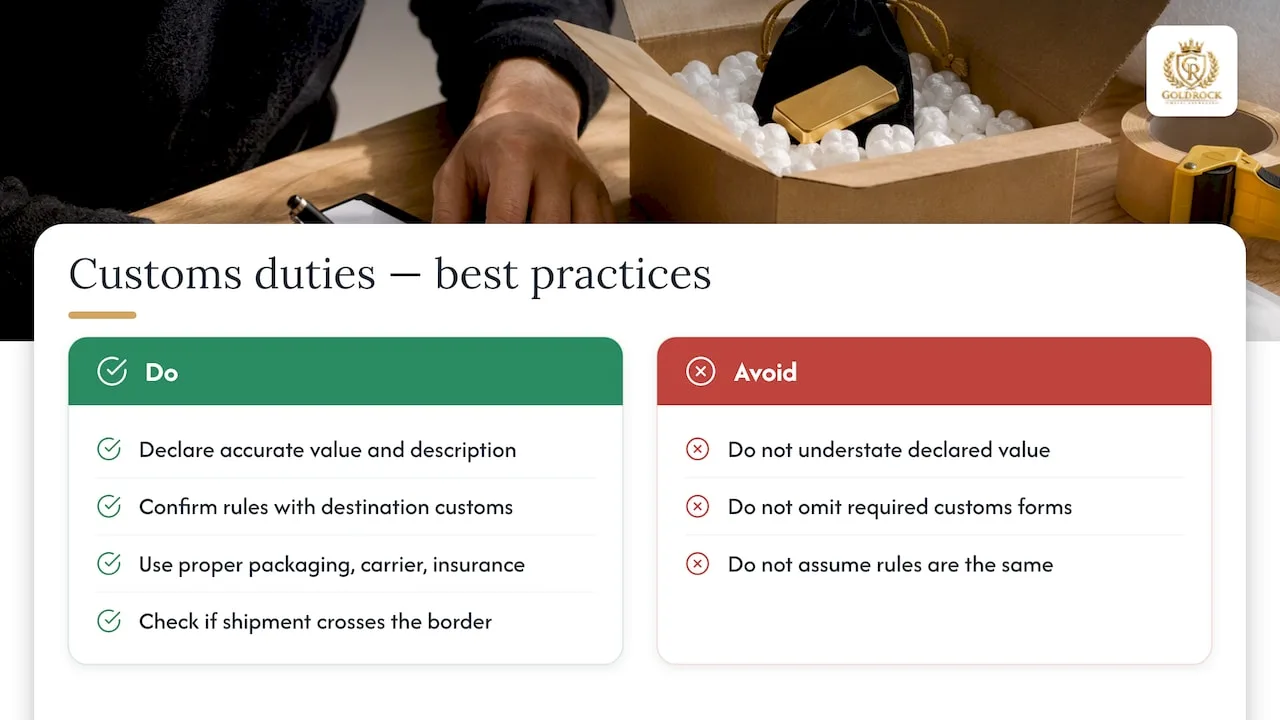
Domestic shipments within the United States do not involve customs duties, since customs rules apply to shipments crossing an international border. If you are shipping gold internationally, whether receiving metal from abroad or sending it out of the country, you become subject to that country’s import and export rules in addition to U.S. requirements, and those rules vary significantly by destination.
Declare the accurate value and description of the metal on any customs form required for an international shipment. Understating value to reduce potential duties can result in confiscation, fines, or denial of an insurance claim if the shipment is lost or damaged in transit.
Because customs treatment of bullion and coins differs by country and by the form the metal takes, confirm the applicable rules directly with the destination country’s customs authority or a qualified professional before shipping internationally. This guide focuses on domestic U.S. delivery, where the operational concerns are packaging, carrier selection, and insurance rather than customs clearance.
GoldRock’s view on when managed delivery makes sense
Self-shipping works for investors comfortable managing packaging, carrier paperwork, and claims documentation themselves. For larger purchases or anything tied to an IRA, the calculus changes: a single documentation error can complicate a claim or, in the IRA context, trigger a distribution.
A private delivery process and dedicated IRA department can help remove execution risk by coordinating insured transit and custody-compliant handling under one point of contact. The practical question for most investors is not whether self-shipping is possible, but whether the value at stake justifies handling every step alone.
— Blake
How GoldRock can help with private delivery and IRA rollovers
Investors who would rather not manage packaging, carrier selection, and claims documentation themselves have a managed alternative. A Private Delivery service may coordinate insured transit and handling for purchased metals, and an in-house IRA department can manage the custodial requirements that apply to retirement account rollovers.

- Private, insured delivery for physical gold, silver, platinum, and palladium purchases.
- A dedicated in-house IRA department that handles custodian coordination for Precious Metals IRA rollovers.
- Guidance on authenticating and documenting delivered metals for your own records.
If you are planning a high-value purchase, considering an IRA rollover, or simply want a managed, compliant path instead of self-shipping, call (888) 859-0978 or request a Free Precious Metals Consultation through our Private Delivery page.
This article is general information, not a substitute for advice from a qualified financial advisor. Consult a qualified financial professional about your own circumstances before acting on anything here.
Sources
- Registered Mail® – The Basics
- Publication 122 – Domestic Claims: Customer Reference Guide
- 609 Filing Indemnity Claims for Loss or Damage | Postal Explorer
- Form 5305-A (Rev. October 2016)
FAQ
Is it possible to buy gold anonymously?
No purchase or shipment of gold in the United States is fully anonymous, since carriers require accurate recipient information and dealers follow standard purchase documentation. What investors can achieve is discretion, meaning packaging and labeling that do not advertise the contents to anyone handling the box.
Does the IRS know if I buy gold?
Reporting requirements for precious metals purchases depend on the transaction type and payment method rather than a blanket rule that every purchase is reported. Investors with specific concerns about reporting obligations should speak with a tax professional, since this varies by circumstance and is not something a dealer can advise on directly.
How can I avoid gold tax in the USA?
There is no shipping method or packaging choice that changes tax treatment of a gold purchase or sale. Tax obligations depend on individual circumstances such as how the metal is held and how it is eventually sold, so this question is best answered by a qualified tax professional rather than through shipping or delivery choices.
How much gold can you keep at home legally in the USA?
There is no federal law limiting how much gold a private individual can hold at home. IRA-owned gold is a separate matter entirely: it must remain under proper custodial control under IRS rules, and taking physical possession of it outside an approved custodial process can be treated as a taxable distribution.
What is the maximum insurance coverage for a discreetly shipped gold package?
USPS Registered Mail provides insurance up to $50,000 matched to the declared value of the shipment. Shipments worth more than that require supplemental private insurance or a managed delivery service that can arrange higher-limit coverage.