

A transfer moves your IRA directly between custodians and is never reported to the IRS, while a rollover involves plan-to-IRA money and can trigger taxes if you miss the 60-day deadline. The simple rule: use a transfer for IRA-to-IRA moves, and use a direct rollover (never indirect) when money comes from a 401(k) or similar workplace plan. Stick to trustee-to-trustee methods whenever you can, and watch the one-per-12-month limit on IRA rollovers.
TL;DR:
- Use a transfer for IRA-to-IRA moves, as it is nonreportable and involves no time limit or risk of taxes.
- Request a direct rollover for employer plan funds moving to an IRA to avoid withholding and reporting issues.
- Indirect rollovers, where you receive a check, require redeposit within 60 days and risk taxes or penalties if missed.
- Only one IRA-to-IRA rollover per 12 months applies, but transfers and employer plan rollovers do not count against this limit.
- Always document every step carefully, including any confirmations, to prevent costly IRS questions or penalties.
Table of Contents
- Ira Rollover vs Transfer: A Quick Decision Checklist
- What Is an IRA Transfer, and How Does the Paperwork Work?
- Direct vs. Indirect Rollovers: Where the 60-Day Clock Comes In
- Forms 1099-R and 5498: What Gets Reported and When
- How to Move Your Retirement Funds Without Triggering a Penalty
- Matching the Method to Your Situation
- The Four Mistakes That Cost Investors the Most
- How GoldRock Approaches Retirement Fund Transfers
- Request a Free Precious Metals Consultation
- Verify the Rules Yourself: IRS and Regulator Resources
- Sources
- FAQ
Ira Rollover vs Transfer: A Quick Decision Checklist
Most people overthink this decision. The mechanics dictate the answer almost every time, so here’s the short version before the details.
- Moving an IRA to a new custodian? Use a transfer. It’s nonreportable, has no time limit, and the IRS treats trustee-to-trustee transfers as outside the rollover rules entirely.
- Moving a 401(k) or employer plan to an IRA? Request a direct rollover. The plan sends funds straight to the new custodian, so you never touch the money and never trigger withholding.
- Received a check made out to you? That’s an indirect rollover, and it’s the riskiest path. You have 60 days to redeposit the full amount, and if you’re a day late, the whole distribution becomes taxable.
- Doing this more than once this year? Check the calendar first. IRA-to-IRA rollovers are limited to one per 12 months, though transfers and direct rollovers from employer plans don’t count against that limit.
The pattern here isn’t subtle. Direct movement of funds, whether it’s called a transfer or a direct rollover, keeps the IRS out of the transaction and keeps your money working instead of sitting in limbo. Morningstar’s analysis of transfer and rollover rules reaches the same conclusion: direct methods reduce the odds of a costly mistake, and indirect rollovers should be a last resort, not a convenience.
What Is an IRA Transfer, and How Does the Paperwork Work?
An IRA transfer is a direct, trustee-to-trustee movement of assets between two custodians holding the same type of account, say, a traditional IRA at one firm moving to a traditional IRA at another. You never receive a check, never touch the funds, and the IRS doesn’t require you to report the transaction on your tax return.
That nonreportable status is worth sitting with for a second. The IRS explicitly excludes trustee-to-trustee transfers from the rollover reporting requirements because the money never leaves institutional custody. There’s no distribution to report because, technically, no distribution happened.
Here’s what the process typically looks like:
- Open the receiving account at the new custodian if you haven’t already.
- Complete a transfer authorization form, usually provided by the receiving institution, naming the current custodian and account details.
- Specify the assets being moved (cash, securities, or in the case of a precious metals IRA, the physical bullion held by the depository).
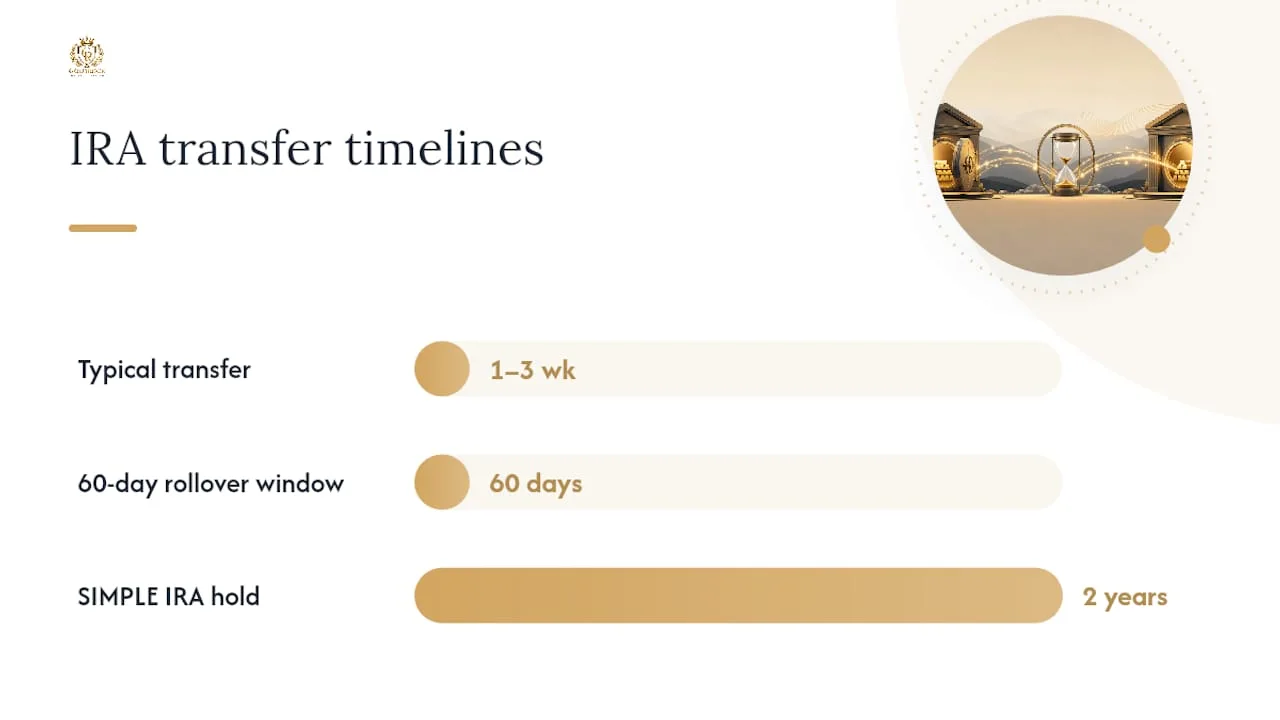
- Wait for the custodians to communicate directly. Timing varies, but most transfers complete within one to three weeks depending on asset type.
- Confirm receipt and check that the new account reflects the correct balance or asset holdings.
There’s no 60-day clock here, and generally no limit on how many transfers you can do in a year. The one notable exception involves SIMPLE IRAs, which carry a two-year holding requirement before assets can be transferred to a different type of retirement account without penalty. Outside of that carve-out, transfers are about as low-risk as retirement account moves get.
Direct vs. Indirect Rollovers: Where the 60-Day Clock Comes In
A rollover happens when money moves from one retirement account to another and involves at least a brief moment where it’s classified as a distribution. There are two flavors, and the difference between them matters more than most people realize.
A direct rollover happens when your employer plan administrator sends the funds straight to your IRA custodian. You never receive a check in your name, so no withholding applies, and the funds land in your new account intact.
An indirect rollover happens when the distribution is paid to you directly. This is where the risk concentrates.
- The plan is required to withhold 20% of the distribution for federal taxes, even if you intend to roll over the entire amount.
- You then have exactly 60 days from the date you receive the funds to deposit the full original amount, including the 20% that was withheld, into a new IRA.
- If you don’t have cash on hand to replace that withheld 20%, you’ll owe taxes on the shortfall, and possibly a 10% early withdrawal penalty if you’re under age 59½.
- Miss the 60-day window entirely, and the whole distribution becomes taxable income for the year, with the early withdrawal penalty applying if relevant.
The IRS does allow limited waivers of the 60-day requirement, but only for circumstances genuinely beyond your control, think hospitalization, natural disaster, or a bank error, not “I forgot” or “I was busy.” Waivers require a formal request and aren’t guaranteed, so treat the 60-day deadline as fixed, not flexible. If you’re rolling over an employer plan, our 401(k) rollover best practices guide walks through how to request the direct option specifically to sidestep this entire withholding problem.
Forms 1099-R and 5498: What Gets Reported and When
Every rollover generates paperwork, even when no tax is ultimately owed, and knowing which form does what saves you a confused phone call to your tax preparer in April.
- Form 1099-R reports any distribution from a retirement account, including money that’s later rolled over. You’ll receive this from the distributing custodian even if you completed a clean 60-day rollover with zero tax owed.
- Form 5498 reports contributions and rollovers received by the new custodian, and it confirms to the IRS that the money you took out actually landed somewhere appropriate.
- Trustee-to-trustee transfers generally don’t generate either form in the way rollovers do, since the IRS doesn’t classify them as reportable distributions.
- When you file your return, you’ll typically note the rollover amount on the relevant line even though it’s not taxable, so the IRS can match your 1099-R against your reported figures.
The one-per-12-month rule deserves its own mention here. It applies specifically to IRA-to-IRA indirect rollovers, and it’s aggregated across every IRA you own, not counted separately per account. Do two indirect rollovers from different IRAs within twelve months, and the second one becomes a fully taxable distribution. This limit doesn’t touch trustee-to-trustee transfers or direct rollovers from an employer plan, which is one more reason direct methods are the safer default. Roth conversions and required minimum distributions carry their own separate rules and generally fall outside this specific limit, but if your situation involves either, a tax advisor should weigh in before you move anything.
How to Move Your Retirement Funds Without Triggering a Penalty
The actual mechanics differ slightly depending on which method applies to your situation, so here’s each path broken down.
For an IRA-to-IRA transfer:
- Contact the custodian you’re moving assets to and request their transfer paperwork.
- Sign the authorization form, which typically requires your current account number and the custodian’s information.
- Confirm what asset types are being moved, cash transfers are fastest, while transfers involving physical metals or specific securities may take longer.
- Track the timeline with both institutions and confirm final receipt once it’s complete.
For a direct rollover from an employer plan:
- Contact your plan administrator and explicitly request a “direct rollover,” not a distribution.
- Provide your new IRA custodian’s account information so the check or wire is made payable to the custodian, not to you.
- Verify with the plan administrator that no withholding will apply, since direct rollovers are exempt from the mandatory 20% withholding.
- Confirm the funds arrive at the new custodian and match your expected balance.
If you already received a distribution (indirect rollover):
- Deposit the full amount, including any withheld taxes you’ll need to cover out of pocket, within 60 days of receiving the funds.
- If 20% was withheld, you’ll need to replace that amount from other funds to complete a full rollover; otherwise, that portion is treated as a taxable distribution.
- Keep every piece of documentation: the original 1099-R, deposit confirmations, and dated correspondence showing when funds were received and redeposited.
Pro Tip: Photograph or scan every transfer and rollover confirmation the day you receive it. If the IRS ever asks you to prove a 60-day redeposit happened on time, a dated bank confirmation is worth far more than your memory of “sometime in March.”
For a full timeline you can follow step by step, our IRA rollover timeline and checklist breaks down exact windows so nothing slips past the deadline. If you’re specifically moving into a metals-backed account, the paperwork guide for gold IRA transfers covers the additional forms custodians request for physical bullion.

Matching the Method to Your Situation
Real decisions rarely come with a textbook label attached, so here’s how the choice plays out in practice.
- Consolidating IRAs from multiple old jobs or accounts? A transfer is almost always the right call, no reporting, no deadline, no risk of an accidental taxable event.
- Leaving a job with a 401(k) balance? A direct rollover into an IRA usually opens up more investment choices than staying in an employer plan, and it avoids withholding entirely.
- Need short-term access to cash? An indirect rollover technically lets you use the funds for up to 60 days, but this is a narrow, risky maneuver. Missing the deadline by even one day converts the entire amount into taxable income, plus a possible penalty. Most financial planning resources, including a retiree-focused investing strategy from Oracle Investments, recommend treating retirement funds as untouchable for this purpose rather than a short-term loan.
- Handling a divorce settlement or an inherited IRA? These situations often involve special transfer rules that differ from standard trustee-to-trustee moves, and a tax advisor should review the specifics before you initiate anything.
- Dealing with a SIMPLE IRA? Remember the two-year holding rule before attempting any transfer to a different account type, since jumping the gun triggers a penalty even on what looks like a straightforward move.
The Four Mistakes That Cost Investors the Most
Small errors here carry outsized consequences, and they’re almost always avoidable with a little planning ahead of time.
- Miscounting the 60-day window. The clock starts the day you receive the distribution, not the day you decide to move it. Calendar it immediately.
- Doing a second indirect IRA rollover within 12 months. The aggregate limit applies across all your IRAs combined, not per account, and it’s a common blind spot.
- Forgetting to replace withheld taxes. If 20% was withheld and you only redeposit 80% of the distribution, the IRS treats the missing 20% as a taxable withdrawal.
- Losing the paperwork trail. Without your 1099-R, deposit confirmation, and dated correspondence, an IRS inquiry becomes far harder to resolve in your favor.
According to Morningstar’s review of these rules, the vast majority of costly rollover errors trace back to exactly these four issues, and nearly all of them disappear entirely when you choose a direct transfer or direct rollover instead. Our guide on avoiding rollover mistakes through direct transfers covers additional edge cases worth reviewing before you move a large balance.
How GoldRock Approaches Retirement Fund Transfers
Working with clients who want to move retirement savings into physical precious metals, we’ve found the safest path is almost always the same one the IRS rules point toward: direct, trustee-to-trustee movement. Our in-house IRA department coordinates directly with the outgoing and receiving custodians, so clients typically avoid handling paperwork alone or guessing at deadlines.
Physical metals held in an IRA require a qualified custodian and depository, and insured private delivery options are available once metals are eligible for distribution. We consistently steer clients toward transfers over indirect rollovers whenever both are available, and we recommend involving a tax advisor before finalizing any move involving a former employer plan.
— Blake
Request a Free Precious Metals Consultation
GoldRock Metal Exchange’s in-house IRA department exists specifically so you don’t have to coordinate a transfer or direct rollover on your own while also researching IRS deadlines. We handle the trustee-to-trustee paperwork directly with your current and new custodians, and once your precious metals IRA is funded, we offer insured private delivery options for clients who want physical possession of eligible holdings down the line.

If you’re weighing whether to move an existing IRA or roll over a 401(k) into physical gold, silver, platinum, or palladium, our team can walk through the specific steps for your situation before you initiate anything with your current custodian. Visit our Precious Metals IRA page to see how the setup and transfer process works, or request a free consultation and speak directly with our IRA department by calling (888) 859-0978.
This article is educational and does not constitute personalized investment, tax, or legal advice. Consult a qualified tax professional or financial advisor about your specific situation before initiating a transfer or rollover.
Verify the Rules Yourself: IRS and Regulator Resources
Before moving any retirement funds, confirm the current rules directly with the IRS rollover guidance page and the IRS reporting FAQ. To check a custodian’s registration and standing before opening an account, FINRA’s BrokerCheck is a free, neutral resource worth using.
This article is general information, not a substitute for advice from a qualified financial advisor. Consult a qualified financial professional about your own circumstances before acting on anything here.
Sources
- Rollovers of retirement plan and IRA distributions | Internal Revenue Service
- IRA Transfers vs. Rollovers: The Rules That Can Cost You | Morningstar
FAQ
Is an IRA Rollover the Same as a Transfer?
No. A transfer moves assets directly between custodians of the same account type and is never reported to the IRS. A rollover involves a distribution, even briefly, and carries reporting requirements along with the 60-day redeposit rule if it’s indirect.
What Are the Disadvantages of a Rollover IRA?
Indirect rollovers carry real risk: mandatory 20% withholding on employer plan distributions, a strict 60-day deadline to redeposit the full amount, and a one-per-12-month limit on IRA-to-IRA rollovers. Miss any of these, and the distribution becomes taxable, with a possible 10% penalty if you’re under 59½.
Does an IRA-to-IRA Transfer Count as a Rollover?
No. Trustee-to-trustee transfers are explicitly excluded from the IRS rollover rules and don’t count against the one-per-12-month rollover limit. You can generally complete as many transfers as you need in a year without restriction.
Is Moving a 401(k) to an IRA a Rollover or a Transfer?
It’s classified as a rollover, specifically a direct rollover when the plan sends funds straight to your IRA custodian without paying you first. This avoids the mandatory 20% withholding that applies when a distribution check is made out to you personally.