
For a precious metals IRA, “IRS-approved” is really about your custodian, not the vault itself. The IRS approves nonbank trustees and custodians to hold IRA assets in physical possession; it does not certify individual buildings as safe or superior. If you’re funding a gold or silver IRA, call your custodian today, ask for their approved depository list, and get written proof of custody and insurance before you send a dollar.
TL;DR:
- The IRS approves nonbank trustees and custodians, not individual vaults, so verifying your custodian’s approval is essential before funding your IRA.
- Custodians contract with approved depositories like Delaware Depository or Brink’s, but storage arrangements are not officially certified or endorsed by the IRS.
- Always obtain written confirmation of custody, insurance details, and agreement terms from your custodian and depository before wiring funds for an IRA metals purchase.
- Segregated storage offers specific, identifiable holdings at a higher fee, while commingled storage pools metals together at a lower cost, affecting your distribution options.
- The real risk lies in choosing a custodian with legitimate approval and documented depository relationships; the depository itself does not have an individual official approval.
Table of Contents
- What “IRS Approved Depository” Actually Means for an IRA
- What to Verify Before You Fund a Purchase
- Depositories Commonly Referenced for IRA Storage
- Segregated, Allocated, and Commingled Storage: What’s the Difference?
- How to Confirm Your Custodian’s IRS Approval
- What Fees and Timelines Usually Look Like
- Warning Signs That Something Isn’t Right
- Moving Metals Into an Approved Depository
- Recordkeeping Rules You Should Expect From a Depository
- Why the “Approved Depository” Question Misses the Real Risk
- How GoldRock Metal Exchange Supports Compliant IRA Storage
- Ready to Set Up Compliant IRA Storage?
- Primary Sources for Verifying Depository and Custodian Status
- Sources
- FAQ
What “IRS Approved Depository” Actually Means for an IRA
The phrase “IRS-approved depository” gets thrown around loosely, but the legal reality is narrower and more useful once you understand it. The IRS doesn’t inspect vaults, rate their security systems, or issue seals of approval to specific storage buildings. What it does approve, through a formal application process, are the nonbank trustees and custodians permitted to hold IRA assets, including physical bullion, in their possession.
That distinction matters because Treasury Regulation §1.408-2(e) sets the actual custody requirement: IRA-held metals must sit in the physical possession of a bank or an IRS-approved nonbank trustee. Depositories like Delaware Depository, Brink’s Global Services, International Depository Services, and the Texas Bullion Depository come into the picture because custodians contract with them to store the metal, not because the IRS hands each facility its own approval letter.
Here’s how the custody chain typically works in practice:
- You purchase metals through a dealer, specifying IRA-eligible gold, silver, platinum, or palladium.
- Your IRA custodian, an IRS-approved trustee, takes legal responsibility for the assets on your account’s behalf.
- The custodian directs the depository to receive the shipment, verify contents against the packing list, and log it into inventory.
- The depository reports holdings back to the custodian, who reflects them on your account statements and files required IRS reporting.
- Any withdrawal or distribution flows back through the custodian, who coordinates release from the depository.
Skip a step in that chain, say, by taking personal possession of the metal, and the IRS can treat the whole IRA as a distributed, taxable event. That’s the entire reason the custody rule exists: to keep a clean paper trail between purchase and storage so nobody can quietly convert retirement assets into pocketed metal.
What to Verify Before You Fund a Purchase
Before wiring money for an IRA metals purchase, get answers to a short list of questions in writing. A phone assurance isn’t documentation; a PDF or emailed confirmation is.
- Ask your custodian to confirm their name appears on the IRS’s approved nonbank trustees and custodians list, and request their Notice of Approval reference.
- Request the written agreement between your custodian and the depository, including chain-of-custody procedures for receiving and logging shipments.
- Ask for the depository’s insurance summary: insurer name, policy type, and coverage limits, not just the word “insured” on a brochure.
- Clarify whether segregated or commingled storage is available, and get the fee difference in writing before you choose.
- Confirm how often you’ll receive account statements and how audits or inventory reconciliations are handled.
Pro Tip: Ask specifically whether the depository’s insurance is “all-risk,” and get the insurer’s name. Many facilities reference coverage through underwriters associated with Lloyd’s of London, but policy wording and exclusions vary widely between providers, so the label “insured” alone tells you very little.
Our guide on spotting gold IRA scams walks through additional math-based red flags worth running before you commit funds.
Depositories Commonly Referenced for IRA Storage
A handful of facility names come up again and again when custodians and dealers discuss IRA storage. None of them carry individual IRS certification; the approval sits with the custodian arranging the storage. Still, knowing what each facility is known for helps you ask sharper questions.
- Delaware Depository is frequently cited in the industry for its Delaware location and long operating history in bullion storage, with segregated and allocated storage options commonly advertised.
- Brink’s Global Services brings a logistics-heavy reputation, drawing on its broader armored transport and secure warehousing business to handle receiving, inventorying, and reporting for custodians.
- International Depository Services (IDS) operates multiple facility locations across the U.S. and is often mentioned for its regional footprint, giving custodians options outside a single storage hub.
- Texas Bullion Depository is a state-administered facility whose operator holds nonbank trustee approval; its IRA storage page describes how custodians coordinate storage there for account holders.
Treat any list like this as background context, not an endorsement roster. Whether a given facility works for your IRA depends entirely on whether your custodian has an active relationship with it.
Segregated, Allocated, and Commingled Storage: What’s the Difference?
The storage model you choose changes both your cost and what you actually get back on distribution. Get the definitions straight before signing a storage agreement.
- Segregated storage keeps your specific bars or coins physically separated from other clients’ holdings, identified individually. This usually carries a premium fee but guarantees you receive the exact items you deposited if you take an in-kind distribution.
- Allocated storage is a closely related term, generally meaning your metal is specifically identified as yours, even if stored alongside other allocated holdings in the same vault section.
- Commingled storage pools like-kind metals from multiple clients together. It’s typically cheaper, but a distribution returns equivalent metal (same weight and purity), not necessarily the identical bar or coin you originally deposited.
Our breakdown of precious metal storage options covers the cost and access tradeoffs in more depth. Before funding an account, ask your custodian to put the allocation method and reconciliation process for inventory in writing, not just in a sales conversation.
How to Confirm Your Custodian’s IRS Approval
Verifying custodian status takes about ten minutes and three steps.
- Check the IRS list. Search the approved nonbank trustees and custodians page for your custodian’s name.
- Cross-reference the official PDF. The IRS publishes a periodically updated nonbank trustees list you can download and search directly.
- Ask for the Notice of Approval. Every approved nonbank trustee went through a formal application under Treasury regulations, and the application procedures page explains exactly what standards they had to meet.
A legitimate custodian will produce this documentation without hesitation. If a company hedges, changes the subject, or points you to marketing copy instead of a Notice of Approval, that’s a signal to slow down and ask more questions before proceeding.
What Fees and Timelines Usually Look Like
Depository and custodian fees generally fall into a handful of predictable categories, though exact numbers vary by provider.
- Annual storage fees, often billed by the custodian and passed through to the depository, sometimes scaled by account value or a flat rate.
- Segregated storage premiums, an added charge above standard commingled rates for individually identified storage.
- Transaction or handling fees, charged when metal is received, shipped, or distributed.
- Custodian administrative fees, separate from storage, covering account maintenance and reporting.
A typical timeline runs from purchase to shipment, to the depository receiving and inventorying the metal against a packing list, to the custodian confirming the holding on your statement. That full cycle often takes days to a couple of weeks depending on the dealer and shipping method. Ask upfront how often you’ll be billed, whether segregated premiums are flat or percentage-based, and what handling fees apply to future distributions.
Warning Signs That Something Isn’t Right
A few patterns should stop you before you sign anything or wire funds.
- Any pitch involving home storage or a personal LLC “vault” that keeps metals under your direct control is a serious compliance risk; our piece on home storage gold IRA risks covers the tax consequences in detail.
- Vague insurance claims with no named insurer, no policy number, and no willingness to share a summary document.
- A custodian who can’t produce a Notice of Approval or describe their written relationship with the depository they’re recommending.
If you hear “trust us, it’s insured” without a name and a document, keep asking.
Moving Metals Into an Approved Depository
Transferring metal into an IRS-approved storage arrangement follows a fairly standard sequence, whether you’re funding a new IRA or rolling over an existing retirement account. First, you open or fund the self-directed IRA with your chosen custodian, who becomes the legal trustee of the account. Next, you select IRA-eligible metals through a dealer; not every gold or silver product qualifies, since the IRS sets purity and eligibility standards for what counts as an acceptable retirement asset rather than a collectible.
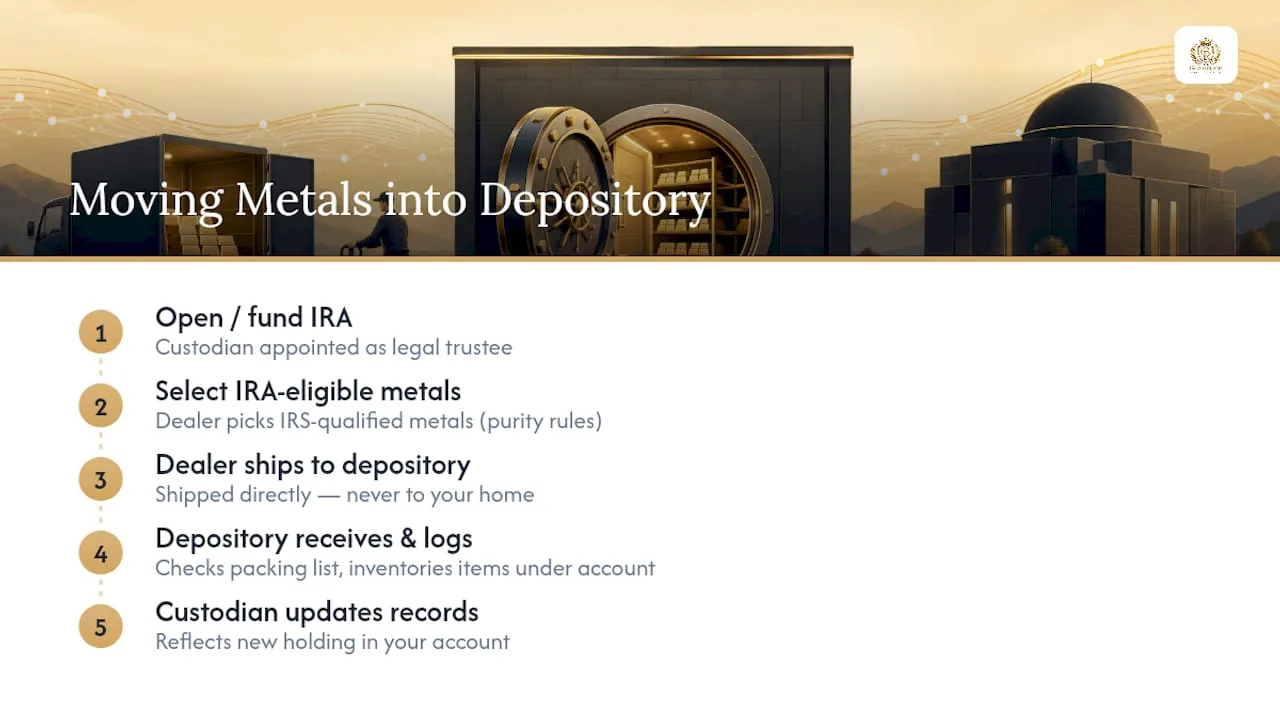
Once the purchase is finalized, the dealer ships the metal directly to the depository your custodian has an active relationship with, never to your home address. The depository receives the shipment, checks it against the packing list and invoice, and logs the exact items into its inventory system under your account. The custodian then updates your IRA records to reflect the new holding.
If you’re switching depositories after your account is already established, expect some coordination between your dealer, custodian, and both depositories, along with possible handling fees and additional verification steps. Confirm your custodian’s switching policy before you assume a transfer will be quick or free. Rollovers from a 401(k) or traditional IRA follow a similar path, just with an added step where funds move from the old account to the new self-directed IRA before any metal purchase happens.
Recordkeeping Rules You Should Expect From a Depository
Once your metal is in storage, documentation doesn’t stop. A properly approved depository maintains its own inventory records tied to your specific account, distinguishing segregated holdings from commingled pools, and reconciles those records on a regular schedule.
Your custodian is separately responsible for annual IRS reporting on your IRA, including Form 5498 for contributions and fair market value reporting. That reporting depends entirely on accurate data flowing from the depository, which is why the custodian-depository relationship needs to be documented and active, not assumed.
Ask your custodian how often depository audits happen and whether you can request a statement showing your specific holdings, not just an aggregate account value. Reputable operations will provide this without friction. If you ever need to prove custody for tax purposes, that documentation trail, purchase invoice, shipping record, depository receipt, and custodian statement, is what protects you. Keep copies of everything yourself, even though the custodian maintains its own records. A missing link in that chain is exactly what turns an audit into a headache.
Why the “Approved Depository” Question Misses the Real Risk
Most investors researching IRS-approved depositories are actually asking the wrong question, and it’s an understandable mistake. The marketing language around this topic makes it sound like there’s a certified list of vaults you should be shopping between, the way you’d compare insured banks. There isn’t. The approval sits with your custodian, and the depository relationship is just one piece of paperwork the custodian is supposed to have in order.
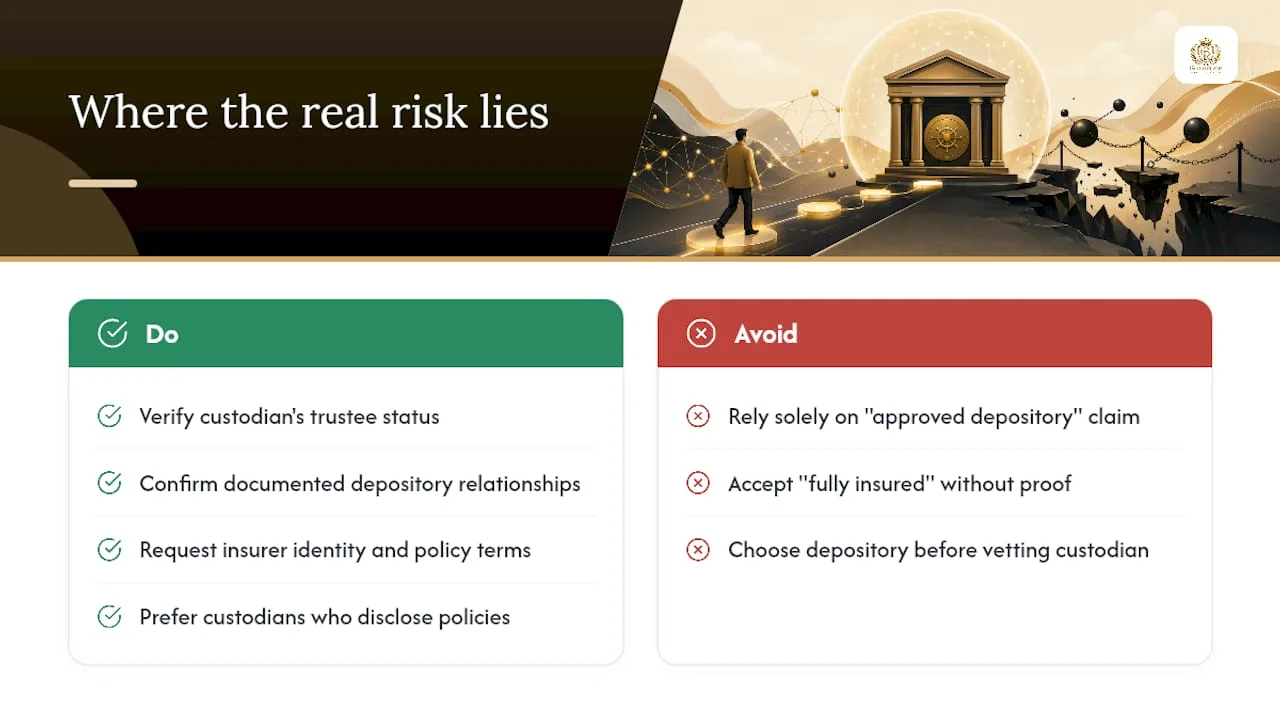
That shifts the real risk earlier in the process than most people expect. By the time you’re evaluating which depository your metal ends up in, the harder decision, choosing a custodian who actually holds legitimate nonbank trustee status and maintains documented depository relationships, is already behind you. Get that step wrong, and no depository’s insurance policy or segregated storage option saves you from a compliance problem.
The industry’s own insurance language deserves the same scrutiny. “All-risk insured” sounds definitive, but all-risk policies still carry exclusions, and the identity of the underwriter matters more than the adjective. A depository that names its insurer and shares policy terms on request is operating differently than one that just prints “fully insured” on a brochure. That’s not a subtle distinction. It’s the entire difference between a paper promise and a documented one.
— Blake
How GoldRock Metal Exchange Supports Compliant IRA Storage
Coordinating custodian approval, depository relationships, and custody documentation is exactly the kind of logistics investors don’t want to manage alone, and it’s where GoldRock Metal Exchange’s in-house IRA department focuses its work. The team helps walk through custodian selection, documentation requests, and depository coordination so the paper trail stays clean from purchase through storage.
Some dealers offer insured private delivery for personal collections held outside an IRA structure. This article is educational and general in nature, not personalized tax or legal advice; consult a qualified tax professional or attorney about how these rules apply to your specific account.
Ready to Set Up Compliant IRA Storage?
If the custody chain outlined above feels like a lot to manage on your own, that’s normal, most investors have never had to verify a nonbank trustee approval before opening a retirement account. An in-house IRA department can help coordinate with your custodian, confirm depository relationships, and gather necessary documentation to ease the rollover process.

Whether you’re rolling over an existing 401(k) into a Precious Metals IRA or exploring insured private delivery for gold, silver, platinum, or palladium held outside a retirement account, GoldRock’s team provides ongoing consultation rather than a one-time transaction. Request a Free Precious Metals Consultation by calling (888) 859-0978, or visit the Precious Metals IRA page to start the conversation about which custodian and storage setup fits your situation.
Primary Sources for Verifying Depository and Custodian Status
Before making any decisions, verify claims directly against primary sources rather than relying on a dealer’s summary.
- Approved nonbank trustees and custodians, the IRS’s own listing page
- Nonbank trustees list as of April 1, 2026, the downloadable PDF version
- Application procedures for nonbank trustees and custodians, explaining the approval standard
- IRA storage at Texas Bullion Depository, a state-administered example of custodian coordination
This article is general information, not a substitute for advice from a qualified financial advisor. Consult a qualified financial professional about your own circumstances before acting on anything here.
Sources
- Approved nonbank trustees and custodians | Internal Revenue Service
- Nonbank trustees list as of Apr 1, 2026 (IRS PDF)
- IRA storage — Texas Bullion Depository
- Application procedures for nonbank trustees and custodians | Internal Revenue Service
FAQ
Is There an Official List of IRS-Approved Depositories?
Not exactly. The IRS maintains a list of approved nonbank trustees and custodians, and it’s the custodian’s approval, not a separate vault certification, that determines whether storage arrangements meet IRA custody rules.
Where Is Most of America’s Gold Stored?
The largest publicly known U.S. gold reserves sit at government facilities like Fort Knox and the Federal Reserve Bank of New York, which hold sovereign and central bank gold rather than IRA assets. Privately held IRA metals are stored separately at commercial depositories under custodian arrangements, entirely apart from those government vaults.
What Metal Is Roughly 30 Times Rarer Than Gold?
Rhodium is often mentioned as notably rarer than gold based on annual mining output, though it is not an IRA-eligible metal under current IRS rules. Eligible IRA metals are limited to specific purity grades of gold, silver, platinum, and palladium.
How Much Gold Can I Buy Without It Being Reported to the IRS?
Cash purchases above certain thresholds generally trigger federal reporting requirements under broader anti-money-laundering rules, separate from IRA reporting. This is general background information, not tax advice, so confirm reporting specifics with a tax professional for your situation.
What’s the Safest Way to Store IRA Gold?
There’s no single “safest” answer, but IRS rules require IRA metals to sit with a bank or an IRS-approved nonbank trustee, ruling out home storage entirely. Choosing between segregated and commingled storage at an approved depository, based on documented insurance and custody agreements, is the compliant path within that requirement.
Can GoldRock Metal Exchange Help Me Set Up IRA Storage?
Yes. GoldRock’s in-house IRA department helps coordinate custodian selection and documentation for IRA metals purchases, and current program details are available by calling (888) 859-0978 or visiting the IRA page directly.