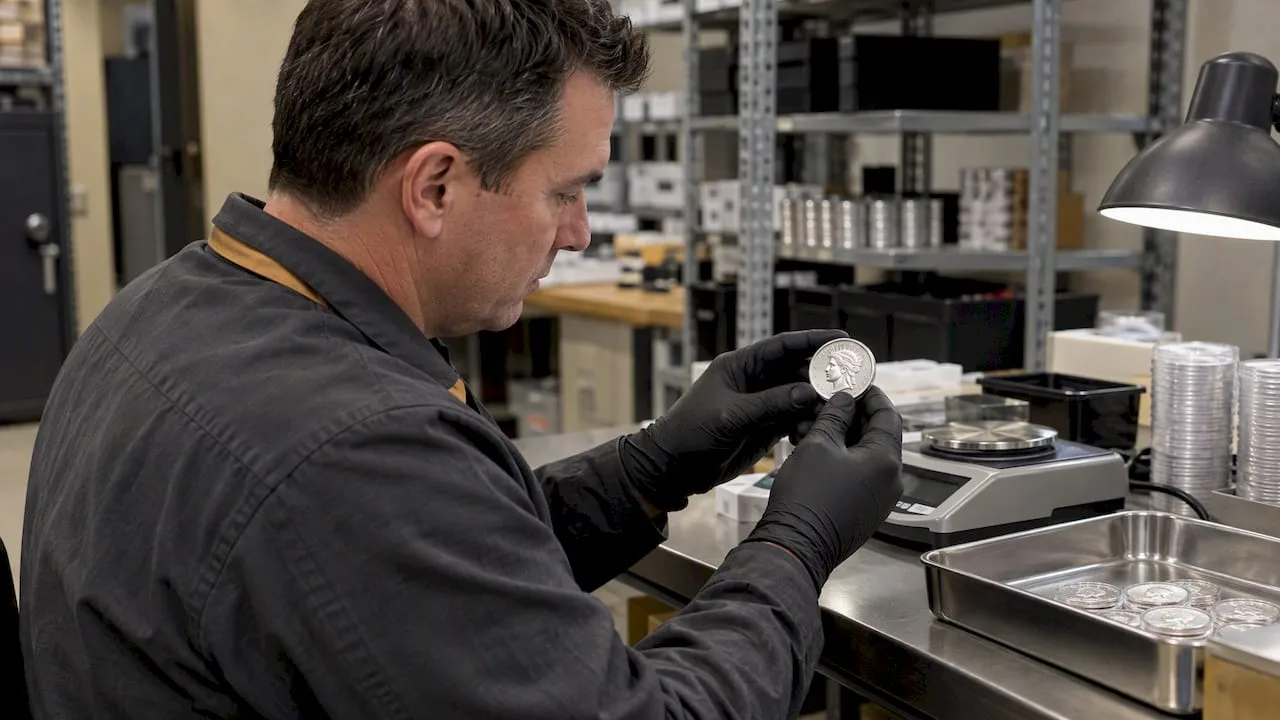
Qualifying palladium bullion can be held in a U.S. self-directed IRA when it meets the contract-market fineness standard, commonly .9995 or 99.95%, and remains in the physical possession of an IRC 408(a) trustee. The American Eagle One Ounce Palladium bullion coin meets that commonly applied standard, though acceptance still depends on your custodian.
TL;DR:
- Bullion Eagles usually clear review faster than proof or uncirculated versions; matching purity does not guarantee acceptance of a collector finish.
- Have the dealer ship directly to a depository approved by your custodian; personal receipt, even briefly, can jeopardize eligibility and trigger collectible treatment.
- Transfers can take days to weeks, with several business days more for shipment and acceptance; budget for custodian, storage, and purchase fees.
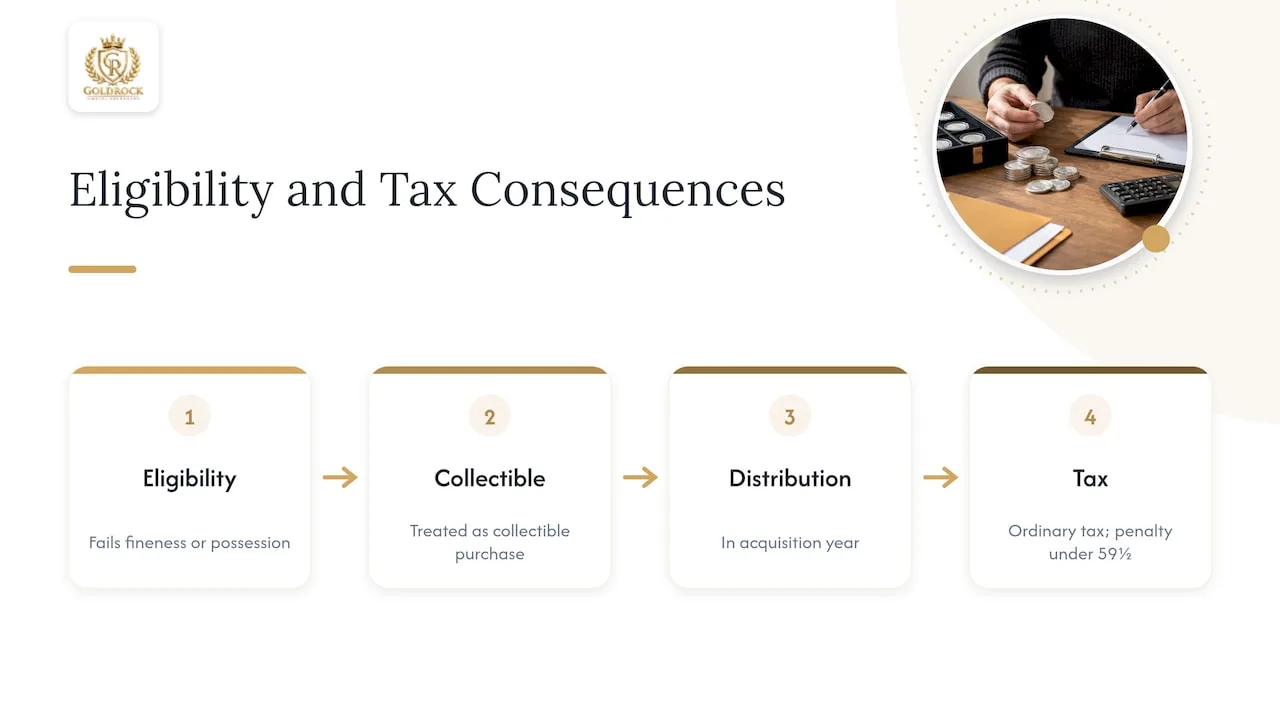
- An ineligible purchase may count as a taxable distribution in the acquisition year, with an early withdrawal penalty possible before age 59 and a half.
Table of Contents
- What IRS rules actually say about palladium IRA eligibility
- Which palladium coins and bars typically qualify
- Bullion versus collector finishes: why the difference matters
- How to buy and ship palladium into a self-directed IRA
- A custodian verification checklist you can send before you buy
- How GoldRock Metal Exchange helps you navigate palladium IRA purchases
- Tax implications and reporting for palladium IRA holdings
- Custodians and depositories that handle palladium IRAs
- Palladium IRAs compared with gold, silver, and platinum IRAs for diversification
- A practical takeaway on palladium IRA compliance
- Request a free precious metals consultation
- FAQ
- Sources
What IRS rules actually say about palladium IRA eligibility
The Internal Revenue Code treats most coins and metals held in an IRA as collectibles, and collectibles trigger a taxable distribution the moment the IRA acquires them. There’s an exception built into IRC 408(m), and palladium bullion can fall inside it when two conditions are met together: the metal meets the minimum fineness required for delivery under the applicable regulated futures-contract standard, and it sits in the physical possession of a trustee under section 408(a), not in your home safe or a personal deposit box.
Custodians translate that statutory language into something they can check at the counter. Treat that counter check as a practical proxy for the legal test, not the test itself.
The possession requirement matters just as much as the purity number. If you take delivery yourself, even briefly, you risk having that purchase reclassified as a collectible acquisition or treated as a prohibited transaction. Shipment has to run through the custodian to an approved depository, never to your address first.
Here’s how the legal test maps to what actually happens at purchase:
- Statutory test: fineness meets the applicable futures-contract delivery standard, and the IRA’s trustee holds the metal.
- Operational proxy: custodians commonly apply 99.95% (.9995) fineness as the practical cutoff for palladium.
- Possession rule: the depository, not the account holder, takes physical custody at every step.
- Verification step: the custodian confirms the exact product, not just the metal type, before funds move.
The commonly used fineness standard for IRA-eligible palladium is 99.95% (.9995), a threshold tied to contract-market delivery requirements rather than a simple published list of approved coins.
Which palladium coins and bars typically qualify
The American Eagle One Ounce Palladium bullion coin is the product most U.S. investors reach for first. It’s struck by the United States Mint at .9995 fine palladium with one troy ounce of palladium content, carries a $25 face value, and its specifications are published directly by the Mint.
Palladium bars and rounds can qualify too, provided they meet the same fineness standard and come from a refiner your custodian recognizes. The legal test doesn’t care whether the metal is shaped like a coin or a bar. What matters is the fineness and the paper trail behind it. A bar from an unfamiliar or unlisted refiner, even at the right purity, can stall at the custodian’s review stage simply because there’s no established spec sheet to check against.
Before you buy anything, gather the documentation and send it to your custodian ahead of time rather than after the invoice arrives. That single step avoids most of the friction investors run into.
Capture these details for any palladium product you’re considering:
- Product name exactly as listed by the mint or refiner.
- Weight in troy ounces.
- Fineness expressed as a decimal (.9995) or percentage (99.95%).
- Year of issue and finish (bullion, proof, uncirculated).
- Certificate of authenticity or catalog URL from the mint or refiner’s own page.
Matching these fields to your custodian’s written acceptance list, rather than relying on a dealer’s “IRA eligible” label, is the verification step that actually protects you.
Bullion versus collector finishes: why the difference matters
Two coins can carry identical metal content and still get treated differently by a custodian. The American Eagle palladium coin is a good example. The U.S. Mint has issued it in bullion form and, in other years, in proof or uncirculated collector finishes, with finishes and packaging changing from year to year and mintages often far smaller on the collector versions. The palladium content might be the same .9995 fine, one troy ounce, but the collector edition carries different documentation, different packaging, and usually a higher premium over spot.
Custodians don’t always treat those two versions the same way. A bullion-strike Eagle tends to move through pre-approval quickly. A limited proof or reverse-proof version, even with matching purity, may draw extra scrutiny because of its numismatic characteristics and smaller mintage. The U.S. Mint’s alternating finish schedule for the palladium Eagle means this distinction comes up often enough that it’s worth checking every single time, not just the first time you buy.
Before committing to a collector issue, take these steps:
- Pull the exact product page from the Mint or refiner, including the finish designation.
- Send that page, along with the certificate of authenticity, to your custodian for written pre-clearance.
- Ask specifically whether the finish (not just the metal) is accepted under the custodian’s current policy.
- Wait for written confirmation before placing the order.
Pro Tip: Attach the Mint or catalog URL directly in your pre-approval request. Custodians move faster when they can verify the exact SKU themselves rather than relying on a dealer’s description.
How to buy and ship palladium into a self-directed IRA
Moving palladium into a self-directed IRA follows a sequence, and skipping a step is where most delays and compliance problems start.
- Request your custodian’s written palladium acceptance policy and get pre-approval for the specific product.
- Fund the IRA, either through a new contribution or a transfer or rollover from an existing retirement account.
- Place an IRA-directed order with your metals dealer, specifying the exact coin or bar and quantity.
- Confirm the dealer ships directly to the trustee-approved depository, never to your personal address.
- Collect custody receipts and inventory or lot numbers once the depository confirms receipt.
- Verify storage arrangements and insurance coverage with the depository and custodian.
Keep documentation at every stage: the pre-approval email or letter, the dealer’s invoice, the shipping manifest, and the depository’s custody receipt. If a question ever comes up about whether a specific item was properly held, this paper trail is what resolves it.
Expect a few categories of cost along the way: custodian setup or annual fees, depository storage fees, and transaction costs on the metals purchase itself. Timelines vary. An IRA transfer from an existing custodian can take anywhere from a few days to a few weeks depending on the sending institution, and shipment-to-depository acceptance typically adds several more business days once the dealer has the order. Building in that buffer avoids unnecessary pressure to rush a purchase before documentation is confirmed.
- Pre-approval email or letter from the custodian naming the exact product.
- Purchase invoice listing weight, fineness, and finish.
- Shipping manifest showing direct dealer-to-depository transit.
- Custody receipt with inventory or lot number from the depository.
A custodian verification checklist you can send before you buy
A short, specific written request to your custodian solves most eligibility questions before they become problems. Include these fields:
- Coin or refiner name and exact product name.
- Year of issue and finish (bullion, proof, uncirculated).
- Weight in troy ounces and fineness as a decimal or percentage.
- Certificate of authenticity or mint and catalog link.
- Serial or lot numbers, if available, and the dealer’s invoice.
- Proposed ship-to depository and any depositor instructions.
Ask directly for written acceptance of the exact SKU, not a general statement about palladium being allowed. If the custodian declines, ask what specification would change the answer. Sometimes it’s the finish, sometimes the refiner, and knowing which one saves you from repeating the same mistake with a different product.
Pro Tip: Save every email exchange with your custodian in one folder, and cross-reference each claim against the U.S. Mint’s own product pages rather than a dealer’s marketing description.
How GoldRock Metal Exchange helps you navigate palladium IRA purchases
Our in-house IRA department coordinates directly with your custodian to confirm product acceptance before you commit to a purchase, and we arrange insured private delivery to the depository your custodian designates, so metal never routes through your personal address. During a consultation, we walk through the documentation checklist, confirm which palladium products a custodian currently accepts, and outline shipping and storage options. We don’t provide tax advice. For a conversation about your specific situation, request a free precious metals consultation or call (888) 859-0978.
Tax implications and reporting for palladium IRA holdings
A palladium IRA follows the same tax structure as any other self-directed IRA holding physical metal: contributions, distributions, and required minimum distributions are governed by the rules for traditional or Roth IRAs, depending on which type of account holds the metal. The custodian handles the account-level reporting, including annual fair market value statements on Form 5498 and any distribution reporting on Form 1099-R.
Where things can go wrong is at the eligibility stage, not the reporting stage. If palladium is acquired that doesn’t meet the fineness and possession requirements under IRC 408(m), the IRS can treat that acquisition as a collectible purchase, which the Code treats as a distribution to you in the year of acquisition, potentially triggering ordinary income tax and, if you’re under 59 and a half, an early withdrawal penalty.
Because every investor’s tax situation differs based on account type, age, and overall retirement strategy, this is a question for a qualified tax professional or CPA familiar with self-directed IRAs, not something to resolve from a general article. What you can control directly is the eligibility question itself: confirming fineness and custody before the purchase happens is what keeps the tax treatment straightforward in the first place.
Custodians and depositories that handle palladium IRAs
Custodians for self-directed IRAs are trust companies or banks authorized under IRC 408(a) to hold retirement assets, including physical metals, on behalf of the account owner. Not every custodian handles palladium. Some self-directed IRA custodians focus primarily on gold and silver and either decline palladium and platinum or apply more conservative fineness and product restrictions to them.
Depositories are the physical storage facilities, separate from the custodian, that actually hold the metal. They’re typically insured, audited, and equipped for bulk metal storage, and a custodian will usually work with one or more depositories it has an existing relationship with rather than an open list of any facility nationwide.
Because palladium is a thinner market than gold or silver, with fewer refiners and mints producing IRA-grade product, it’s worth confirming upfront that a custodian has an active palladium policy and an established depository relationship for it, rather than assuming every self-directed IRA provider treats all four metals identically.
Palladium IRAs compared with gold, silver, and platinum IRAs for diversification
All four metals, gold, silver, platinum, and palladium, can sit in a self-directed IRA under the same basic framework: meet the applicable fineness standard, keep the metal in trustee possession. Where they differ is in market size, price behavior, and product availability.
Gold and silver have the deepest markets, the widest range of IRA-eligible coins and bars, and the most custodians actively supporting them. Platinum and palladium are both tied heavily to industrial demand, particularly automotive catalytic converter production, which makes their prices move differently than gold’s, which is driven more by investment and central bank demand. Palladium specifically has a narrower set of IRA-eligible bullion products than gold or silver, with the American Eagle palladium coin as the primary widely available option for U.S. investors.
Diversifying across more than one metal is a decision about exposure to different market drivers, not a guarantee of any particular outcome. Because palladium’s market is smaller and less liquid than gold’s or silver’s, it’s reasonable to expect fewer product choices and potentially less custodian flexibility, which is exactly why the verification steps covered earlier carry more weight with this metal than with gold or silver.
A practical takeaway on palladium IRA compliance
The eligibility question for palladium boils down to two checks every time: does the fineness meet the standard your custodian applies, and will the metal go straight into trustee possession. Treat “IRA eligible” as something you verify in writing for each specific product, not a label you take on faith. Blake covers retirement account compliance topics for this publication.
— Blake
Request a free precious metals consultation
Confirming palladium eligibility product by product takes time most investors would rather not spend alone. Our in-house IRA team handles the custodian coordination and documentation checklist directly, so you’re not cross-referencing Mint pages and custodian policies by yourself.

During a consultation, we walk through:
- Which palladium products your prospective custodian currently accepts.
- The documentation needed for pre-approval before you buy.
- Insured private delivery arranged directly to your depository.
- Setup or rollover support for opening a self-directed precious metals IRA.
Call (888) 859-0978 or request a free precious metals consultation to start the conversation.
This article is general information, not a substitute for advice from a qualified financial advisor. Consult a qualified financial professional about your own circumstances before acting on anything here.
FAQ
Which gold coins are IRA eligible?
Gold coins generally need to meet a minimum fineness required by the applicable regulated futures-contract standard and be held in the physical possession of an IRC 408(a) trustee to qualify. The American Eagle gold bullion coin is a widely used example, though as with palladium, final acceptance always depends on the specific custodian’s policy.
Is it better to invest in palladium or gold?
Neither metal is inherently better; they respond to different market forces, with gold driven more by investment demand and palladium tied closely to industrial and automotive use. The right mix depends on your own diversification goals and risk tolerance, which is a decision best made with a financial professional familiar with your full retirement picture.
Can I invest in precious metals in my IRA?
Yes, a self-directed IRA can hold physical gold, silver, platinum, and palladium when the metal meets the applicable fineness standard and stays in the physical possession of an IRS-approved trustee under IRC 408(a). A standard IRA through a typical brokerage usually doesn’t support physical metal, which is why a self-directed structure is required.
How much is a 1 oz palladium coin worth?
The value of a one troy ounce palladium coin tracks the live palladium spot price plus a dealer premium that varies by product and market conditions at the time of purchase. Because spot prices change daily, check current pricing directly with a dealer rather than relying on a fixed figure.
Sources
- Investments in collectibles in individually directed qualified plan accounts | Internal Revenue Service
- American Eagle Palladium Bullion Coins | U.S. Mint
- American Eagle 2023 One Ounce Palladium Uncirculated Coin | U.S. Mint Catalog