Palladium qualifies for a self-directed IRA only when it clears three IRS tests set out under IRC §408(m): a minimum fineness of 0.9995 (99.95%), production by an approved mint or refiner, and storage exclusively through a qualified custodian in an IRS-approved depository. There is no exception that lets you hold the metal at home or in a personal safe. Miss any one of these three conditions and the IRS treats the purchase as ineligible, or worse, as a taxable distribution.
TL;DR:
- Palladium must meet a minimum fineness of 0.9995, be produced by an approved mint or refiner, and stored only in an IRS-approved depository to qualify for a self-directed IRA.
- Eligible palladium coins include the American Palladium Eagle and the Canadian Palladium Maple Leaf, with bars also qualifying if produced by recognized refiners and properly documented.
- Possession of palladium outside the depository violates IRS rules and triggers a taxable distribution, meaning physical delivery is strictly prohibited during the IRA’s hold period.
- Funding and adding palladium involve verifying custodian support, obtaining pre-approval for specific products, and ensuring proper documentation before purchase.
- The major costs include higher premiums over spot price due to market thinness, custodian fees, and storage charges, which tend to be more expensive than for gold or silver.
Table of Contents
- What Does the IRS Require for a Palladium IRA?
- Which Palladium Coins and Bars Qualify?
- Where Must Palladium Be Stored, and What Happens if You Take Possession?
- How Do You Add Palladium to a Self-Directed IRA?
- What Are the Tax and Liquidity Risks of Holding Palladium?
- How GoldRock Metal Exchange Supports Compliant Palladium IRAs
- What Are the Contribution Limits for a Palladium IRA?
- What Happens When You Withdraw Palladium From an IRA?
- Can You Roll Over an Existing IRA Into Palladium?
- How Long Does It Take to Set Up a Palladium IRA?
- What Does It Cost to Buy, Store, and Hold Palladium in an IRA?
- When Palladium Fits (and When It Doesn’t) in a Retirement Allocation
- Ready to Add Palladium to Your Self-Directed IRA?
- Where to Verify These Rules Yourself
- Sources
What Does the IRS Require for a Palladium IRA?
The legal basis for holding palladium in a retirement account comes from IRC §408(m), the statute that generally bars “collectibles” from IRAs but carves out a narrow exception for specific bullion and coins. IRS Publication 590-B repeats this exception in plainer language for taxpayers filing distributions and contributions. Palladium sits alongside gold, silver, and platinum as one of exactly four metals eligible under this carve-out, and each one carries its own purity floor.
This is a narrower margin for error than gold’s 0.995 standard, so sourcing matters more.
The product also needs a traceable origin. Custodians generally require:
- A mint or refiner mark from a producer accredited by a recognized body such as NYMEX, COMEX, or the LPPM
- Weight and fineness stamped or certified on the item itself
- An accompanying assay or manufacturer certificate confirming the metal meets the 0.9995 standard
Skip any of these, and a custodian will typically reject the purchase before it ever reaches the depository.
Which Palladium Coins and Bars Qualify?
Two coin types dominate the eligible list for U.S. investors. The American Palladium Eagle, a 1 oz coin issued by the U.S. Mint, is named directly in the statutory exception, but annual mintages have been limited since its 2017 launch, which can mean waiting periods or premium spikes when demand outpaces supply. The Canadian Palladium Maple Leaf, produced by the Royal Canadian Mint, meets the same 0.9995 fineness standard and tends to be more consistently available through U.S. dealer networks, which is why many custodians default to it when the American Eagle is backordered.
Bars are the other route, and they qualify when produced by a refiner accredited to NYMEX, COMEX, or LPPM good delivery standards, with the fineness and weight stamped directly on the bar.
What gets rejected:
- Jewelry, medallions, or decorative palladium items
- Numismatic or collector coins valued for rarity rather than metal content
- Rounds or bars from refiners without recognized accreditation
- Any item that fails to document 0.9995 purity
Our guide on investing in coins for retirement walks through documentation standards in more detail if you’re comparing coin types across metals.
Where Must Palladium Be Stored, and What Happens if You Take Possession?
Every ounce of IRA-held palladium has to sit in a depository approved for that purpose, under the control of a qualified custodian, not the account owner. The IRS is explicit that IRA owners cannot take physical delivery of the metal while it remains part of the account, and there’s no workaround through a home safe, a personal safe-deposit box, or an LLC structure that claims to hold the asset on the owner’s behalf.
The custody chain typically works like this:
- The custodian directs your purchase order to an approved dealer.
- The dealer ships the product directly to the depository, never to you.
- The depository logs the item into insured, segregated or allocated storage under your account’s name.
- The custodian receives confirmation and updates your account statement.
Attempting to bypass this chain is not a paperwork violation. The IRS treats personal possession as an immediate taxable distribution equal to the metal’s cost basis to the plan, and it can happen the moment you take delivery, not at year-end. For details on how insured storage actually works day to day, see our breakdown of precious metal storage options.
How Do You Add Palladium to a Self-Directed IRA?
Adding palladium correctly is less about paperwork volume and more about sequence. Skip a step, and you either delay the purchase or create a compliance gap.
- Confirm custodian capability. Not every self-directed IRA custodian actively deals in palladium, since the market is thinner than gold or silver’s. Ask for their specific approved-product list before funding anything.
- Fund or roll over the account. Whether you’re moving funds from a 401(k) or an existing IRA, direct trustee-to-trustee transfers avoid the 60-day deadline that applies to indirect rollovers.
- Get product pre-approval. Confirm the exact coin or bar, its refiner mark, and its assay certificate match the custodian’s accepted list before you commit funds.
- Coordinate the purchase and delivery. The dealer ships straight to the depository; you never touch the metal.
- Keep your records. Retain the invoice, the assay certificate, and the custodian’s confirmation of receipt for your own file, separate from what the custodian keeps on record.
Pro Tip: Call the custodian before you call the dealer. Confirming they’ll accept your specific product, by exact refiner and weight, saves you from a purchase that stalls at the depository’s intake desk.
What Are the Tax and Liquidity Risks of Holding Palladium?
Distributions from a traditional palladium IRA are taxed as ordinary income when you eventually withdraw, exactly like distributions of cash or any other IRA asset. There’s no special capital-gains treatment for the metal itself. Required minimum distributions apply on the same schedule as any traditional IRA, and because palladium can’t be partially liquidated as easily as cash, some owners plan RMDs around a whole-unit sale rather than fractional withdrawals.
Liquidity is the bigger practical friction. Palladium trades in a thinner market than gold or silver, which tends to mean wider premiums over spot price and, occasionally, longer waits when selling back through a custodian or depository network.
Common errors worth avoiding:
- Buying a product before confirming the custodian’s accepted list
- Assuming any “0.999” stamped item automatically qualifies (it needs 0.9995)
- Underestimating dealer lead times for the American Palladium Eagle specifically
- Forgetting that a sale still routes through the custodian, not a direct buyer
How GoldRock Metal Exchange Supports Compliant Palladium IRAs
GoldRock Metal Exchange runs an in-house IRA department built specifically to keep this custody chain intact from purchase through storage. That matters most with palladium, where fewer custodians actively support the metal and mistakes are costlier to unwind.
Here’s what that support looks like in practice:
- Verification that a specific coin or bar meets the 0.9995 standard before you buy
- Direct coordination with your custodian and an IRS-approved depository
- Insured private delivery for any metals purchased outside an IRA structure
- Ongoing consultation as you fund, transfer, or roll over an account into precious metals
If you’re weighing palladium against gold, silver, or platinum for a self-directed IRA, request a Free Precious Metals Consultation or call (888) 859-0978 to walk through your specific account and eligibility with GoldRock’s IRA team.
What Are the Contribution Limits for a Palladium IRA?
Palladium doesn’t carry its own separate contribution cap. It shares whatever limit applies to the IRA type holding it, because the metal is simply an asset inside the account, not a distinct account category.
For a traditional or Roth IRA, that means the standard annual IRA contribution limit applies, the same figure you’d use whether you’re buying palladium, holding mutual funds, or sitting in cash. Eligibility to contribute to a Roth IRA still phases out at higher income levels, and traditional IRA deductibility still depends on whether you or a spouse has access to a workplace retirement plan. None of that changes because palladium is the asset in question.
Where this gets more flexible is with rollovers and transfers. Moving funds from an existing 401(k), 403(b), or another IRA into a self-directed IRA that will hold palladium is not a “contribution” in the annual-limit sense at all. There’s no cap on how much you roll over, only on new money contributed directly in a given tax year. This is why most investors adding palladium to a retirement account do it through a rollover of existing funds rather than years of fresh annual contributions, since it lets them allocate a meaningful amount to the metal in a single transaction rather than building toward it gradually.
Eligibility to even open the account requires no special qualification beyond having earned income (for direct contributions) or an existing eligible retirement account (for rollovers). The metal itself doesn’t require investor accreditation or net worth thresholds.

What Happens When You Withdraw Palladium From an IRA?
Withdrawals from a palladium IRA follow the same structural rules as any other IRA distribution, with one added logistical layer: the metal itself has to be dealt with, not just a dollar figure.
Take a distribution before age 59½, and you generally owe both ordinary income tax and a 10% early withdrawal penalty, identical to cash distributions from a traditional IRA. Roth IRA rules follow their own separate ordering rules for contributions versus earnings, and those don’t change because the underlying asset is metal instead of securities.
You have two practical paths at withdrawal time. The custodian can sell the palladium and distribute the cash proceeds, which is the more common route since it avoids the logistics of physically moving bullion. Or, in what’s called an in-kind distribution, you can request the actual coins or bars be shipped to you, at which point they leave the IRA’s protected structure and the fair market value on the distribution date becomes your taxable income.
Required minimum distributions kick in at the same age thresholds as any other traditional IRA, and because palladium can’t always be split into precise fractional amounts the way cash can, some owners coordinate with their custodian ahead of time to plan which specific coins or bars get liquidated to satisfy that year’s RMD amount.
Can You Roll Over an Existing IRA Into Palladium?
Yes, and this is how most investors end up holding palladium at all, since new contributions alone rarely justify the minimum purchase sizes dealers and custodians expect.
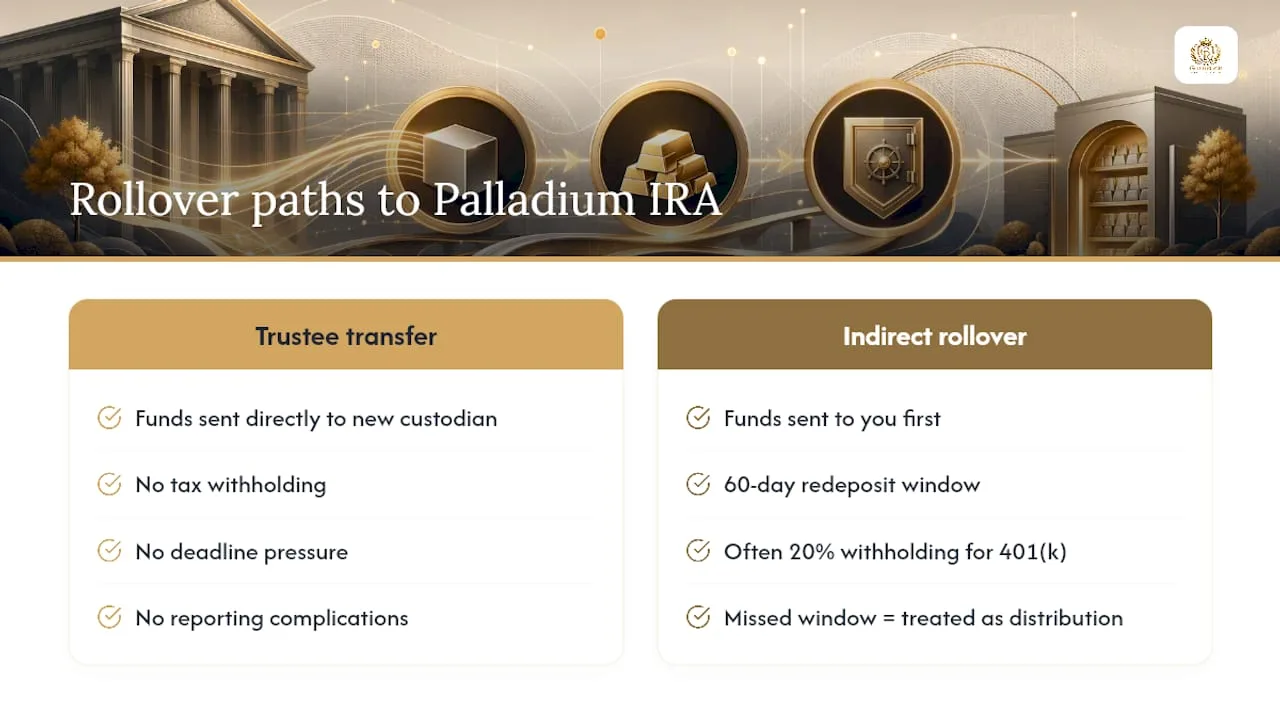
Two mechanisms exist. A direct trustee-to-trustee transfer moves funds from your existing custodian straight to your new self-directed IRA custodian without the money ever touching your hands. This is the cleaner method: no tax withholding, no deadline pressure, and no reporting complications.
The alternative, an indirect rollover, has the funds sent to you first, and you then have 60 days to deposit them into the new account. Miss that window and the IRS treats the entire amount as a distribution, subject to income tax and, if you’re under 59½, the early withdrawal penalty. Indirect rollovers from 401(k) plans also typically face mandatory 20% withholding upfront, money you’d need to make up out of pocket to complete a full rollover. Our guide on moving a pension to a Gold IRA covers this transfer mechanic in more detail, and the same timing rules apply whether the destination metal is gold or palladium.
You can generally roll over funds from a 401(k), 403(b), 457(b), traditional IRA, or SEP IRA. Employer plans sometimes restrict rollovers while you’re still actively employed there, so check plan rules first if you’re rolling over a current employer’s 401(k) rather than a former one.
How Long Does It Take to Set Up a Palladium IRA?
The full sequence, from opening an account to having palladium sitting in an approved depository, typically runs over a few weeks, though the exact timeline depends heavily on which funding method you use and how available your chosen product is.
Account opening with a self-directed custodian is usually the fastest piece, often completed within a few business days once paperwork is submitted. Funding is where timing diverges. A direct transfer from an existing IRA can take one to two weeks depending on the sending institution’s processing speed. A 401(k) rollover, especially from a former employer’s plan, sometimes stretches longer if the plan administrator requires additional verification steps.
Once funds land in the account, product availability becomes the variable most specific to palladium. If you’re buying Canadian Palladium Maple Leaf coins or an accredited refiner’s bar, purchase and shipment to the depository often happens within a matter of days. If you specifically want the American Palladium Eagle, be prepared for a longer wait given its limited annual mintage, sometimes weeks, depending on dealer inventory at the time.
The final step, confirmation of receipt at the depository and custodian record updates, usually adds another few business days after the metal ships. Building in buffer time around the product-sourcing stage, rather than the paperwork stages, is where most delays actually happen.
What Does It Cost to Buy, Store, and Hold Palladium in an IRA?
Costs for a palladium IRA break into three categories, and understanding which one drives the total is where most first-time buyers get surprised.
The purchase premium is usually the largest and most variable cost. Because palladium trades in a thinner market than gold or silver, premiums over spot price tend to run higher, and that premium can widen further for lower-mintage products like the American Palladium Eagle. Canadian Maple Leaf coins and accredited bars generally carry somewhat tighter premiums simply because supply is more consistent.
Custodian fees typically include an account setup fee, an annual administration fee, and sometimes a transaction fee per purchase or sale. These are usually flat dollar amounts rather than a percentage of assets, though structures vary by custodian.
Depository storage fees cover insured, segregated or allocated storage and are usually billed annually, either as a flat fee or a small percentage of the stored value. Segregated storage, where your specific coins or bars are kept apart from other investors’ holdings, generally costs more than commingled storage but gives you a documented claim to the exact items you purchased.
None of these fees are unique to palladium as a structure, but the wider purchase premiums common in this metal mean the total cost of entry tends to run higher than an equivalent-value gold or silver purchase. Confirming premium and fee structures before committing funds avoids an unpleasant surprise once the purchase is already underway.
When Palladium Fits (and When It Doesn’t) in a Retirement Allocation
Palladium can add real diversification value precisely because its price behavior often diverges from gold’s, tied more closely to industrial demand than to safe-haven flows. That’s a legitimate reason to consider a small allocation. But the same qualities that make it interesting, thin trading, fewer supporting custodians, limited coin mintage, also make it a poor fit for anyone who wants to move quickly or minimize friction. If ease of liquidation matters more to you than diversification math, gold or silver will typically serve you better. Either way, confirm your custodian actually supports palladium before you fall in love with the allocation on paper.
— Blake
Ready to Add Palladium to Your Self-Directed IRA?
GoldRock Metal Exchange’s in-house IRA department exists to handle exactly the sequence outlined above: verifying custodian capability, confirming product eligibility against the 0.9995 standard, and coordinating delivery straight to an IRS-approved depository. Every purchase outside an IRA structure also comes with insured private delivery, so whether you’re building a retirement allocation or buying metal directly, the chain of custody stays documented from dealer to your door or to the depository.

If you’re ready to see current palladium pricing or discuss how it fits alongside gold, silver, and platinum in a self-directed account, request a Free Precious Metals Consultation or call (888) 859-0978 to speak directly with GoldRock’s IRA team about opening or funding your account.
This article is for educational purposes only and does not constitute investment, tax, or legal advice. Consult a qualified professional about your specific situation before making decisions involving retirement accounts or precious metals.
Where to Verify These Rules Yourself
- IRS: Investments in collectibles in individually directed qualified plan accounts — governing guidance on IRC §408(m)
- IRS Publication 590-B — distribution and eligibility rules for IRA assets
- IRC §408(m) — statutory text defining the collectibles exception for approved bullion and coins
This article is general information, not a substitute for advice from a qualified financial advisor. Consult a qualified financial professional about your own circumstances before acting on anything here.
Sources
- Investments in collectibles in individually directed qualified plan accounts | Internal Revenue Service
- IRS Rules for Palladium IRA Investments — 2026 Fineness Standards, Approved Products & Storage | Rollover Guidance
- IRA Approved Palladium: Rules, Benefits, and Investment Guide – Gold IRA Blueprint