

For most U.S. investors and small businesses holding meaningful quantities of bullion, a commercial depository offers the clearer path to secure custody and reliable insurance, while a home safe tends to suit smaller, liquid holdings where quick access and privacy matter more. Which option fits you depends on how much value you hold, whether it sits inside an IRA, and how your insurance is structured. Always confirm the details directly with your custodian or insurer before deciding.
TL;DR:
- Depositories offer higher security, insurance, and detailed audit trails, making them suitable for large or inventory-level holdings, especially within IRAs.
- Home safes are better suited for small, liquid holdings where quick access, privacy, and convenience outweigh extensive security features.
- IRS rules require IRA bullion to be stored by approved custodians, making personal home storage non-compliant for retirement accounts, regardless of perceived control.
- Standard homeowners or renters insurance generally provides limited coverage for precious metals, necessitating added endorsements or separate policies for full protection.
- Always verify storage eligibility and insurance limits directly with custodians and insurers before choosing between depository and home safe storage options.
Table of Contents
- How depositories and home safes differ in construction and use
- IRS custody rules for IRA-held precious metals
- What insurance actually covers, and where it falls short
- A checklist for choosing between a depository and a home safe
- How our services support your storage and custody decisions
- What cautious owners often get wrong
- Request a free consultation to review your options
- FAQ
- Sources
How depositories and home safes differ in construction and use
A commercial depository and a home safe are built for different jobs, and the construction reflects that. Depository vaults use reinforced steel, multiple relocking mechanisms that trigger if someone attempts forced entry, and fire ratings designed for sustained high heat over hours rather than minutes. Many facilities also use drop slots or chutes for frequent deposits, which is a feature built for repeat commercial activity rather than one-time home storage. According to one industry comparison of depository and home safes, commercial units are engineered for heavy daily use and carry higher fire-resistance ratings than typical residential safes.
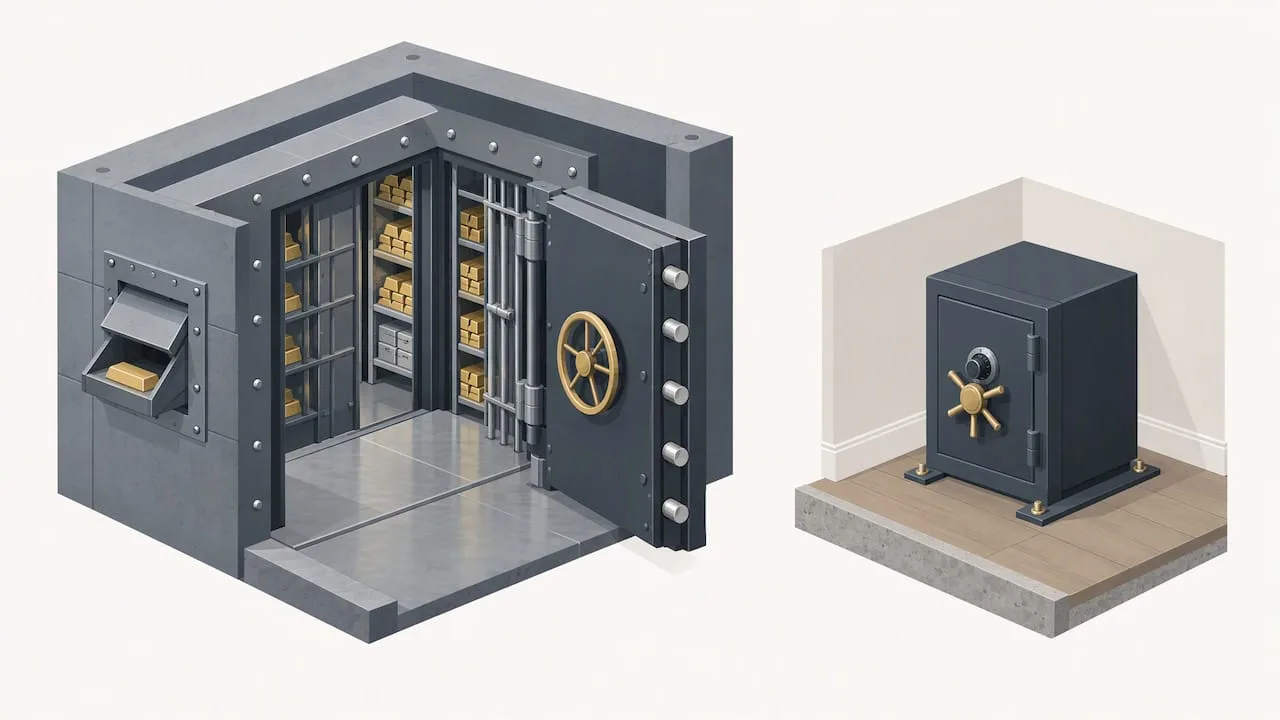
Home safes, by contrast, are built around convenience and discretion. A bolted-down floor safe or a quality fire-rated unit can protect a modest collection of coins or bars, but most residential models trade off some of the structural depth and relocking complexity found in commercial vaults.
The workflows differ just as much as the hardware:
- Depositories log every deposit and withdrawal, often with photo verification, sealed storage, and third-party audits.
- Home safes give you immediate, unsupervised access at any hour, with no paperwork and no waiting.
- Businesses handling inventory-level quantities of metal typically lean toward depository storage for the audit trail.
- Individuals holding a smaller, personally owned stack often prefer a home safe for simplicity and privacy.
Operational controls matter as much as the container itself; platforms offering security practices for financial SaaS highlight the importance of continuous monitoring and rogue-trade detection. A depository separates duties among staff, tracks chain of custody for every item, and monitors the facility continuously. A home safe puts all of that responsibility on you: you decide who knows the location, who has the combination, and how movements are logged, if at all.
Pro Tip: Keep a simple written inventory of serial numbers, weights, and purchase dates for anything in a home safe. It is the single easiest way to speed up an insurance claim or an estate transfer later.
IRS custody rules for IRA-held precious metals
If your bullion sits inside a self-directed IRA, the storage decision is not really a preference question. The IRS states that qualifying IRA bullion must be in the physical possession of a bank or an IRS-approved nonbank trustee. That rule applies specifically to retirement-account holdings. It does not restrict you from personally owning and storing metals you purchased outside an IRA.
The distinction that trips people up is the difference between physical control and legal custody. You might feel more secure holding your own gold, but for IRA purposes the law cares about who has approved custodial possession, not who feels most responsible for the metal. Storage arrangements built around an IRA-owned LLC are sometimes marketed as a workaround, but these structures still require careful documentation and custodian cooperation, and missteps can expose the account to prohibited-transaction risk.
Before moving forward with any IRA-held metals, verify a few things directly with your custodian:
- Confirm the custodian is an IRS-approved bank or nonbank trustee for the metals you plan to hold.
- Ask which products meet IRS fineness requirements for IRA eligibility.
- Request written documentation of where your metal is stored and how it is segregated or allocated.
- Clarify any custodian-imposed limits on products, quantities, or storage locations.
Our guide on verifying an IRS-approved depository walks through these checks in more detail, and our explainer on why home storage IRA structures can create compliance problems covers the common pitfalls in plain language. None of this is tax advice. Speak with a qualified tax professional about how custody rules apply to your specific account.
What insurance actually covers, and where it falls short
Insurance is where good intentions most often meet an unpleasant surprise. The FDIC states plainly that safe-deposit boxes, and by extension home safes, are not FDIC-insured. The FDIC treats a safe-deposit box as rented space, not a deposit account, so federal deposit insurance never applies to the gold or silver sitting inside it.
That leaves homeowners or renters insurance as the default fallback for most home storage, and most standard policies cap coverage for precious metals, jewelry, and collectibles far below their actual value. A few practical steps close that gap:
- Ask your insurer directly what sublimit applies to precious metals under your current policy.
- Add a scheduled personal property endorsement for anything above that sublimit.
- Consider a standalone valuable-items floater policy if your holdings are concentrated or growing.
- Review the private depository’s own insurance structure, since many carry policies with exclusions for transit, employee dishonesty, or claims above a stated ceiling.
Depositories and safe-deposit boxes are not covered by federal deposit insurance, according to FDIC guidance. That single fact is why a separate, verified insurance arrangement matters regardless of which storage method you choose.
Documentation is the other half of the equation. FINRA’s investor alerts emphasize keeping thorough records, serial numbers, assay marks, purchase invoices, and independent third-party appraisals, to support both fraud prevention and insurance claims. A safe can slow down a thief. Without documentation and the right policy behind it, recovery after a loss can still be limited.
A checklist for choosing between a depository and a home safe
Five factors tend to drive this decision more than anything else: how quickly you need access, how much value is concentrated in one place, the physical security available to you, the strength of your insurance, and how well you can maintain records over time.
Weigh these differently depending on who you are. An individual with a modest, diversified collection may lean toward a home safe for convenience. A small business holding inventory-level quantities, or an investor with a large, concentrated position, usually benefits more from depository-level controls, audit trails, and insurance capacity.
A few rule-of-thumb scenarios help frame the decision:
- A small, personally owned collection you may need to access on short notice often fits a quality home safe.
- Concentrated holdings of bars or a large coin position typically call for depository-level security and documentation.
- Business inventory that changes hands regularly benefits from the chain-of-custody tracking a depository provides.
Pro Tip: Before committing to either option, ask directly: what is the maximum claim this policy will pay for precious metals, and what specific events are excluded? Our breakdown of precious metal storage options and our guide to storing physical gold safely at home both walk through these questions in more depth. For broader context on layered security planning for high-value assets, CISA’s guidance recommends restricted access, inventory tracking, and separation of duties rather than relying on a single container, a principle that applies just as well to a home office as it does to a larger facility.
How our services support your storage and custody decisions
We offer services to assist with Precious Metals IRA setups and provide insured delivery options for metals held personally outside a retirement account. Both services are designed to reduce the documentation and verification gaps that tend to cause problems later: custodial paperwork for IRA holdings, and insured tracking for anything shipped directly to you.
If you want help thinking through which approach fits your holdings, request a free consultation by calling (888) 859-0978, or visit our education resources to review the fundamentals first.
What cautious owners often get wrong
The mistake I see most often is treating control and compliance as the same thing. Holding your own metal feels secure, but for an IRA it is the custodial structure that counts, not your physical grip on the coins. On the home-storage side, the recurring errors are small but costly: insurance limits that were never updated, hiding spots that are predictable to anyone who knows you, and no written inventory at all. A solo investor who adds to a position gradually over several years, without ever revisiting the policy limit, is the clearest example of a gap that is easy to avoid and expensive to discover after the fact.
— Blake
Request a free consultation to review your options
We built our Precious Metals IRA service and insured Private Delivery option around the exact gaps this article covers: custodial compliance for retirement accounts and documented, insured handling for metals you hold personally. Our IRA support team works with approved custodians to assist with paperwork from the first transfer.

If you would like a straightforward walk-through of which approach fits your situation, request a free precious metals consultation by calling (888) 859-0978, or start with our Precious Metals IRA page to see how the setup works.
This article is general information, not a substitute for advice from a qualified financial advisor. Consult a qualified financial professional about your own circumstances before acting on anything here.
FAQ
What is the difference between a depository and a depositary?
A depository is a physical facility or institution that stores assets like precious metals, cash, or securities. A depositary is a broader legal or financial role, often referring to an entity responsible for holding assets on behalf of others under a formal agreement, such as a bank acting in a custodial or trustee capacity.
What is the difference between a depository and a repository?
A depository typically refers to a secure facility for storing physical assets, including precious metals, cash, or important documents. A repository is a more general term for a storage location, which can be physical or digital, and is more commonly used for records, data, or documents rather than tangible valuables.
What does depository mean?
A depository is a facility or institution designated to hold and safeguard physical assets, often under contractual or regulatory oversight. In the context of precious metals, a depository provides secure vault storage with controlled access, monitoring, and insurance arrangements that differ from a personal home safe.
Is home storage ever appropriate for IRA-held gold?
Generally, no. The IRS requires that qualifying IRA bullion be held by a bank or an IRS-approved nonbank trustee, which home storage typically does not satisfy. Speak with a tax professional before considering any alternative custody structure for retirement-account metals.
Does homeowners insurance cover precious metals in a home safe?
Most standard homeowners or renters policies include a sublimit for precious metals and collectibles that is often far below their actual value. Adding a scheduled personal property endorsement or a separate floater policy is the usual way to close that gap.
Sources
- Retirement plans FAQs regarding IRAs | Internal Revenue Service
- Financial products that are not insured by the FDIC | FDIC
- ChemLock: Secure Your Chemicals | CISA