

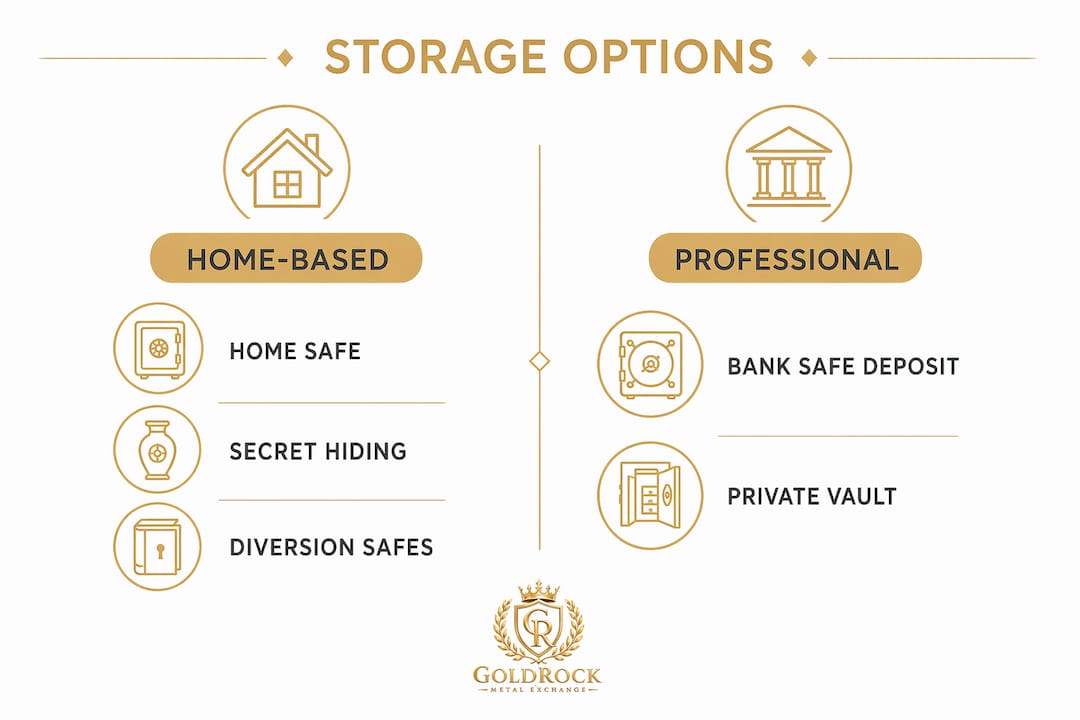
Your three core choices for storing physical precious metals are home safes, bank safe deposit boxes, and private vault storage, each sitting at a different point on the cost, security, and accessibility spectrum. No single method wins outright. Every option trades one risk for another, and the right answer almost always involves combining at least two of them.
Here is a quick orientation before the details:
- Home safes: Immediate access, zero counterparty risk, but full exposure to theft and disaster, plus limited insurance under standard homeowner policies.
- Bank safe deposit boxes: Bank-grade physical security at modest cost, but not covered by FDIC insurance, restricted to bank hours, and subject to access freezes.
- Private vault storage: Institutional security, professional insurance, and allocated custody, but annual fees and moderate counterparty risk.
- Secret hiding places and diversion safes: Useful as a secondary layer for small amounts, not a primary strategy.
- IRS rules for IRAs: Precious metals held inside a self-directed IRA cannot be stored at home. They must go to an IRS-approved third-party depository.
- Insurance: Standard homeowner policies cap precious metal coverage at $1,000–$2,500 without a scheduled rider, which is a gap most investors do not realize until it is too late.
Precious metal storage options explained: your full breakdown
1. Home safes
Home storage gives you full custody and instant access. The cost is essentially zero beyond the safe itself and any insurance upgrade. That immediacy is genuinely valuable, especially if you hold metals partly as a crisis hedge.
The catch is execution. A basic residential safe from a big-box store and a properly anchored TL-30 rated safe are not remotely equivalent, even though both are marketed as “home safes.” A TL-30 is rated to resist tool attack for 30 minutes; a cheap residential model can be pried open in minutes. For any holding worth protecting, a UL-listed TL-15 or TL-30 safe, bolted to a concrete floor or wall, is the minimum.
Home storage trades counterparty risk for theft and disaster risk. Fire, flood, and burglary are real exposures, and most homeowner policies do almost nothing to cover them for precious metals specifically.
- Pros: Immediate access, maximum privacy, no counterparty risk, no annual fees.
- Cons: Full theft and disaster exposure, insurance gaps, requires serious hardware to be genuinely secure.
Pro Tip: Anchor your safe to a concrete subfloor, not just a wood floor. A 500-pound safe that is not anchored can still be removed by two people with a dolly.
2. Bank safe deposit boxes
Safe deposit boxes offer bank-grade vault security at a fraction of what private storage costs. Access requires identity verification, and the two-key system (yours plus the bank’s) adds a meaningful layer of physical protection. For decades, this was the default choice for gold and jewelry storage.

That default has weakened considerably. Banks do not insure safe deposit box contents, and the rental agreement typically limits the bank’s liability to a nominal amount regardless of what is inside. If the vault floods, the bank fails, or the box is broken into, the bank bears no financial responsibility for your metals.
Access is also constrained. You can only reach the box during branch hours, and in a bank failure or emergency, access can be frozen entirely. For metals held as a liquidity reserve, that restriction is a real problem.
- Pros: Strong physical security, low annual cost, discreet.
- Cons: No FDIC coverage, no bank insurance on contents, limited hours, access freeze risk.
3. Private vault storage
Private vaulting is a distinct category from bank boxes. These facilities are purpose-built for bullion, staffed by professionals, and carry institutional-grade security including 24/7 surveillance, armed guards, and biometric access controls. Private vault storage includes professional insurance covering theft, damage, and natural disasters as standard.
The key distinction inside private vaulting is how your metals are held:
- Allocated and segregated: Your specific bars, identified by serial number, stored separately from all other clients’ holdings. You own those exact bars. This is the most secure form of custody and the most expensive, typically 0.5%–1% of asset value annually.
- Allocated but commingled: Your bars are identified by serial number and legally yours, but stored alongside other clients’ metals in the same physical area.
- Unallocated: You hold a claim against the vault’s pool, not specific bars. Cheapest option, but you are effectively an unsecured creditor of the operator.
Allocated and segregated storage guarantees investors receive their exact physical bars or coins, which matters most for collectors and anyone who needs verifiable ownership for resale or estate purposes.
- Pros: Institutional security, all-risk insurance included, professional audits, allocated custody options.
- Cons: Annual fees, moderate counterparty risk, records exist (lower privacy), scheduled access.
4. Secret hiding places and diversion safes
Diversion safes, hidden compartments, and creative concealment have a legitimate role as a secondary layer. A small amount of silver coins hidden in a wall cavity or a diversion safe disguised as a household item adds obscurity that a standard burglar will not bother defeating.

The limits are obvious. Concealment is not security. A determined thief with time, or a house fire, defeats any hiding spot. These methods work best for small amounts of metal you want immediately accessible without advertising the presence of a safe. They should never be your primary storage method for anything of real value.
5. Layered storage: the approach most serious investors use
Experts recommend combining a small at-home reserve for liquidity with larger holdings in secure third-party depositories. The logic is straightforward: home storage covers the scenario where institutions fail or access is restricted; vault storage covers the scenario where your home is compromised.
A practical split for most investors looks like this:
- Keep enough at home (in a quality safe) to cover short-term liquidity needs.
- Move the bulk of your holdings to an allocated private vault, especially once values exceed what your homeowner policy covers.
- Consider a second vault in a different jurisdiction for holdings above $250,000.
Pro Tip: Do not treat layering as a one-time decision. Revisit your split annually as your holdings grow, because the insurance math and fee math both shift at different portfolio sizes.
How storage location affects your insurance coverage
Standard homeowner policies are the single biggest insurance blind spot for precious metal investors. Most policies cap precious metal coverage at $1,000–$2,500 unless you purchase a scheduled rider. That limit applies regardless of how much gold or silver you actually own.
A scheduled rider (sometimes called a floater or endorsement) adds named-item coverage above that sub-limit. Each lot of bars is appraised and listed. Coverage is broader than the base policy and typically includes mysterious disappearance and transit. Annual cost runs roughly 1%–2% of insured value for bullion at home.
For larger holdings, a specie policy is the professional-grade solution. Specie is a specialty insurance line written by Lloyd’s syndicates and carriers such as AXA Art, Chubb Masterpiece, Hiscox, and AIG Private Client. It covers precious metals on an all-risk, worldwide basis, including bank-box and vault locations, without a bullion-specific sub-limit.
Here is how insurance coverage breaks down by location:
| Storage location | Bank insurance | Homeowner policy | Specie/rider needed? |
|---|---|---|---|
| Home safe | None | Up to $1,000–$2,500 base | Yes, for meaningful holdings |
| Bank safe deposit box | None (bank disclaims liability) | Possible, with rider | Recommended |
| Private vault | All-risk included as standard | Not applicable | Usually not needed |
Key figure: Most standard homeowner policies limit precious metal coverage to $1,000–$2,500 without a scheduled rider, leaving most investors significantly underinsured.
The practical takeaway: if you store metals at home or in a bank box, assume you are uninsured until you have confirmed otherwise in writing with your insurer.
How to choose the right storage method for your investment goals
Portfolio size is the most useful starting point. Small holdings (under $10,000) can reasonably live in a quality home safe with a scheduled insurance rider. Once you cross into the $50,000–$250,000 range, a split between a TL-30 home safe and an allocated private vault becomes the standard approach. Above $250,000, most advisors recommend two separate vault locations, ideally in different jurisdictions.
Beyond size, consider your reason for holding metals. If your metals are a portfolio diversifier and you value liquidity, an allocated vault with scheduled access works well. If you hold metals specifically to hedge against institutional failure, a meaningful share needs to be outside institutions entirely, which means serious home storage hardware plus potentially an offshore position.
Storage choice also affects resale value and liquidity. Metals stored in an allocated vault with documented serial numbers and professional audit trails sell faster and at tighter spreads than metals pulled from a home safe with no provenance record. Dealers and institutional buyers want chain-of-custody documentation, and vault storage provides it automatically.
- Small holdings (under $10,000): Home safe with a scheduled rider.
- Mid-range ($10,000–$50,000): Home safe plus bank box, or entry-level vault allocation.
- Larger holdings ($50,000–$250,000): TL-30 home safe plus allocated private vault.
- Significant holdings (above $250,000): Multiple allocated vaults across jurisdictions.
Pro Tip: Match your storage choice to your worst-case scenario, not your average one. Ask yourself: if my bank froze access tomorrow, could I still reach enough metal to cover three months of expenses?
2026 IRS rules for storing precious metals in a retirement account
The IRS rule on IRA precious metals storage is unambiguous: metals held within an IRA must be stored in an IRS-approved third-party depository. Home storage of IRA metals is strictly prohibited. Storing IRA metals at home, even in a high-quality safe, triggers a deemed distribution, which means the full value becomes taxable income in that year and may incur a 10% early withdrawal penalty.
Approved depositories are specialized facilities that meet IRS requirements for security, insurance, and record-keeping. They provide the documentation the IRS requires to maintain your account’s tax-advantaged status.
Best practices for IRA precious metals storage:
- Confirm your depository is IRS-approved before transferring any metals.
- Verify that your storage is allocated and segregated, not unallocated, so your specific bars are on record.
- Keep copies of all depository statements and audit reports with your IRA paperwork.
- Work with a dealer that has an in-house IRA department to avoid compliance gaps during transfers.
GoldRock Metal Exchange operates a dedicated in-house IRA department that handles the transfer of retirement accounts into physical gold, silver, platinum, and palladium, and connects investors with IRS-approved depositories. Their self-directed IRA services are designed to keep the process compliant and straightforward.
Pro Tip: Ask your storage provider directly: “Are you an IRS-approved depository for self-directed IRAs?” Get the answer in writing. A verbal assurance is not sufficient for IRS compliance purposes.
What does storage actually cost?
Cost varies widely depending on the method and the size of your holdings.
| Storage method | Typical annual cost | What is included |
|---|---|---|
| Home safe (purchase) | $1,000–$2,500 one-time | Safe hardware only; insurance extra |
| Bank safe deposit box | — | Box rental only; no insurance |
| Private vault (allocated, segregated) | 0.5%–1% of asset value | Security, insurance, audits |
For a $100,000 holding in an allocated private vault, annual fees run roughly $500–$1,000. Over a decade, that is 5%–10% of value, which sounds steep until you compare it to the cost of a TL-30 safe plus a specie insurance policy for the same amount stored at home. Below roughly $25,000, vault fee minimums often push the effective rate above 1%, which is why home storage with a rider tends to win on cost at smaller portfolio sizes.
Bank boxes are the cheapest annual cost, but the absence of insurance coverage means you need a separate policy anyway, which narrows the cost advantage considerably.
Legal and regulatory considerations for precious metal storage
Beyond IRS rules for IRAs, several other legal considerations apply to how and where you store metals in the United States.
Reporting requirements: Purchasing and selling precious metals can trigger IRS Form 1099-B reporting obligations depending on the transaction type and volume. Storage itself does not create a reporting event, but the underlying transactions do.
Estate and title: Metals stored in a private vault should be held in your name or a clearly documented legal entity. Unallocated storage can complicate estate transfers because you hold a claim, not specific property.
Customs and import: Bringing metals into the United States from abroad requires customs declaration. The CBP requires declaration of monetary instruments and precious metals above certain thresholds at the border.
State-level sales tax: Several states exempt investment-grade precious metals from sales tax, but rules vary. Verify your state’s current exemption status before purchasing, as tax treatment can affect the effective cost of acquiring metals for storage.
Offshore storage: Holding metals in a foreign vault is legal for U.S. investors but may trigger FBAR (FinCEN Form 114) and FATCA reporting requirements if the value exceeds applicable thresholds. Consult a tax advisor familiar with cross-border asset reporting before moving metals offshore. Tax planning services that specialize in precious metals can help you navigate these obligations cleanly.
How storage location affects resale value and liquidity
Where you store your metals directly affects how quickly and at what price you can sell them. This is one of the most underappreciated dimensions of the storage decision.
Metals held in an allocated private vault come with serial numbers, professional audit documentation, and a clear chain of custody. When you go to sell, a dealer or institutional buyer can verify the bars without assay, which speeds up the transaction and often results in tighter spreads. Metals pulled from a home safe, particularly if they have been stored for years without documentation, may require assay before a buyer accepts them at full spot value.
Allocated vaults enhance liquidity and provenance verification in ways that home storage simply cannot replicate. For investors who may need to liquidate quickly, that documentation trail is worth the annual fee on its own.
Bank box metals fall somewhere in between. The physical condition is usually good, but the chain of custody documentation is minimal unless you have maintained your own records.
Key Takeaways
The most effective precious metal storage strategy combines a quality home safe for liquidity with allocated private vault storage for the bulk of your holdings, backed by proper insurance at every level.
| Point | Details |
|---|---|
| Home storage insurance gap | Standard homeowner policies cover only $1,000–$2,500 in precious metals without a scheduled rider. |
| Bank boxes are not insured | Banks disclaim liability for safe deposit box contents; FDIC does not cover them. |
| Private vault fees | Allocated, segregated vault storage typically costs 0.5%–1% of asset value annually, including insurance. |
| IRA storage is non-negotiable | IRS rules require IRA precious metals in an approved third-party depository; home storage triggers a taxable distribution. |
| Liquidity and provenance | Vault-stored metals with documented serial numbers sell faster and at tighter spreads than undocumented home-stored metals. |
Ready to secure your metals the right way?

GoldRock Metal Exchange works with investors at every portfolio size to find the right combination of physical ownership, secure storage, and IRS-compliant IRA solutions. Whether you are building your first position or restructuring a significant holding, their team provides personalized guidance on physical precious metals and connects you with IRS-approved depositories that meet the highest security and insurance standards.
Check live metal prices and speak with a GoldRock specialist about the storage setup that fits your goals.