

Yes, you can hold platinum inside a U.S. self-directed IRA if the metal and its custody meet IRS rules, and the CFTC publishes consumer warnings worth reading before you commit funds. Your next move is simple: confirm product eligibility and fee terms with a self-directed IRA custodian before you transfer a dollar.
TL;DR:
- Only platinum that meets IRS fineness standards and is stored at an IRS-approved depository can be held in a self-directed IRA without risking taxes or disqualification.
- Confirm product eligibility and depository details in writing with your custodian before purchasing or transferring funds into the IRA.
- Fees for platinum IRAs include premiums, custodial and storage costs, and shipping, with high commissions and premiums often reducing overall returns.
- Platinum’s price is more sensitive to industrial demand and demands a small allocation, typically below 10 percent, as part of a diversified retirement portfolio.
- Ensure proper documentation and regular statements from depository and custodians to verify holdings and avoid the risk of unqualified or misclassified assets.
Table of Contents
- What makes a platinum self-directed IRA different from a standard IRA
- IRS rules on platinum eligibility, fineness, and custody
- Step-by-step: opening, funding, and buying platinum for your IRA
- Fees, markups, and regulator warnings worth knowing before you buy
- Where platinum fits in a retirement portfolio
- Custody, private delivery, and how to verify your holdings
- Why a rules-first approach protects your retirement savings
- How we help you set up a platinum-capable IRA
- FAQ
- Sources
What makes a platinum self-directed IRA different from a standard IRA
A self-directed IRA (SDIRA) is a retirement account that lets you hold assets beyond stocks, bonds, and mutual funds, including physical precious metals. Most standard brokerage IRAs cannot hold physical platinum because their custodians have no procedure for direct depository storage or insurance on bullion.
Once platinum sits inside an IRA, it must stay at an IRS-approved depository. Storing it at home or in a personal safe disqualifies the holding and can trigger a taxable distribution. Platinum also produces no dividends or interest, so you should treat it as a non-income, store-of-value asset rather than a cash-flow investment.
Forms typically used inside these accounts include:
- Qualifying platinum bullion bars from accredited refiners
- Eligible platinum coins that meet IRS fineness and purity standards
- Metals purchased directly through a custodian for depository placement, never shipped to your home
IRS rules on platinum eligibility, fineness, and custody
Coins and bars below that standard, along with collectible or numismatic items, do not meet the requirement and can cause the IRS to treat the purchase as a distribution rather than a retirement asset.
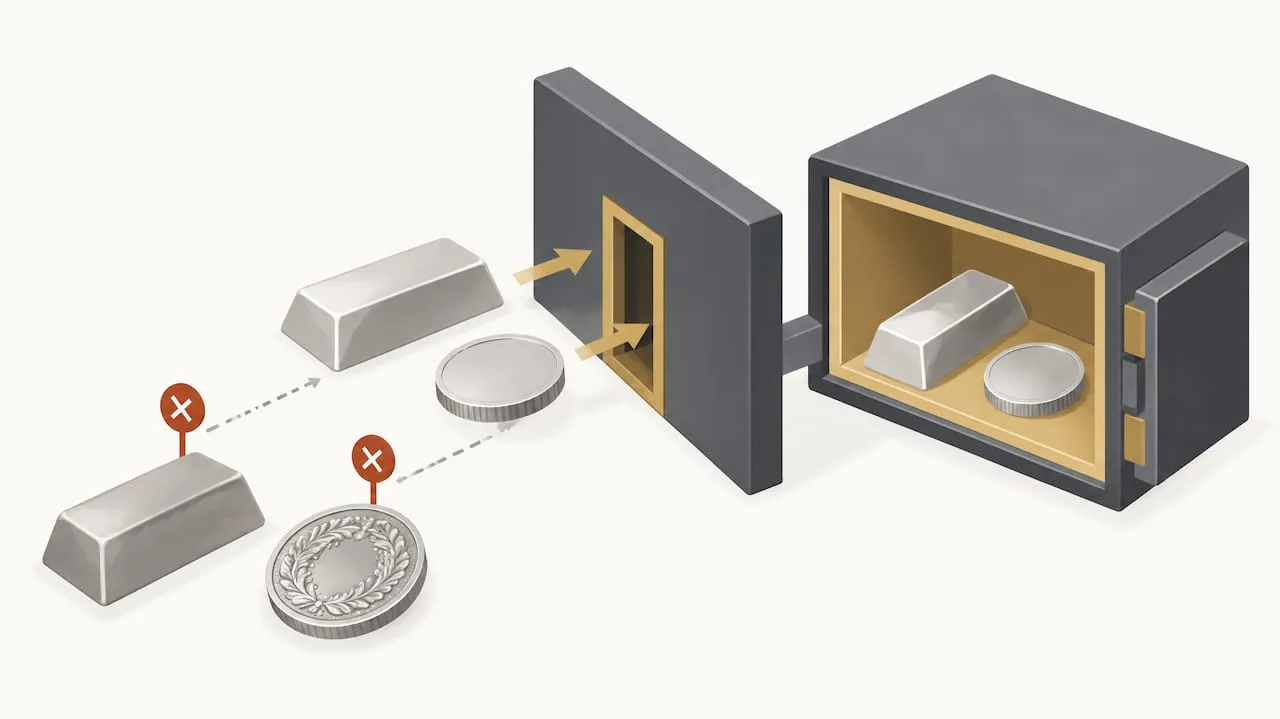
Only platinum that meets IRS fineness and custody requirements avoids being treated as a taxable distribution, which is why confirming eligibility before purchase matters more than chasing a lower price. You can review our breakdown of the 99.95% rule for platinum IRAs for details on which products typically qualify.
Custody has to run through an IRS-approved depository, not a personal vault or safe deposit box. Before funding an account, ask for:
- Written confirmation that the specific coin or bar meets the 99.95% fineness threshold
- The depository’s name, insurance coverage, and audit frequency
- A custodial agreement naming your IRA, not you personally, as the account holder
Common compliance traps include buying numismatic coins mistaken for bullion, accepting home delivery of IRA-owned metal, and failing to get documentation tying the metal to your account rather than the dealer’s general inventory. Our guide on coin eligibility for retirement accounts covers the bullion-versus-numismatic distinction in more depth.
Step-by-step: opening, funding, and buying platinum for your IRA
Setting up a platinum-capable IRA follows a predictable sequence, though timing varies by custodian and whether funds come from a rollover or new contributions.
- Choose a self-directed IRA custodian that explicitly supports physical platinum and has an established depository relationship.
- Fund the account, either through a rollover from an existing 401(k) or IRA, or with new contributions. For 2026, the IRA contribution limit is $7,500, with an additional $1,100 catch-up contribution allowed for investors aged 50 and older.
- Select IRS-eligible platinum products with your custodian or dealer, confirming fineness documentation before the order is placed.
- Arrange depository delivery, where the metal ships directly to the approved depository rather than to you.
- Verify documentation, including the custodial statement reflecting your specific holdings and depository confirmation of receipt.
Rollovers typically take one to three weeks depending on the releasing institution, while depository delivery after purchase often adds several more business days. For guidance on opening an account from scratch, see our overview on setting up a self-directed IRA.
Pro Tip: Get your custodian’s fee schedule and the depository’s storage and insurance terms in writing before you send any funds.
Fees, markups, and regulator warnings worth knowing before you buy
Platinum IRAs carry several layers of cost beyond the metal’s spot price. Typical charges include the dealer’s premium over spot, custodial and administrative fees, depository storage and insurance, and shipping or private delivery charges when metals move outside the IRA.
The CFTC has documented complaints where commissions and fees consumed a large portion of rollover funds, a reminder that markups compound quickly when multiple parties take a cut. Numismatic or “collectible” coins often carry premiums far above melt value and can be harder to resell at a fair price later, reducing liquidity exactly when you might need it.
The CFTC’s advisory on CARES Act-related schemes warned that promoters used pandemic-era distribution rules to push savers into risky metals purchases, often without disclosing full fee structures. Dealers are typically commission-based salespeople, not fiduciaries, so the burden of verification sits with you.
Before buying, check for these warning signs:
- Pressure to act immediately or lock in a price “today only”
- Reluctance to put fees or storage terms in writing
- Recommendations to take personal possession of IRA-owned metal
- Heavy promotion of numismatic or “rare” coins over standard bullion
Our math-based checklist for spotting pricing red flags walks through how to compare total cost across offers.
Where platinum fits in a retirement portfolio
Platinum behaves differently from gold because industrial demand, particularly from the automotive sector, plays a larger role in its price. CME Group commentary notes that platinum’s industrial demand and supply dynamics can support its case as a diversifier while also contributing to price swings.
Key considerations before adding platinum:
- Platinum tends to trade with lower liquidity than gold, which can matter at resale time
- Prices are more sensitive to industrial and automotive demand cycles than gold’s
- Portfolio guidance generally favors a small, single-digit percentage allocation to precious metals rather than a core holding
- Rebalancing between metals or back into other assets should happen inside the IRA, since Morningstar notes that shifts made within an IRA avoid triggering immediate tax consequences
Platinum’s role is best understood as a satellite position alongside gold, not a replacement for it. Our piece on platinum’s role in wealth protection covers allocation reasoning in more detail.
Custody, private delivery, and how to verify your holdings
IRA-owned platinum must stay in an IRS-approved depository because the account structure requires third-party custody to preserve its tax-advantaged status. The depository should provide periodic statements confirming your specific holdings, not just a pooled balance.
Private delivery is a separate service entirely. It applies when you purchase platinum outside an IRA and want it shipped insured to your own address, never as a substitute for IRA depository custody. Our explanation of when private delivery applies outlines the distinction clearly.
To verify your holdings are properly recorded, ask for:
- Purchase receipts showing fineness, weight, and serial or batch identifiers
- Depository statements matching your custodial account records
- Reconciliation of melt value (weight multiplied by spot price) against what you’re billed for storage
- A custodian checklist before applying that covers account minimums, transfer timelines, and fee transparency
Pro Tip: Request your first depository statement within 30 days of purchase and compare it line by line against your receipt.
Why a rules-first approach protects your retirement savings
Platinum IRAs reward patience and documentation over speed. The investors who run into trouble are usually the ones who skipped a written fee schedule or trusted a verbal promise about custody. A rules-first approach, meaning you confirm eligibility, fees, and depository terms before moving money, closes off most of the problems regulators warn about.
Our in-house IRA department exists to walk through exactly these checks with you, and our insured private delivery and educational resources are built around the same documentation-first standard. If you’re unsure whether a specific platinum product qualifies, verify eligibility and fees in writing first, and request a consultation if questions remain.
— Blake
How we help you set up a platinum-capable IRA
Opening a self-directed IRA that can hold IRS-eligible platinum takes coordination between a custodian, a depository, and a dealer who understands fineness requirements. Our in-house IRA department is designed to help handle this coordination directly, to simplify the paperwork process between parties.

Services for platinum-focused retirement planning can include self-directed IRA setup and rollover support, guidance on IRS-eligible platinum products, and insured private delivery for purchases made outside an IRA structure.
Before transferring any funds, confirm fees, product eligibility, and depository arrangements in writing. To talk through your options, request a Free Precious Metals Consultation or call (888) 859-0978.
This article is general information, not a substitute for advice from a qualified financial advisor. Consult a qualified financial professional about your own circumstances before acting on anything here.
FAQ
Which is best for investment, gold or platinum?
Neither metal is universally better: gold typically offers more liquidity and price stability, while platinum’s price moves more with industrial and automotive demand. CME Group notes platinum can offer diversification benefits alongside gold rather than as a replacement for it.
Is a Roth IRA exclusive to the United States?
Roth IRAs are a U.S. retirement account structure governed by IRS rules and are not available outside the United States. Other countries have their own tax-advantaged retirement accounts with different names and rules.
Are gold and silver IRAs a good idea?
Whether any precious metals IRA fits your situation depends on your broader retirement plan, timeline, and risk tolerance, which we cannot assess without knowing your full financial picture. Portfolio guidance generally suggests keeping precious metals to a small percentage of a diversified retirement account rather than a dominant holding.
Who has the best performing IRA?
IRA performance depends entirely on the specific assets held inside the account, not the account type itself, so there is no single “best performing IRA” to point to. An IRA holding stocks, bonds, or metals will perform differently depending on market conditions and the investor’s chosen allocation.
What is the 2026 contribution limit for an IRA?
For 2026, the IRA contribution limit is $7,500, with an additional $1,100 catch-up contribution allowed for those 50 and older. This limit applies to new contributions and does not cap funds moved through a rollover.
Sources
- CFTC: Metals – 10 things to know about investing in precious metals
- What kind of IRA should you use? — Morningstar personal finance
- Why are silver and platinum outperforming as portfolio diversifiers to gold? — CMEGroup OpenMarkets