

Platinum is defined as a rare, tangible asset that serves a dual purpose no other precious metal can match: it functions as both an inflation hedge and an industrial commodity. That combination gives it a unique place in wealth preservation strategies. Investors who focus only on gold and silver miss the added layer of protection that platinum provides through its scarcity, its low correlation with stocks and bonds, and its growing industrial demand from green technologies. The role of platinum in wealth protection has grown sharper in 2026 as ETF inflows rise and supply constraints tighten, making it a serious consideration for any diversified portfolio.
How platinum’s scarcity drives its value as a wealth shield
Platinum’s protective power starts with its supply. Platinum is 30 times rarer than gold, mined almost entirely in South Africa, Russia, and Zimbabwe. That geographic concentration creates structural supply bottlenecks that no policy decision can quickly fix.
When mines in South Africa face labor disruptions or energy shortages, global platinum supply tightens fast. That tightness translates directly into price support, which is exactly what investors protecting wealth want from a hard asset.

The scarcity premium is real and measurable. Unlike gold, which has centuries of above-ground stockpiles, platinum’s above-ground reserves are thin. Annual mining output is modest, and industrial users compete with investors for the same limited supply. That competition keeps a floor under prices even during periods of weak investor sentiment.
Pro Tip: Watch South African mining output reports quarterly. Supply disruptions there move platinum prices faster than almost any other single factor.
The supply picture in 2026 points toward continued tightness. Industrial demand from automotive catalytic converters remains steady, and the hydrogen economy is adding a new layer of consumption. Physical precious metals like platinum also act as hard asset portfolio hardening, providing a tangible, offline wealth protection layer that digital assets simply cannot replicate.
| Supply factor | Impact on platinum value |
|---|---|
| Geographic concentration | Single-region disruptions create immediate price support |
| Thin above-ground reserves | No large stockpile to dampen price spikes |
| Dual industrial and investment demand | Competing buyers keep a price floor in place |
| Green technology growth | Hydrogen fuel cells add long-term demand pressure |
Why platinum works as an inflation hedge and portfolio diversifier
Platinum’s low correlation with stocks and bonds is its most underappreciated quality. When equity markets fall and bond yields compress, platinum does not follow the same script as financial assets. That independence is what makes it genuinely useful for reducing portfolio risk rather than just adding another correlated position.
Gold serves as the core defensive metal for capital preservation, while platinum provides an industrial exposure layer that bets on economic growth and green technologies. That distinction matters. Gold protects in every environment. Platinum protects and grows when the economy expands and industrial demand rises.
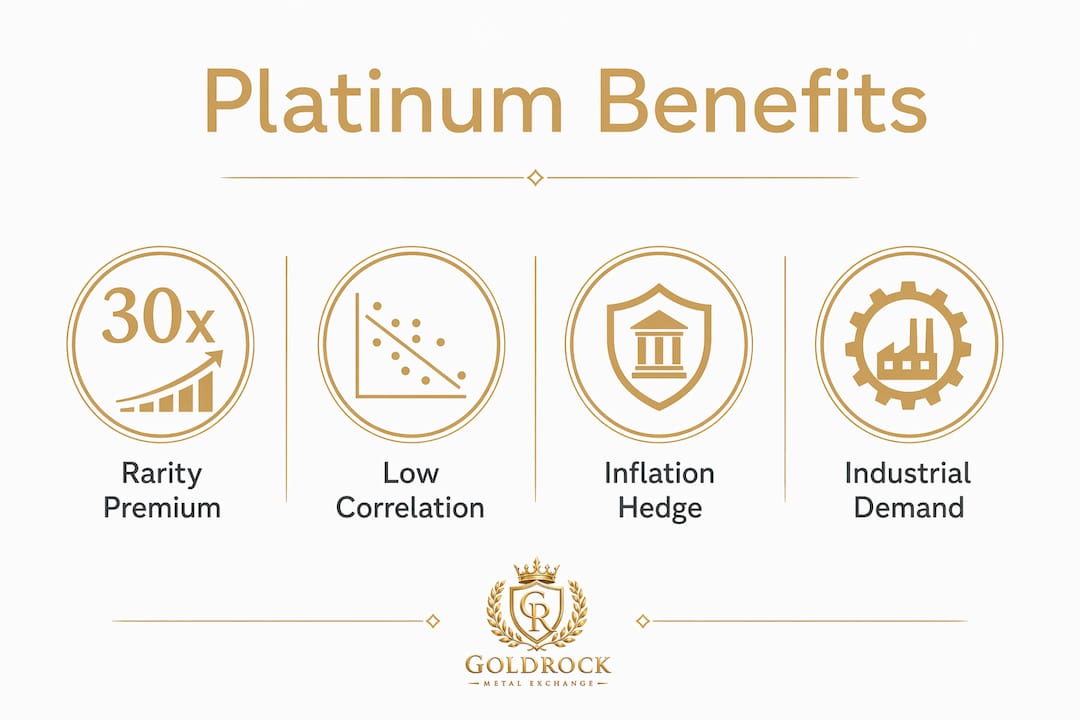
Platinum’s inflation protection works through two channels. First, its scarcity means the supply cannot be inflated away the way paper currency can. Second, rising industrial demand during inflationary growth phases pushes prices higher, giving investors real purchasing power protection.
The investment demand numbers support this case:
- Platinum ETF holdings increased by 234,000 ounces in 2025, with 2026 bar and coin investment forecast to grow 35% to reach 725,000 ounces. That level of institutional and retail interest signals a genuine shift in how investors view the metal.
- Platinum has traded at a discount to gold since 2008, a historic inversion from its traditional premium. Many analysts read this as a value opportunity, not a structural decline.
- Platinum’s dual identity as a precious and industrial metal makes it a hybrid asset: a stronger inflation hedge during growth phases, though it lacks gold’s pure safe-haven status in pure crisis conditions.
Silver also plays an industrial role, but its market is far larger and more liquid than platinum’s. Platinum sits in a narrower, more specialized position that rewards investors who understand its cycles. For a full comparison of how silver handles inflation, the silver inflation hedging guide offers useful context.
What are the real risks of investing in platinum?
Platinum’s risks are specific and worth taking seriously before committing capital. The metal’s price is more volatile than gold’s because industrial demand, not just investor sentiment, drives it. When automotive production slows or EV adoption accelerates faster than expected, platinum demand from catalytic converters falls, and prices feel it.
The key risks investors face include:
- Liquidity risk. The smaller physical platinum market can make it hard to sell quickly at fair prices during periods of market stress. Gold’s market is far deeper and more liquid.
- Industrial demand cycles. Automotive catalysts account for a large share of platinum consumption. A sharp shift toward battery electric vehicles reduces that demand, though hydrogen fuel cells may offset it over time.
- Substitution risk. Automakers have historically substituted palladium for platinum in gasoline engines and vice versa depending on price. That substitution dynamic can shift demand unexpectedly.
- Timing sensitivity. Technical analysts watch the $1,685–$1,700 per ounce range as a key breakout point for a bullish medium-term outlook in 2026. Buying without regard to price levels increases downside exposure.
- Purity requirements. Platinum must meet 95% purity to qualify for self-directed IRAs. Not all coins or bars meet this standard, so investors need to verify eligibility before purchasing for retirement accounts.
Pro Tip: Never allocate more than a fraction of your precious metals position to platinum alone. Its liquidity profile means you want gold as the larger, more liquid anchor in any hard asset allocation.
The hydrogen fuel cell opportunity is real but long-dated. Government green technology commitments may shift the demand picture over decades, not quarters. Investors who buy platinum today for hydrogen upside need patience measured in years, not months.
How to build platinum into a diversified wealth protection portfolio
Practical allocation starts with the right range. Financial advisors recommend limiting precious metals to 5%–15% of a portfolio, with platinum representing a smaller portion of that allocation to balance risk and reward. A reasonable starting point is to hold the majority of your precious metals position in gold, with platinum as a secondary position.
The steps below give a clear path for investors building a platinum position:
- Set your total precious metals allocation first. Decide what percentage of your overall portfolio belongs in hard assets. Most wealth preservation strategies land in the 10%–15% range for investors with moderate risk tolerance.
- Anchor with gold. Gold is the core defensive position. It is more liquid, more universally recognized, and carries a longer track record as a safe haven. Build this position before adding platinum.
- Allocate a portion to platinum. Within your precious metals sleeve, platinum works best as a secondary position. It adds industrial exposure and diversification without replacing gold’s defensive function.
- Choose your investment vehicle. Physical bars and coins give you direct ownership. ETFs provide liquidity and ease of trading. A self-directed precious metals IRA lets you hold physical platinum inside a tax-advantaged retirement account, which is a significant benefit for long-term wealth protection.
- Scale entries around key price levels. Financial advisors recommend scaling into platinum near $1,600–$1,700 per ounce in 2026 rather than buying all at once. Spreading purchases across multiple price points reduces timing risk.
- Rebalance annually. Precious metals prices move. A position that starts at 3% of your portfolio can drift to 6% after a strong run. Annual rebalancing keeps your allocation intentional.
GoldRock Metal Exchange offers physical platinum bars and coins alongside IRA services designed for investors who want to hold platinum inside a retirement account. Their in-house IRA department handles the transfer process directly, which removes the friction that often stops investors from acting. For investors building their first precious metals portfolio, starting with a clear allocation plan before selecting products is the most important step.
Key Takeaways
Platinum protects wealth most effectively when held as a secondary position within a broader precious metals allocation anchored by gold, with entry points timed to technical price levels and allocation capped within the 5%–15% precious metals range.
| Point | Details |
|---|---|
| Scarcity drives value | Platinum is 30 times rarer than gold, with supply concentrated in just a few countries. |
| Hybrid inflation hedge | Platinum hedges inflation through scarcity and industrial demand, strongest during growth phases. |
| Liquidity risk is real | The smaller platinum market can slow sales during stress; gold remains the more liquid anchor. |
| IRA eligibility requires 95% purity | Only platinum meeting the 95% purity standard qualifies for self-directed retirement accounts. |
| Scale entries near key levels | Buying near $1,600–$1,700 per ounce in 2026 reduces timing risk versus lump-sum purchases. |
Why I think most investors misread platinum’s role
Platinum gets treated as a gold substitute by investors who haven’t looked closely at what it actually does. That framing misses the point entirely. Gold and platinum are not interchangeable. They serve different functions, and confusing them leads to poor allocation decisions.
What I’ve found after watching precious metals markets closely is that platinum rewards investors who understand its industrial identity. It is not a pure safe haven. It is a hybrid asset that performs best when economic growth and green technology investment are both moving in the right direction. Buying it as a crisis hedge and then being surprised when it underperforms gold during a recession is a category error.
The hydrogen economy angle is the most interesting long-term thesis I’ve seen in precious metals in years. Platinum’s role in hydrogen fuel cells is not speculative fiction. It is grounded in chemistry that has no current substitute. The timeline is long, but investors with a 10-year horizon who build a modest platinum position today are buying optionality on a structural demand shift.
My honest warning: do not overweight platinum. Its liquidity profile is genuinely narrower than gold’s. If you ever need to liquidate hard assets quickly, a large platinum position can work against you. Keep it as a secondary position, stay disciplined on allocation, and treat it as the growth and diversification layer within your precious metals strategy, not the foundation.
— Blake
Platinum investment options at GoldRock Metal Exchange
GoldRock Metal Exchange gives investors direct access to physical platinum bars and coins, along with the IRA services needed to hold platinum inside a tax-advantaged retirement account.
GoldRock’s in-house IRA department handles the account transfer process from start to finish, removing the paperwork burden that stops most investors from acting. You can track live platinum prices before you buy, browse the full product catalog of bars and coins, and explore self-directed IRA options built specifically for precious metals. GoldRock also offers insured private delivery for physical assets, so your platinum arrives securely regardless of where you are. For investors who want guidance before committing, the GoldRock education center covers allocation strategies, product selection, and market fundamentals in plain language.
FAQ
What is the role of platinum in wealth protection?
Platinum protects wealth by acting as a scarce, tangible asset with low correlation to stocks and bonds. Its dual role as a precious metal and industrial commodity adds both inflation protection and growth exposure to a portfolio.
How does platinum compare to gold as an investment?
Gold is the core defensive metal for capital preservation, while platinum adds industrial exposure and diversification. Platinum has traded at a discount to gold since 2008, which some analysts view as a value opportunity.
What percentage of my portfolio should be in platinum?
Financial advisors recommend keeping total precious metals at 5%–15% of a portfolio, with platinum as a smaller portion of that allocation. Gold should anchor the precious metals position, with platinum as a secondary holding.
Can I hold platinum in a self-directed IRA?
Yes. Platinum qualifies for self-directed IRAs when it meets the 95% purity standard. GoldRock Metal Exchange’s in-house IRA department can guide you through the transfer and product selection process.
What are the biggest risks of investing in platinum?
The main risks are liquidity, price volatility tied to industrial demand cycles, and substitution risk from palladium or EV adoption shifts. Scaling purchases near key technical price levels, such as $1,600–$1,700 per ounce in 2026, helps manage timing risk.