

Gold holds intrinsic value because its physical and chemical properties sustain worth independent of any government promise, central bank policy, or institutional guarantee. No other element combines gold’s corrosion resistance, scarcity, workability, and global acceptance in a single package. That combination is why gold has functioned as money and a wealth-preservation tool across every major civilization for thousands of years. Understanding why gold holds intrinsic value is the first step toward using it as a deliberate part of your financial strategy, whether you are protecting retirement savings or hedging against inflation.
What physical and chemical properties give gold its intrinsic value?
Gold’s intrinsic value starts at the atomic level. Gold does not corrode, tarnish, or decay, which means a gold coin buried for 2,000 years emerges in the same condition it was minted. No other widely available metal matches that combination of chemical stability and physical durability.
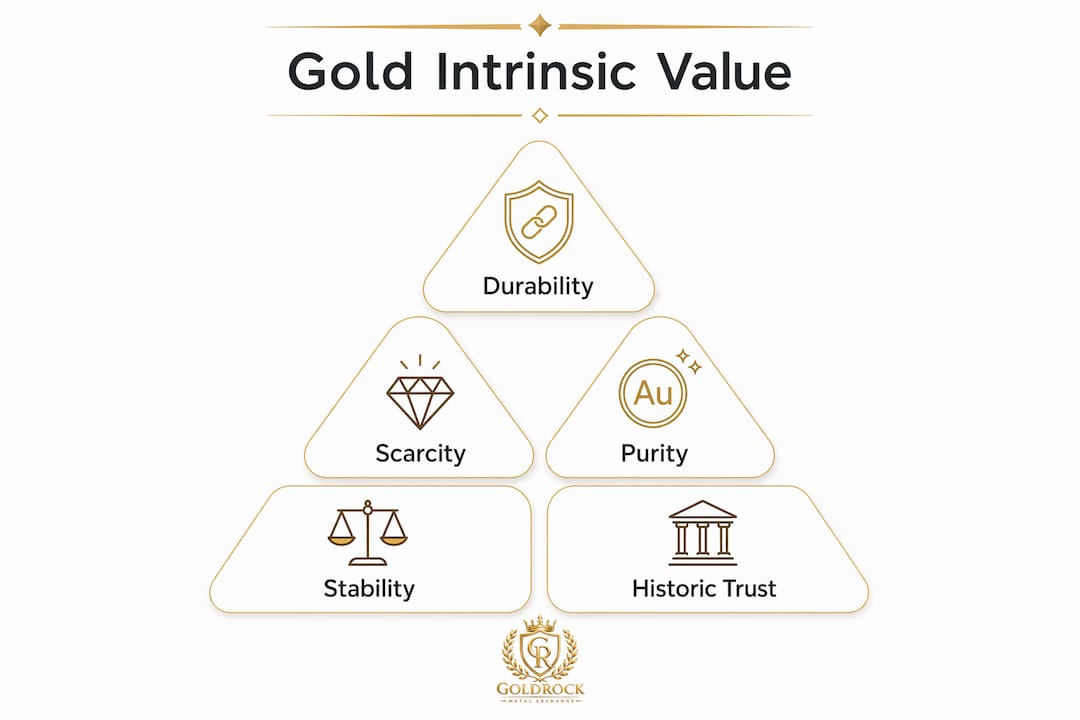
Scarcity reinforces those physical advantages. Gold is rare enough to hold value but common enough to be mined, shaped, and traded. It melts at a manageable temperature, can be divided into coins or bars without losing purity, and is dense enough to be portable in meaningful quantities. Silver shares some of these traits, but silver tarnishes. Platinum is rarer, but it is far harder to work with and less liquid as a traded asset.

Purity testing is also straightforward. Investors and dealers can verify gold’s authenticity through acid tests, X-ray fluorescence, or ultrasonic density checks. That ease of verification reduces fraud risk and supports trust in physical gold transactions. Gold’s workability and reusability make it practical as money in ways that most other elements simply cannot replicate.
Pro Tip: When evaluating any monetary metal, ask whether it can survive 500 years without degrading. Gold passes that test. Most alternatives do not.
How does gold’s valuation differ from standard financial assets?
Standard financial valuation relies on discounted cash flow, or DCF. You project future earnings, dividends, or interest payments, then discount them back to a present value. Gold generates no cash flows at all. Gold’s intrinsic value cannot be assessed via DCF, so investors use entirely different frameworks to assess it.
The primary frameworks are scarcity models and monetary premium models. Scarcity models compare gold’s above-ground supply growth rate to other assets. Monetary premium models measure how much extra value investors assign to gold because it functions as an alternative form of money. Both approaches factor in inflation expectations and the opportunity cost of holding a non-yielding asset.
This distinction matters practically. When real interest rates rise, the opportunity cost of holding gold increases, which tends to push its price down even though gold’s physical properties have not changed. The metal’s underlying characteristics remain constant. Its market price does not.
- Gold’s value rests on scarcity and monetary function, not earnings.
- Relative valuation compares gold to inflation expectations and real rates.
- Opportunity cost rises when interest-bearing assets yield more, pressuring gold’s price.
- Price fluctuations do not alter gold’s physical or monetary properties.
Pro Tip: Never confuse intrinsic value with price stability. Gold’s core properties are stable. Its price is not. Treating them as the same thing leads to poor timing decisions.
Why is gold a hedge against inflation and institutional risk?
Gold’s independence from monetary policy is its most powerful macroeconomic feature. Gold’s supply cannot be expanded at will the way a central bank can print fiat currency. That constraint is structural, not political. No government decision can change it.
History confirms this advantage. During periods of currency debasement, hyperinflation, and sovereign debt crises, gold has consistently preserved purchasing power when paper assets have not. Ray Dalio has described gold as the safest form of money precisely because it carries no counterparty risk and cannot be defaulted on. A bond can be restructured. A currency can be inflated away. Physical gold cannot be either.
Central banks have reached the same conclusion. Gold now accounts for 27% of global central bank reserves, surpassing US Treasuries at 22%. That shift reflects institutional recognition that gold protects against financial sanctions, currency devaluation, and loss of confidence in sovereign debt. When the world’s largest institutional investors increase gold allocations, that signals something beyond sentiment.
Gold also protects against risks that inflation metrics do not capture:
- Currency devaluation: Gold holds value when a national currency loses purchasing power.
- Sovereign default: Gold carries no issuer risk. A government cannot default on physical gold you own.
- Financial repression: When real yields are held artificially low, gold preserves capital that bonds cannot.
- Geopolitical sanctions: Gold held physically cannot be frozen by a foreign government the way bank deposits or securities can.
Demand for gold rises when uncertainty about debt levels and central bank independence increases. That pattern has repeated across every major financial crisis of the past century.
What are the common misconceptions about gold’s intrinsic value?
The biggest misconception is that intrinsic value guarantees price stability. It does not. Gold prices react to real interest rates, US dollar liquidity, and investor risk appetite, all of which shift constantly. Intrinsic value explains why gold is worth holding over the long term. It does not explain what gold will be worth next quarter.
A second misconception is that gold competes directly with stocks or bonds. Gold is a non-credit, no-duration asset with no counterparty risk. It does not behave like an equity or a fixed-income instrument. Its role in a portfolio is to provide diversification during stress events when credit and sovereign risks diverge sharply from normal conditions.
A third misconception is that gold’s value is purely cultural or speculative. The physical properties that make gold valuable as money are objective and measurable. Scarcity, durability, divisibility, and portability are not matters of opinion. They are the same criteria economists use to evaluate any monetary asset, and gold scores highest among naturally occurring elements on every one of them.
How can investors apply gold’s intrinsic value to their portfolios?
Physical ownership is the most direct way to capture gold’s intrinsic value. Coins and bars give you an asset with no counterparty risk and no dependency on a financial institution’s solvency. Storing physical gold safely is a critical part of that strategy, whether through a home safe, a bank vault, or an insured private depository.
Self-directed IRAs offer a tax-advantaged path to physical gold ownership. The IRS permits gold, silver, platinum, and palladium in self-directed IRAs provided the metals meet specific purity standards. GoldRock Metal Exchange operates a dedicated in-house IRA department that handles the transfer of existing retirement accounts into physical precious metals, removing the administrative friction that stops most investors from acting.
A practical approach to building gold exposure looks like this:
- Assess your inflation and crisis exposure. Identify what portion of your portfolio is vulnerable to currency debasement or sovereign credit risk.
- Choose your vehicle. Physical coins and bars provide maximum control. A precious metals IRA provides tax advantages for retirement savings.
- Determine allocation size. Gold works as a portfolio anchor, not a speculation. Most financial planners suggest a range of 5%–15% of total assets.
- Arrange secure storage. Insured delivery and private storage protect the physical asset from theft and loss.
- Review periodically. Gold’s role shifts with interest rate cycles and geopolitical conditions. Rebalance when your overall allocation drifts significantly.
Pro Tip: Gold is not a short-term trade. Its value proposition is long-term purchasing power preservation. Investors who buy gold expecting quick price gains often sell at exactly the wrong time.
Key Takeaways
Gold holds intrinsic value because its physical durability, chemical stability, and structural scarcity make it a reliable store of wealth independent of any government, institution, or monetary policy.
| Point | Details |
|---|---|
| Physical properties drive value | Gold does not corrode, tarnish, or decay, giving it unmatched long-term durability among monetary metals. |
| Valuation uses scarcity models | Gold has no cash flows, so investors assess it through scarcity, monetary premium, and inflation frameworks. |
| Central banks confirm the thesis | Gold accounts for 27% of global central bank reserves, surpassing US Treasuries at 22%. |
| Intrinsic value is not price stability | Gold’s market price reacts to real rates and dollar conditions even when its physical properties stay constant. |
| Physical ownership removes counterparty risk | Coins, bars, and precious metals IRAs give investors direct exposure with no issuer or credit risk. |
Gold’s staying power is not a theory. It’s a track record.
I have spent years watching investors treat gold as a relic or a panic trade. Both framings miss the point entirely. Gold is not something you buy when you are scared. It is something you hold because the risks it protects against are always present, even when markets feel calm.
The mistake I see most often is investors expecting gold to behave like a bond. They want steady income and predictable price appreciation. Gold delivers neither. What it delivers is something harder to quantify: the assurance that your wealth cannot be inflated, defaulted on, or sanctioned away. That is a different kind of return, and it requires a different kind of patience.
Central banks buying gold at a 50-year high pace is not a coincidence. It reflects a structural shift in how the world’s largest institutions think about reserve assets. Geopolitical fragmentation, rising sovereign debt levels, and questions about dollar dominance are all accelerating that trend. Individual investors who understand this are positioning ahead of the curve, not chasing it.
My honest view is that gold belongs in every serious long-term portfolio, not as a dominant position, but as a permanent allocation. The investors who regret owning gold are rare. The investors who regret not owning it during a crisis are not.
— Blake
How GoldRock Metal Exchange supports your gold investment strategy
GoldRock Metal Exchange gives investors a direct path to physical gold ownership backed by personalized guidance and insured delivery. Whether you are buying your first gold coin or rolling over a retirement account into a self-directed precious metals IRA, GoldRock’s in-house IRA specialists handle the process from start to finish.

Physical gold, silver, platinum, and palladium are available through GoldRock’s full product catalog, with real-time pricing so you always know what you are paying. Every order ships with insured private delivery, and the team provides ongoing consultation to help you align your precious metals holdings with your broader financial goals. If you want to understand your options before committing, the GoldRock education center is a free resource built specifically for investors at every experience level.
FAQ
What does intrinsic value mean for gold?
Gold’s intrinsic value refers to the worth created by its physical and chemical properties, including durability, scarcity, and corrosion resistance, independent of any government or institutional backing. Unlike stocks or bonds, gold’s value does not depend on a promise to pay.
Why can’t gold’s value be calculated using discounted cash flow?
Gold generates no earnings, dividends, or interest payments, so discounted cash flow analysis does not apply. Investors instead use scarcity models and monetary premium frameworks that compare gold to inflation expectations and opportunity costs.
Does gold always go up during inflation?
Gold tends to preserve purchasing power over long periods of inflation, but its short-term price is also driven by real interest rates, US dollar strength, and investor sentiment. High real rates can suppress gold’s price even when inflation is rising.
Why are central banks buying more gold?
Central banks have increased gold reserves to diversify away from US Treasuries and protect against financial sanctions, currency devaluation, and sovereign credit risk. Gold now accounts for 27% of global central bank reserves, surpassing US Treasuries at 22%.
How much gold should an investor hold?
Most financial planners suggest allocating 5%–15% of a total portfolio to gold, treating it as a long-term anchor against inflation and institutional risk rather than a short-term trade. The right amount depends on your overall exposure to currency and credit risk.