

A private metals delivery service is an insured, door-to-door transfer of physical bullion where a secure delivery provider takes custody of your metals from point of origin to your door, maintaining a documented chain-of-custody and providing proof of delivery at handoff. It is the industry term for what most dealers call “arranged insured delivery,” and it covers everything from a single gold coin shipped via declared-value carrier to a multi-bar transfer handled by an armored courier.
Who uses it and what to weigh before you decide:
- Retail investors taking physical possession after a direct purchase
- IRA rollover clients coordinating custody transfer between a custodian and a depository or home address
- Family offices moving holdings between vaults or estate locations
Primary benefits: immediate personal possession, insured transit with documented coverage, and a tracked chain-of-custody from pickup to signature.
Primary trade-offs: delivery costs add to your total acquisition price, home delivery introduces a storage and security responsibility you must plan for, and high-value shipments may require specialist insurance beyond standard carrier limits.
GoldRock Metal Exchange offers insured private delivery as part of its full-service dealer model, along with free consultations to help you decide which delivery or custody arrangement fits your situation.
Table of Contents
- What types of private metals delivery services exist in the U.S.?
- How does a private metals delivery actually work, step by step?
- Which carriers and U.S. rules apply to domestic precious metals shipments?
- What insurance options actually protect your shipment?
- How should you package and label a precious metals shipment?
- What do private metals deliveries typically cost, and how long do they take?
- When does private delivery make more sense than vault storage?
- How do you evaluate a private metals delivery service before you commit?
- Key Takeaways
- A practical perspective on private delivery and what investors often miss
- GoldRock Metal Exchange: insured delivery and personalized guidance
What types of private metals delivery services exist in the U.S.?
The U.S. market offers four distinct delivery models. Knowing which one a dealer is using tells you a lot about the liability exposure and the cost you are actually paying for.
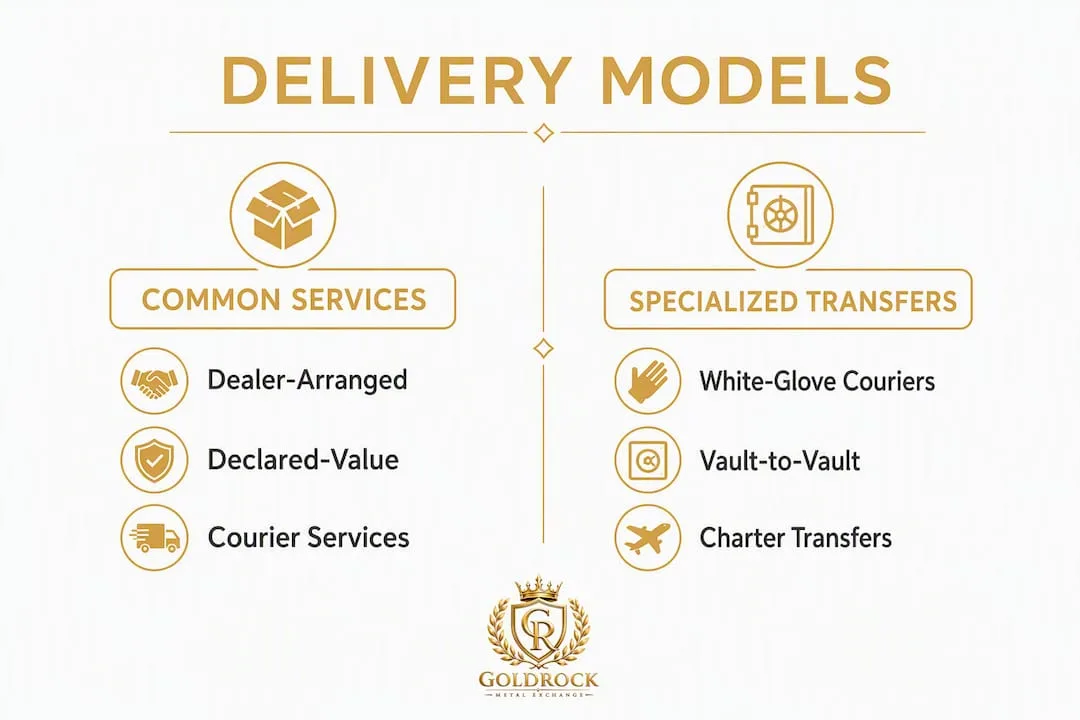
Dealer-arranged insured delivery
The most common option for retail investors. The dealer packages your metals, places transit insurance, and hands the shipment to a carrier or courier on your behalf. You receive a tracking number, and delivery requires your signature. Insured door-to-door delivery of this type typically includes tamper-evident packing, a packing list, and a certificate of authenticity inside the package. It works well for purchases up to mid-six figures in value.
Declared-value carrier services
USPS Registered Mail, UPS, and FedEx all offer declared-value options for high-value shipments. The shipper declares the value of the contents, pays an add-on fee, and the carrier’s liability extends to that declared amount if the shipment is lost or damaged. The catch: carrier declared-value is not insurance in the legal sense. It is a liability cap, and carriers can and do dispute claims on precious metals if packaging or documentation standards are not met.
White-glove and armored courier
For shipments above a certain value threshold, or for clients who want maximum discretion, armed courier services provide trained security personnel, counter-surveillance route planning, and direct hand-to-hand delivery. Discreet armed courier operations emphasize route security and personnel vetting in a way standard carriers cannot match. Expect significantly higher costs and longer scheduling lead times.
Vault-to-vault and charter transfers
Institutional-scale movements between depositories, or sovereign-level transfers, use closed logistics networks with GPS-tracked containers, climate-controlled crating, and Lloyd’s-compliant in-transit insurance. This model is rarely relevant to individual retail investors but is worth understanding if you hold metals in a segregated vault and need to move them to another facility.
| Delivery model | Typical use case | Speed | Discretion | Liability exposure |
|---|---|---|---|---|
| Dealer-arranged insured | Retail purchase, IRA delivery | 2–5 business days | Moderate (discreet packaging) | Covered by transit insurance |
| Declared-value carrier | Mid-value shipments, direct buyer | 1–5 business days | Moderate | Carrier liability cap only |
| White-glove/armored courier | High-value, urban, or estate transfers | Same-day to 48 hours | High | Specialist policy, typically Lloyd’s |
| Vault-to-vault/charter | Institutional, depository-to-depository | Scheduled/charter | Very high | Closed-loop, fully insured |
How does a private metals delivery actually work, step by step?
The process is more structured than a standard parcel shipment, and each step exists to protect both the buyer and the dealer in the event of a claim.
-
Order confirmation and identity verification. The dealer confirms your purchase, verifies your identity against the order record, and establishes the declared value of the shipment. For IRA-related deliveries, the custodian must authorize the release.
-
Packing and documentation. Metals are packed in tamper-evident inner packaging, then placed inside a plain outer box with no value-descriptive labeling. A packing list and certificate of authenticity are included inside the sealed package. The outer label carries only the necessary address and return information.
-
Insurance placement. The dealer or shipper places transit coverage before the package leaves the facility. This may be a declared-value add-on with the carrier, a dealer’s blanket transit policy, or a specialist third-party policy underwritten by Lloyd’s syndicates for higher-value shipments. The declared value on the shipping label must match the insured value on the policy.
-
Pickup and carrier handoff. The carrier or courier takes physical custody and issues a tracking number. From this point, the chain-of-custody is documented at every scan point. Sealed containers and GPS tracking are standard for white-glove services.
-
In-transit monitoring. Track-and-trace updates are provided throughout transit. For armored courier services, a dedicated handler monitors the shipment in real time.
-
Signature-required delivery. The package is released only to the named recipient upon presentation of valid ID and a signature. No signature, no release. This step is non-negotiable for insured precious metals shipments.
-
Proof of delivery and claims window. After delivery, the carrier or dealer issues a proof-of-delivery receipt. If anything is wrong, the claims window opens from the delivery date. Document any discrepancy immediately: photograph the outer packaging before opening, retain all packing materials, and notify the dealer within the timeframe specified in your insurance documentation.
Pro Tip: Before the package ships, ask your dealer to confirm the declared value on the shipping label matches the insured value on the transit policy. A mismatch between those two figures is one of the most common reasons claims are partially denied.

Which carriers and U.S. rules apply to domestic precious metals shipments?
Carrier options and their practical limits
USPS Registered Mail is the most secure domestic postal option. Every transfer point is documented, and the chain-of-custody is tighter than standard Priority Mail. However, USPS liability for Registered Mail is capped, and that cap is well below the value of most meaningful bullion shipments. Dealers typically use USPS Registered Mail for smaller purchases or as a cost-effective option when a separate insurance policy covers the full value.
UPS and FedEx declared-value services extend carrier liability up to declared amounts, but both carriers impose restrictions on precious metals shipments and reserve the right to limit or deny claims if packaging standards are not met. Neither UPS nor FedEx provides true all-risk insurance coverage; their declared-value programs are liability extensions, not insurance policies.
Dealer-arranged private couriers bypass carrier restrictions entirely. The dealer contracts directly with a logistics specialist, and the transit policy is placed separately from the carrier relationship. Closed-loop logistics providers offer end-to-end custody with GPS tracking and documented handover protocols to Grade A vaults, which is the standard for institutional-scale movements.
U.S. regulatory touchpoints
For domestic shipments, there is no federal permit required to ship or receive physical precious metals as a private individual. That said, a few regulatory considerations apply:
- OFAC sanctions screening: Dealers are required to screen transactions against the Office of Foreign Assets Control (OFAC) sanctions list. If a shipment involves a sanctioned party or destination, it cannot proceed regardless of the delivery model.
- IRA custody rules: If your metals are held in a self-directed IRA, the IRS requires that IRA assets be held by a qualified custodian. Taking personal delivery of IRA-held metals without a proper distribution event is treated as a taxable distribution and may trigger penalties. GoldRock Metal Exchange’s in-house IRA department coordinates these logistics to keep the transfer compliant.
- International shipments: Cross-border moves require customs declarations, export documentation, and compliance with the destination country’s import rules. Sanctions screening applies at both ends.
A useful illustration of concentrated-value risk: a standard 400-troy-ounce LBMA gold bar, at current spot prices, represents a shipment value that exceeds the declared-value caps of every major domestic carrier. That single data point explains why specialist transit insurance is not optional for larger holdings.
What insurance options actually protect your shipment?
Transit coverage for precious metals comes in three forms, and understanding the difference matters before you sign off on a shipment.
Carrier liability
The baseline. If a carrier loses or damages your package, their liability is limited to the declared value on the label, subject to their terms and conditions. For precious metals, carriers often apply additional restrictions. This is the weakest form of protection and is generally insufficient for anything beyond a small purchase.
Declared-value add-on coverage
A step up from basic carrier liability. You pay an additional fee based on the declared value, and the carrier’s liability extends to that amount. Still not a true insurance policy. Claims can be disputed, and the carrier controls the claims process.
Specialist third-party transit insurance
The strongest option. Policies underwritten by Lloyd’s syndicates or equivalent specialty markets provide all-risk in-transit coverage, meaning loss or damage from virtually any cause is covered unless specifically excluded. Some logistics specialists offer Lloyd’s-underwritten liability with fully trackable documentation that creates an auditable chain-of-custody. This is the standard for high-value bullion shipments and is what reputable dealers use for significant orders.
Claims-ready checklist:
- Photograph the outer packaging before opening, including any damage or tampering
- Retain all inner packing materials, tamper-evident seals, and the packing list
- Note the time and condition of delivery on the proof-of-delivery receipt
- Contact the dealer and the insurer within the claims window stated in your policy (typically 24–72 hours for visible damage, longer for concealed loss)
- Keep the certificate of authenticity and any assay documentation separate from the shipment until delivery is confirmed
Pro Tip: Ask for the insurer’s name and policy number before your shipment departs. A reputable dealer will provide this without hesitation. If the answer is vague, that is a signal worth taking seriously.
How should you package and label a precious metals shipment?
Good packaging does two things: it protects the metals physically and it protects your insurance claim legally. A poorly packaged shipment gives a carrier grounds to dispute a claim even when the loss is real.
Packaging essentials:
- Use a plain, unmarked outer box with no indication of contents or value
- Double-box the metals: inner packaging holds the metals securely; the outer box provides structural protection
- Fill void space with inert packing material (foam, bubble wrap, or packing peanuts) to prevent movement
- Apply tamper-evident tape to all seams of the inner package; photograph the sealed package before it goes into the outer box
- Include the packing list and certificate of authenticity inside the sealed inner package, not loose in the outer box
Labeling guidance:
- Use only the recipient’s name, address, and a return address
- No product descriptions, no value indicators, no “fragile” or “high value” markings that attract attention
- If the dealer is shipping on your behalf, confirm the label matches the name on the insurance policy
On-site security at delivery:
- Schedule delivery for a time when you or a trusted adult will be present
- Do not accept a package that shows visible damage or tampering without documenting it first
- For high-value deliveries, arrange for a witness at handoff
- Store the proof-of-delivery receipt and all packaging documentation for at least 90 days after delivery
Packaging and chain-of-custody documentation are the two factors most likely to determine whether a claim is paid quickly or disputed at length.
What do private metals deliveries typically cost, and how long do they take?
Costs and timelines vary by service level, declared value, and geography. Here is a realistic picture for domestic U.S. deliveries.
Typical domestic timelines:
- Declared-value carrier (UPS/FedEx): standard delivery takes a few business days, with overnight available at premium cost
- USPS Registered Mail: 3–7 business days, no overnight option
- White-glove/armored courier: same-day to 48 hours, depending on scheduling and location
- Vault-to-vault charter: scheduled in advance, timeline varies by logistics provider
Cost drivers to budget for:
- Declared value: insurance premiums scale with the value of the shipment; higher value means higher premium
- Weight and dimensions: standard carrier rates apply on top of insurance costs
- Service level: armored courier and white-glove services carry a significant premium over standard carrier options
- Insurance underwriting band: specialist Lloyd’s policies are priced differently than carrier declared-value add-ons; expect higher premiums for all-risk coverage on large shipments
Tracking and confirmation:
Most dealer-arranged deliveries provide a tracking number at the time of shipment. Signature-required delivery generates a proof-of-delivery record in the carrier’s system. For white-glove services, a dedicated handler may provide direct updates throughout transit.
Factors that can extend timelines:
- Federal holidays and carrier peak periods
- Customs clearance on international legs (add several business days minimum)
- OFAC sanctions screening delays on flagged transactions
- Weather events affecting specific routes
Budget for delivery costs as part of your total acquisition cost, not as an afterthought. For smaller purchases, delivery may represent a meaningful percentage of the transaction. For larger holdings, the cost of specialist insurance is a necessary expense, not an optional upgrade.

When does private delivery make more sense than vault storage?
The honest answer is that it depends on what you are trying to accomplish, and most investors benefit from thinking through this before they place an order rather than after.
Home delivery gives you immediate possession and personal control over your metals. You can access them without third-party involvement, which matters to investors who hold physical metals specifically because they want assets outside the financial system. The trade-off is that home storage introduces risks: theft, fire, flood, and the logistical complexity of insuring a significant holding at your residence.
Professional vaulting reduces home-theft risk and simplifies estate handling. A depository holds your metals in a segregated or allocated account, maintains its own insurance, and provides documented proof of holdings. For larger or long-term positions, industry analysis consistently points to professional vaulting as the more practical choice, especially considering The Role Of Israeli Wealth Management Law For International Investors which highlights legal perspectives important in multi-jurisdictional estate planning.
Decision rules by investor scenario:
| Scenario | Recommended approach |
|---|---|
| Small purchase, immediate possession desired | Private delivery to home |
| IRA rollover, metals must stay in qualified custody | Vault/depository (IRS requirement) |
| Large holding, long-term storage | Professional vault |
| Liquidity event, need physical access quickly | Private delivery |
| Estate planning, multi-generational transfer | Professional vault with documented title |
Pro Tip: If you are holding metals as part of a retirement account, personal delivery is not an option without triggering a distribution event. Coordinate with your IRA custodian and a qualified tax advisor before requesting any delivery from a custodied account.
For investors weighing how physical metals fit into a broader retirement portfolio diversification strategy, the custody choice is as important as the metal itself.
How do you evaluate a private metals delivery service before you commit?
The difference between a reliable delivery service and a problematic one usually shows up in the documentation, not the marketing. Here is what to verify.
Trust signals to confirm before shipping:
- Written insurance certificate with the insurer’s name, policy number, and coverage amount
- Documented chain-of-custody procedure (who handles the package at each stage)
- Signature-required delivery as the default, not an option
- Track-and-trace with real-time updates accessible to the recipient
- Tamper-evident packaging confirmed in writing
- Proof-of-delivery receipt provided after every shipment
- Written claims process with stated time windows
Questions to ask your dealer or delivery provider:
- Who underwrites your transit insurance, and what is the policy number?
- What is the maximum declared value your current policy covers per shipment?
- How is the chain-of-custody documented between your facility and the carrier?
- What is the claims filing window, and what documentation do you require from me?
- Is signature-required delivery standard, or do I need to request it?
- Can you provide a sample proof-of-delivery receipt before I place my order?
Red flags that should give you pause:
- No written insurance documentation available before shipment
- Vague answers about the claims process (“we handle it internally”)
- No tracking number provided at the time of shipment
- Courier is unnamed or unverifiable
- No signature requirement at delivery
How to verify credentials quickly:
Request the insurance certificate and the carrier’s name before the shipment departs. Cross-reference the carrier against their own website or a public directory. For specialist couriers, ask for their licensing information. A legitimate provider will have no hesitation providing this.
Ready to arrange insured delivery? Talk to GoldRock first
If you are working through the details of a purchase or IRA rollover and want to understand your delivery options before committing, GoldRock Metal Exchange offers a free consultation.
- Request a Free Precious Metals Consultation: call (888) 859-0978
- Ask about insured private delivery options for your specific purchase or IRA transfer
- GoldRock’s in-house IRA department can coordinate custody logistics for self-directed IRA clients
Key Takeaways
A private metals delivery service is only as reliable as the insurance, documentation, and chain-of-custody procedures behind it — verify all three before your shipment departs.
| Point | Details |
|---|---|
| Definition | Insured, door-to-door bullion transfer with documented chain-of-custody and signature-required proof of delivery. |
| Insurance matters most | Carrier declared-value is a liability cap, not insurance; specialist Lloyd’s-underwritten policies provide all-risk coverage for high-value shipments. |
| IRA delivery rules | IRS rules require IRA-held metals to stay with a qualified custodian; personal delivery without a proper distribution triggers tax consequences. |
| Vault vs. delivery | Private delivery suits immediate possession and smaller purchases; professional vaulting is preferred for large, long-term, or estate-planning holdings. |
| GoldRock Metal Exchange | Offers insured private delivery and a free consultation to help investors choose the right custody and delivery arrangement for their situation. |
A practical perspective on private delivery and what investors often miss
Most of the questions investors ask about private metals delivery focus on cost and speed. Those matter, but they are not where the real risk lives. The risk lives in the gap between what an investor assumes is covered and what the insurance policy actually says.
Carrier declared-value programs are widely misunderstood. Many investors believe that declaring a value on a shipping label means that value is insured. It is not. It means the carrier’s liability extends to that amount, subject to their terms, their packaging requirements, and their claims adjudication process. Carriers have every incentive to dispute claims on high-value contents, and they do. The investors who come out of a lost or damaged shipment whole are the ones who had a separate, written insurance policy with a named underwriter before the package left the building.
The second thing investors underestimate is the IRA custody dimension. If your metals are held in a self-directed IRA, the delivery question is not just logistical. It is a compliance question. Taking physical possession of IRA assets without a proper distribution event is a taxable transaction under IRS rules, and the penalties can be significant. GoldRock Metal Exchange’s in-house IRA department exists precisely to navigate this, coordinating with custodians so that delivery and custody transfers happen correctly the first time.
Private delivery is a genuinely useful tool for the right situation. Immediate possession, personal control, and a documented chain-of-custody from a reputable dealer are real advantages. The investors who use it well are the ones who treat the insurance and documentation requirements with the same seriousness they give to the purchase itself.
GoldRock Metal Exchange: insured delivery and personalized guidance

GoldRock Metal Exchange gives investors something most dealers do not: a single point of contact who handles both the purchase and the delivery logistics, with insured private delivery built into the process rather than bolted on as an afterthought. Whether you are taking physical possession of a direct purchase or coordinating a self-directed IRA rollover into gold, silver, platinum, or palladium, GoldRock’s team manages the chain-of-custody documentation, insurance placement, and delivery confirmation on your behalf.
The in-house IRA department is a genuine differentiator. Most dealers hand IRA clients off to a third party. GoldRock keeps the process in-house, which means fewer handoffs, fewer documentation gaps, and a cleaner audit trail from purchase to delivery.
Ready to arrange insured delivery or start an IRA rollover? Browse the full product catalog or call (888) 859-0978 to request a Free Precious Metals Consultation. A specialist will walk you through your delivery options, insurance coverage, and custody arrangements at no charge.
This article is for educational purposes only and does not constitute investment, tax, or legal advice. Precious metals involve risk, including the possible loss of principal. Consult a qualified financial, tax, or legal professional before making investment decisions. For IRA-related questions, verify current IRS rules with a qualified tax advisor or visit IRS.gov.
Primary sources and further reading
- Precious Metals Delivery Options Explained for Buyers — GoldRock’s practical guide to delivery models, insurance basics, and what to expect from an arranged shipment
- What Is Precious Metals Transit Coverage? 2026 Guide — Detailed breakdown of carrier liability, declared-value programs, and specialist transit insurance
- Precious Metal Storage Options Explained for Investors — Compares home storage, private delivery, and professional vaulting across key decision criteria
- How to Store Physical Gold Safely for Retirement — Covers documentation, packaging standards, and IRA storage compliance
- Precious Metals IRA | Self-Directed Gold & Silver IRAs — GoldRock’s IRA rollover services and in-house custodian coordination
- GoldRock Education Center — Ongoing investor resources covering delivery, storage, and portfolio strategy
- IRS.gov — Primary source for IRA distribution rules, qualified custodian requirements, and tax treatment of precious metals holdings