

The standard gold bar most people picture, the LBMA Good Delivery bar, weighs approximately 400 troy ounces. That said, the formal tolerance band runs from 350 to 430 troy ounces, so no two institutional bars are identical. For retail investors, the more common reference is the kilobar: exactly 1,000 grams and equal to 32.151 troy ounces.
One conversion you’ll use constantly: 1 troy ounce = 31.1035 grams. This is a different unit from a standard kitchen ounce (avoirdupois). Every gold price you see quoted, every dealer invoice, every exchange settlement uses troy ounces. If you’re calculating a bar’s market value, jump to the “How to calculate a gold bar’s market value” section below.
Key reference: The LBMA Good Delivery bar centers near 400 troy ounces (~12.4 kg; ~27.4 lb) with a permitted range of 350–430 troy ounces and minimum fineness of 995/1,000.
Table of Contents
- Common gold bar weights and conversions at a glance
- The Good Delivery bar, the kilobar, and other large formats
- Minted vs. cast bars and the most common retail sizes
- Troy ounces vs. avoirdupois ounces: the math every buyer must know
- How to calculate a gold bar’s market value
- Purity standards, hallmarks, and how to authenticate a bar
- Premiums, insured delivery, storage, and expected timelines
- How GoldRock Metal Exchange supports your purchase or IRA rollover
- Key Takeaways
- Why fine weight and purity matter more than most investors realize
- GoldRock Metal Exchange: physical gold, IRA rollovers, and insured delivery
- Authoritative sources and further reading
Common gold bar weights and conversions at a glance
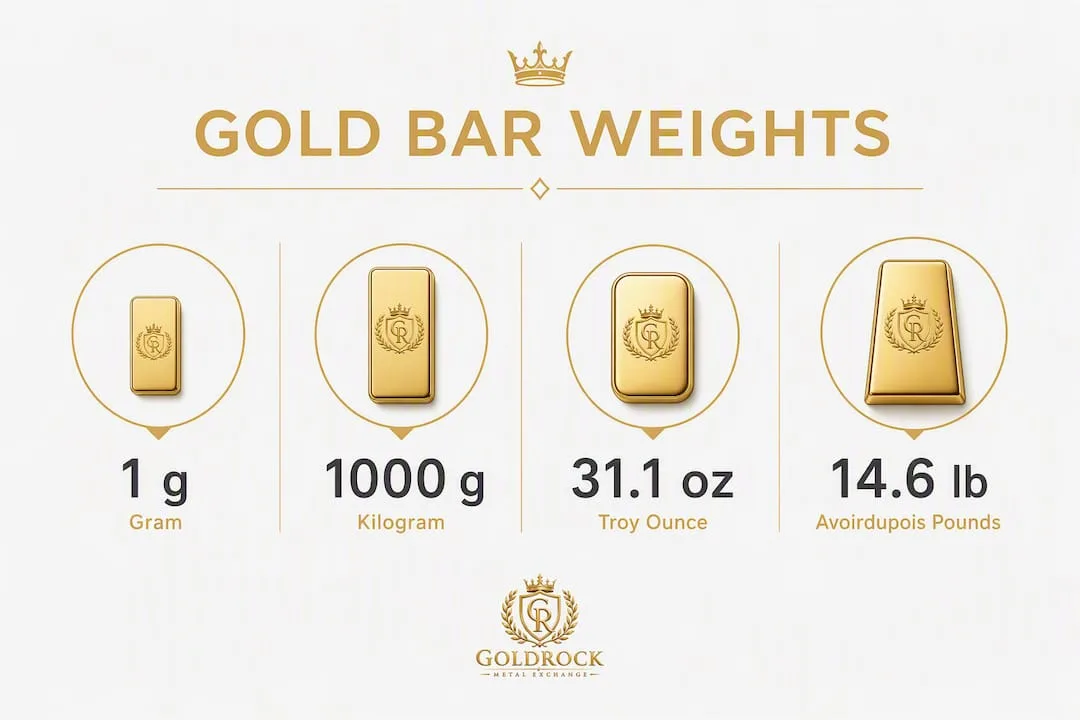
Gold bullion weight is expressed in grams, kilograms, troy ounces, and sometimes avoirdupois pounds depending on context. The table below covers every format you’re likely to encounter, from the smallest retail wafer to the institutional Good Delivery bar.
| Bar Format | Grams | Kilograms | Troy Ounces | Avoirdupois Pounds |
|---|---|---|---|---|
| 1 g wafer | 1.000 | 0.001 | 0.03215 | 0.0022 |
| 10 g bar | 10.000 | 0.010 | 0.3215 | 0.0220 |
| 1 troy oz bar | 31.1035 | 0.0311 | 1.000 | 0.0686 |
| 100 g bar | 100.000 | 0.100 | 3.215 | 0.220 |
| 10 troy oz bar | 311.035 | 0.3110 | 10.000 | 0.686 |
| 250 g bar | 250.000 | 0.250 | 8.0377 | 0.5512 |
| 500 g bar | 500.000 | 0.500 | 16.0754 | 1.1023 |
| 1 kg (kilobar) | 1,000.000 | 1.000 | 32.151 | 2.2046 |
| 100 troy oz bar | 3,110.35 | 3.1104 | 100.000 | 6.8571 |
| 400 troy oz (Good Delivery) | 12,441.4 | 12.4414 | ~400 (350–430) | 27.428 |
Worked conversion examples:
Convert 1 avoirdupois pound to troy ounces: 1 lb = 453.592 g ÷ 31.1035 g/troy oz = 14.583 troy ounces.
Estimate the value of 20 avoirdupois pounds of gold: The conversion between avoirdupois pounds and troy ounces is relevant for valuation calculations.
One visual note worth keeping in mind: gold’s density is approximately 19.3 g/cm³, which means a full Good Delivery bar measures only about 250 × 70 × 35 mm despite weighing 27-plus pounds. It is far more compact than most people expect. For scale, that is roughly the size of a standard smartphone box.
Always confirm which “ounce” a listing uses. A dealer quoting price per “ounce” means troy ounces. A shipping carrier quoting package weight in “ounces” means avoirdupois. Mixing the two is a costly mistake.
The Good Delivery bar, the kilobar, and other large formats
The LBMA Good Delivery bar
The Good Delivery bar is the benchmark for wholesale gold trading worldwide. Its allowed fine weight runs from 350 to 430 troy ounces, with most bars produced close to the 400 troy ounce center. Minimum fineness is 995 parts per 1,000. Each bar carries a unique serial number, and buyers in wholesale markets pay for the recorded fine troy ounces on that specific bar, not a nominal “400 ozt” figure. Invoice fine weight is what matters.
The 400 troy ounce convention did not emerge arbitrarily. It evolved to balance three institutional needs: transportability between central bank vaults, ease of assay sampling, and fungibility among bullion dealers. A bar too large becomes unwieldy to move and assay; one too small multiplies handling costs. The reference hits the practical midpoint for institutional trading.
The kilobar
A kilobar is exactly 1,000 grams and most kilobars refine to 999.9 fineness. It is the format of choice for allocated holdings in private vaults and appears in COMEX delivery options. Its exact gram weight makes accounting straightforward, and its size sits between the large Good Delivery bar and the smaller retail formats, giving it broad liquidity across both institutional and retail markets.

The 100 troy ounce bar
COMEX commonly settles gold futures contracts in 100 troy ounce bars, or alternatively three 1 kg bars. The exchange’s enhanced-delivery contract also accepts the 400 troy ounce bar. For U.S. investors who want exposure to exchange-deliverable formats without the storage demands of a Good Delivery bar, the 100 ozt bar is the practical entry point into institutional-grade sizes.
Comparison: Good Delivery vs. kilobar vs. 100 ozt
- Good Delivery (350–430 ozt): Wholesale and central bank use; individually weighed and invoiced; requires vault-grade storage; lowest per-ounce premium at scale but least liquid for individual investors.
- Kilobar (1,000 g / 32.151 ozt): High liquidity in both institutional and retail markets; exact gram weight simplifies accounting; common in allocated storage programs; 999.9 fineness standard.
- 100 ozt bar: COMEX-deliverable; bridges institutional and high-net-worth retail; requires secure storage but more manageable than Good Delivery; good liquidity in U.S. markets.
For context on how extreme gold production can get: a 250 kg bar was publicly reported as produced by Emirates Minting Factory LLC, underscoring just how wide the gap is between retail formats and specialized institutional pieces.
Minted vs. cast bars and the most common retail sizes
How bars are made
Minted bars are cut from a rolled gold strip and then stamped with precise dimensions, weight, and refiner details. They are the format you see in sealed assay cards at retail, typically ranging from 1 gram up to 1 troy ounce, though minted bars up to 100 grams are common. The precision is high, the finish is clean, and the assay card provides built-in authentication.

Cast bars are poured from molten gold into molds. They are less uniform in appearance, often show pour lines or surface texture, and are produced in larger sizes where the manufacturing cost per ounce matters more than aesthetics. A 1 kg cast bar and a 400 ozt Good Delivery bar are both cast products.
Common retail sizes and their use cases
| Size | Typical Use | Notes |
|---|---|---|
| 1 g | Gift, entry-level holding | Highest per-ounce premium |
| 5 g | Small savings accumulation | Still carries elevated premium |
| 10 g | Flexible retail holding | Popular in Asian markets |
| 1 troy oz | Most liquid retail format | Benchmark for spot-price comparison |
| 100 g | Mid-size retail/investment | Lower premium than 1 ozt |
| 10 troy oz | Serious retail / small institutional | Good balance of premium and liquidity |
| 250 g / 500 g | Larger retail holdings | Approaching kilobar premium efficiency |
Smaller minted bars and coins carry higher per-ounce premiums than larger bars because manufacturing and distribution costs are spread over fewer troy ounces. A 1 gram bar might carry a premium of 10–20% over spot; a kilobar might carry 1–3%. That gap narrows your effective return if you ever sell, so size selection matters.
For investors comparing bars to coins, the gold coin examples guide at GoldRock Metal Exchange covers weight specs and premium patterns for popular bullion coins.
Pro Tip: If liquidity is your priority, the 1 troy ounce bar is the most universally recognized retail format. Dealers everywhere price it, buy it back, and verify it quickly. Larger bars save on premiums but may require more time to sell or transfer, especially outside major financial centers.
Troy ounces vs. avoirdupois ounces: the math every buyer must know
The single most common source of confusion in gold pricing is the word “ounce.” There are two entirely different units sharing that name.
- Troy ounce: 1 troy oz = 31.1035 grams. This is the unit used for all precious metals pricing, dealer invoices, and exchange settlements worldwide.
- Avoirdupois ounce: 1 avoirdupois oz = 28.3495 grams. This is the ounce on your kitchen scale, your bathroom scale, and every shipping label.
- Conversion constants you need:
- 1 troy oz = 31.1035 g
- 1 kg = 32.15074656 troy oz
- 1 avoirdupois pound = 14.5833 troy oz
- 1 avoirdupois oz = 0.91146 troy oz
Worked example: You weigh a bar on a kitchen scale and it reads 1.00 avoirdupois ounce. You might assume it is a 1 troy ounce bar. It is not. At 28.3495 g, it is actually 0.9115 troy ounces, meaning you are undervaluing it by about 8.85% if you price it at the 1 troy oz spot rate. That error compounds fast on larger holdings.
Dealers and exchanges always invoice in fine troy ounces, which means weight × purity. A 1 kg bar at 999.9 fineness contains 32.151 × 0.9999 = 32.148 fine troy ounces. The difference is small on one bar but meaningful across a portfolio.
How to calculate a gold bar’s market value
The formula is straightforward:
Value = (Spot price per troy oz × Fine troy ounces) + Premium + Fees
Where fine troy ounces = gross weight in troy oz × purity expressed as a decimal (e.g., 0.9999 for 24-karat).
Worked examples
Example 1: 1 troy oz bar at 999.9 fineness
- Fine troy oz: 1.000 × 0.9999 = 0.9999
- At spot $3,200/ozt: 0.9999 × $3,200 = $3,199.68
- Add a typical retail premium of ~$60–$100: total cost approximately $3,260–$3,300
Example 2: 1 kg kilobar at 999.9 fineness
- Gross weight: 32.151 troy oz
- Fine troy oz: 32.151 × 0.9999 = 32.148
- At spot $3,200/ozt: 32.148 × $3,200 = $102,874
- Add a kilobar premium (often 1–3% over spot): approximately $103,900–$105,960 total
Example 3: 20 avoirdupois pounds of gold (999.9 fineness)
- Convert: 20 lb × 14.5833 troy oz/lb = 291.666 troy oz
- Fine troy oz: 291.666 × 0.9999 = 291.637
- At spot $3,200/ozt: 291.637 × $3,200 = $933,238
- Add shipping, insurance, and storage fees for a holding this size
Premiums decline as bar size increases, so the per-ounce cost of a 1 gram bar is meaningfully higher than a kilobar even when spot price is identical. For a deeper look at how premiums work, the gold premium over spot explainer at GoldRock Metal Exchange breaks down each component.
Retail bars typically list fine weight on the assay card, so the formula simplifies to spot × stated fine weight + premium. Wholesale bars, including Good Delivery bars, carry separate gross and fine weight accounting on the invoice. Always use the fine weight figure for valuation.
Note on live pricing: Spot prices move continuously. Check GoldRock Metal Exchange’s live prices before running any valuation calculation to use a current figure.
Purity standards, hallmarks, and how to authenticate a bar
What to look for on any bar
Every legitimate gold bar carries a set of trust signals that establish its provenance and purity. Before accepting delivery or completing a purchase, verify all of the following:
- Refiner hallmark: The name or logo of the producing refinery, stamped or engraved on the bar. Recognized refiners appear on the LBMA Good Delivery list.
- Serial number: A unique identifier tied to the bar’s assay record. On Good Delivery bars, this number links to the recorded fine weight.
- Fineness or purity stamp: Expressed as a decimal (e.g., 999.9) or millesimal fineness (e.g., 9999). Most retail bars are 999.9; Good Delivery bars require a minimum of 995.
- Weight stamp: Gross weight in grams or troy ounces, as appropriate to the bar’s format.
- Assay certificate or assay card: For minted bars, a sealed assay card enclosing the bar provides tamper-evident authentication. Breaking the seal to weigh the bar separately voids this protection.
- LBMA Good Delivery listing: For institutional bars, confirm the refiner appears on the current LBMA Good Delivery list.
Authentication methods
Common non-destructive tests include XRF (X-ray fluorescence) analysis and specific-gravity checks; ultrasonic or acoustic testing is also used to detect tungsten-core counterfeits. For absolute confirmation, fire assay remains the definitive destructive test, though it is rarely needed for bars from recognized refiners with intact assay cards.
Minted bars in sealed assay cards are the easiest to authenticate at the retail level. Cast bars, particularly older or secondhand pieces, may warrant XRF testing before acceptance. When receiving a large delivery of cast bars, third-party re-assay is standard practice in institutional settings.
Buyer inspection checklist:
- Confirm the assay card or certificate is intact and unbroken
- Match the serial number on the bar to any accompanying documentation
- Verify the refiner hallmark against the LBMA Good Delivery list or a recognized refiner database
- Weigh the bar on a calibrated scale (troy ounce setting) and compare to the stated weight
- For cast bars or secondhand pieces, request XRF testing before finalizing the transaction
For guidance on choosing a dealer who provides proper documentation, the gold dealer selection guide at GoldRock Metal Exchange covers what to expect from reputable sources.
Pro Tip: Never buy a bar whose assay card has been opened or resealed. Once the tamper-evident seal is broken, the bar’s provenance cannot be confirmed without independent testing. A small discount is not worth the authentication risk.
Premiums, insured delivery, storage, and expected timelines
How premiums scale with bar size
The per-ounce premium you pay above spot price reflects manufacturing cost, distribution, and dealer margin. Small minted bars (1 g–10 g) carry the highest premiums because the fixed cost of minting, packaging, and assay certification is spread over very few troy ounces. As bar size increases, that fixed cost per troy ounce drops sharply.
| Bar Size | Typical Premium Range (over spot) |
|---|---|
| 1 g minted | High (manufacturing cost dominates) |
| 10 g minted | Moderate-high |
| 1 troy oz minted | Moderate |
| 100 g bar | Lower moderate |
| 1 kg kilobar | Low (often 1–3% over spot) |
| 100 ozt / Good Delivery | Lowest (near spot for institutional buyers) |
Note: Premium ranges vary by dealer, market conditions, and product availability. The table reflects general patterns, not fixed figures.
Delivery options and trade-offs
- Insured private delivery (door-to-door): The bar ships directly to your address in discreet, insured packaging. Typical for retail purchases up to a few kilograms. Timeline from order confirmation to receipt: generally 3–7 business days for standard in-stock items.
- Insured carrier to vault: For larger holdings, direct shipment to an allocated storage facility is common. The vault provides segregated or allocated storage with insurance coverage. Timeline varies by vault location and carrier.
- Allocated storage: Your specific bars are held in your name, identified by serial number. You pay storage and insurance fees but retain direct ownership.
- Unallocated storage: You hold a claim on a pool of gold rather than specific bars. Lower storage cost, but you do not own identifiable pieces.
For IRA-held metals, the IRS requires storage in an approved depository rather than home storage. Processing an IRA rollover adds time: expect 2–4 weeks for account transfer and allocation, depending on the custodian and paperwork.
Larger holdings stored at home carry meaningful insurance and security costs that often exceed vault fees. For practical guidance on storage decisions, see how to store physical gold safely for retirement.
How GoldRock Metal Exchange supports your purchase or IRA rollover
Whether you are buying a single 1 troy ounce bar or rolling over a retirement account into physical metals, the process is cleaner when you work with a dealer who handles the details end to end.
GoldRock Metal Exchange offers:
- Live pricing on gold, silver, platinum, and palladium across multiple bar sizes and formats
- Product sourcing by size and fineness, from 1 gram wafers to kilobars
- Insured private delivery with provenance documentation for every shipment
- Self-directed IRA rollover assistance through a dedicated in-house IRA department
- Secure storage options and guidance on allocated vs. unallocated arrangements
- Ongoing consultation for portfolio questions and rebalancing decisions
Ready to move forward? Request a Free Precious Metals Consultation or call (888) 859-0978 to speak with a specialist about bar sizes, IRA eligibility, and delivery options. You can also review the step-by-step buying process to understand what happens from order to delivery.
Pro Tip: If you are considering a self-directed IRA, ask your dealer specifically which bar sizes and refiners are IRS-approved for IRA inclusion. Not every bar qualifies. GoldRock Metal Exchange’s in-house IRA department can confirm eligibility before you commit.
This article is for educational purposes only and does not constitute personalized investment, tax, or legal advice. Confirm current IRS rules and eligibility requirements with a qualified tax professional or the IRS directly.
Key Takeaways
The LBMA Good Delivery bar at approximately 400 troy ounces (~12.4 kg) is the institutional benchmark, but for most U.S. investors the kilobar (1,000 g / 32.151 troy oz) and the 1 troy ounce bar are the practical reference points for valuation and purchasing.
| Point | Details |
|---|---|
| Good Delivery bar weight | Centers near 400 troy oz (~12.4 kg; ~27.4 lb); formal tolerance is 350–430 troy oz; minimum fineness 995/1,000. |
| Kilobar precision | Exactly 1,000 g = 32.151 troy oz; most refine to 999.9 and are widely used for allocated holdings. |
| Always use troy ounces | 1 troy oz = 31.1035 g, not the 28.3495 g avoirdupois ounce; all dealer invoices and spot prices use troy units. |
| Value formula | Spot price per troy oz × fine troy oz (weight × purity) + premium + fees = total cost. |
| GoldRock Metal Exchange | Offers live pricing, multiple bar sizes, insured private delivery, and IRA rollover assistance; call (888) 859-0978. |
Why fine weight and purity matter more than most investors realize
The weight stamped on a bar is only half the story. What actually drives resale value is fine weight, the product of gross weight and purity. Two bars that both say “1 kg” can differ in value if one is 999.9 and the other is 995. That gap is small on a single bar but compounds across a portfolio, and it shows up immediately when you try to sell.
Accurate record-keeping of serial numbers, assay certificates, and fine weights protects you at every stage: when you insure a holding, when you transfer it to an IRA custodian, and when you eventually liquidate. Buyers who prioritize refiner reputation and intact documentation over novelty packaging or unusual shapes consistently have smoother transactions. A bar from a recognized refiner with a clean assay card will always move faster and at a tighter spread than an equivalent weight from an obscure source, regardless of how attractive the packaging looks.
For new investors, the learning curve on weights and units is genuinely short. Master the troy ounce conversion, understand the premium structure by size, and insist on proper documentation. Those three habits cover most of what separates confident buyers from ones who get caught off guard.
GoldRock Metal Exchange: physical gold, IRA rollovers, and insured delivery
Physical gold ownership starts with knowing exactly what you are buying, and that means weight, purity, and provenance. GoldRock Metal Exchange provides live pricing across the full range of bar sizes, from 1 gram wafers to kilobars, with every product backed by refiner documentation and shipped via insured private delivery. For investors looking to hold metals inside a retirement account, the in-house IRA department handles the rollover paperwork and custodian coordination so the process does not stall on administrative details.

Browse the full product catalog to see available bar sizes and current formats, or visit the Precious Metals IRA page if you are exploring a self-directed retirement account. When you are ready to talk specifics, Request a Free Precious Metals Consultation or call (888) 859-0978. A specialist will walk you through bar selection, delivery logistics, and IRA eligibility without pressure.
Authoritative sources and further reading
The following primary and reference sources were used throughout this article for standards, conversion constants, and regulatory context:
- LBMA Good Delivery Rules — London Bullion Market Association — The authoritative specification for Good Delivery bar weight tolerances, fineness requirements, and refiner accreditation.
- Gold bar — Wikipedia — Comprehensive reference on bar formats, production methods, historical context, and the 400 troy ounce convention.
- IRS Retirement Plans FAQs Regarding IRAs — Investments — Governs which precious metals and storage arrangements qualify for self-directed IRA inclusion.
- U.S. Mint — Gold Coins and Bullion — Reference for coin weights, fineness standards, and legal tender specifications relevant to U.S. bullion products.
- GoldRock Education Hub — GoldRock Metal Exchange — Investor education resources covering weights, standards, IRA rules, and purchasing guidance.
- Institutional gold trading benefits — Galami Gold — Background on institutional trading formats and liquidity considerations for large-bar formats.