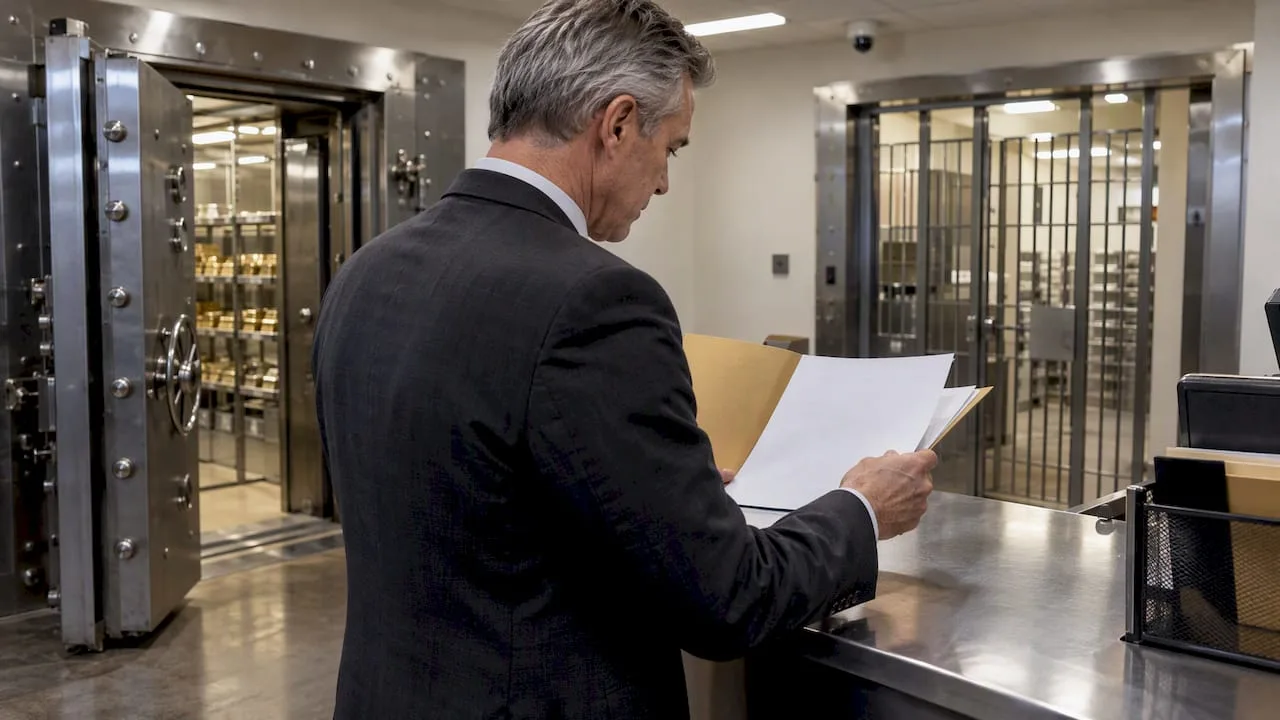
For a gold IRA to stay IRA-eligible under U.S. tax rules, qualifying bullion must be held in the physical possession of a qualifying trustee or custodian, not at home and not in a personal safe. Depository insurance protects against specified physical losses once that metal is stored, but it is only one layer of protection. Custody arrangements, written agreements, and audit records are the others, and all four matter.
TL;DR:
- IRA-eligible bullion must be stored in a qualified, IRS-approved depository under a trustee, not at home or in personal safes.
- The custodian must be a bank or federally insured institution, and storage records must trace ownership to the depository.
- The depository uses third-party audits, security controls, and clear allocation policies to verify inventory and prevent theft.
- Depository insurance typically covers theft or fire losses, but policies vary and do not replace proper custody documentation.
- Investors should request detailed, written verification of custody, insurance, and audit records to ensure IRA compliance and security.
Table of Contents
- IRS rules that govern IRA storage and eligible bullion
- Custodians and trustees: who is responsible and what to confirm
- What depositories do: vault security, allocation options, and audits
- Insurance explained: what policies usually cover and common exclusions
- Practical verification checklist: questions and documents to insist on
- Costs and fee considerations for storage, insurance, and custodial services
- How GoldRock Metal Exchange helps with depository storage and documentation
- Why custody and documentation decide IRA qualification, not insurance alone
- Set up a Precious Metals IRA with documented, insured storage
- FAQ
- Sources
IRS rules that govern IRA storage and eligible bullion
The starting point is tax law, not insurance. Under the IRS guidance on collectibles in retirement accounts, certain gold, silver, platinum, and palladium bullion escapes treatment as a collectible only when it meets specific fineness standards and sits in the physical possession of a trustee described in IRC section 408(a). That is a conditional exception, not a blanket rule for anything shiny.
Publication 590-A lays out the custodian side of the equation: the entity holding your metal must qualify as a trustee under the statute, and the account’s purchase and storage records need to trace back to that trustee. “Physical possession” in practice means the metal sits in a depository under the trustee’s custody arrangement, with your IRA’s ownership share documented and reconciled, not that you personally hold the coins.
Fineness thresholds matter too. Specific fineness and authentication rules separate eligible IRA bullion from pieces that get tax treatment as collectibles instead, a distinction covered in more detail in GoldRock’s guide to IRA-approved silver and in gold IRA eligibility requirements.
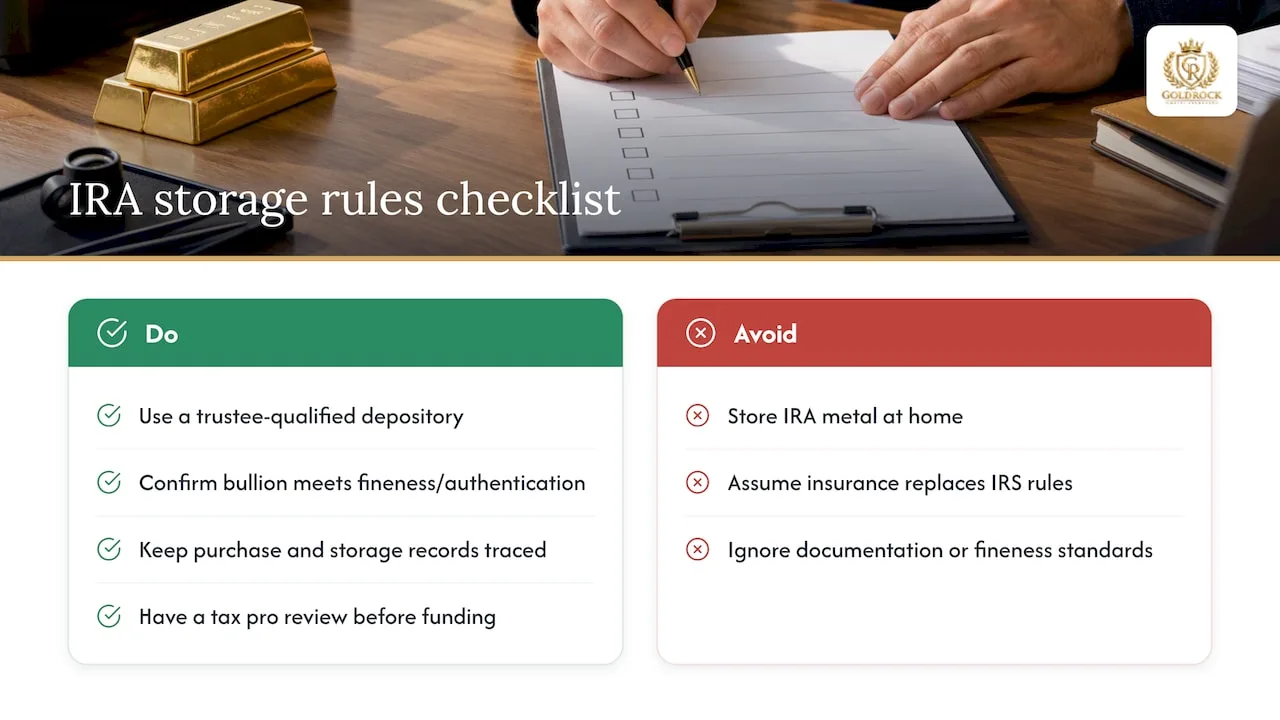
Get any of this wrong, and the consequence is not a warning letter. The IRS can treat the acquisition as a taxable distribution, which can trigger ordinary income tax and, depending on your age, an early withdrawal penalty. Because transaction-specific facts vary, this is an area where a qualified tax professional should review your situation before you fund an account. For background on why keeping metal at home fails this test entirely, see why home storage is not IRA-compliant.
Custodians and trustees: who is responsible and what to confirm
Not every company that offers to “hold” your IRA metal can legally do so. Publication 590-A limits qualifying trustees and custodians to banks, federally insured credit unions, savings and loan associations, or entities specifically approved by the IRS. That status is the first thing to confirm in writing before you fund an account.
A custodian’s job is recordkeeping, title documentation, and acting as the facilitator between you and the depository. What a custodian does not do is vouch for the investment quality of what you are buying. The SEC’s investor alert on self-directed IRAs makes this distinction directly: custodians typically hold and administer assets but do not evaluate the legitimacy of promoters or the suitability of the investment itself.
Before funding, ask for the custodian’s regulatory status, a copy of the custody agreement, a description of how it documents trustee possession, and direct contact information for the depository it uses. Custodian acceptance of a transaction is not the same as vetting it. That verification is yours to do, a point covered further in gold IRA eligibility rules.
What depositories do: vault security, allocation options, and audits
Professional depositories layer physical controls: restricted vault access, continuous surveillance, and in many cases biometric entry systems. Those controls matter because they are what stands between your metal and theft or loss, and they are part of what an insurance policy is underwriting.
Storage comes in two forms. Allocated or segregated storage means your specific bars or coins are set aside and identified as yours. Commingled, or unallocated, storage means your IRA owns a share of a shared pool of like-kind metal rather than specific identified pieces. The recordkeeping difference matters for IRA documentation: allocated storage ties your account to specific serial numbers or bar identifiers, while commingled storage relies on the custodian’s ownership-share records.
Audits are where claims meet verification. CBS News reporting on gold IRA storage describes how professional depositories typically use independent third-party audits to reconcile physical inventory against custody records. Ask who performs the audit, how often it happens, and whether you can see a summary report.
Transport matters as well. When a dealer ships bullion to a depository, chain-of-custody procedures (tracking, insured carriers, signed receipt confirmation) should document the handoff from the moment metal leaves the dealer to the moment the depository logs it in.
Insurance explained: what policies usually cover and common exclusions
Depository insurance typically covers physical loss from theft, fire, and similar named perils while metal sits in storage. What it does not cover is defined entirely by the policy language, which is why a verbal assurance that “it’s insured” tells you almost nothing on its own.
Common limitations include aggregate coverage caps across all stored assets, exclusions for certain internal fraud scenarios, specific valuation methods used to calculate a payout, and perils that simply are not written into the policy. CBS News notes that investors should request the actual policy language or a certified certificate of insurance rather than take a general statement at face value.
Transit coverage is a separate question from storage coverage. Confirm explicitly whether the insurance that applies while metal sits in the vault also extends to the shipping leg between dealer and depository, since some policies treat the two differently.
Specific items worth requesting: the insurer’s name, the policy number, per-account and aggregate limits, the deductible, the valuation basis used for claims, and the claims contact and process. A depository that cannot produce these details on request is one worth questioning further.

Practical verification checklist: questions and documents to insist on
Before you open or fund a gold IRA, gather the following in writing rather than relying on a sales conversation:
- The custodian’s trustee status and regulatory charter.
- The specific depository’s name and location.
- A certificate of insurance naming the insurer and stating coverage limits.
- The most recent third-party audit report, including auditor identity and date.
- The storage allocation policy: allocated versus commingled.
- The reconciliation cadence between physical inventory and account records.
- A written fee schedule covering setup, storage, and insurance pass-through costs.
- The chain-of-custody procedure used for shipments into the depository.
If any of these items comes back vague, generic, or unavailable, treat that as a signal to ask more questions, not a detail to skip past. GoldRock’s guide to verifying an IRS-approved depository walks through this process in more depth, and legal frameworks for evaluating custody services offer a useful outside lens on what thorough custody documentation looks like.
Pro Tip: Ask for written confirmation that the custodian will accept delivery directly to the named depository, and that your account statement will reflect allocated holdings rather than a generic balance.
Costs and fee considerations for storage, insurance, and custodial services
Expect several line items rather than one flat charge. Typical fees include custodian setup and annual administration, an annual storage fee charged by the depository, an insurance pass-through component, shipping and receiving charges, and a liquidation fee if you later sell.
Billing models vary: some custodians charge a flat annual fee regardless of account size, while others charge a percentage of the metal’s value. Allocated storage and higher insurance limits generally cost more than commingled storage with standard coverage, since both require more individualized recordkeeping and larger insured exposure.
Rather than comparing marketing pages, ask each custodian for a written, itemized fee example based on a sample holding size. That is the only way to compare offers on equal terms. For context on transfer-related paperwork and timing, see the exact forms used to move a gold IRA.
How GoldRock Metal Exchange helps with depository storage and documentation
Working through custodian paperwork, depository selection, and insurance verification on your own takes time most investors do not have to spare. An in-house IRA department handles the coordination side of that process directly.

- Coordinates between you, your custodian, and IRS-approved depositories during setup and funding.
- Helps assemble the custody paperwork and documentation a custodian requires before an account is funded.
- Offers insured private delivery for investors who choose to take direct possession of purchased metal outside an IRA structure.
- Provides educational resources on depository verification and IRA eligibility through GoldRock’s education hub.
If you want help confirming custody paperwork, depository insurance documentation, or shipment coordination, Request a Free Precious Metals Consultation at the Precious Metals IRA page or call (888) 859-0978.
This article is educational and not personalized tax or legal advice. Consult a qualified tax or legal advisor before making decisions specific to your account.
Why custody and documentation decide IRA qualification, not insurance alone
Insurance reduces the financial consequence of theft or physical loss. It does not, by itself, establish that your holdings meet IRS requirements for IRA treatment. Those requirements rest on trustee possession, fineness standards, and documented custody, not on a policy number.
The investors who avoid trouble are the ones who verify independently: a signed custody agreement, a recent audit report with a named auditor, and account statements that reconcile against actual depository inventory. Insurance paperwork belongs in that same file, not as a replacement for it.
Keep copies of everything, and ask your custodian in advance how often audits and reconciliations happen so you know when to expect updated documentation rather than finding out after a problem surfaces.
— Blake
Set up a Precious Metals IRA with documented, insured storage
An in-house IRA department helps coordinate custodian paperwork, depository selection, and insurance documentation from one point of contact, backed by insured private delivery options for direct possession of metal outside an IRA.
Request a Free Precious Metals Consultation by calling (888) 859-0978 or visiting the Precious Metals IRA page to get started.
This is educational information, not personalized tax or legal advice. Speak with a qualified advisor about your specific situation.
FAQ
What is the downside of a gold IRA?
A gold IRA requires strict compliance with IRS possession and fineness rules, and getting storage wrong can trigger distribution tax treatment and penalties. It also typically carries storage, insurance, and custodial fees that a standard brokerage IRA does not, so costs should be compared carefully before funding one.
Where do people keep assets if bank deposit insurance has limits?
Bank deposits carry federal deposit insurance up to a stated limit per depositor, per institution, through FDIC coverage. For amounts beyond that limit, some investors diversify across institutions or asset types, including precious metals held through a custodian and IRS-approved depository, though metals carry their own custody and insurance considerations rather than deposit insurance.
Who has the best gold IRA?
There is no single “best” provider for every investor, since the right fit depends on custodian status, depository insurance terms, fee structure, and your own documentation requirements. An in-house IRA department helps investors compare these factors and coordinate custodian and depository paperwork directly.
How do you cash out a gold IRA?
Cashing out typically means instructing your custodian to liquidate the metal (sell it back through the dealer or custodian network) or take an in-kind distribution of the physical metal itself. Either path has tax consequences depending on your age and account type, so this is a decision worth reviewing with a tax professional before you act.
Sources
- Investments in collectibles in individually directed qualified plan accounts | Internal Revenue Service
- Gold IRA storage explained: Depositories, insurance and what you should verify | CBS News
- Investor Alert: Self-Directed IRAs and the Risk of Fraud | SEC