
Yes, a young investor can open a self-directed IRA (SDIRA) to hold alternative assets like precious metals, real estate, or private equity, but the account must sit with a qualified custodian and follow the same IRA tax rules as any other retirement account. The fastest path forward looks like this:
- Pick your account type (Traditional or Roth SDIRA, most commonly).
- Choose a custodian that actually supports the asset you want.
- Fund the account through a new contribution, rollover, or direct transfer.
Pro Tip: Call a custodian before you fill out any paperwork. Ask if they support your exact asset (physical gold, for instance) before you commit to a rollover.
If precious metals are part of your plan, request a free precious metals consultation to see how the process fits your timeline.
Key Takeaways
A self-directed IRA lets young investors hold alternative assets like precious metals under standard IRA tax rules, but success depends on picking the right custodian and avoiding prohibited transactions.
| Point | Details |
|---|---|
| Same tax rules apply | SDIRAs follow standard IRA contribution limits and tax treatment; only the custody options expand. |
| Custodian fit matters most | Match your custodian to your asset type, especially for physical metals or real estate. |
| Compliance risk is real | Prohibited transactions can trigger excise taxes starting at 15% and possible IRA disqualification. |
| Timelines vary by funding method | New accounts open in days; rollovers typically take 7 to 30 days. |
| GoldRock supports metals SDIRAs | GoldRock Metal Exchange’s in-house IRA team handles rollovers and insured private delivery for physical metals. |
Table of Contents
- What Is a Self-Directed IRA and How Does It Differ From a Brokerage IRA?
- How Do You Open and Fund a Self-Directed IRA?
- How Do You Choose a Qualified SDIRA Custodian?
- What Do SDIRAs Cost, and What Are the Real Risks?
- What Can You Hold Inside an SDIRA, and What Changes With Custody?
- What Makes a Precious-Metals SDIRA Different, and Where Does GoldRock Fit?
- How Can GoldRock Metal Exchange Help You Get Started?
- Frequently Asked Questions
- Sources
What Is a Self-Directed IRA and How Does It Differ From a Brokerage IRA?
A self-directed IRA for millennials and Gen Z investors runs on the exact same tax framework as a regular IRA. Same contribution limits, same withdrawal rules, same tax treatment on growth. The difference is custody: a brokerage IRA restricts you to stocks, bonds, mutual funds, and ETFs, while an SDIRA lets a specialized custodian hold alternative assets on your behalf.
Common alternative assets held in SDIRAs include:
- Physical precious metals (gold, silver, platinum, palladium)
- Real estate and raw land
- Private equity and private placements
- Cryptocurrency
- Promissory notes and tax liens
Each asset class carries its own custody quirks. Metals need approved storage. Real estate needs the title held in the IRA’s name, not yours. Private placements require subscription documents that name the IRA as the owner, not the individual.
Pro Tip: If your time horizon runs 25 or 30 years, a Roth SDIRA often makes sense: you pay tax now on contributions, then withdraw tax-free later. Just watch the income phase-out thresholds, since they can knock high earners out of direct Roth contributions.
One thing worth repeating: opening an SDIRA does not change your contribution limits or tax rules. It only changes what the account is allowed to hold.
How Do You Open and Fund a Self-Directed IRA?
Investing in a self-directed IRA follows a predictable sequence, even though the paperwork varies by custodian and asset type.
- Choose your account type. Traditional, Roth, SEP, or SIMPLE IRA are the standard options. If you’re self-employed, a Solo 401(k) might fit better, particularly if debt-financed real estate is part of the plan.
- Select a custodian that supports your asset. Not every custodian handles every alternative asset, so confirm this before applying.
- Open the account. This usually means an application, an ID verification step, and a signed custodial agreement.
- Fund the account. You can fund by new contribution (subject to annual limits), a rollover from an old 401(k), or a direct transfer from another IRA.
- Direct the custodian to complete your purchase. The custodian executes the transaction, whether that’s buying metals, funding a real estate purchase, or processing a private placement subscription.
Processing times vary by funding method. A new account can often be opened within a few days once paperwork and funds arrive. Rollovers typically take 7 to 30 days, depending on your previous plan administrator and the receiving custodian’s intake process. Direct transfers between IRAs tend to move faster than 401(k) rollovers because fewer parties are involved.
Expect a standard packet of documents: an account application, a transfer or rollover authorization form, and asset-specific purchase or subscription documents. Your custodian will process transactions and handle IRS reporting, but they will not vet your investment choices or tell you whether a deal is a good one. That responsibility sits entirely with you.
One warning deserves its own paragraph. The IRS prohibits certain transactions between your IRA and “disqualified persons,” which includes you, your spouse, and close family members. Buying an IRA-owned property and using it yourself, or having your IRA purchase an asset from your own business, can trigger serious penalties. Keep your hands off IRA-owned assets entirely, and when in doubt, ask before you act, not after.
How Do You Choose a Qualified SDIRA Custodian?
Custodian selection determines whether your SDIRA experience is smooth or a slow-motion headache. Run through this checklist before signing anything:
- Supported asset types. Does the custodian actually handle your target asset, or do they just claim to on a marketing page?
- Fee structure. Look at setup fees, annual maintenance fees, per-asset processing fees, and storage or insurance costs separately. Fee schedules vary widely by provider and asset class.
- Account minimums. Some custodians have no minimum; others require a meaningful opening balance.
- Turnaround times. Ask how long transfers, rollovers, and asset purchases typically take.
- Reporting capability. Confirm they handle annual valuations and any UBIT/UBTI reporting your asset might trigger.
Questions worth asking directly: Do you support physical precious metals? How is custody and storage handled, and is it segregated or pooled? What is the full fee list, not just the headline number? How long do transfers usually take?
Fee models matter more than they seem to at first glance. A small account paying flat annual fees regardless of balance can see those fees eat a disproportionate share of returns compared to a larger account paying the same flat rate. Low, medium, and high fee tiers usually track the complexity of the asset, with physical metals and real estate often costing more to administer than publicly traded securities held in a self-directed wrapper.

Pro Tip: Match the custodian to the asset, not the other way around. A custodian built for real estate paperwork may not handle physical metals storage well, and vice versa.
What Do SDIRAs Cost, and What Are the Real Risks?
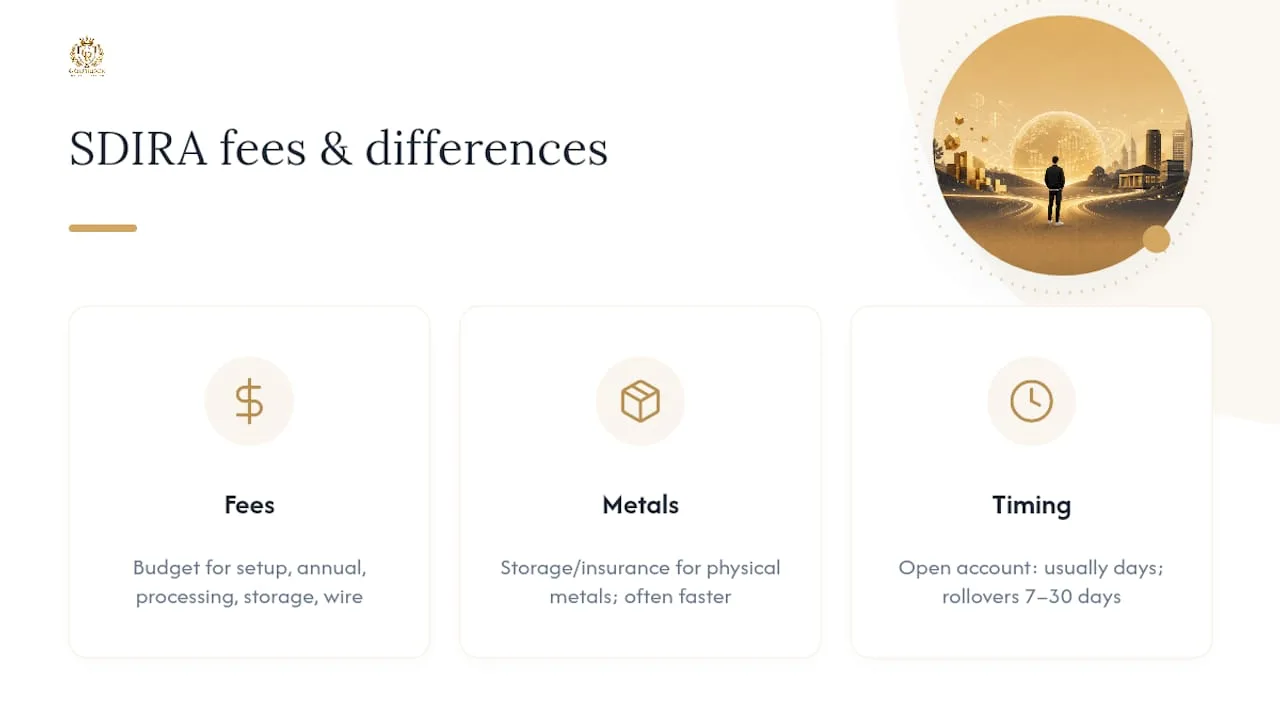
Budget for several fee categories before you open anything: account setup, annual maintenance, per-asset processing, storage or insurance (for physical assets), and wire or transfer fees. Costs vary meaningfully by asset type, and a metals SDIRA will carry different line items than one holding private equity.
Minimums matter less than the practical minimum set by your asset. A single gold bar costs a lot more than a fractional coin purchase, so your real starting point often depends on what you’re buying, not what the custodian requires.
A rough timeline: opening the account itself usually takes days. Rollovers commonly run 7 to 30 days. Asset processing time varies by type, with metals purchases often completing faster than real estate closings or private placement subscriptions.
The compliance risks are where young investors get burned. IRC §4975 sets excise taxes on prohibited transactions starting at 15%, climbing as high as 100% if the issue isn’t corrected, and an IRA that runs afoul of these rules can be retroactively disqualified and treated as fully distributed. That means ordinary income tax on the whole balance, plus an early-withdrawal penalty if you’re under 59 and a half. Debt-financed investments inside an IRA can also trigger UBIT/UBTI, a tax most investors don’t expect until it shows up on a return.
Only an estimated 2 to 5 percent of the roughly $18.9 trillion held in U.S. IRAs sits in self-directed accounts. That small share reflects real complexity, not lack of interest.
What Can You Hold Inside an SDIRA, and What Changes With Custody?
Asset eligibility comes with custody strings attached. Physical precious metals need IRS-approved storage; you can’t keep IRA-owned gold in a home safe. Real estate needs the title held in the IRA’s name. Private placements need subscription paperwork that names the account, not you personally, as the owner.
- Annual valuations matter: your custodian needs a current market value or appraisal for reporting, and stale numbers create headaches at tax time.
- Illiquid assets can complicate required minimum distributions later, since you can’t sell a fraction of a rental property to satisfy a withdrawal.
- Custodians accept and process these assets. They do not evaluate whether the investment itself is sound, so due diligence is on you every time.
What Makes a Precious-Metals SDIRA Different, and Where Does GoldRock Fit?
Metals SDIRAs run on their own custody rules. Coins and bars must meet IRS purity and eligibility standards, storage happens at an approved depository rather than in your possession, and you’ll choose between segregated storage (your metal, kept separately) or pooled storage (commingled with other investors’ holdings).
Before funding a metals SDIRA, confirm four things:
- The specific coins or bars are IRA-eligible.
- Your chosen storage provider meets IRS depository standards.
- The account is titled correctly for tax-favored treatment.
- You’ve budgeted for appraisal and shipping costs on top of the metal’s purchase price.
GoldRock Metal Exchange runs an in-house IRA department built specifically to walk young investors through this process, from rollover paperwork to insured private delivery once metals leave depository storage.
Pro Tip: Ask any metals custodian for their full IRA-eligible coin list before you buy. Not every coin sold at retail qualifies for IRA custody.
Request a free precious metals consultation to walk through eligibility and storage options for your specific situation.
A Younger Investor’s Take on Self-Directed IRAs
An SDIRA is a tool, not a shortcut. It rewards investors who research thoroughly and manage their accounts actively, and it punishes carelessness with real tax consequences. For complex moves like debt-financed real estate, talk to a tax professional first, and lean on GoldRock’s in-house IRA team for the execution side of a precious-metals rollover.
How Can GoldRock Metal Exchange Help You Get Started?
GoldRock Metal Exchange is built for investors who want a straightforward way to add physical gold, silver, platinum, or palladium to a retirement account without navigating custodian paperwork alone. Our in-house IRA department handles rollover coordination directly, and every physical purchase can ship through insured private delivery once it leaves depository storage.

If you’re weighing a precious-metals SDIRA against other alternative assets, the practical advantage is personal guidance at every step, not a call center or a self-service portal you’re left to figure out alone. Visit the Precious Metals IRA page to see current setup options, or call (888) 859-0978 to request a free precious metals consultation and get your questions answered before you move a dollar.
Frequently Asked Questions
Can a young investor open a self-directed IRA with a small balance?
Yes. There’s no federal minimum for SDIRAs, though custodian minimums and the practical cost of your chosen asset (like a full gold bar versus fractional coins) will shape your realistic starting point.
Is a self-directed IRA riskier than a regular brokerage IRA?
It carries different risks. The tax treatment is identical, but custodians don’t vet investments, and prohibited-transaction rules create penalties that don’t exist in a standard brokerage account.
Can I hold precious metals in a Roth SDIRA?
Yes, both Traditional and Roth SDIRAs can hold IRS-eligible physical precious metals, provided the metals sit in approved depository storage rather than your personal possession.
How long does it take to roll over a 401(k) into a self-directed IRA?
Rollovers commonly take between 7 and 30 days, depending on your prior plan administrator’s processing speed and your new custodian’s intake requirements.
This article is for educational purposes only and does not constitute investment, tax, or legal advice. Consult a qualified professional before making retirement account decisions.
This article is general information, not a substitute for advice from a qualified financial advisor. Consult a qualified financial professional about your own circumstances before acting on anything here.
Sources
- Investor
- 26 U.S. Code § 4975 — Tax on prohibited transactions
- Self-Directed IRA Guide: Alternative Investments 2026 (Angel Investors Network)