

Circulating U.S. That’s the practical cutoff: any quarter dated 1965 or later that passed through general circulation is copper-nickel clad, with no silver content at all. The legal trigger was the Coinage Act of 1965, signed into law on July 23, 1965, which eliminated silver from dimes and quarters and cut the half dollar’s silver content to 40%.
A few facts anchor that answer:
- 1964 is the final year the U.S. Mint struck quarters at 90% silver, 10% copper, for regular circulation.
- Each 1964-dated Washington quarter contains roughly 0.1808 troy ounces of pure silver.
- The Coinage Act of 1965 (Pub. L. 89–81) is the statute that made the switch permanent, moving the Mint to a copper-nickel clad composition still used today.
Coin collectors and precious metals investors both care about this date for different reasons. Collectors want to know exactly which coins in a jar of change might be worth more than face value. Investors want a reliable way to identify junk silver, the informal term for pre-1965 U.S. coinage valued for its metal content rather than its collector appeal. Both groups need the same starting point: the year on the coin.
Key Takeaways
Circulating U.S.
| Point | Details |
|---|---|
| The exact cutoff year | 1964 is the last year quarters were struck at 90% silver for circulation; the Coinage Act of 1965 made the change legal on July 23, 1965. |
| Why it happened | Rising silver prices made coins worth more melted than spent, causing hoarding and coin shortages that forced Congress to act. |
| How to identify silver quarters | Check the date first, then confirm with weight (5.67 grams) and the absence of a copper stripe on the edge. |
| Known exceptions | The 1976-S 40% silver Bicentennial quarter and silver proof sets are the only post-1964 quarters containing silver, and both are clearly marked collector issues. |
| Where to get guidance | GoldRock Metal Exchange offers a free consultation to help sort melt-value junk silver from numismatic coins and to explain self-directed IRA options for physical metals. |
Table of Contents
- When Did Quarters Stop Being Silver? A Timeline of Composition Changes
- Why Did the U.S. Stop Making Silver Quarters?
- What the Coinage Act of 1965 Actually Changed
- How to Tell If Your Quarter Is Silver
- Were Any Quarters Made With Silver After 1964?
- What Determines the Value of a Silver Quarter?
- Where This Information Comes From
- What This Cutoff Actually Means for You
- How GoldRock Metal Exchange Can Help With Your Silver Coin Decisions
- Sources
When Did Quarters Stop Being Silver? A Timeline of Composition Changes
The story of silver in the American quarter runs from the earliest days of the Mint through a single legislative decision in the mid-1960s. Composition didn’t change gradually. It changed once, sharply, in a single calendar year.
A few dates on that table matter more than the rest. Then 1964 arrived, and everything changed the following year.
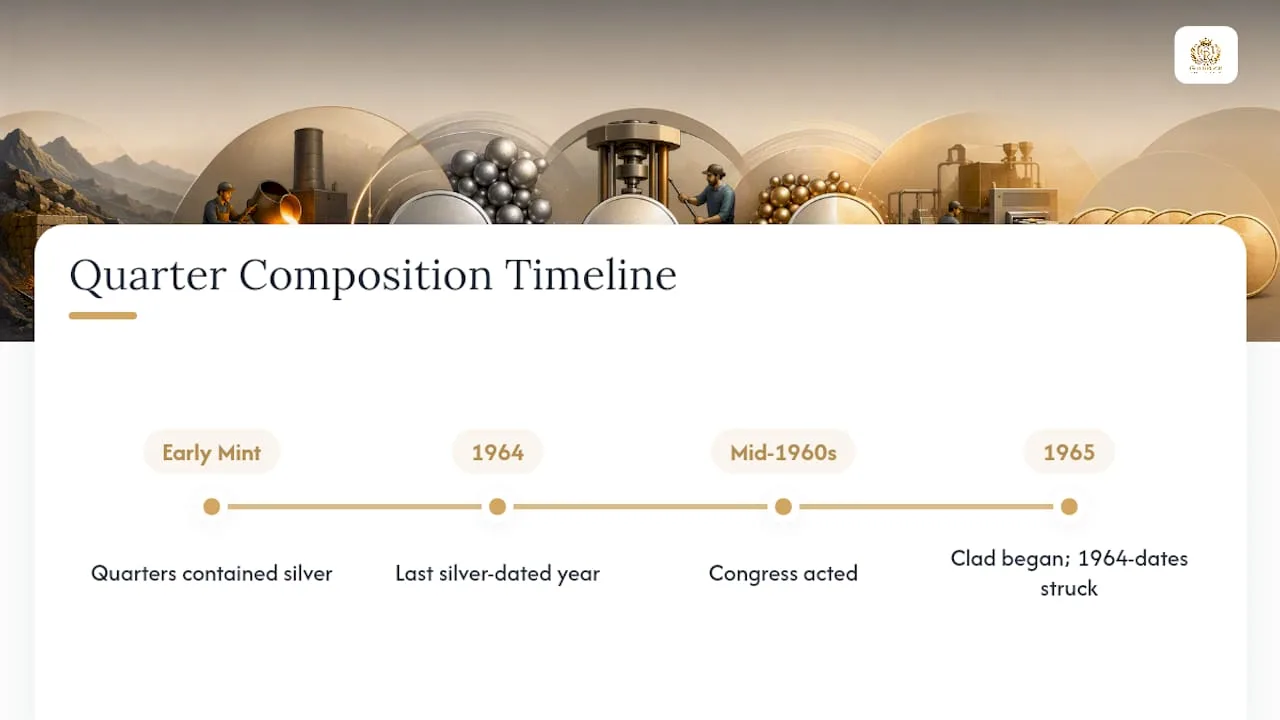
One wrinkle trips up a lot of new collectors: the U.S. Mint kept striking coins dated 1964 well into 1965, because demand for coins outpaced the transition to new clad blanks. That means some “1964” quarters were physically minted months after the law changed. It doesn’t matter. The date on the coin, not the strike date, determines the legal composition standard that coin was made under.
Why Did the U.S. Stop Making Silver Quarters?
Rising silver prices made the metal in a quarter worth more than the coin’s face value, and that mismatch triggered hoarding, coin shortages, and a fast legislative response. The government wasn’t chasing a design trend or a cost-cutting whim. It was reacting to a market problem that was actively pulling coins out of circulation.

Silver prices climbed through the early 1960s to a point where melting old coins for their metal started to make financial sense for some people. The math is simple enough that ordinary citizens figured it out on their own: if the silver in your pocket is worth more than the number stamped on it, why spend it?
That dynamic produced three connected problems:
- Hoarding accelerated. People pulled silver coins out of everyday transactions and stashed them, betting silver prices would keep rising.
- Industrial demand competed for the same metal. Photography, electronics, and other industries needed silver too, adding pressure on supply.
- Government silver stocks were depleting fast. The Treasury was buying silver to keep striking coins at the same time private demand for that silver was climbing.
The result was a genuine coin shortage. Banks and retailers struggled to get enough circulating coinage for daily commerce, a problem that grew serious enough to force Treasury officials to recommend a structural fix rather than a temporary patch.
“In the Act I am signing today, we call for an entirely new coinage. This coinage will not disappear from our pocketbooks, as, unfortunately, the silver coins have,” President Lyndon B. Johnson said at the signing of the Coinage Act on July 23, 1965.
Johnson’s remarks made the intent explicit: stop the drain on silver reserves and get a coin supply that could actually stay in circulation instead of vanishing into private hoards. Treasury and Congress moved fast once the problem was clear, and the Silver Institute’s price data from 1960 to 1965 shows exactly why urgency won out over a slower fix.
What the Coinage Act of 1965 Actually Changed
Pub. L. It’s the single piece of legislation responsible for every clad quarter you’ve handled since.
The Act did more than swap one metal for another. It restructured how the United States thought about coinage value.
- Dimes and quarters became copper-nickel clad, made from a pure copper core sandwiched between outer layers of 75% copper and 25% nickel.
- Half dollars dropped to 40% silver, a compromise composition that lasted until 1970, when silver left the half dollar too.
- The Mint received transitional authority to keep striking 1964-dated coins for up to five years if supply hadn’t caught up with demand, which is exactly why 1964-dated silver quarters kept coming off presses into 1965 and 1966.
- Clad coinage was formally authorized as the new standard, ending the direct link between a coin’s face value and the market value of the metal inside it.
The Coinage Act of 1965 didn’t just remove silver. It marked a structural break from commodity-backed circulating coinage toward a system where face value and metal value no longer had to match.
That break is why modern quarters can be minted cheaply and reliably regardless of what silver or copper happen to cost on a given day. The govinfo record of Pub. L. 89–81 is the definitive text if you want to read the statutory language yourself rather than take a secondhand summary on faith.
How to Tell If Your Quarter Is Silver
Check the date first. Any quarter dated 1965 or later, outside of specific collector exceptions covered in the next section, is clad and contains no silver.
Date alone gets you most of the way there, but a handful of secondary checks can confirm what your eyes are telling you.
- Check the edge. A silver quarter has a solid silver edge. A clad quarter shows a visible copper stripe running around the rim, easy to spot even without magnification.
- Weigh it. A 90% silver quarter has a distinctive weight characteristic used to identify its composition. A clad quarter weighs 5.67 grams. A cheap digital jewelry scale, the kind sold for $10 to $15, will catch this difference reliably.
- Look at the color and toning. Silver quarters develop a distinct grayish or golden-brown patina over decades. Clad coins tend to look flatter and more uniformly gray.
- Skip the magnet test for confirmation. Neither silver nor the copper-nickel clad alloy is magnetic, so a magnet won’t distinguish them. It’s useful only for ruling out counterfeit steel cores in other coin types.
Pro Tip: Buy a digital scale that reads to the hundredth of a gram before you buy or sell any quantity of pre-1965 coinage. Weight is the fastest, cheapest way to confirm silver content on a coin you already have in hand, and it catches plated fakes that visual inspection alone can miss.
One more thing worth repeating: never clean a coin you suspect has collector value. Cleaning strips away the natural patina that graders and buyers look for, and it can cut a coin’s value dramatically even if the metal content stays the same. If a quarter looks like it might be worth more than melt value, leave the surface alone and get it evaluated before you touch it with anything.
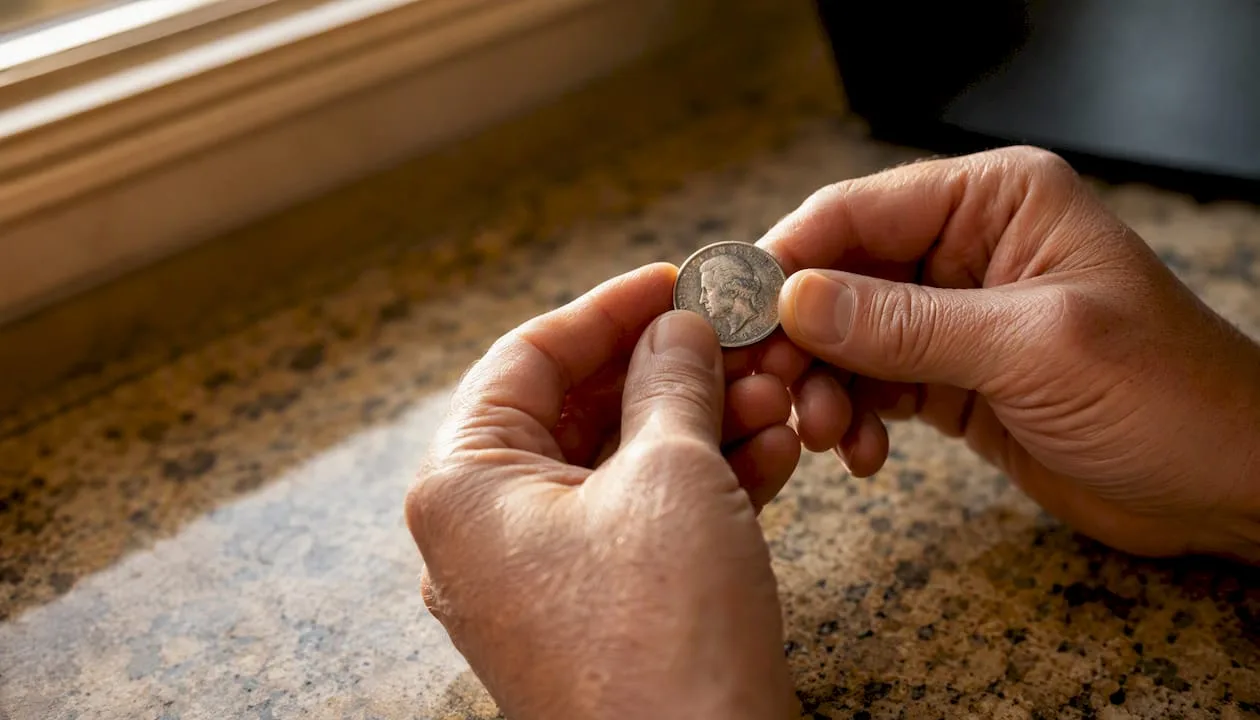
And on that 1964-dated-but-struck-in-1965 detail from the timeline: it doesn’t affect identification. The date on the coin is the only thing that matters for composition purposes, regardless of when the coin physically left the press.
Were Any Quarters Made With Silver After 1964?
Ordinary circulating quarters dated 1965 or later contain no silver. The exceptions are limited to specific collector and commemorative issues that the Mint clearly marked and distributed outside normal circulation.
- The 1976-S Bicentennial quarter, 40% silver version. Struck for the nation’s 200th anniversary, this variant was sold directly to collectors in special Mint packaging and never entered general circulation.
- Silver proof sets. Starting in the 1990s, the Mint began offering annual silver proof sets containing 90% silver quarters struck specifically for collectors, sold at a premium over face value through official Mint channels.
- America the Beautiful quarters in silver proof format. Since 2010, select proof and uncirculated sets have included 90% silver versions of the circulating design series, again sold only through collector channels.
You can recognize these exceptions by their packaging and documentation. Proof coins ship in official Mint capsules or boxes with certificates, not loose in circulation, and Mint sets carry explicit labeling noting silver content.
What Determines the Value of a Silver Quarter?
Most pre-1965 quarters are worth their melt value, the price of the raw silver they contain, unless condition, rarity, or demand pushes them into numismatic territory. Melt value is the floor. Everything above that floor comes down to what collectors are willing to pay for a specific coin’s story and scarcity.
Calculating melt value starts with the silver content per coin and the current spot price of silver.
| Input | Value |
|---|---|
| Silver content per 90% quarter | 0.1808 troy oz |
| Melt value formula | Silver content × current spot price per troy ounce |
| Common trading term | “Junk silver” (bulk pre-1965 coinage valued for metal, not rarity) |
| Where to check current spot price | Live precious metals prices |
Spot silver prices move throughout the trading day, so any melt-value figure is only accurate at the moment you check it. That volatility is exactly why serious buyers and sellers of junk silver track spot prices in real time rather than relying on a number from last week.
Above melt value, a separate set of factors determines whether a quarter carries real numismatic premium:
- Condition and grade. A quarter graded MS-65 or higher by a third-party service can sell for many times its melt value, while a heavily worn example rarely exceeds melt.
- Mintmark and rarity. Certain mintmark and year combinations were struck in much smaller numbers, and scarcity drives price independent of silver content.
- Variety and errors. Doubled dies, off-center strikes, and other minting errors can turn an ordinary date into a coin worth hundreds of dollars.
- Provenance. A documented collection history occasionally adds value, particularly for coins tied to notable collections sold at auction.
- Market demand. Collector interest in specific series rises and falls, and prices for premium coins track that demand more than they track silver spot prices.
If you’re holding a jar of old quarters and trying to decide whether they’re melt-value junk silver or something worth grading, that’s exactly the kind of question worth talking through with someone who handles this daily. GoldRock Metal Exchange offers a free precious metals consultation to help you sort bulk silver from coins that deserve a closer look, whether you’re building a position in physical silver or considering how coins fit into a broader self-directed IRA strategy. Call (888) 859-0978 to talk through what you’re holding.
Where This Information Comes From
Every date, weight, and legal claim in this article traces back to primary government records rather than secondhand summaries. That distinction matters when you’re making decisions based on a coin’s legal composition history.
- Pub. L. 89–81 on govinfo is the official statutory text, useful if you want the precise legal language rather than a paraphrase.
- Presidential archives from the University of California, Santa Barbara preserve Johnson’s signing remarks, which explain the government’s stated reasoning at the time.
When you’re verifying a claim about coin composition, check the Mint’s own pages first. When you’re verifying the legal mechanics, the govinfo statute text settles any dispute. Secondary sources, including numismatic price guides, are useful for practical detail like weights and mintmark rarity, but the legal and historical backbone of this story sits in those four records.
What This Cutoff Actually Means for You
The 1964 cutoff is a clean historical fact, but most people misuse it by treating every old quarter as a hidden fortune. It isn’t. The overwhelming majority of pre-1965 quarters sitting in collections and coin jars are worth their silver content and nothing more, and that’s still a meaningful premium over face value, just not a windfall.
Where people leave money on the table is skipping the grading step on anything that looks unusually sharp or well-preserved. A worn 1964 quarter is junk silver. A 1964 quarter with strong detail and original luster might be a $30 or $40 coin instead of a $4 one, and you won’t know the difference without getting it looked at by someone who grades coins for a living. On the flip side, people also waste money sending common, heavily circulated coins for grading that will never come back numismatically valuable. Knowing which bucket your coins fall into before you spend money on grading fees saves you from both mistakes.
If you’re weighing whether pre-1965 silver coinage belongs in a broader portfolio, or whether it makes sense inside a self-directed precious metals IRA, that’s a conversation worth having with people who handle these transactions regularly rather than guessing from an online price guide. Preserve the coin’s original surface, get anything unusual graded by a reputable third-party service, and work with an established dealer for any transaction involving real volume.
How GoldRock Metal Exchange Can Help With Your Silver Coin Decisions
Whether you’re holding a coffee can of pre-1965 quarters or considering silver as part of a retirement strategy, GoldRock Metal Exchange gives you direct access to a dedicated in-house IRA department and personal consultation, instead of guessing your way through melt-value math and grading questions alone.

GoldRock Metal Exchange buys and sells physical gold, silver, platinum, and palladium, provides insured private delivery on completed purchases, and helps investors move retirement funds into a self-directed IRA backed by physical metal rather than paper assets. If you’re deciding whether your quarters belong in a bulk silver sale or deserve individual grading first, or whether adding physical silver to a retirement account fits your broader plan, a conversation with someone who does this daily beats guessing from a price chart. Request a Free Precious Metals Consultation today by calling (888) 859-0978 or visiting the GoldRock Metal Exchange shop to see current inventory and pricing.
This article provides general educational information only. It is not investment, tax, or legal advice, and you should consult a qualified professional before making decisions about your specific financial situation.
Sources
These are the documents worth bookmarking if you ever need to verify a date, a composition figure, or the legislative language behind this history.
- Pub. L. 89–81 — Coinage Act of 1965 (govinfo)
- Remarks at the Signing of the Coinage Act | Lyndon B. Johnson, July 23, 1965
These four sources cover the composition facts, the legal text, the executive rationale, and the market conditions behind the entire story. Anything else you read about this topic should trace back to one of them.