
A single retail gold bar most commonly weighs 1 troy ounce, or about 31.1 grams, while the institutional benchmark, the Good Delivery bar, weighs roughly the typical nominal weight defined by the standard. That’s the short answer. The rest comes down to which “bar” you mean, because gold bars range from 1 gram wafers you could lose in a coat pocket to 400 ounce bricks that require two hands and a strong back to move.
Here’s the quick math you’ll actually use:
- 1 troy ounce bar: 31.1035 grams, 0.0686 pounds, 1.097 avoirdupois ounces
- 1 kilobar (1,000 g): 32.1507 troy ounces, 2.2046 pounds
- 400 ozt Good Delivery bar: approximately 12.44 kilograms, approximately 27.4 pounds, and its true weight can legally range from 350 to 430 troy ounces
The troy ounce, the unit that defines all of this, equals exactly 31.1034768 grams, a figure that’s slightly heavier than the standard avoirdupois ounce most Americans use for cooking or shipping. That mismatch trips up more buyers than you’d expect, and it’s worth nailing down before you look at a single price tag.
Key Takeaways
Gold bar weight follows fixed unit conversions, and understanding troy ounces versus grams versus pounds is the foundation for every pricing, storage, and IRA decision that follows.
| Point | Details |
|---|---|
| Retail standard | A common single gold bar weighs 1 troy ounce, equal to 31.1035 grams or 0.0686 pounds. |
| Institutional standard | The Good Delivery bar weighs nominally 400 troy ounces (about 12.4 kg, or 27.4 lb), with a legal range of 350 to 430 ozt. |
| Unit accuracy matters | A troy ounce (31.1035 g) is heavier than a standard avoirdupois ounce (28.3495 g); confusing them skews conversions. |
| Size affects premium | Small bars from 1 g to 100 g carry higher per-ounce premiums than kilobars or Good Delivery bars, which track spot more closely. |
| Verify before you buy | Compare a bar’s stamped weight against a calibrated scale reading and check refiner hallmarks before any high-value transaction. |
| Get personal guidance | GoldRock Metal Exchange offers a free consultation to walk through bar sizing, IRA rollovers, and insured private delivery for your specific situation. |
Table of Contents
- How Much Does 1 Bar of Gold Weigh in Common Sizes?
- What’s the Difference Between a Troy Ounce and a Regular Ounce?
- Why Does a Small Gold Bar Feel So Heavy?
- What Is a Good Delivery Bar and Why Do Weights Vary?
- How Do You Verify a Gold Bar’s Weight Yourself?
- How Do You Calculate a Gold Bar’s Dollar Value?
- Is It Legal to Own a 400 Ounce Gold Bar?
- Why Weight Literacy Matters More Than Most Investors Realize
- Ready to Add Physical Gold to Your Portfolio?
- Frequently Asked Questions
- Sources
How Much Does 1 Bar of Gold Weigh in Common Sizes?
Gold bars come in a dozen or so standard weights, and each one serves a different kind of buyer. A collector wants something small and displayable. A retirement investor wants a size that balances low premiums against reasonable liquidity. A central bank wants the 400 ounce brick because that’s the London bullion market’s accepted unit of settlement.
Here’s how the full range breaks down:
That 1 troy ounce line is where most individual investors live, and the collectible-sized bars explained here show just how far the range stretches below it, down to 1 gram wafers meant more for gifting than serious accumulation.
Picturing these sizes helps more than the numbers alone. A 1 ounce bar is roughly the size of a large postage stamp, thin enough to slide into a card. The 400 ounce Good Delivery bar, by contrast, is commonly cast to dimensions around 7 inches by 3.625 inches by 1.75 inches, though exact measurements shift by refiner and casting method. It looks less like a coin and more like a paving brick, and it weighs about as much as a large housecoat.
Premiums move in the opposite direction from size. Small bars, anything from 1 gram up to about 100 grams, carry higher per-ounce premiums because minting, assay, and distribution costs eat up a bigger share of a smaller bar’s price. Kilobars and Good Delivery bars track spot price much more tightly, which is exactly why they dominate wholesale and institutional trading. Our gold bricks weight guide breaks down kilobar and brick-format pricing in more detail if you’re weighing that tradeoff.
What’s the Difference Between a Troy Ounce and a Regular Ounce?
A troy ounce weighs more than the avoirdupois ounce you’d use to weigh a sandwich or a bag of flour, and the gap is bigger than most people assume: 31.1034768 grams versus 28.3495231 grams. That’s a difference of nearly 2.75 grams per ounce, which sounds small until you’re pricing out a 100 ounce position and the wrong conversion quietly shifts your math by several ounces of gold.
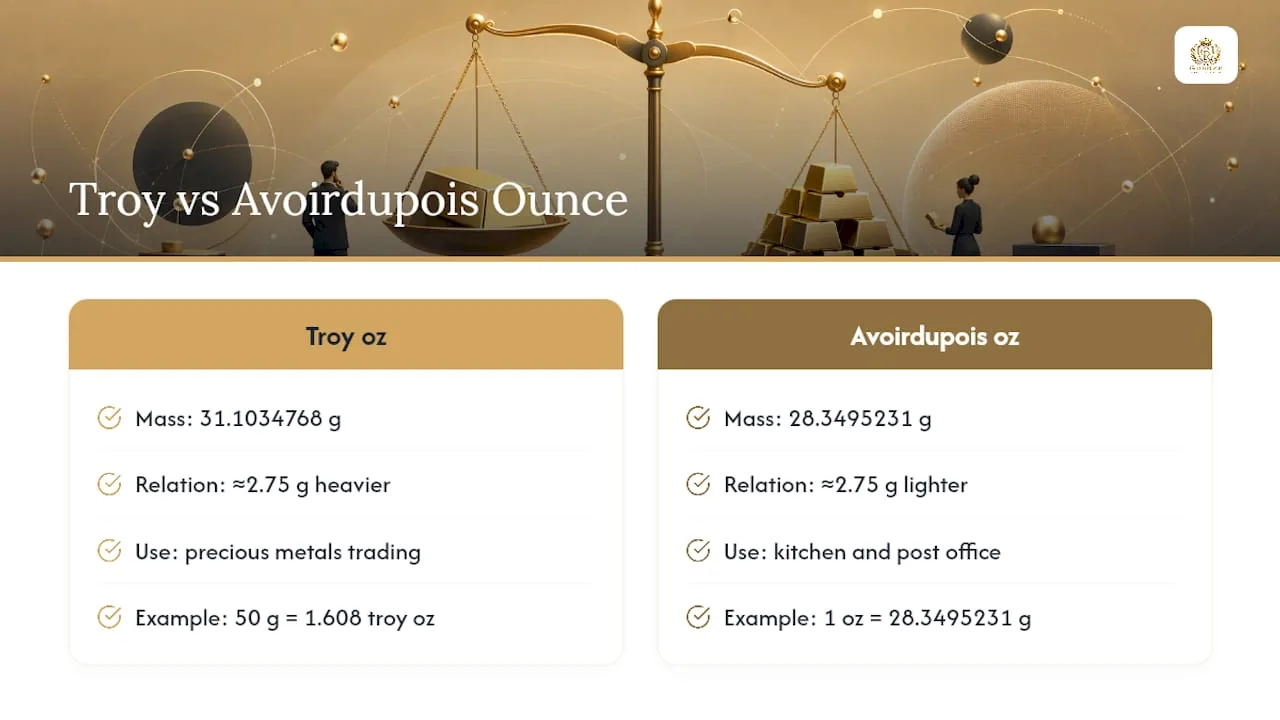
The troy ounce has been the standard weight unit for precious metals trading for centuries, and it’s the unit every spot price, every bar stamp, and every dealer invoice in the bullion market uses. Avoirdupois ounces stay in the kitchen and the post office. Gold, silver, platinum, and palladium all get weighed in troy ounces, full stop.
Two conversions cover almost everything you’ll need:
Grams to troy ounces: grams ÷ 31.1034768 = troy ounces. A 50 gram bar: 50 ÷ 31.1034768 = 1.608 troy ounces.
Troy ounces to pounds: troy ounces × 0.0685714 = pounds. A 10 troy ounce bar: 10 × 0.0685714 = 0.686 pounds.
The conversion constant worth memorizing is this: 1 troy ounce equals exactly 31.1034768 grams, per the standard gold conversion reference. Round it to 31.1035 for everyday math and you’ll be accurate to four decimal places.
Pro Tip: Before you finalize any purchase, check whether the listed weight on an invoice or product page says “troy oz” or just “oz.” Some overseas listings quietly use grams or avoirdupois ounces, and that ambiguity can make a bar look cheaper per ounce than it actually is.
Why Does a Small Gold Bar Feel So Heavy?
Gold’s density is 19.3 grams per cubic centimeter, nearly twice that of lead and about seven times denser than aluminum. That single figure explains almost every “wow, this is heavier than it looks” reaction people have the first time they hold a gold bar.

Picture a 1 ounce gold bar next to a same-sized block of aluminum. The aluminum block would need to be roughly seven times larger in volume to match the gold bar’s weight. That’s why a coin-sized wafer of gold can feel like a small brick, while a similarly sized piece of most other metals feels almost hollow by comparison. Density, not size, is doing all the work.
This matters practically because it means gold bars pack enormous value into very little space. A kilobar, smaller than a standard smartphone, represents tens of thousands of dollars in value at typical spot prices. That compactness is part of why bullion has stayed a preferred store of wealth for so long, but it also means small bars are easy to mishandle, mislabel, or, in dishonest hands, easy to fake with a tungsten core, since tungsten’s density comes close to gold’s.
If you’re trying to picture bar sizes at a glance: a 1 gram bar is about the size of a fingernail, a 1 ounce bar is about the size of a large stamp, and a kilobar is roughly the footprint of a deck of playing cards, just much denser.
What Is a Good Delivery Bar and Why Do Weights Vary?
The Good Delivery bar is the London bullion market’s accepted standard for wholesale gold trading, and its nominal weight of 400 troy ounces is actually a range, not a fixed number. Individual bars can legally weigh anywhere from 350 to 430 troy ounces, with a minimum required fineness of 995 parts per thousand, meaning at least 99.5% pure gold.
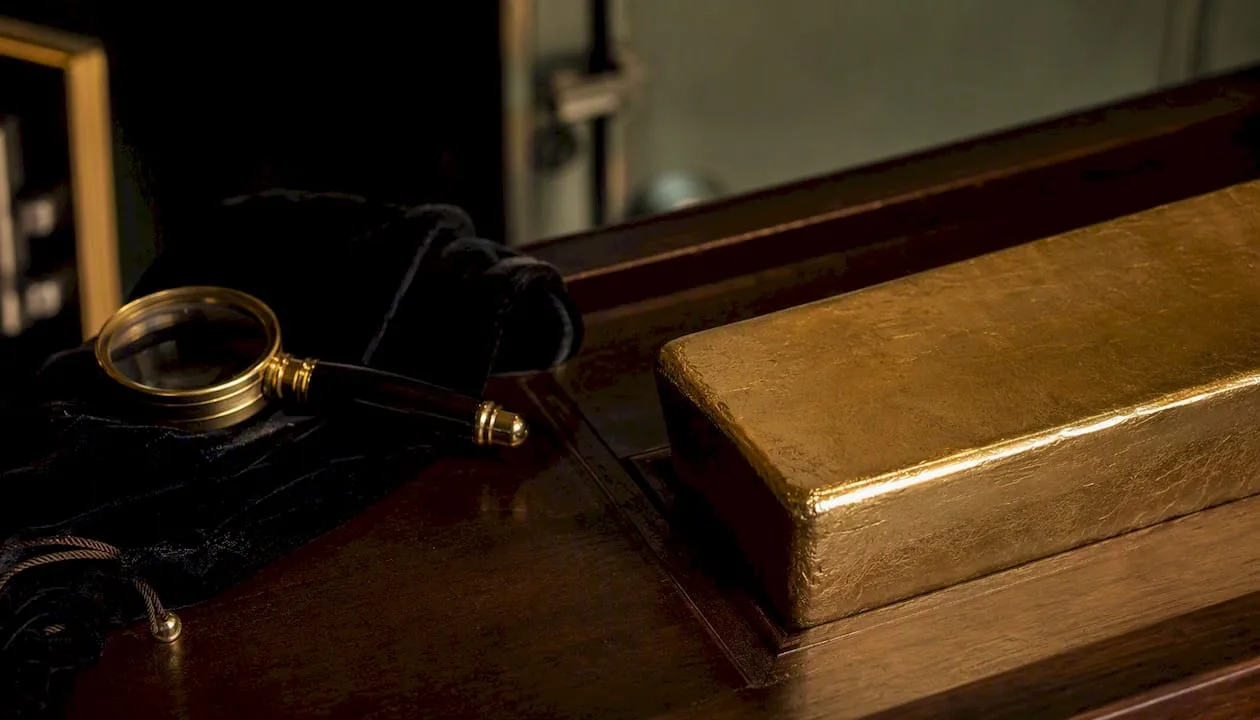
That tolerance exists because Good Delivery bars are cast, not stamped from pre-measured blanks. Refiners pour molten gold into molds, and the exact weight that results depends on the pour. Every bar gets weighed to four decimal places, stamped with its exact weight and purity, and recorded before it ever enters the market.
Central banks and large bullion dealers rely on this standard because it guarantees traceable provenance and consistent purity across an enormous, otherwise unregulated global market. A bar’s chain of custody matters as much as its weight once you’re dealing in units this large, since resale and settlement depend on the market trusting that the bar hasn’t been tampered with since it left the refinery.
Verifying a Good Delivery bar typically means checking for:
- The refiner’s hallmark, which identifies an accredited assayer recognized by the London Bullion Market Association
- A unique serial number that ties the bar to refinery records
- The stamped fineness (995 or higher) and the exact weight to four decimal places
- Assay marks confirming the bar passed purity testing before leaving the refinery
None of these markings mean much without paperwork and a trusted chain of custody behind them, which is why institutional buyers rarely take physical possession without a vault or bonded courier involved.
How Do You Verify a Gold Bar’s Weight Yourself?
Checking a gold bar’s weight is straightforward, but it needs to be done carefully, especially for anything beyond a small retail bar. Here’s the sequence worth following:
- Use a calibrated digital scale accurate to at least 0.01 grams for smaller bars, or a certified scale rated for the bar’s full weight for anything kilobar-sized or larger.
- Read the stamped gross weight and purity on the bar itself, and confirm whether the stamp uses troy ounces or grams.
- Weigh the bar and compare the measured result to the stamped figure, allowing for the scale’s stated margin of error.
- Inspect the refiner’s hallmark and serial number against publicly available refiner lists where they exist, and check that engraving looks consistent with the rest of the bar’s finish.
- Check the dimensions against published specifications for that size and refiner, since a bar that’s noticeably thicker or thinner than standard for its weight can signal a filled or plated fake.
Pro Tip: Calibrate your scale with a certified reference weight before you trust any reading, and do the weighing in a private, secure space rather than in public. For anything above a few ounces, or for any bar you didn’t buy directly from a known refiner or dealer, a professional assay or XRF (X-ray fluorescence) scan is worth the cost before money changes hands.
High-value bars and anything institutional in scale should go through a qualified vault, assay service, or accepted refiner for verification before settlement. That’s not a step worth skipping to save time.
How Do You Calculate a Gold Bar’s Dollar Value?
The formula is simple once you have the right inputs:
Value = (weight in troy ounces) × (spot price per troy ounce) × (purity fraction) + premium
If your bar’s weight is listed in grams, convert first by dividing by 31.1034768. If it’s listed in kilograms, multiply by 32.1507465 to get troy ounces, per the standard conversion constants.
Purity matters because most investment bars aren’t pure 24 karat gold in an absolute sense; they’re stamped with a fineness like .999 or .9999. A 1,000 gram bar at 995 fineness contains 995 grams of fine gold, not 1,000, though most retail investment bars run .999 or higher, making the gap negligible for everyday buyers.
Here’s how the math plays out using placeholder spot prices you’d swap for a live quote:
Those spot figures are placeholders for illustration only. Always plug in the current quote from a live source, like GoldRock Metal Exchange’s live prices page, before you calculate anything you intend to act on.
Premiums stack on top of that base value, and they come from real costs: minting, assay, distribution, and dealer margin. Small bars carry the highest premiums relative to their gold content, while kilobars and larger institutional bars trade much closer to raw spot value.
Is It Legal to Own a 400 Ounce Gold Bar?
Yes. There’s no federal restriction on private ownership of gold bars of any size in the United States, including full 400 troy ounce Good Delivery bars, and no legal limit on how much gold an individual can own. The restrictions that existed under Executive Order 6102 were repealed decades ago, and modern U.S. law treats physical gold ownership as unrestricted for private citizens.
A few quick conversions people commonly search for: 27 pounds of gold works out to roughly 393.4 troy ounces, close to a single Good Delivery bar. A 1 kilogram bar, at 2.2046 pounds, converts to 32.15 troy ounces. If you’re holding 10 troy ounces, that’s about 0.686 pounds, or 311 grams.
Tax and reporting obligations are a separate matter from ownership itself, and they depend on how you acquire, hold, and eventually sell the metal, including whether it sits inside a retirement account. This article provides general educational information only and isn’t tax or legal advice; confirm your specific reporting requirements with a qualified tax advisor or the IRS directly, and speak with a qualified custodian before making decisions about precious metals inside a retirement account.
Why Weight Literacy Matters More Than Most Investors Realize
Precise weight and conversion knowledge sounds like a minor detail until you’re actually pricing a purchase, valuing a holding for a retirement account, or deciding how to store something worth tens of thousands of dollars. Get the troy ounce versus avoirdupois distinction wrong, and your mental math on a 10 or 20 ounce position drifts further off than most people expect. Get the Good Delivery tolerance range wrong, and you might question a legitimate bar’s authenticity over a weight variance that’s completely standard.
I’ve seen enough confusion around these numbers to know it’s rarely about math ability. It’s about not knowing which unit a given number is even in. That’s a solvable problem, and it’s one worth solving before you’re standing in front of a scale with money on the line rather than after.
This is exactly the kind of groundwork brings to conversations with clients who are deciding how physical metal fits into a broader retirement strategy. Weight conversions are simple mechanics, but they sit underneath every decision that follows: how much to buy, how to store it, and how to value it later. If you want to talk through what that looks like for your own situation, request a Free Precious Metals Consultation or call (888) 859-0978.
Ready to Add Physical Gold to Your Portfolio?
Knowing exactly how much a bar weighs is only useful once you have a straightforward way to buy it, store it, or move it into a retirement account, and that’s where a full-service dealer earns its keep over trying to piece together a purchase, a custodian, and insured shipping on your own.

GoldRock Metal Exchange handles the parts that trip up first-time buyers most: sourcing verified bars at the size that fits your budget, coordinating self-directed IRA rollovers through an in-house IRA department, and arranging insured private delivery so your metal arrives documented and accounted for. Whether you’re weighing a single 1 ounce bar or considering a kilobar for a retirement account, the same team walks you through pricing, paperwork, and delivery from one point of contact.
Services relevant to what you just read include:
- Physical gold, silver, platinum, and palladium in standard retail sizes
- Self-directed Precious Metals IRA setup and 401(k) rollover support
- Insured private delivery for bars and coins
- Ongoing consultation from an in-house IRA specialist
Check current pricing on the live prices page before you buy, and when you’re ready to talk through options, request a Free Precious Metals Consultation or call (888) 859-0978.
Frequently Asked Questions
How much does 1 bar of gold weigh in pounds?
A standard 1 troy ounce retail bar weighs about 0.0686 pounds. A 1 kilogram kilobar weighs about 2.2046 pounds, and a 400 troy ounce Good Delivery bar weighs approximately 27.4 pounds.
What is the weight of a gold bar in grams for the most common retail size?
The most common retail gold bar, 1 troy ounce, weighs exactly 31.1034768 grams, typically rounded to 31.1035 grams for everyday calculations.
Is a troy ounce the same as a regular ounce?
No. A troy ounce is 31.1034768 grams, while a standard avoirdupois ounce is 28.3495231 grams. All precious metals pricing and bar stamps use troy ounces, not standard ounces.
How heavy is a gold bar compared to everyday objects?
A 1 ounce gold bar, roughly the size of a large stamp, weighs about the same as a smartphone charger. A kilobar, about the size of a deck of cards, weighs roughly the same as a bag of sugar (2.2 pounds).
Is it legal to own a 400 ounce gold bar in the United States?
Yes, there’s no federal restriction on individual ownership of gold bars of any size, including full 400 troy ounce Good Delivery bars. Tax reporting depends on how the metal is acquired and sold, so confirm specifics with a qualified tax advisor.
How much gold is actually in a bar if it’s not pure?
Fine gold content equals gross weight multiplied by purity. A 1,000 gram bar at 995 fineness contains 995 grams of fine gold; most retail investment bars run .999 fineness or higher.
This article provides general educational information about gold bar weights and units. It is not personalized investment, tax, or legal advice. Consult a qualified financial, tax, or legal professional before making investment decisions.
This article is general information, not a substitute for advice from a qualified financial advisor. Consult a qualified financial professional about your own circumstances before acting on anything here.