
Start by identifying what you own (bullion, government coin, collectible coin, or jewelry), then record the current spot price as your benchmark. Get at least three written quotes and compare each as a percentage of spot after fees. Ignore unsolicited buyers and high-pressure offers. If you want a second opinion, call us at GoldRock Metal Exchange at (888) 859-0978.
TL;DR:
- Send standard bullion and government coins to bullion dealers, collectible coins to numismatic buyers, and designer pieces to auctions, where fees and delays may apply.
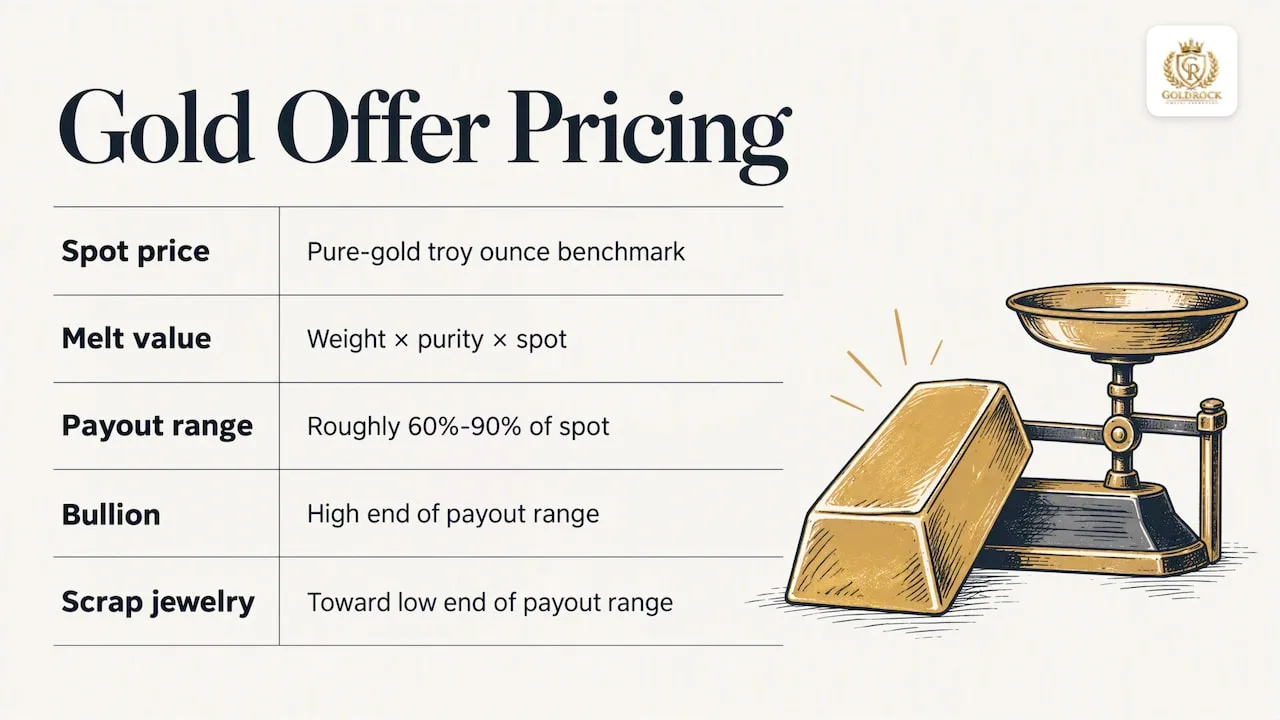
- Consumer guidance places payouts roughly between 60% and 90% of spot, with bullion near the top and scrap jewelry closer to the bottom.
- Estimate melt value by multiplying weight by purity and the current spot price; stones, alloys, refining, and handling can reduce the final offer.
- The IRS generally taxes net gains on collectibles, including coins and bullion, at a maximum rate of 28%; retain purchase receipts and sale confirmations.
- Before shipping anything, get written terms covering fees, storage, assay, and payment dates; reject unsolicited pitches, pressure tactics, and guaranteed return claims.
Table of Contents
- How to identify what you have before you sell gold
- Where to sell gold: local buyers, online dealers, and auctions
- How buyers price gold offers: spot, purity, and spread
- Step-by-step checklist to sell gold and keep the best net price
- Tax and paperwork basics when you sell gold
- How to vet gold buyers and spot red flags
- Why dedicated IRA support and insured delivery make selling simpler
- Request a Free Precious Metals Consultation
- FAQ
- Sources
How to identify what you have before you sell gold
Buyers price what they can verify, so your first job is to sort and document your items. Four groups cover almost everything:
- Bullion bars and rounds: standardized weight and purity, valued mostly on metal content.
- Government bullion coins: the U.S. Mint guarantees the weight, content, and purity of American Eagle and American Buffalo coins, which is why they are easy to price.
- Collectible (numismatic) coins: rarity, date, and condition can matter more than the gold inside.
- Jewelry: designer or antique pieces may carry value beyond metal, while scrap jewelry is priced on melt value.
Purity is stated in karats or fineness. Divide the karat number by 24 to get the share of gold: 18k is 18 ÷ 24, or 75% gold. Weight is quoted in troy ounces, and one troy ounce is about 31.1 grams. A 10-gram 18k ring contains roughly 7.5 grams of pure gold.
Jewelry usually earns a lower percentage of spot because the buyer pays for refining and labor. Standard bullion and recognized government coins land closer to spot.
Photograph hallmarks, serial numbers, and assay marks, weigh each item, and keep the records. Photographing marks and confirming weight before packing gives you evidence if a dispute comes up. Our guide on verifying gold bars covers the checks in more detail.

Where to sell gold: local buyers, online dealers, and auctions
The right channel depends on what you own, and matching the item to the buyer is often worth more than any negotiating trick.
- Local coin shops, jewelers, and pawn shops: you get same-day payment and can watch the weighing. Offers on some items tend to run lower, so these suit small sales and jewelry where speed matters more than the last few percent.
- Online bullion dealers: these often pay closest to spot for standard bullion and government coins. The trade-off is insured shipping and processing time before you are paid.
- Auctions and specialty marketplaces: collectible coins and designer pieces can fetch premiums here. Expect waiting time, possible appraisal or seller fees, and uncertainty about the final price.
A simple rule of thumb: standard bars and bullion coins go to a dealer who buys on metal value, collectible coins go to the numismatic market, and everyday scrap jewelry goes to whichever buyer quotes the highest written percentage of spot.
Convenience has a price. A buyer who pays cash quickly is solving a problem for you, and the quote may reflect it. If you are not in a hurry, collecting two or three offers across different channels costs little and shows you the real range.
If you are interested in gold bullion, see our gold bullion page or call (888) 859-0978. See our gold bullion page or call (888) 859-0978.
How buyers price gold offers: spot, purity, and spread
Every offer starts from the spot price, the market benchmark for one troy ounce of pure gold. Dealers build margin into what they pay, so the gap between spot and the buy price is the number to watch.
To estimate melt value, multiply weight by purity by spot. A 14k piece contains less pure gold than its total weight, so its melt value depends on the weight and the spot price. A buyer will offer less than that, because refining and handling come out of the margin.
Dealers buy below spot and sell above it. That buy/sell spread pays for risk, refining, storage, and overhead. Our explainer on premium over spot shows how it works from the buyer’s side.
Consumer guidance commonly puts payouts somewhere in a range of roughly 60% to 90% of spot, depending on the item and the buyer. Bullion sits at the high end and scrap jewelry toward the low end, per this consumer reporting.
Small lots, refining backlogs, and jewelry with stones or heavy alloys can all pull an offer down.
Step-by-step checklist to sell gold and keep the best net price
Follow these steps in order, and write down each result.
- Identify, photograph, and weigh. Record purity, serial numbers, and the spot price on the day you gather quotes.
- Request written quotes from at least three buyers. Ask for the percentage of spot, all fees, processing time, and payment method.
- Verify each buyer. Check the business address, reviews, and regulator advisories. Insist on written terms and a clear payment date.
- Ship with care. Document every item, buy insurance, use a tracked carrier, and confirm the assay and processing steps. Keep every receipt. Our discreet shipping guide explains private delivery options.
- Compare net payout. Subtract all fees, then weigh the result against speed and convenience before you accept.
Pro Tip: Quote everything as a percentage of the same day’s spot price. A flashy per-gram number means little until you know the spot it is measured against.
Also remember that premiums, fees, and commissions can erode profits, so a higher headline offer with large fees can pay you less than a modest offer with none.
Tax and paperwork basics when you sell gold
This section is general education, not tax advice. Your situation may differ, so talk with a qualified tax professional.
- The IRS treats gold as a capital asset, and net capital gains on collectibles, including coins and bullion, are generally taxed at a maximum rate of 28%.
- Gain or loss depends on what you paid (your basis) and what you received, as explained in IRS Publication 544.
- Dealers may report certain transactions to the IRS, so keep purchase receipts, appraisals, and sale confirmations in one folder.
- Buying rules differ from selling rules; our overview of sales tax on gold covers the purchase side.
How to vet gold buyers and spot red flags
Ask every prospective buyer the same questions, and keep their answers in writing:
- How is your buy price calculated?
- Are all fees in writing before I ship?
- Where will my metal be held, and by whom?
- When and how will I be paid?
The CFTC lists high-pressure tactics, unsolicited calls, financing arrangements, and guaranteed-return claims as common fraud signals. Its fraud advisory adds unverifiable storage and unclear inventory to the list, and suggests checking registration and complaint histories with regulators. Never ship or hand over items before you have terms on paper. Our dealer selection practices offer a longer checklist.
Why dedicated IRA support and insured delivery make selling simpler
People often assume the hard part of selling gold is finding a buyer. In my view the harder part is the logistics around it: custodian paperwork when retirement metals are involved, and the shipping risk on high-value items. A dealer with an in-house IRA team and insured private delivery removes much of that friction, and friction is where mistakes and scams tend to enter.
— Blake
Request a Free Precious Metals Consultation
If you want help weighing offers, converting holdings, or moving metals into a retirement account, we are ready to talk it through with you. Here is what we offer:
- Self-directed Precious Metals IRA guidance, with in-house IRA support
- Insured private delivery
- Clear information to help you understand your options before you commit
We never promise returns or tax outcomes. We do promise a clear conversation. Review the terms and documentation before any sale. Request a Free Precious Metals Consultation or call (888) 859-0978 today.
This article is general information, not a substitute for advice from a qualified financial advisor. Consult a qualified financial professional about your own circumstances before acting on anything here.
FAQ
How much will I get if I sell my gold?
Payouts depend on the item and the buyer. Consumer guidance commonly cites roughly 60% to 90% of spot, with bullion at the high end and jewelry lower. Written quotes from several buyers show your real number.
What is 1 oz of gold selling for right now?
The price changes constantly, so check a live spot price on the day you sell and note it when you collect quotes. That benchmark lets you compare every offer fairly.
How does the IRS know if you sell gold?
Dealers may report certain transactions to the IRS, and sellers are responsible for tracking gain or loss using IRS Publication 544. Keep records of what you paid and what you received.
How can I convert my gold to cash?
Sell to a local shop for fast payment, to an online dealer for bullion, or at auction for collectibles. Get written quotes first, then compare net payouts after fees.
Sources
- Topic no. 409, Capital gains and losses | Internal Revenue Service
- How to sell your gold investment for a profit now, according to experts – CBS News
- Bullion Coin Programs | U.S. Mint