

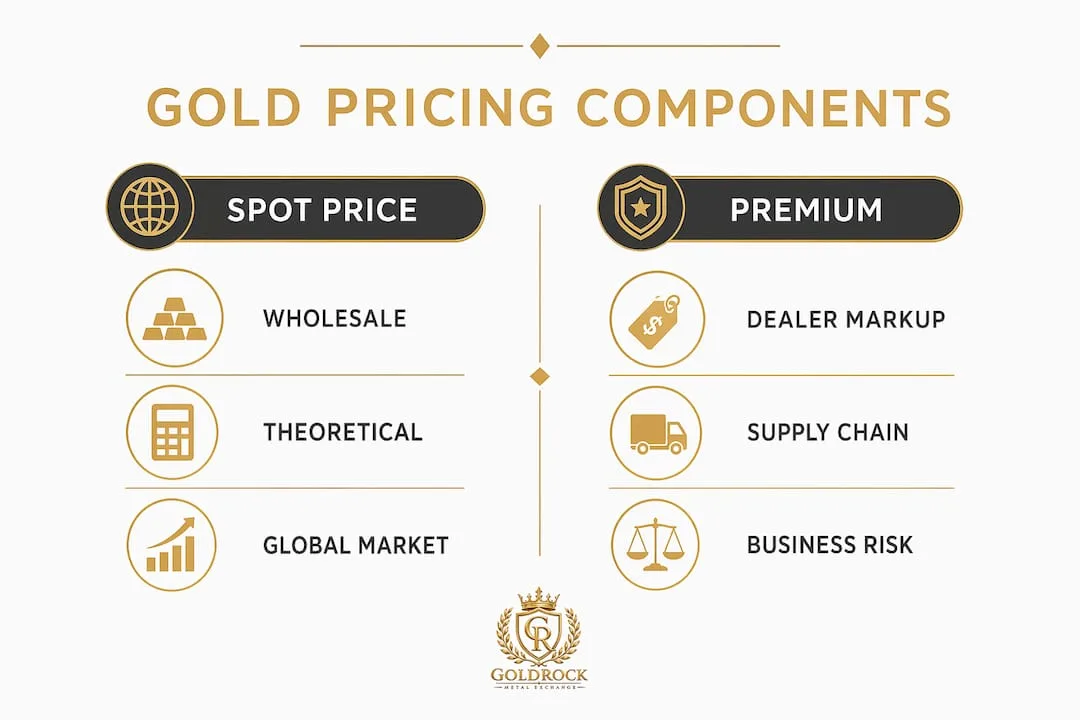
The gold premium over spot is the dollar amount you pay above gold’s current market price when you buy physical bullion. Spot price is the wholesale benchmark traded on commodity exchanges like the COMEX in New York. The premium is everything stacked on top of that number to get you an actual coin or bar in hand.
Here is what the premium over spot includes:
- Melt value gap: The difference between the spot price and the retail price you pay
- Manufacturing costs: Minting, refining, and packaging expenses built into every product
- Distribution costs: Shipping, insurance, and storage from refinery to dealer to you
- Dealer margin: The markup that covers business operations and profit
- Market conditions: Supply tightness or demand surges that push premiums higher or lower
No physical gold changes hands at spot price. Spot is a theoretical wholesale figure. The premium is the real-world cost of ownership.
Why spot price and retail price are never the same
Spot price comes from commodity exchanges where gold trades in large institutional lots. It reflects the raw metal’s value at a given moment, not the cost of turning that metal into a coin, shipping it across the country, and selling it to you through a dealer.
The retail price you pay is always: spot price + premium.
- Spot price = wholesale benchmark, set by futures markets, not accessible to individual buyers
- Premium = the retail markup that covers every cost between the exchange and your hands
- Retail price = the only price that actually matters when you write the check
Think of spot price the way you think of the wholesale price of wheat. You cannot walk into a grain exchange and buy a bushel at that price. By the time wheat becomes bread on a store shelf, milling, baking, packaging, and distribution have all added to the cost. Gold works the same way. The physical acquisition costs that spot excludes are exactly what the premium covers.
What actually drives the premium on physical gold
Several distinct cost layers combine to form the premium on any gold product. Understanding each helps you recognize when a premium is reasonable and when it is inflated.
- Minting and refining: Producing a finished coin or bar requires precision equipment, quality assurance, and skilled labor. Government mints like the U.S. Mint charge a seigniorage fee on top of raw metal costs.
- Packaging and certification: Sealed assay cards, certificates of authenticity, and tamper-evident packaging all add cost.
- Shipping and insurance: Moving physical gold from refinery to distributor to dealer involves freight, tracking, and full-value insurance at every leg.
- Storage: Dealers carry inventory. Holding physical gold in a secure vault costs money, and that cost flows into the premium.
- Dealer margin: Every dealer operates a business. Staff, compliance, marketing, and profit are all baked into the spread between what a dealer pays and what you pay.
- Market dynamics: Supply shortages and demand spikes push premiums up. Calm markets with deep inventory bring them down.
Dealer markups are not arbitrary gouging. They reflect legitimate supply chain costs and business risk. A dealer who buys inventory at one spot price and sells it days later faces real price exposure in between.

How premiums differ across coins, bars, and rounds
Not all gold products carry the same premium, and the gap between product types can be meaningful. Gold coins typically carry a higher premium than bars or rounds because of legal tender status, design complexity, and government-backed authenticity.
- Government coins (American Gold Eagle, Canadian Gold Maple Leaf, South African Krugerrand): Highest premiums due to legal tender status, recognized purity guarantees, and strong secondary market demand. Easier to resell at fair prices.
- Gold bars: Generally lower premiums because production is simpler, no legal tender status, and they are produced in large quantities. A 1 oz gold bar at 4.07% premium costs more than some sovereign coins when bar supply tightens.
- Gold rounds: Private mint products that look like coins but carry no legal tender status. Premiums sit between bars and government coins. Less recognized in the secondary market, which can affect resale.
- Size matters: Larger bars (10 oz, 1 kilo) carry lower percentage premiums per ounce than 1 oz bars, because fixed production costs spread across more metal. Fractional coins (1/4 oz, 1/10 oz) carry the highest percentage premiums of all.
- Collectibility and scarcity: Proof coins, limited mintage releases, and numismatic pieces carry premiums that can far exceed their melt value. For pure bullion investing, stick to products where the premium reflects production cost, not collector demand.
Pro Tip: If your goal is to own the most gold for the least premium, 1 oz government coins or larger bars from recognized refiners usually offer the best balance of liquidity and cost.
How supply and demand move premiums up and down
Premiums are not fixed. They respond to market conditions in real time, sometimes dramatically. During periods of high demand or constrained supply, dealer inventories tighten and premiums climb well above their normal range.
- Demand surges: Economic uncertainty, geopolitical events, or sharp stock market drops send buyers rushing to physical gold. Dealers sell through inventory fast and raise premiums to slow demand or reflect replacement cost.
- Supply constraints: Mint production shutdowns, refinery disruptions, or shipping delays reduce available product. Less supply at the same demand level means higher premiums.
- Seasonal patterns: Demand for gold gifts and jewelry tends to rise around certain holidays, which can nudge premiums slightly higher during those windows.
- Order size: Buying in larger quantities often unlocks lower per-unit premiums. Dealers pass on volume savings because large orders reduce their per-transaction costs.
- Dealer inventory depth: A dealer sitting on deep inventory can afford tighter margins. A dealer running low has less room to compete on price.
Watching premium trends over time gives you a real edge as a buyer. When premiums compress during quiet markets, you get more gold per dollar spent.
Real examples of gold premium over spot in action
Concrete numbers make this clearer than any abstract explanation. Using a spot price of $4,115 per troy ounce as a reference point, here is how premiums play out across common products:
- 1 oz American Gold Eagle: Priced at $4,253, that is a $138 premium, or 3.32% above spot. Strong secondary market demand and U.S. Mint backing justify the markup.
- 1 oz gold bar: Priced at $4,285, carrying a $170 premium or 4.07% above spot. Higher than the Eagle right now, which signals tight bar supply or elevated dealer margins on bars.
- 1 oz Canadian Gold Maple Leaf: Priced slightly above spot and somewhat lower than the Eagle for the same amount of gold. Same purity, slightly lower premium because of different collector demand.
- Fractional 1/10 oz coin: Percentage premium can run two to three times higher than a 1 oz coin, because the fixed minting cost spreads across far less metal.
The formula is straightforward. Premium percentage = (retail price minus spot price) divided by spot price, multiplied by 100. Dollar premium = retail price minus spot price. Both figures matter. Dollar premium tells you the absolute extra cost. Percentage premium lets you compare products fairly, regardless of size.
Dollar premiums can mislead you when spot price moves. If spot rises $200 and the dealer holds the same dollar markup, your percentage premium actually drops. Percentage is the more reliable metric for comparing value across products and over time.

Practical tips for evaluating and managing gold premiums
Premium over spot is unavoidable. Every physical gold purchase carries one. The goal is not to eliminate it but to understand it well enough to buy smart.
- Calculate both dollar and percentage premiums before any purchase. A low dollar premium on a small coin can still be a high percentage premium.
- Compare across product types. A 1 oz bar and a 1 oz coin contain the same gold. The premium difference is pure cost. Know what you are paying for.
- Shop multiple dealers. Premiums vary from one dealer to the next for identical products. A few minutes of comparison can save real money per ounce.
- Buy larger sizes when possible. Larger bars and coins carry lower percentage premiums. If you are building a precious metals portfolio that includes gemstones, favor 1 oz or larger products over fractional sizes.
- Watch market conditions. Premiums compress during calm periods and spike during crises. Buying when demand is moderate and inventory is deep means you pay less above spot.
- Factor in resale. Products with strong secondary market recognition, like American Gold Eagles, tend to resell closer to spot. A lower-premium generic round might cost less upfront but sell at a steeper discount later.
- Avoid numismatic markups if your goal is bullion investment. Collector premiums reflect rarity and condition, not metal content, and they do not reliably recover at resale.
Understanding the intrinsic value of gold separate from its premium helps you keep perspective on what you are actually buying.
How GoldRock Metal Exchange helps investors navigate gold premiums
GoldRock Metal Exchange gives investors the tools and guidance to understand exactly what they are paying and why. Transparent pricing tied to live spot prices means you can see the premium on every product in real time, not after the fact.
- Live spot price tracking: GoldRock publishes current spot prices so buyers can calculate premiums themselves before committing to a purchase.
- Personalized education: The team walks investors through premium components, product comparisons, and timing considerations, not just product listings.
- Insured private delivery: Physical gold ships with full insurance coverage, so the delivery cost you pay is transparent and the metal arrives safely.
- In-house IRA department: For investors using a self-directed precious metals IRA, GoldRock’s dedicated team handles the transfer process and helps select products with appropriate premiums for retirement accounts.
- Ongoing consultation: Markets change. Premiums shift. GoldRock provides continued support so investors can respond to those changes with confidence.
Pro Tip: Before buying, ask your dealer to show you the current spot price and the exact dollar and percentage premium on the product you want. Any reputable dealer will provide this without hesitation.
Ready to see current premiums on gold coins and bars? Browse GoldRock’s products or check live spot prices to calculate your true cost of ownership before you buy.
The bottom line on gold premiums
Gold premium over spot is not a hidden fee or a dealer trick. It is the real cost of converting a wholesale market price into a physical asset you can hold, store, and sell. Every component of the premium, from minting to shipping to dealer margin, reflects a genuine expense in the supply chain.
What separates informed buyers from uninformed ones is knowing how to calculate that premium, compare it across products, and recognize when market conditions are working in their favor. Spot price tells you what gold is worth. Premium tells you what it costs to own it. Both numbers belong in every buying decision you make.
Key Takeaways
The gold premium over spot is the unavoidable markup above spot price that covers manufacturing, distribution, and dealer costs for every physical gold product.
| Point | Details |
|---|---|
| Premium formula | Subtract spot price from retail price for the dollar premium; divide by spot and multiply by 100 for the percentage. |
| Product type matters | Government coins carry higher premiums than bars; fractional sizes carry the highest percentage premiums of all. |
| Supply and demand shift premiums | Tight inventory and demand surges push premiums up; calm markets with deep stock bring them down. |
| Percentage beats dollar for comparison | Dollar premiums stay flat when spot moves; percentage premium gives a more accurate read across products and time. |
| Resale liquidity has a cost | Recognized products like American Gold Eagles resell closer to spot, making their higher upfront premium worth considering. |