

Whether you pay sales tax on a gold purchase depends on two things: the state where your order ships, and whether the product qualifies as investment-grade bullion or a collectible coin. Many states exempt bullion from sales tax, but some still tax it, and rules can change with little warning.
That upfront sales tax is a separate issue from capital gains tax, which applies later when you sell. The IRS classifies physical gold and silver as collectibles, meaning long-term gains face a federal ceiling of 28 percent instead of the lower rates that apply to stocks.
- Sales tax: charged at purchase, determined by your delivery state
- Capital gains tax: charged at sale, determined by the IRS collectibles rule
- Large orders and IRA custody change both the tax exposure and the delivery logistics
Quick fact: Investment-grade bullion is exempt from sales tax in most U.S. states, though a small group of states and Washington, D.C. still apply it.
Key Takeaways
Sales tax on gold hinges on your delivery state’s bullion exemption rules, while capital gains tax applies separately at sale under the IRS collectibles rule with a 28 percent long-term ceiling.
| Point | Details |
|---|---|
| Sales tax depends on delivery state | Online bullion purchases are taxed based on the ship-to address, not the dealer’s location. |
| Most states exempt bullion | A small group, including Hawaii, Maine, New Mexico, Vermont, and D.C., still tax bullion purchases. |
| Capital gains is a separate tax | The IRS treats physical gold as a collectible, capping long-term gains at 28 percent federally. |
| Keep every document | Invoices, purity certificates, and delivery receipts protect your cost basis at tax time. |
| IRA custody shifts the picture | GoldRock Metal Exchange’s in-house IRA department and insured private delivery help buyers manage eligible bullion, custody, and documentation together. |
This article is general information, not a substitute for advice from a qualified financial advisor. Consult a qualified financial professional about your own circumstances before acting on anything here.
Table of Contents
- Which States Charge Sales Tax on Gold?
- Why Are Some Coins Taxed and Others Exempt?
- How Sales Tax Differs From Capital Gains Tax on Gold
- How Can You Lower Your Sales Tax Exposure Legally?
- What Should You Confirm Before You Buy Gold?
- What Matters More Than the Sales Tax Line Item
- Request a Free Precious Metals Consultation for Tax-Aware Buying
- Sources
Which States Charge Sales Tax on Gold?
Online bullion purchases are taxed according to the buyer’s delivery address, not the dealer’s location. That single rule explains most of the confusion buyers run into: a Texas dealer might sell you a coin tax-free, but if you ship it to a state that taxes bullion, you still owe that state’s tax.
Five states charge no statewide sales tax at all, including Alaska, Delaware, Montana, New Hampshire, and Oregon. Buyers shipping to any of those states avoid sales tax on gold by default, since there is no general sales tax to apply in the first place.
Beyond those five, most states exempt investment-grade bullion outright, treating it more like currency exchange than a retail sale. A smaller group, including Hawaii, Maine, New Mexico, Vermont, and Washington, D.C., still applies sales tax to bullion purchases. Some states draw the line using a purchase-size threshold instead of a flat exemption or taxable rule.
- Some states exempt bullion entirely, regardless of order size
- Others exempt bullion only above a set dollar threshold per transaction
- A few states tax bullion the same way they tax any retail good
State exemption thresholds and even entire exemptions have shifted in recent years. Washington repealed its long-standing bullion exemption effective January 1, 2026, re-imposing tax on purchases that were exempt for decades, according to The Vault Report’s state-by-state breakdown.
Pro Tip: Check your state Department of Revenue’s current bullion guidance right before you order, not from memory or an old article. Exemptions and thresholds change, and the rule that applied last year might not apply today.
Why Are Some Coins Taxed and Others Exempt?
States generally split precious metals into two buckets: investment-grade bullion and numismatic or collectible coins. Bullion’s value comes almost entirely from its metal content, which is why states tend to treat it more like a monetary asset than merchandise. Colorado’s Department of Revenue, for example, explicitly exempts monetized coins and refined bullion whose worth tracks metal content, while taxing jewelry and decorative items made from the same metals.

Purity matters too. Gold bars and rounds generally need to meet a 99.5% purity standard to qualify for IRA eligibility, and that same purity threshold often overlaps with state bullion-exemption definitions. Legal-tender coins issued by a recognized mint, like American Eagles, usually get bullion treatment even though they carry a face value.
Before you check out, look for these details on a dealer invoice:
- Product classification (bullion vs. numismatic/collectible)
- Purity percentage listed on the item description
- Whether sales tax was calculated based on your ship-to address
- Separate line items for premium, shipping, and insurance
How Sales Tax Differs From Capital Gains Tax on Gold
Sales tax and capital gains tax hit at completely different moments and answer completely different questions. Sales tax, when it applies, gets collected once, at checkout, based on your delivery state’s rules. It has nothing to do with what happens after you own the metal.
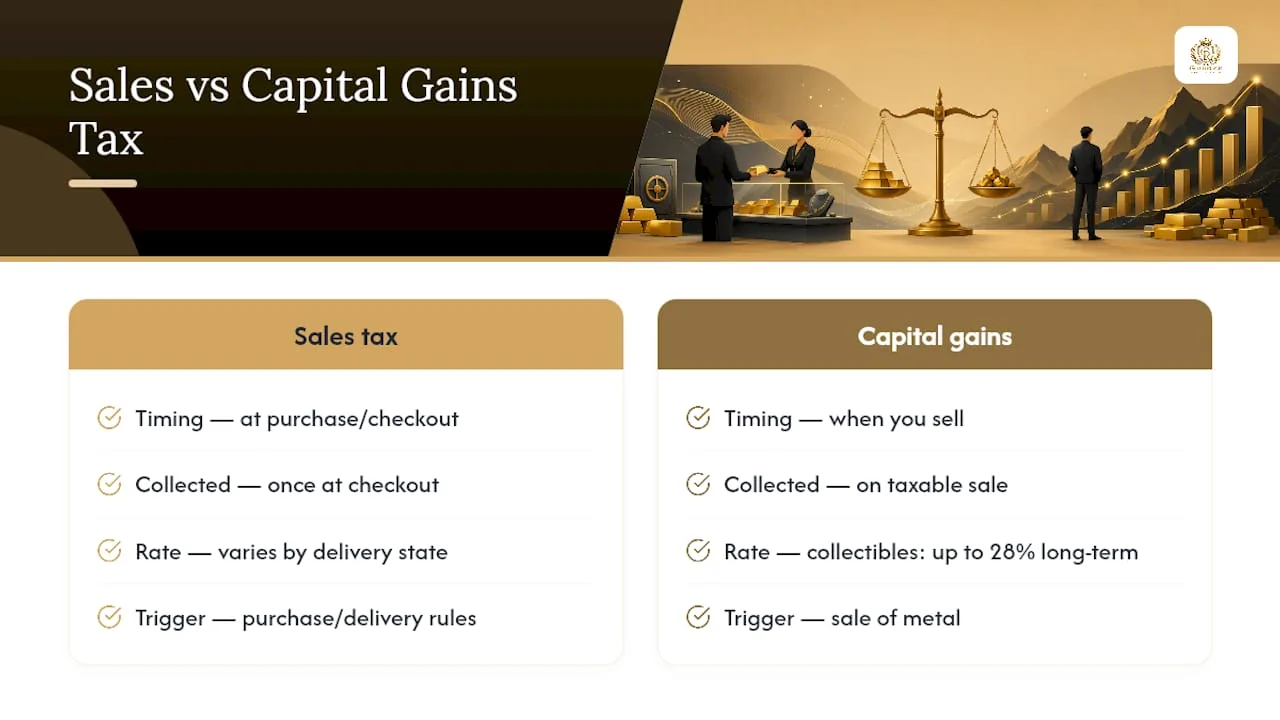
Capital gains tax shows up only when you sell, and the federal government treats physical gold and silver as collectibles. That classification caps long-term capital gains at 28 percent for gains held over a year, notably higher than the top long-term rate on most stock gains. Sell within a year of buying, and the gain gets taxed as ordinary income instead.
Your cost basis, the number the IRS uses to calculate gain or loss, can often include more than the sticker price. Dealer premiums, shipping charges, insurance, and in some cases storage fees may factor into basis, which lowers your taxable gain when you eventually sell. Certain sales also trigger Form 1099-B reporting depending on the item type and quantity involved, so keeping every receipt and invoice matters well beyond the day of purchase.
How Can You Lower Your Sales Tax Exposure Legally?
A few lawful strategies show up repeatedly among gold buyers trying to manage both sales tax and future capital gains exposure. None of these guarantee a specific tax outcome, and all of them depend on your personal situation, so treat this as a starting framework rather than a prescription.
- Ship to an exempt state when it’s genuinely your delivery address. This only works if the state is where the metal actually goes, not a workaround address, and it requires proper documentation from the dealer.
- Consolidate purchases to clear threshold exemptions. Where a state exempts bullion above a certain dollar amount, combining smaller intended orders into one transaction can shift you across that line, provided the purchase and paperwork reflect it accurately.
- Hold assets inside a self-directed Precious Metals IRA. Eligible bullion held by an approved custodian can grow tax-deferred, changing both the sales tax and capital gains picture compared to personal ownership. Purity and custody rules apply, and our IRA guide covers eligibility in detail.
- Use holding-period timing, tax-loss harvesting, or gifting. Holding gold for more than a year before selling qualifies gains for the long-term rate, and offsetting gains with losses elsewhere or timing sales to a lower-income year are common tactics investors discuss with a tax professional.
Pro Tip: Don’t chase a small sales-tax savings at the expense of good recordkeeping. A missing invoice or purity certificate can cost you far more at tax time than a percentage point of sales tax ever would.
What Should You Confirm Before You Buy Gold?
A short conversation with a dealer before you order can prevent most tax surprises. Ask directly whether your delivery address triggers sales tax, whether the product you’re buying is coded as investment bullion or a numismatic collectible, and whether the invoice breaks out premium, shipping, and insurance as separate line items.
Keep these documents for every purchase:
- Itemized invoice showing product classification and price breakdown
- Purity certificate or assay documentation
- Serial numbers, when applicable to the product
- Insured-delivery receipt confirming the shipment
- Custodian paperwork, if the purchase is going into an IRA
GoldRock Metal Exchange’s in-house IRA department handles custody and purity verification directly, and every order ships with insured private delivery so you have documentation on file from day one. If you want a second set of eyes on your delivery state, product classification, or IRA eligibility before you commit to an order, request a free precious metals consultation and walk through your specific situation with someone who does this daily.
What Matters More Than the Sales Tax Line Item
Buyers fixate on sales tax percentages because it’s the number they see first, right there on the invoice. But for anyone buying beyond a token amount, custody decisions and recordkeeping usually carry more long-term weight than a few points of sales tax ever will.
A self-directed IRA or a well-documented private purchase protects you at tax time in ways a tax-free shipping address never will. Prioritize the paperwork trail before you chase the lowest sales tax rate.
— Blake
Request a Free Precious Metals Consultation for Tax-Aware Buying
GoldRock Metal Exchange removes the two biggest friction points buyers hit when sales tax and custody questions collide: figuring out IRA eligibility and getting physical delivery handled safely. Our in-house IRA department manages custodian paperwork and purity verification directly, so you’re not left interpreting state exemption rules or IRA purity thresholds on your own.

Every order also ships with insured private delivery, giving you a documented paper trail from the day you buy, which matters as much for your own records as for any future tax reporting. Whether you’re weighing a direct purchase or a 401(k) rollover into metals, our team can walk through delivery-state considerations and IRA eligibility before you place an order. Browse current bullion products or check today’s live spot prices to see what fits your plan.
Ready for specifics on your situation? Request a Free Precious Metals Consultation by calling (888) 859-0978, and we’ll help you plan a purchase or IRA rollover with your delivery state and custody needs mapped out in advance.
This article is for general educational purposes only and is not personalized tax, legal, or investment advice. Consult a qualified tax professional or financial adviser regarding your specific situation.
Sources
- Understanding Taxes on Gold and Silver Investments — Investopedia
- Which states have no sales tax on silver and gold? — CBS News
- Sales Tax on Gold & Silver by State (2026) | The Vault Report
- What Are the Tax Implications of Gold and Other Precious Metal Investments? — JCCS CPA