

Yes, you can roll a qualifying pension lump sum or eligible 401(k) distribution into a self-directed precious-metals IRA, and the safest way to do it is a direct trustee-to-trustee transfer. This method moves funds custodian-to-custodian, so the money never touches your hands, which means no mandatory 20% withholding and no 60-day clock working against you. This guide walks through eligibility, the transfer steps, IRS metal standards, real costs, and how GoldRock Metal Exchange supports the process from paperwork to storage.
TL;DR:
- Only certain pension and 401(k) payouts qualify for rollover, including separation from service and plan termination events, but not required minimum distributions.
- A direct trustee-to-trustee transfer avoids withholding and the 60-day redeposit window, making the process safer and more straightforward.
- Watch out for 20% withholding on indirect rollovers and ensure all paperwork specifies a direct transfer to prevent unexpected taxes or penalties.
- GoldRock Metal Exchange offers in-house coordination, itemized quotes, and insured delivery options to simplify pension rollovers into precious-metals IRAs.
Table of Contents
- Quick Checklist Before You Call Your Plan Administrator
- Which Pension or 401(k) Payouts Actually Qualify for Rollover?
- How Do You Complete a Direct Rollover Into a Gold IRA?
- What Metals Qualify, and Where Must They Be Stored?
- What Fees Should You Expect, and What Should You Get in Writing?
- How Much of a Pension Lump Sum Should Go Into Gold?
- What Risks and Red Flags Should You Watch For?
- How GoldRock Metal Exchange Supports a Pension Rollover
- Your One-Page Checklist Before You Sign or Fund Anything
- The Two Decisions Hiding Inside One Pension Choice
- Talk to GoldRock Metal Exchange Before You Move a Dollar
- Sources
Quick Checklist Before You Call Your Plan Administrator
Before you pick up the phone, get your paperwork lined up so the call moves fast and nothing gets misrouted.
- Open a self-directed IRA with a custodian that accepts physical precious metals, and get their exact payment instructions, payable to the custodian FBO (for the benefit of) you.
- Request your pension or plan distribution forms and specify in writing that you want a direct rollover, not a check made out to you personally.
- Ask for an itemized metal quote, a written custodial and storage fee schedule, and the exact depository name where your metals will sit.
Skipping any one of these steps is how people end up with delayed transfers or, worse, an accidental taxable distribution.
Which Pension or 401(k) Payouts Actually Qualify for Rollover?
Not every payout from a pension or employer plan is rollover-eligible, so confirm the event before you request paperwork.
- Separation from service, plan termination, or an employer buyout window are the most common triggers; your plan document or buyout letter will specify the exact terms.
- Defined benefit lump sums often require written spousal consent when a lump sum replaces a joint-and-survivor annuity, since federal rules protect a surviving spouse’s claim to that income.
- Required minimum distributions cannot be rolled over. If you’re already taking RMDs, confirm with your administrator that the funds in question aren’t classified as an RMD before requesting a transfer.
IRS Publication 590-A lays out which distributions are eligible for rollover and which ones aren’t, and it’s worth reading the relevant section before you sign anything. The statutory backbone for IRA rules more broadly sits in 26 U.S.C. § 408, which defines what counts as a legitimate individual retirement account in the first place.
How Do You Complete a Direct Rollover Into a Gold IRA?
A trustee-to-trustee transfer has four moving parts, and getting the order right keeps the whole thing tax-free.
- Open the receiving self-directed IRA first. Choose a custodian that permits physical metals, and get their precise wiring or check instructions before you contact your old plan.
- Notify your plan administrator in writing. Tell them you want a direct rollover, not a personal distribution, and ask whether they send a wire or a check made payable to the new custodian.
- Track the transfer until funds post. Once your custodian confirms receipt, instruct them on how much to allocate toward metals, then request itemized purchase quotes before authorizing the buy.
- If you end up with an indirect distribution, understand the trap. The plan will withhold 20% for federal taxes automatically, and you have 60 days to redeposit the full original amount, including the withheld portion, into your new IRA. That means covering the missing 20% out of your own pocket temporarily, or that amount becomes taxable income plus potential early withdrawal penalties.
Pro Tip: Call your plan administrator and ask directly, “Will this be a direct trustee-to-trustee transfer, or will I receive a check?” If the answer is anything other than a direct transfer to your custodian, push back and ask them to reissue it correctly before you accept the funds.
This mechanism is documented clearly in SmartAsset’s guide to 401(k)-to-gold-IRA rollovers, and the withholding pitfall specifically is a frequent source of unplanned tax bills, as Yahoo Finance has reported. For a deeper walkthrough of best practices at each stage, GoldRock’s 401(k) rollover guide covers the paperwork sequence in more detail.
What Metals Qualify, and Where Must They Be Stored?
The IRS restricts what you can hold in a precious-metals IRA, and the rules are stricter than most people expect.
- Gold and silver generally need .995 fineness or better, with a notable statutory exception for American Gold Eagle coins, which qualify despite slightly lower purity.
- Platinum and palladium have their own minimum fineness standards, and products must come from an approved mint or refiner.
- Collector and numismatic coins do not qualify, even if they’re gold or silver, because their value comes from rarity rather than metal content.
- All IRA metals must sit in an approved third-party depository, never in a home safe or personal deposit box, and you’ll choose between segregated storage (your metals only) or commingled storage (pooled with other investors’ identical products).
Get the depository name and storage type in writing before you fund anything. GoldRock’s guide on storing physical gold safely for retirement breaks down the segregated-versus-commingled tradeoff in more depth, and the eligibility rules themselves are detailed further in GoldRock’s Gold IRA rules overview.
What Fees Should You Expect, and What Should You Get in Writing?
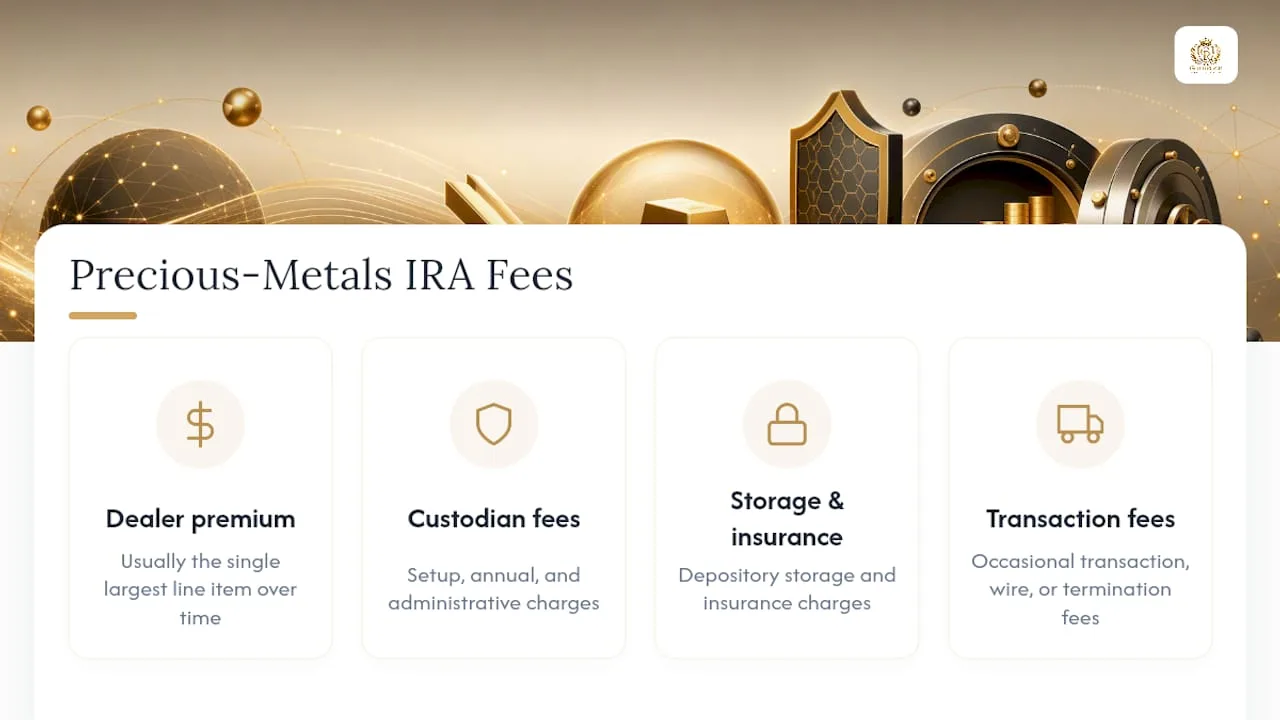
The cost structure of a precious-metals IRA has more moving pieces than a standard brokerage account, and the dealer premium is usually the single largest line item over time. Custodian setup, annual, and administrative fees stack on top of that, along with storage and insurance charges at the depository and occasional transaction, wire, or account-termination fees.

Insist on three documents before you buy anything: an itemized quote listing quantity, per-unit price, and premium-over-spot; a written custodian fee schedule; and a storage contract naming the depository. According to IRAWealthGuide’s cost breakdown, the long-run economics of a gold IRA hinge more on dealer premium and recurring custody costs than on short-term spot price swings, which is exactly why itemized pricing matters more than headline spot quotes. Ask about buyback and bid policies too. A dealer that won’t state its buyback terms in writing is a dealer you should walk away from, regardless of how competitive the initial quote looks. You can compare live spot pricing against any quote you receive on GoldRock’s live prices page.
How Much of a Pension Lump Sum Should Go Into Gold?
There’s no universal number here, but a commonly cited approach for diversification purposes is to allocate a modest portion of retirement assets to physical metals rather than a wholesale replacement for guaranteed pension income, as summarized by TaxFree401kConversion.com.
- Take the lump sum decision and the allocation decision separately. Roll the full amount into a conventional IRA first if you’re under time pressure, then decide calmly how much moves into metals once the buyout deadline pressure is gone.
- Weigh your own life expectancy, survivor income needs, and other guaranteed income before committing a large share to any single asset class.
- Factor in liquidity needs. Physical metals aren’t as instantly liquid as a brokerage account, so don’t allocate money you might need on short notice.
Academic research on precious metals pricing, including work published in Resource Policy, shows gold can behave differently than equities in certain environments, but that’s a diversification argument, not a promise of protection or appreciation.
What Risks and Red Flags Should You Watch For?
Most problems in pension-to-gold-IRA rollovers aren’t about the metal itself. They’re administrative or sales-related.
- The 20% withholding trap on indirect rollovers catches people who don’t realize their distribution went to them personally instead of trustee-to-trustee.
- The 60-day deadline for redepositing an indirect distribution is firm, and missing it converts the whole amount into a taxable event, potentially with early withdrawal penalties attached.
- The one-rollover-per-12-months rule applies to IRA-to-IRA rollovers, so don’t assume you can do multiple indirect rollovers back to back.
- Opaque pricing and refusal to itemize quotes are the clearest sign of a dealer more interested in margin than transparency.
- Aggressive, time-limited pressure to buy immediately has no place in a retirement decision. There’s no metals-market deadline attached to your pension paperwork.
Pro Tip: If a salesperson tells you the price “expires today” or pushes you to skip the written quote, treat that as a reason to slow down, not speed up.
How GoldRock Metal Exchange Supports a Pension Rollover
GoldRock Metal Exchange maintains an in-house IRA department specifically to coordinate direct rollovers, confirm custody and storage arrangements, and produce itemized purchase quotes before you commit a dollar. That in-house structure means one team tracks your transfer from the moment your plan administrator issues payment through the moment your metals are confirmed at an approved depository.
For clients who choose to take personal possession of metals purchased outside an IRA structure, GoldRock offers insured private delivery. It’s worth being clear that this option applies only to metals held outside a retirement account; IRA-held metals must remain in an approved depository under IRS rules, and moving them into personal possession would trigger a taxable distribution.
| What you get | Why it matters |
|---|---|
| In-house IRA department | One point of contact for the entire rollover, reducing paperwork errors |
| Itemized purchase quotes | Lets you see per-unit price and premium-over-spot before buying |
| Insured private delivery (non-IRA purchases) | Physical security for metals held outside a retirement account |
| Custodian and depository coordination | Confirms storage type and location in writing before funds move |
If you’re weighing a pension buyout or preparing to roll a 401(k), request a free precious metals consultation or call (888) 859-0978 to talk through your specific plan documents with GoldRock’s IRA team before you sign anything.
Your One-Page Checklist Before You Sign or Fund Anything
Print this list and check each item off before authorizing a transfer or a purchase.
- Confirm trustee-to-trustee transfer instructions, in writing, from both the old plan and the new custodian.
- Get the custodian and depository names, plus the storage type (segregated or commingled), confirmed in writing.
- Collect an itemized metal quote showing quantity, per-unit price, and premium-over-spot, along with a written fee schedule and buyback policy.
- Verify any required spousal consent or buyout window deadline directly with your plan administrator, and confirm the timing in writing.
- Call GoldRock Metal Exchange for a consultation if you want help executing any of these steps correctly.
The Two Decisions Hiding Inside One Pension Choice
Most guidance on pension-to-gold-IRA rollovers treats it as a single decision. It isn’t. There are actually two separate choices stacked on top of each other, and conflating them is where people get into trouble.
The first decision is whether to take the lump sum at all versus keeping the annuity, and that one usually has a real deadline attached, along with survivor income consequences that can’t be undone later. The second decision, how much of that lump sum to move into precious metals, has no deadline whatsoever. Once your funds sit in a conventional IRA, you can take weeks to decide on an allocation without losing anything.
The conventional advice out there tends to rush both decisions together, often because a buyout window creates artificial urgency that gets applied to the metals allocation too. That’s backward. The IRS’s 60-day rule and the mandatory 20% withholding on indirect distributions are the real deadlines that matter, and both are avoidable entirely with a direct trustee-to-trustee transfer. Prioritize the paperwork and the transfer mechanics first. The percentage can wait a week.
— Blake
Talk to GoldRock Metal Exchange Before You Move a Dollar
GoldRock Metal Exchange is built specifically for readers in your position: someone with pension or 401(k) funds sitting at a decision point who wants the transfer handled correctly the first time, not fixed after a withholding surprise. The in-house IRA department handles the coordination between your old plan and your new custodian directly, so you’re not relaying instructions between two institutions that have never spoken to each other.

What sets this apart is the itemized approach. You see exact per-unit pricing and premium-over-spot before you buy, not a bundled number that hides the markup. Explore current product pricing on the live prices page, or browse IRA-eligible options in the shop. If your rollover involves a divorce-related distribution, divvi’s QDRO resource is a useful reference for understanding qualified domestic relations orders before you proceed.
Request a Free Precious Metals Consultation by calling (888) 859-0978 or visiting the Precious Metals IRA page to start the process with GoldRock’s IRA team today.
This article is for educational purposes only and does not constitute investment, tax, or legal advice. Consult a qualified financial, tax, or legal professional before making decisions about your retirement funds.
This article is general information, not a substitute for advice from a qualified financial advisor. Consult a qualified financial professional about your own circumstances before acting on anything here.
Sources
- 26 U.S.C. § 408 — Individual retirement accounts
- Gold IRA rollover mistakes and how to avoid them — Yahoo Finance