

Conservative investors tend to land near 2 to 4%, moderate investors near 4 to 8%, and aggressive investors up to 15%. Research from the Silver Institute and Oxford Economics points to roughly 4% to 6% as the sweet spot for medium-risk portfolios. Check your target once or twice a year and rebalance when it drifts too far from where you started.
TL;DR:
- Investors should adjust their silver holdings based on time horizon, liquidity needs, other assets, age, and risk capacity, as these factors influence appropriate allocation bands.
- A 4 to 6 percent silver allocation is considered optimal for medium-risk portfolios, according to research from the Silver Institute and Oxford Economics.
- Physical bullion, ETFs, and IRAs are common vehicles for holding silver, with costs and storage options affecting overall investment efficiency.
- Rebalancing should occur annually or when silver’s share drifts more than 20% from the target, to manage premiums, storage fees, and behavioral risks.
- Silver’s higher volatility and industrial demand give it growth potential and diversification benefits that warrant a distinct, flexible allocation approach.
Table of Contents
- Allocation Bands Explained: Why Conservative, Moderate, and Aggressive Ranges Differ
- How to Split Your Metals Sleeve: What Portion Should Be Silver Versus Gold
- Allocation Frameworks Investors Cite and How to Adapt Them for Silver
- How to Implement Your Target Silver Percentage: Vehicles, Storage, and Rebalancing Steps
- Risks, Tradeoffs, and Common Mistakes When Increasing Silver Exposure
- GoldRock Metal Exchange: Services and Resources for Implementing a Silver Allocation
- What the Research Actually Supports, and What It Doesn’t
- Request a Free Precious Metals Consultation
- Sources
Allocation Bands Explained: Why Conservative, Moderate, and Aggressive Ranges Differ
The gap between a 2% silver position and a 15% one isn’t arbitrary. It reflects how much price swing an investor can stomach and how long their money can sit before they need it.
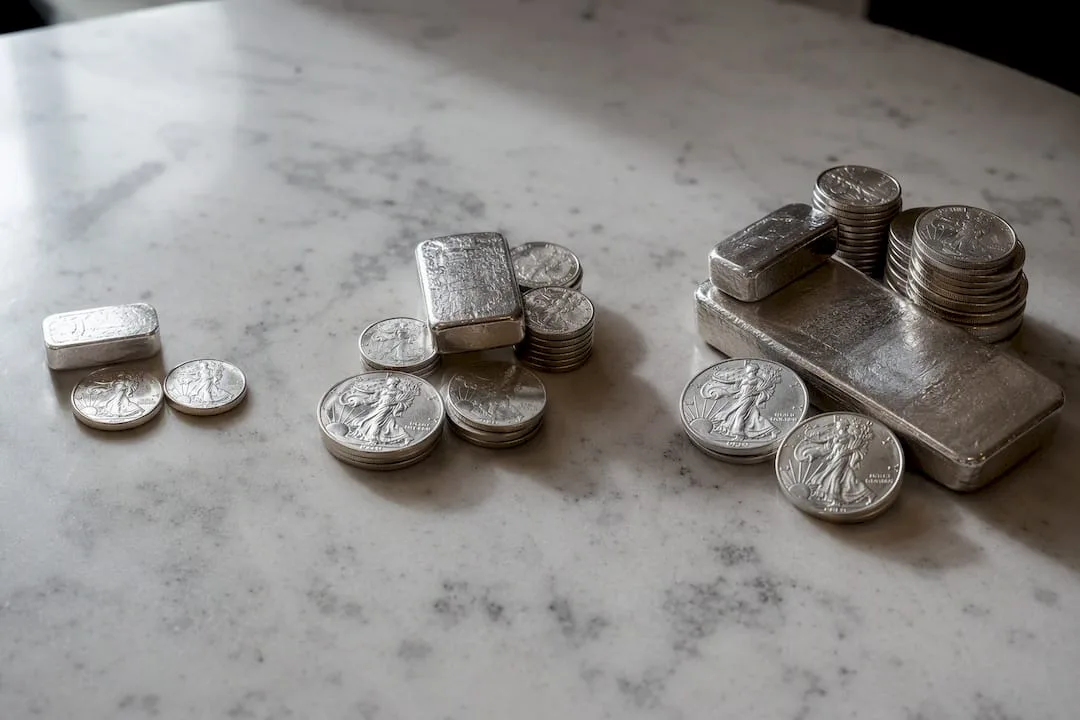
A conservative investor with a $500,000 portfolio holding 3% in silver has about $15,000 in the metal. That’s enough to provide a hedge without silver’s price swings meaningfully moving the household’s net worth on a bad week. A moderate investor with the same portfolio size at 6% holds $30,000, aligning closely with the 4 to 6% figure that Silver Institute and Oxford Economics research identified as improving portfolio efficiency across a historic sample running from January 1999 through June 2022.
What actually moves you between bands:
- Time horizon. Someone 15 years from retirement can absorb a silver drawdown that a retiree living off portfolio income cannot.
- Liquidity needs. If you might need to convert holdings to cash within a year or two, lean toward the lower end of your band.
- Other holdings. A portfolio heavy in bonds and cash has more room for a volatile asset than one already concentrated in growth stocks.
- Age and risk capacity. Younger investors with stable income streams generally tolerate a larger metals sleeve, a point echoed in broader asset-allocation-by-age guidance for balancing risk across decades of investing.
Academic work on gold’s role as a safe-haven asset notes that silver shares some of the same diversification properties but carries meaningfully higher volatility, which is exactly why conservative bands sit lower for silver than they typically do for gold.
How to Split Your Metals Sleeve: What Portion Should Be Silver Versus Gold
Once you’ve settled on a total precious-metals target, the next question is how to divide it.
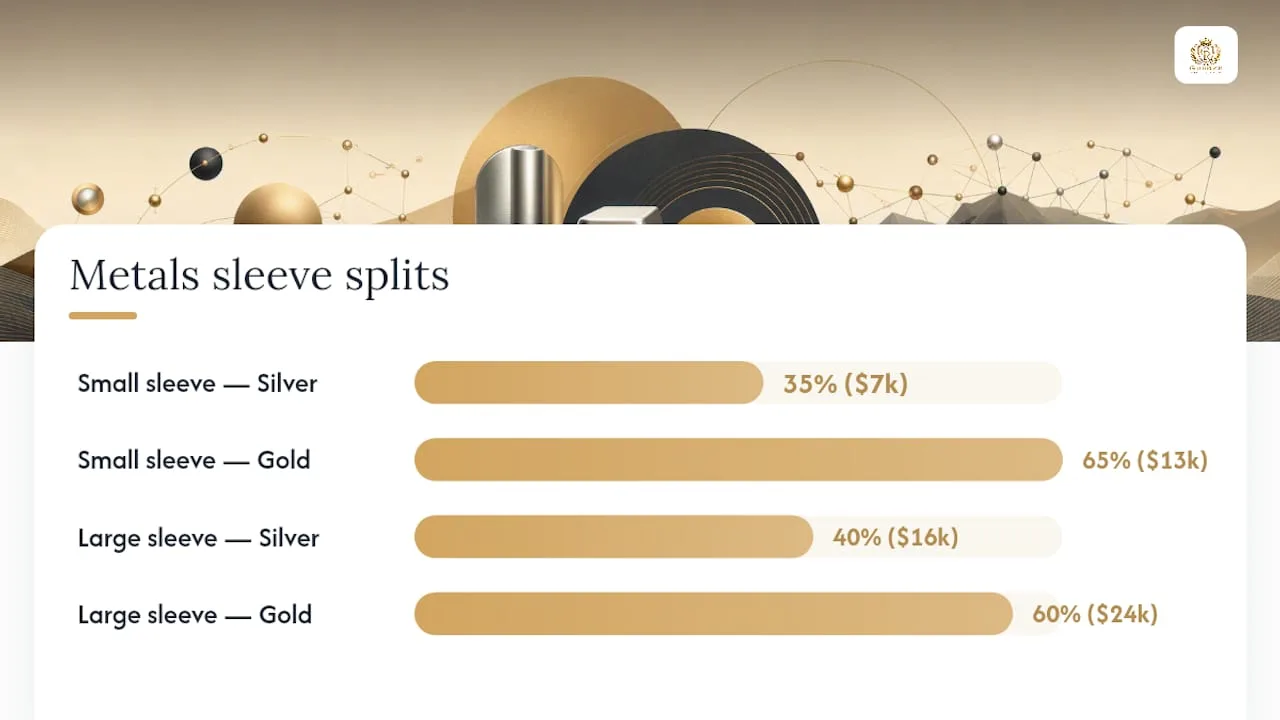
- Small metals sleeve (5% of portfolio). On a $400,000 portfolio, that’s $20,000 total. A 65/35 split puts roughly $13,000 in gold and $7,000 in silver.
- Larger metals sleeve (10% of portfolio). On the same $400,000 portfolio, that’s $40,000 total, with a 60/40 tilt toward silver placing $16,000 in the metal.
- Ratio-driven adjustment. Watch the gold-to-silver ratio as a rough guide. When the ratio runs historically high, meaning silver is cheap relative to gold, some investors tilt new purchases toward silver rather than adjusting existing holdings.
Silver’s dual identity as both a monetary and industrial metal, used in solar panels, electronics, and medical equipment, gives it demand drivers gold simply doesn’t have. That’s a reason growth-oriented investors sometimes overweight silver within their metals sleeve, and a reason conservative investors often don’t.
Pro Tip: Don’t chase the gold-to-silver ratio with every purchase. Use it as a directional signal for where new dollars go, not a trading trigger you check weekly.
Allocation Frameworks Investors Cite and How to Adapt Them for Silver
Several well-known portfolio frameworks give a rough sense of how much room metals occupy in a diversified mix, and silver’s share follows from there.
- The All-Weather approach, popularized by Ray Dalio, typically allocates a modest slice, often cited around 7 to 8%, to gold and commodities combined, designed to perform across different economic regimes rather than chase returns.
- The Permanent Portfolio splits assets into four equal 25% quarters: stocks, bonds, cash, and gold, making metals a full quarter of the mix, a far more aggressive tilt than most individual investors adopt today.
- The 60/20/20 approach, which has drawn renewed attention after a Morgan Stanley executive publicly favored it as an inflation hedge, allocates 20% to alternatives including metals, a meaningfully larger commitment than traditional 60/40 stock-bond portfolios.
Treat them as a starting scaffold: take the total metals percentage the framework implies, then decide how much of that slice is silver based on your own conviction and the bands above.
How to Implement Your Target Silver Percentage: Vehicles, Storage, and Rebalancing Steps
Turning a target percentage into actual holdings comes down to a handful of decisions, each with real cost and compliance implications.
- Choose your vehicle. Physical bullion gives direct ownership and control; exchange-traded funds offer paper exposure without storage logistics; a self-directed Precious Metals IRA lets you hold physical metal inside a tax-advantaged retirement account.
- Decide on storage. Allocated storage means your specific bars or coins are set aside and identifiable; pooled storage is less expensive but commingles assets. Review storage options before committing to a vehicle.
- Count everything. Include IRA-held metals alongside taxable-account holdings when calculating your overall percentage. A metals position sitting inside a 401(k) rollover counts just as much as coins in a safe.
- Set a rebalancing rule. Review your allocation once or twice per year, or rebalance whenever silver’s share drifts more than roughly 20% from its target, a threshold commonly cited in mainstream portfolio guidance.
- Phase in purchases. Dollar-cost averaging into a target allocation over several months smooths out entry price rather than committing a lump sum at a single price point.
Watch your cost components. Premiums over spot price, storage fees, and IRA administrative charges all erode returns before market performance even enters the picture. A rebalancing approach that trades too frequently stacks these costs unnecessarily, which is exactly why most guidance favors an annual or threshold-based review over constant adjustment.
Anyone starting from scratch benefits from a structured first purchase; see this beginner’s guide to starting a metals portfolio for the sequence that keeps early mistakes to a minimum.
Risks, Tradeoffs, and Common Mistakes When Increasing Silver Exposure
Silver’s higher volatility compared with gold and bonds is the tradeoff every investor accepts when tilting toward the upper end of their allocation band. It swings harder in both directions, and a larger allocation means larger swings in dollar terms.
- Concentration risk. Pushing silver above your risk band to chase a rally turns a diversification tool into a speculative bet.
- Liquidity and premium risk. Physical coins carry dealer premiums on both the buy and sell side, and thinner markets during stress periods can widen spreads.
- Tax and reporting complexity. Precious metals held outside an IRA carry their own tax treatment; consult a qualified tax professional for guidance specific to your situation.
- Behavioral mistakes. Overtrading around short-term price moves, ignoring cumulative storage fees, and miscounting unallocated or paper exposure as if it were physical holdings all quietly erode the strategy’s value.
- Divergent scenarios. An industrial demand shock, say a slowdown in solar panel manufacturing, can hit silver differently than a broad commodity bull market driven by inflation fears. The two scenarios don’t move silver’s price the same way, which is why silver behaves less predictably than gold during macro stress events.
GoldRock Metal Exchange: Services and Resources for Implementing a Silver Allocation
Turning a target allocation into actual holdings is where most investors get stuck, and it’s the exact gap GoldRock Metal Exchange’s in-house IRA department was built to close.
- Self-directed Precious Metals IRAs let you hold physical silver, gold, platinum, or palladium inside a retirement account, with GoldRock’s team handling the rollover paperwork directly.
- Insured private delivery brings physical metal to you securely, an option for investors who prefer direct possession to third-party custody.
- Ongoing consultations help you think through how a silver allocation fits alongside your existing retirement and taxable holdings.
- Review the gold-to-silver ratio, silver price outlook, and IRA eligibility rules before making a purchasing decision.
This article provides educational information only and isn’t personalized investment, tax, or legal advice. Speak with a qualified financial or tax professional about your specific circumstances.
What the Research Actually Supports, and What It Doesn’t
The 4 to 6% figure from the Silver Institute and Oxford Economics research is the most defensible number in this entire conversation, and it’s worth noticing how far it sits from what most institutional portfolios actually hold.
Where conventional advice falls short is in treating silver as an afterthought to gold rather than an asset with its own case. Industrial demand from solar and electronics gives silver a growth driver gold doesn’t share, and that’s a reason to think about silver allocation as a distinct decision, not a rounding error tacked onto a gold position.
My honest read: most readers overthink the exact percentage and underthink implementation. Pick a number inside your band. Start.
— Blake
Request a Free Precious Metals Consultation
Reading about allocation bands is one thing. Actually funding a target percentage, without guessing on storage fees or IRA paperwork, is another. GoldRock Metal Exchange’s in-house IRA department handles the rollover process directly, so moving retirement funds into physical silver or gold doesn’t turn into a multi-month headache of custodian phone calls.

Whether you’re funding a self-directed Precious Metals IRA or making a direct purchase toward your target allocation, GoldRock’s team walks through your specific situation, risk profile, and timeline before you commit a dollar. Request a Free Precious Metals Consultation and speak with a specialist who can map out vehicle choice, storage, and rollover eligibility for your circumstances. Call (888) 859-0978, or browse current silver and gold products to see what’s available today.
This article is general information, not a substitute for advice from a qualified financial advisor. Consult a qualified financial professional about your own circumstances before acting on anything here.
Sources
- The relevance of silver in a global multi-asset portfolio (Silver Institute / study)
- The relevance of silver in a global multi-asset portfolio (Oxford Economics)
- What is a good amount of silver to own in 2026? (CBS News)