A self-directed IRA can hold physical gold, silver, platinum and palladium, but only metals that meet IRS purity standards, bought through the account and kept by a qualified custodian in a depository. The account is a regular IRA with a wider menu of assets. It is not a separate tax category, and it does not make metals safer or more profitable. This guide walks through how the setup works, what the rules require, what it costs you in effort and fees, and which warning signs to watch for.
Educational content only. Nothing here is investment, tax or legal advice. Speak with a qualified tax professional or attorney about your own situation.
TL;DR
- A self-directed IRA lets you hold IRS-eligible physical metals. “Gold IRA” and “Precious Metals IRA” are industry shorthand, not official IRS account types.
- The metals must be held by a qualified custodian. Keeping them at home is treated as a distribution of their cost.
- Setup follows a clear order: choose a custodian, open and fund the account, select eligible metals, then arrange storage.
- Custodians generally do not give investment advice or verify asset quality, so due diligence is yours. Be wary of “premium” coin pitches.
- No metal comes with a promise of returns. Plan for liquidity and required distributions before you buy.
Table of Contents
- What a self-directed IRA for metals actually is
- Which metals can go in the account
- Where the metals must be kept
- How to set up a self-directed IRA for metals, step by step
- Costs and trade-offs to weigh
- Perspective: what we tell people who ask us about this
- Red flags in self-directed IRA metals sales
- Talk to us before you move any funds
- FAQ
- Sources
What a self-directed IRA for metals actually is
Most IRAs sit at a brokerage or bank and hold stocks, bonds and funds. A self-directed IRA is an IRA whose custodian allows alternative assets, including physical bullion. You choose the investments. The custodian handles paperwork, reporting and record keeping.
Two points surprise people:
- It is the same type of IRA underneath. It can be traditional or Roth, and the account type, not the metal inside, determines how the IRS classifies it. Investopedia’s explainer makes the same point: the label is marketing shorthand.
- The extra flexibility brings extra responsibility. The SEC, NASAA and FINRA warn in an investor alert on self-directed IRAs that custodians often have limited duties. They may not verify the value of assets or the claims of the seller.
At GoldRock Metal Exchange, we start every conversation with that framing. A metals IRA is an administrative structure. Whether it fits you depends on your goals, your timeline and your comfort with physical assets.
Which metals can go in the account
Federal law generally treats metals and coins as collectibles, and an IRA that buys a collectible is treated as taking a distribution. The IRS describes this in its page on collectibles in individually directed accounts. Section 408(m) carves out exceptions for certain bullion that meets minimum fineness standards, and for certain U.S. coins.
In practice that means:
- Gold, silver, platinum and palladium can all qualify, but each has its own minimum purity threshold.
- Some coins qualify by statute, such as certain government-minted bullion coins. Others qualify because of their fineness. Origin alone does not decide eligibility.
- Some products do not qualify even though they look like bullion, because their purity falls short or they are priced as numismatic items.
Eligibility details vary by metal, so we publish a separate guide for each:
- Gold IRA eligibility and what the IRS requires
- Two Section 408(m) rules for gold that can trigger tax problems
- IRA-approved silver and fineness
- Platinum IRA rules and setup
- Palladium coins and IRA eligibility
- A checklist for collectible coins in an IRA
Before any purchase, ask for the exact product name, its fineness and written confirmation that the custodian accepts it.
Why “IRA-safe” coin choices matter
The most expensive mistake is buying something the account cannot hold, or paying far above the metal’s value for a coin sold on “rarity.” Our guide to investing in coins for retirement explains how to tell standard bullion from products that carry large markups.
Where the metals must be kept
This is the rule most often misunderstood. In an IRA, the metals must be in the possession of a qualified trustee or custodian. They cannot sit in your safe, your closet or a safe deposit box you control. The IRS has addressed custody arrangements in a private letter ruling on precious metals safekeeping, which describes trustees using a specialist administration and storage service for bullion held as IRA assets.
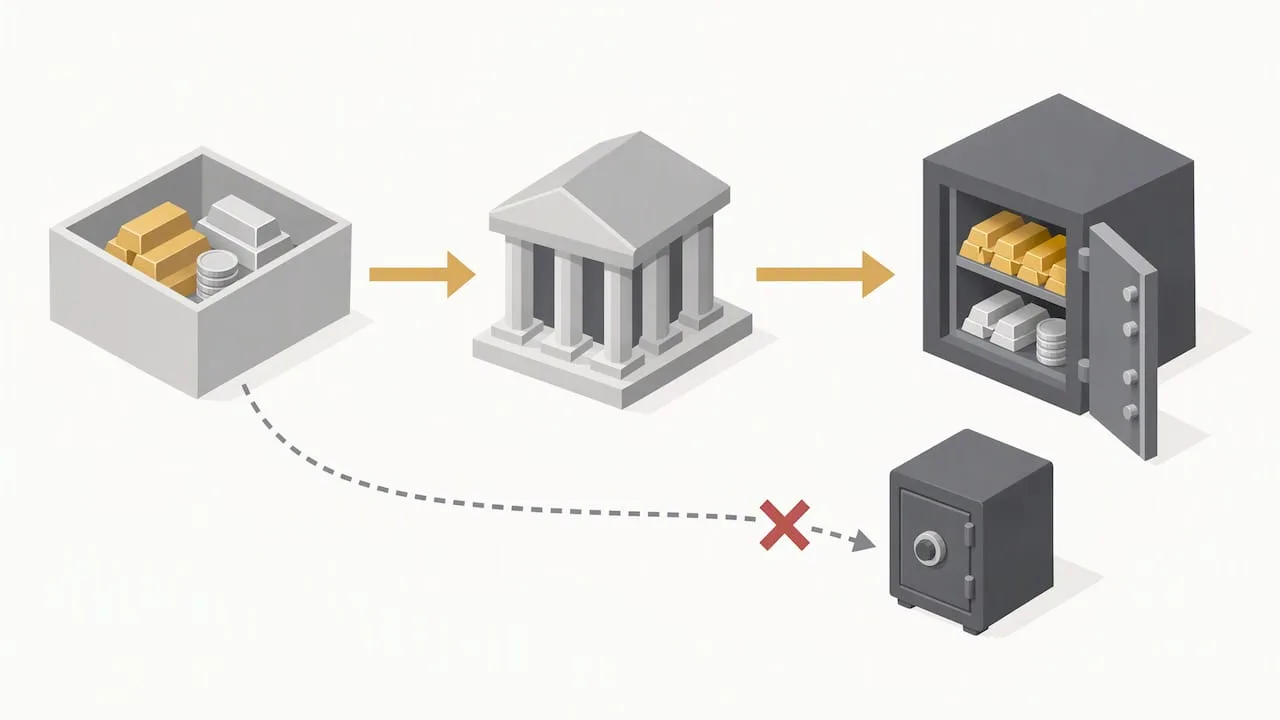
If metals are held personally, the IRS treats the cost of those assets as an immediate distribution. Possible tax consequences follow, and a tax professional is the right person to explain how that would apply to you. Structures that claim to let you hold IRA metals yourself deserve extra scrutiny.
Our article on depository versus home storage covers the storage question in more detail.
Metals you buy outside the IRA
Physical metals bought with after-tax money outside a retirement account are a separate matter. You can keep those wherever you choose. If you want them delivered, we offer insured private delivery, and our guide to private metals delivery services explains how that works. Many investors hold both: retirement metals in a depository and non-retirement metals at home.
How to set up a self-directed IRA for metals, step by step
The process runs in a predictable order. Timelines depend on how quickly your current plan administrator releases funds, so no one can fairly promise a fixed number of days. Ask each party for its own estimate.
1. Decide what you are trying to do
Write down why you want metals: diversification, inflation concern, a desire for a tangible asset. Decide how much of your retirement savings, if any, you are comfortable placing in an asset that pays no interest or dividends and cannot be sold with a click. A licensed financial or tax professional can help you weigh that.
2. Choose a self-directed IRA custodian
Standard brokerages usually do not permit physical metals, so you need a custodian that does. Ask about:
- Annual account and storage fees, and how they are billed
- Transaction and wire fees
- Which depositories are available and whether storage is segregated or commingled
- How the custodian reports values on your statements
- How long a typical transfer or rollover takes
Get the fee schedule in writing. Our in-house IRA department helps clients through this step and coordinates the paperwork. You can see how it works on our Precious Metals IRA page.
3. Open the account
You complete an application with the custodian. Choose traditional or Roth based on advice from your tax professional, not a dealer’s suggestion. Open an IRA with our team and we will walk you through the forms.
4. Fund it
There are three common ways to fund the account:
- Direct transfer from another IRA, custodian to custodian.
- Rollover from an employer plan such as a 401(k) or 403(b).
- New contribution. For 2026, the IRS lists the limit as $7,500, or $8,600 if you are 50 or older, across your traditional and Roth IRAs combined. Rollover funds do not count toward that limit.
Rollovers have strict paperwork and timing rules, and mistakes can create tax consequences. Confirm the steps with your plan administrator and a tax professional first. Our article on moving a 401(k) to gold explains why paperwork comes first.
5. Select eligible metals
Once funds arrive, you instruct the custodian to buy specific metals from a dealer. Confirm each product’s eligibility, the price per ounce, the premium over the spot price and the total cost before you approve the order. You can browse gold, silver, platinum and palladium on our site.
6. Arrange storage and keep records
The custodian directs the metals to an approved depository. Keep confirmations, invoices and annual statements. Compare the quantities on your statements to your purchase records at least once a year.
Costs and trade-offs to weigh
A metals IRA is usually more involved than a basic index fund IRA. Here are the main trade-offs, without any promise about outcomes.
| Factor | What to understand |
|---|---|
| Fees | Account, storage and transaction fees can apply, and they often differ from those of a standard IRA |
| Premiums | Products sell above the spot price. Premiums vary by product, and higher is not better |
| Liquidity | Metals take time and logistics to sell, unlike publicly traded securities |
| Income | Bullion does not pay interest or dividends |
| Valuation | Statements may rely on reported or purchase values rather than live market prices |
| Distributions | Required minimum distributions still need a plan |
The liquidity point matters most for retirees. The investor alert cautions that alternative assets lack daily liquidity, so think ahead about how you would raise cash for required distributions.
Perspective: what we tell people who ask us about this
We sell metals, and we do not think everyone should own them. The people who are happiest with a metals IRA tend to share a few traits. They size the position modestly, they understood the fees before they signed, and they chose metals for diversification, not for a forecast.

We keep the process transparent. Our IRA team stays involved from the first conversation through funding, purchase and storage, and clients can keep asking questions afterward. We encourage you to ask any dealer, us included, for the full price breakdown, the product’s eligibility in writing and the custodian’s complete fee schedule. If an answer feels vague, wait.
We also steer people toward standard bullion over novelty products. For retirement dollars, the metal’s content and liquidity should drive the choice, not a sales story about scarcity.
— Blake
Red flags in self-directed IRA metals sales
Regulators have documented a recurring pattern: a seller pressures an investor to move retirement money, then steers the purchase toward high-markup coins. The SEC’s TSP fraud alert describes scare tactics aimed at getting people to transfer savings out of their accounts. Watch for:
- Urgency. Claims that you must act now or lose an opportunity.
- “Premium” or “rare” coins sold as safer or more valuable than bullion. Markups can consume a large share of the purchase.
- Home storage pitches. Any suggestion that an IRA can hold metals in your possession conflicts with the IRS position on collectibles.
- Guarantees. No one can promise returns, safety or tax outcomes.
- Unclear fees. Any dealer or custodian who will not provide a written fee schedule.
- Pressure to move employer-plan or TSP money without time to consult your plan administrator and a tax professional.
A general-purpose portfolio checklist, even one written for a different asset class, is a useful reminder to define your allocation, risk limits and review schedule before you buy anything. Those habits apply to metals too.
Questions to ask any dealer before you fund
- What is the total cost, including premium, for the exact products I am buying?
- Is each product eligible for an IRA, and who confirms that in writing?
- Which depositories can hold it, and what do they charge?
- How would I sell, and what would I typically receive relative to the spot price?
- Who do I call if I have a question next year?
Our dealer selection guide expands on these criteria.
Talk to us before you move any funds
GoldRock Metal Exchange sells physical gold, silver, platinum and palladium and runs a dedicated in-house IRA department that supports rollovers and account setup. We offer personal guidance, insured private delivery for metals you hold outside an IRA and ongoing consultations. We do not publish prices for our IRA service or metals on our site, so ask us about current pricing when you call.
Request a Free Precious Metals Consultation or call (888) 859-0978.
FAQ
Can I hold physical metals in my IRA?
Yes, if the IRA is self-directed and the metals meet the IRS definition of eligible bullion or an exempt coin. The metals must be held by a qualified custodian, not by you personally. Check each product’s eligibility before buying.
How long does it take to set up a metals IRA?
It depends on the custodian, your current plan administrator and how quickly funds are released. Rollovers from employer plans can take longer than transfers between IRAs. Ask each party for a written estimate, and be cautious of anyone who guarantees a specific timeline.
Is a self-directed IRA safer than a regular IRA?
No. Experts note that a self-directed IRA has no different tax treatment from a standard IRA and does not make an asset inherently safer. It mainly allows non-traditional assets, which can bring higher fees and custody requirements.
Can I store IRA metals at home?
Generally no. The IRS treats personal possession of collectibles as a distribution of their cost. Talk to a tax professional about your situation before considering any storage structure.
What should I watch out for?
High-markup “premium” coins, urgency, guarantees and unclear fees. The SEC and FINRA caution that custodians usually do not verify asset quality or give advice, so confirm the details yourself.
Sources
- IRS: Investments in collectibles in individually directed qualified plan accounts
- IRS Publication 590-A: Contributions to IRAs
- IRS private letter ruling on precious metals safekeeping
- Investor.gov: Self-Directed IRAs and the Risk of Fraud
- Investor.gov: Protect Your TSP Account From Fraud
- Investopedia: Understanding Gold IRAs