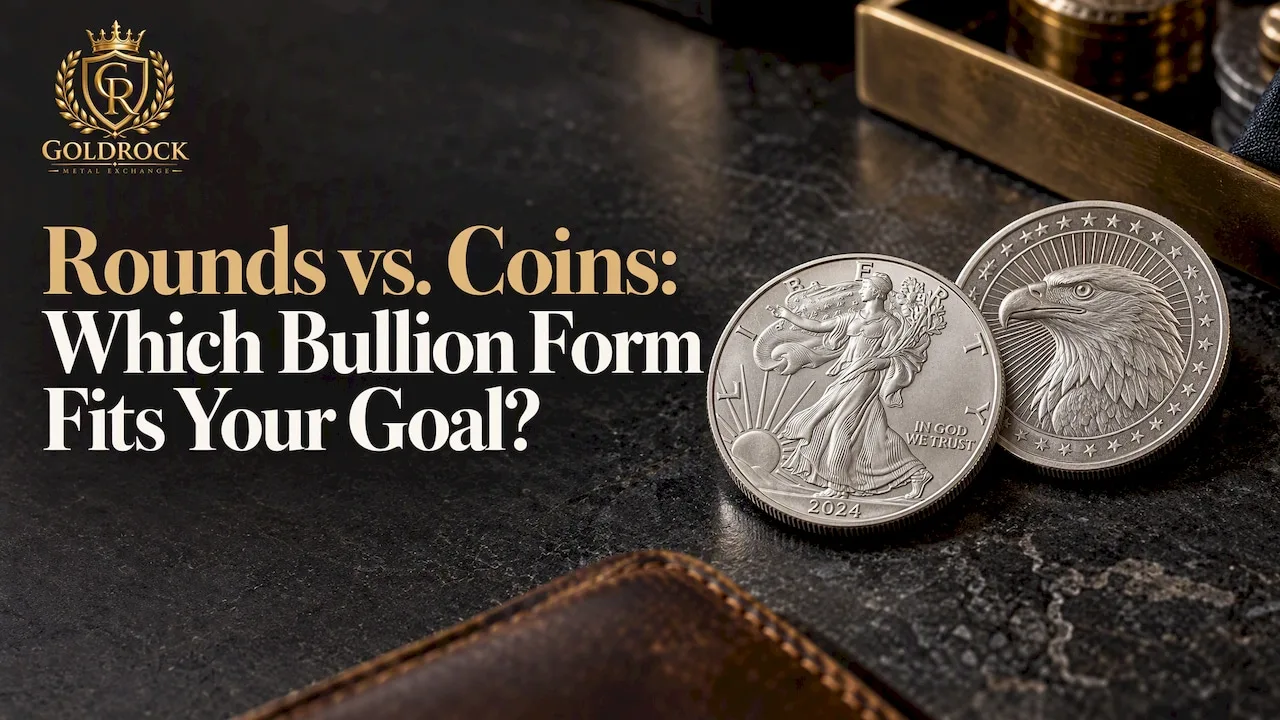
The core difference is who made the piece and what it legally is. A bullion coin is issued by a government, is legal tender, and carries a face value. A round is a coin-shaped piece of metal struck by a private mint, with no legal-tender denomination. Both can hold the same amount of gold or silver. What differs is the premium you pay, how easily the piece is recognized, how many sizes exist, and, for retirement accounts, whether it can be held at all.
This guide walks through each of those points for silver and gold, then ends with a checklist you can use before any purchase. It is educational only. We are not giving personalized investment, tax or legal advice.
TL;DR
- Coins are government-issued legal tender with a face value. Rounds are privately minted and have none. Market value for both is driven mainly by metal weight, fineness, premium and demand.
- Rounds often cost less over the metal’s value, so a budget may buy more ounces. Coins offer recognizable specifications and, in some cases, more size choices.
- A product being fine for personal ownership does not make it eligible for an IRA. Have the custodian confirm each specific product before you buy.
- Before choosing a label, confirm payment, title, custody, insurance and delivery terms in writing.
- Our team can walk you through any of this: call (888) 859-0978.
Table of Contents
- What Is a Coin, and What Is a Round?
- Rounds vs. Coins at a Glance
- Silver Rounds vs. Silver Coins
- Gold Rounds vs. Coins, and Gold Rounds vs. Bars
- Request a Free Precious Metals Consultation
- Rounds, Coins and Your IRA
- Our Perspective on Rounds and Coins
- Check the Terms Before the Label
- How to Choose: A Five-Step Process
- Private Delivery for Your Purchase
- Frequently Asked Questions
- Ready to Talk It Through?
- Sources
What Is a Coin, and What Is a Round?
The U.S. Mint’s glossary defines the terms collectors and investors use, including the difference between bullion and numismatic coins. For our purposes, three features separate the two forms.
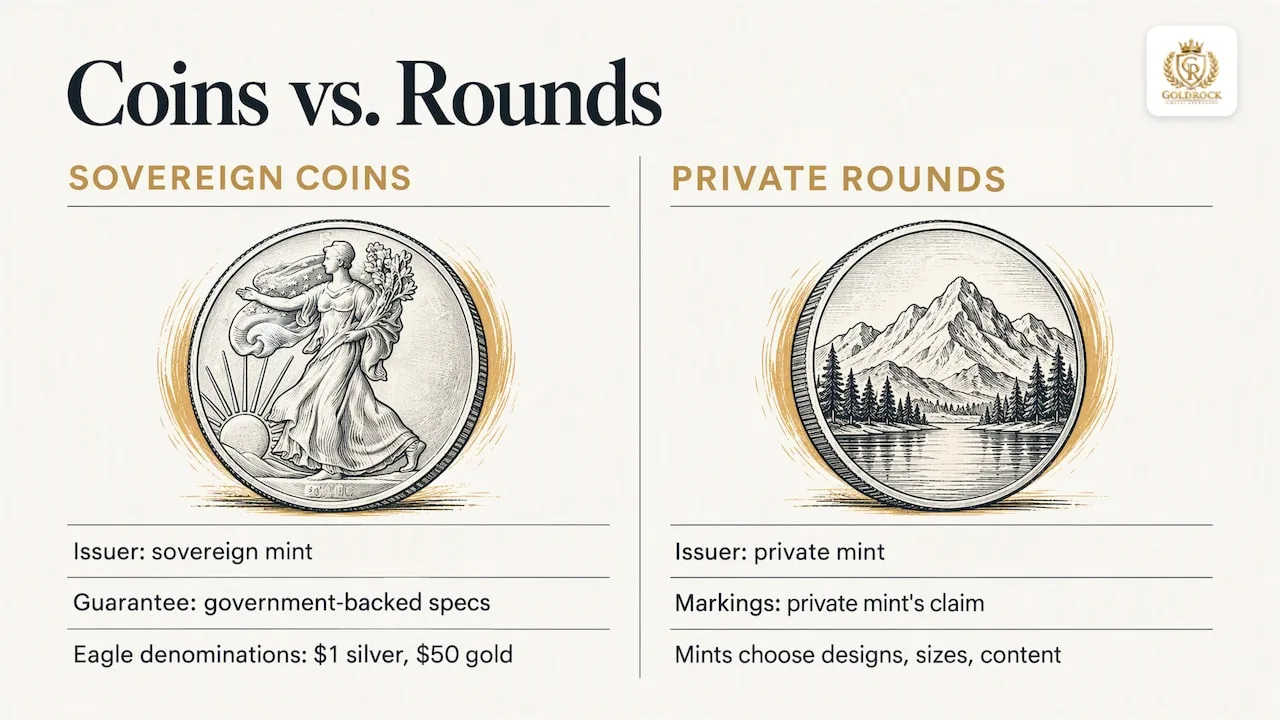
Issuer. Coins come from a sovereign mint. The American Eagle program, for example, is produced by the U.S. Mint. Rounds come from private mints, which are free to choose their own designs, sizes and metal content.
Legal tender. According to the U.S. Mint, a one-ounce American Eagle Silver Bullion Coin contains one troy ounce of .999 fine silver and has a $1 face value. A one-ounce American Eagle Gold Bullion Coin contains one troy ounce of fine gold and has a $50 face value. Those face values are symbolic. Nobody should expect to spend a gold coin for $50. The market prices it by its metal.
Guarantee. A sovereign coin states its weight, fineness, denomination and usually a year, backed by the issuing government. A private round may also state weight and fineness, but those markings are a private mint’s claim, not a government guarantee. That is why documenting the exact product, mint, weight and fineness matters.
Bullion coins versus collectible coins
Appearance alone is a poor rule. The U.S. Mint’s glossary separates bullion coins, valued mostly on weight and fineness, from numismatic or commemorative pieces, whose value depends more on rarity, condition, age and mintage. If you want metal exposure, paying a collector’s premium may not serve that goal. If you want to collect, that is a different decision with different costs. Decide which one you are doing first.
Rounds vs. Coins at a Glance
| Feature | Bullion coin | Round |
|---|---|---|
| Issuer | Government mint | Private mint |
| Legal tender | Yes, with a face value | No |
| Design | Set by the issuing government | Set by the private mint |
| Typical premium over metal value | Often higher | Often lower |
| Sizes | Program-specific (see below) | Varies by mint |
| Recognition | Widely recognized specifications | Depends on the mint and design |
| IRA eligibility | Only if the specific product qualifies | Only if the specific product qualifies |
The words “often higher” and “often lower” are deliberate. Premiums move with demand, supply and dealer inventory, so compare the actual quote on the actual day. For more on how the premium works, see our explainer on gold premium over spot.
Silver Rounds vs. Silver Coins
Silver is where most readers ask this question, because a one-ounce silver piece is affordable and comes in both forms.
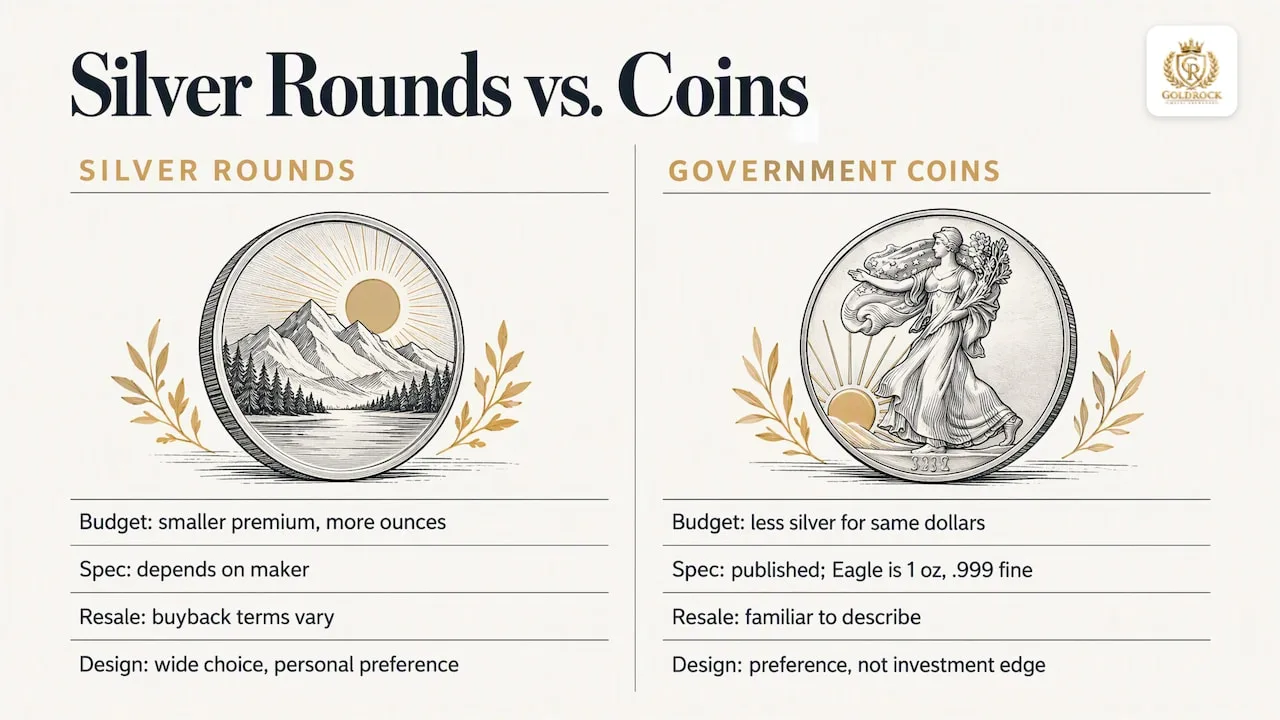
Budget. Because rounds usually carry a smaller premium, the same dollars can often buy more silver by weight. If your priority is accumulating ounces, that matters. If you buy in small, regular amounts, the difference compounds.
Recognition. A government coin has a published specification you can check. The U.S. Mint lists the American Eagle silver coin as a one-ounce, .999 fine product. A round’s specification depends on the maker, so you rely more on the mint’s reputation and on inspecting the item.
Resale terms. Ask any seller what the buyback terms are for the exact item. Familiar coins are usually easy to describe to a future buyer. Rounds can be sold too, but terms vary, and you should know them before purchase rather than after.
Design. Rounds come in a wide range of designs. If a particular design matters to you, that is a legitimate reason to choose one. It is a preference, not an investment advantage.
If you are weighing silver for a retirement account, read our guide to IRA-approved silver and .999 fineness first. You can also browse the silver products we offer.
Gold Rounds vs. Coins, and Gold Rounds vs. Bars
Gold has the same split, but the sizes and dollar amounts change the trade-offs.
Gold coins. The U.S. Mint offers American Eagle gold in 1 oz, 1/2 oz, 1/4 oz and 1/10 oz sizes. Fractional sizes let you buy a smaller amount of gold and, later, sell in smaller pieces. That flexibility is the main practical argument for gold coins.
Gold rounds. Private mints produce gold rounds in various weights. As with silver, the premium may be lower, but the specification rests on the private mint’s markings.
Gold bars. Bars are a third form. They are often sold at a lower premium per ounce than small coins, especially in larger sizes, but a bar is a single large unit, so selling part of a holding is less flexible. Bars and rounds both come from private or government mints, so check the maker and the markings.
Whichever form you consider, the right question is not “which is best?” It is “which fits my purpose, budget and holding period?” Our gold category shows what we carry, and we are happy to talk through the options with you.
Request a Free Precious Metals Consultation
If you are unsure whether coins, rounds or bars suit your goal, our team can explain the options and answer your questions without pressure. Request a Free Precious Metals Consultation or call (888) 859-0978.
Rounds, Coins and Your IRA
This is where the label matters most. Buying for a Precious Metals IRA is not the same as buying for your safe at home.
IRS guidance says participant-directed IRAs generally may not invest in collectibles, such as art, antiques, gems and certain coins. Certain coins and qualifying gold, silver, platinum and palladium bullion are exceptions, but only when the statutory requirements are met. The bullion must meet the applicable fineness standard and be held by a qualified trustee or custodian.
Two practical consequences follow:
- “Round” is not enough. The IRS materials do not make every privately minted round automatically eligible. Eligibility depends on the specific product.
- Custody is part of the rule. The metal must be in the physical possession of the trustee or custodian, so storing it yourself is not the same thing.
Because rules can change and individual situations differ, ask your IRA custodian to confirm each product before purchase, and ask a qualified tax professional about how the rules apply to you. We do not give tax advice.
Our team can help with the process. For background, see our pages on Gold IRA rules, gold IRA eligibility, and investing in coins for retirement. If you are thinking about collectible coins specifically, our custodian checklist lays out the questions to ask. Two related rules are covered in Section 408(m) and gold.
Platinum and palladium follow the same logic: a fineness number alone does not settle eligibility. See our guides on palladium coins in an IRA and platinum IRA fineness.
Our Perspective on Rounds and Coins
We see the same pattern in many first conversations. A buyer arrives asking whether a round or a coin is better, when the more important questions are still unasked: What is my goal? Is this for a retirement account or for private ownership? Who holds the metal, and how will it reach me?
Our view is simple. Neither form is wrong. Coins suit people who value government specifications and smaller-unit flexibility. Rounds suit people who want more metal for their budget and are comfortable checking a private mint’s markings. What we push back on is any choice made from a sales script, urgency or a promise about future prices. We make no such promises, and we do not believe anyone should.
For retirement accounts, we handle the paperwork through our in-house IRA department, so you are not passed between offices. We also deliver purchased metal through insured private delivery, and we stay available for questions afterward. If a product might not qualify for your IRA, we would rather tell you before you buy than after.
— Blake
Check the Terms Before the Label
The coin-or-round choice can distract from the part of a purchase that carries the most practical risk. The CFTC has issued a consumer advisory on precious metals fraud describing offers where the buyer pays only a portion of the metal’s price, often between 15 and 25 percent, with the rest financed. The agency warns about leveraged offers, unusually high fees and promises of quick profits.
In one enforcement matter, customers were told financed metal would be delivered within 28 days. The CFTC explained in its release that actual delivery means transfer of possession and control to the customer or the customer’s agent.
That is the standard to apply to any seller, including us. Before you pay, get these in writing:
- Whether the purchase is fully paid, with no financing or leverage
- The exact product: mint, weight, fineness, year if any, and whether it is bullion or collectible
- Who holds title and where the metal is held until delivery
- The shipping method, insurance terms and expected timing
- How you will verify what arrives
- Buyback or resale terms for that product
A calm, fully paid transaction with documented delivery terms deserves more trust than a pitch built on urgency. Our overview of precious metals delivery options explains what to ask.
How to Choose: A Five-Step Process
- Name your purpose. Is this for a retirement account, personal holdings, or collecting? Collecting is a separate decision from owning metal.
- Set a budget and unit size. If you want to buy or sell in small increments, coin sizes may help. If you want the most metal per dollar, compare round quotes.
- Compare the exact quote. Ask for the total price per ounce including premium, for each form, on the same day.
- Confirm eligibility if it is for an IRA. Have the custodian confirm the specific product in writing.
- Lock down delivery and custody. Review payment, title, insurance and shipping before you commit.
Private Delivery for Your Purchase
Once you have chosen a form, how the metal reaches you matters. We offer insured private delivery of purchased metals. If you are curious about how it differs from standard shipping, read about discreet gold shipping or what a private metals delivery service is. For retirement accounts, we offer a Precious Metals IRA with an in-house IRA department, and you can start at our open an IRA page.
Precious metals prices can fall as well as rise, and nothing here promises returns, safety, tax benefits or appreciation.
Frequently Asked Questions
Are silver rounds worth buying?
They can be a reasonable way to acquire silver if you prioritize ounces per dollar and are comfortable verifying a private mint’s markings. They are not legal tender and carry no government guarantee. Confirm the weight, fineness and resale terms before purchase.
Is a round the same as a coin?
No. A coin is issued by a government, is legal tender and has a face value. A round is made by a private mint and has no legal-tender denomination. Both are valued mainly by metal content, premium and demand.
Can I put rounds in a Precious Metals IRA?
Not automatically. IRS guidance allows qualifying bullion meeting fineness standards, held by a trustee or custodian, but it does not make every private round eligible. Ask your custodian to confirm the specific product, and consult a tax professional about your situation.
Why are coins usually more expensive than rounds?
Coins typically carry a higher premium over their metal value, reflecting government issuance, recognition and, in some cases, more demand. Premiums change with the market, so compare live quotes for the exact items you are considering.
What should I confirm before buying either one?
Get payment, title, custody, insurance, shipping and verification terms in writing. Confirm the purchase is fully paid and that physical delivery will actually occur, as the CFTC advises.
Ready to Talk It Through?
Choosing between rounds and coins is easier with a clear goal and clear terms. Request a Free Precious Metals Consultation or call (888) 859-0978, and we will go through your options.
Educational disclaimer: This article is for general education only. It is not investment, tax or legal advice. Consult a qualified professional about your own situation.
Sources
- U.S. Mint bullion catalog
- U.S. Mint coin term glossary
- IRS information letter 2020-0033
- CFTC consumer advisory on precious metals fraud, 2012
- CFTC press release on the Worth Group sanctions, 2016