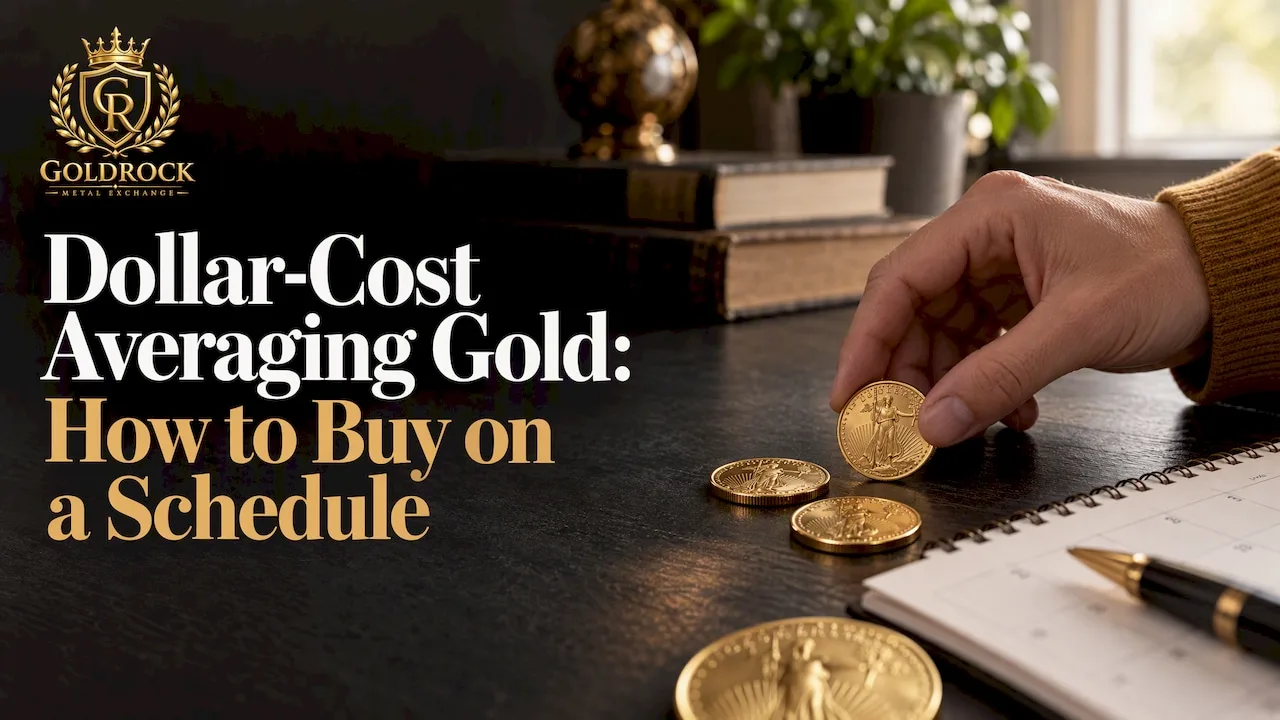
Dollar-cost averaging gold means putting the same dollar amount into gold at regular intervals, for example $500 on the first of every month, whatever the price is that day. The SEC’s investor education site describes the general strategy as investing equal portions at regular intervals regardless of market ups and downs. With gold, one practical twist applies: you buy a fixed amount of money, so the weight you receive changes with each purchase. Below, we cover how that works, what it costs, where it helps, and where it does not.
TL;DR
- Dollar-cost averaging (DCA) gold is a fixed dollar amount, bought on a fixed schedule, with the ounces varying each time.
- It can reduce the risk of committing everything at one price. It does not guarantee a profit or protect against a falling market.
- Physical metals carry dealer premiums, spreads and possibly storage and insurance costs, so the size and frequency of your purchases matter.
- In a self-directed IRA, a schedule usually follows your contributions or rollover timing, and IRS rules on custody and eligible metals apply.
- This is education, not personal investment, tax or legal advice.
Table of Contents
- How dollar-cost averaging works with gold
- Why DCA with physical gold is different from DCA with a fund
- What regulators say you should weigh first
- DCA versus a lump sum: the real trade-offs
- How to set up a gold DCA plan: six steps
- Using a schedule inside a self-directed IRA
- Our perspective
- Buying on a schedule with GoldRock Metal Exchange
- Common mistakes with gold DCA
- FAQ
- Educational disclaimer
- Sources
How dollar-cost averaging works with gold
The logic is simple. You choose an amount you can set aside regularly and a date. When gold is cheaper, that amount buys more of it. When gold is more expensive, it buys less. Over time your average cost per ounce lands somewhere between the highs and lows you bought at, instead of resting on a single day’s price.
The SEC notes that this approach can help you manage risk by following a consistent pattern. It is a method for managing timing risk and building a habit. It is not a forecast, and it does not change what gold is: an asset that pays no interest or dividends.
A worked example with made-up prices
The prices below are hypothetical, chosen to keep the math clear. They ignore premiums and fees, which we cover next.
| Month | Amount invested | Gold price per ounce | Ounces bought |
|---|---|---|---|
| 1 | $500 | $4,000 | 0.1250 |
| 2 | $500 | $4,200 | 0.1190 |
| 3 | $500 | $3,800 | 0.1316 |
| 4 | $500 | $4,100 | 0.1220 |
| Total | $2,000 | 0.4976 |
Your average cost is $2,000 divided by 0.4976 ounces, about $4,019 per ounce. The simple average of the four prices is $4,025. The gap is small here, but it points in the right direction: because the fixed amount buys more when prices dip, your average cost sits slightly below the average price.
Now the honest limit. If gold had risen every month, a lump sum on day one would have beaten the schedule. If it had fallen every month, the schedule would have beaten the lump sum, but you would still be sitting on a loss. DCA does not decide which of those happens. It spreads your entry across time.
Why DCA with physical gold is different from DCA with a fund
With a brokerage account, you can often buy fractional shares, so every dollar goes to work. Physical gold comes in set sizes: fractions of an ounce, one-ounce coins, and bars. That creates three practical differences.
Weight comes in steps
A $500 monthly budget may not buy a whole coin when gold trades in the thousands of dollars per ounce. Many buyers handle this in one of two ways:
- Buy smaller denominations. Fractional coins let each purchase match your budget more closely.
- Accumulate, then buy. You set aside $500 a month, then buy a coin every few months. This keeps the schedule steady but means your cash sits uninvested between purchases.
Both are reasonable. They have different cost profiles, which leads to the next point.
Premiums and spreads hit small purchases harder
Dealers sell above the spot price and buy back below it. FINRA’s bulletin on buying physical gold and other metals explains that profits on physical metals depend on the spot price rising enough to cover the markup and spread, along with costs such as storage, insurance and administrative fees. It also notes that gold pays no dividends and creates no earnings growth.
Why this matters for DCA: you pay the premium every time you buy. Many small purchases can mean paying it many times, and smaller products often carry a higher percentage premium than larger ones. Before you commit to a schedule, ask for the total price in writing, including the premium over spot, any shipping or handling, and the buyback policy.
Delivery and storage are part of the plan
Each purchase has to get to you or to a depository. If you plan to take delivery at home, think about insurance, handling and discretion. Our guide to precious metals delivery options walks through the choices, and discreet gold shipping explains why some buyers use private delivery for larger orders. If you are building a position in small monthly steps, consolidating several months into one delivery can keep logistics simpler.
What regulators say you should weigh first
A calm look at the risks belongs before any schedule.
The CFTC states plainly that gold is not a safe investment in the sense of being protected from losses. Its price can fall, sometimes sharply. The SEC’s guidance on asset allocation stresses spreading money among different asset classes rather than concentrating in one. If you want a broader view of why concentration is a risk, this overview of diversification and investment approaches (in German) is a useful extra read.
Two habits follow from this:
- Decide what share of your overall portfolio gold should be before you decide how to buy it. A schedule is a way to build toward a target, not a reason to skip setting one.
- Be wary of anyone who sells gold with promises of safety or guaranteed results. The CFTC’s page on precious metal frauds warns that these schemes prey on fear and sell metal at inflated prices. Our article on spotting gold IRA scams shows the math checks regulators suggest.
DCA versus a lump sum: the real trade-offs
This is a question of method, not of products, so here are the criteria that matter.
| Criterion | Dollar-cost averaging | Lump sum |
|---|---|---|
| Timing risk | Spread across many dates | Concentrated on one date |
| Cash on hand | Needs a steady budget | Needs a large sum up front |
| Premium paid | Paid on each purchase, can add up on small orders | Often a lower percentage on larger orders |
| Discipline | Built in by the schedule | Relies on a one-time decision |
| Exposure if prices rise | Part of your money enters later | All of your money is in from day one |
| Exposure if prices fall | Later purchases buy at lower prices | All of your money takes the decline |
Neither is correct for everyone. If your money arrives monthly from a paycheck, DCA matches your cash flow. If you already hold a large sum and are nervous about the entry point, you might split it into a few tranches over several months. That is a version of the same idea.
How to set up a gold DCA plan: six steps
- Set your target. Decide what percentage of your total portfolio you want in metals and over what period. A financial professional can help with this question for your situation.
- Choose a budget you can keep. A plan you abandon in a downturn defeats its purpose. Pick an amount that will not strain your other goals or emergency savings.
- Pick a rhythm. Monthly is common because it follows a paycheck. Weekly gives more entry points but can increase per-order costs. Quarterly reduces the number of premiums but spaces out your entries.
- Choose the metal and form. Gold, silver, platinum and palladium behave differently. Silver costs less per ounce, so the same budget buys more units. Our guide on why silver is more affordable than gold explains the trade-offs, and silver can be more volatile.
- Get the full price each time. Ask for the premium over spot, fees, delivery cost and buyback terms before each order. FINRA’s list of questions to ask before buying is a good checklist.
- Keep records. Note the date, price, ounces and total paid for every purchase. You will want an accurate cost record, and a tax professional will ask for it.
Using a schedule inside a self-directed IRA
Many readers who search for this topic hold, or are considering, a Precious Metals IRA. A few points shape how DCA works there.
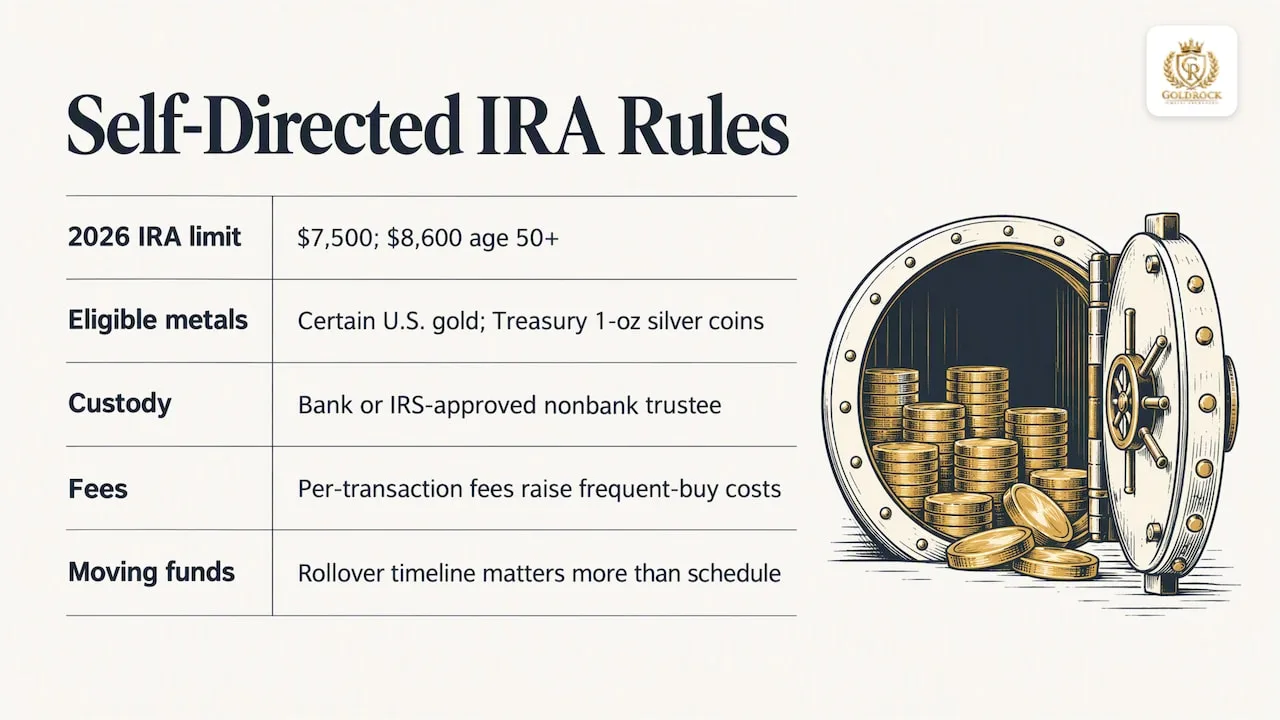
Contributions set the pace. For 2026, the IRA contribution limit is $7,500, or $8,600 if you are 50 or older, according to IRS Publication 590-A. Spreading contributions through the year can fit naturally with a purchase schedule. We explain the numbers in our guide to gold IRA contribution limits.
The metals must be eligible. IRS Publication 590-B says an IRA can invest in certain U.S. gold coins and in one-ounce silver coins minted by the Treasury Department. Other bullion has its own requirements. See our overview of investing in coins for retirement and the Gold IRA rules.
Custody is not optional. The IRS FAQ on IRAs states that IRA-held bullion must be held by a bank or an IRS-approved nonbank trustee. Taking it home can be treated as a distribution, which can have tax consequences. Our article on Section 408(m) rules covers the details. For questions about your own tax position, please speak with a qualified tax professional.
Fees are a cost layer. FINRA’s alert on self-directed IRAs recommends understanding custodian fees and how they could affect performance. A fee schedule that charges per transaction can make frequent small buys more expensive than a few larger ones. Ask for the full fee schedule before choosing a frequency.
If you are moving money from an existing plan rather than contributing new money, the timeline matters more than the schedule. Read about rollover versus transfer and the rollover timeline and checklist before you move anything.
Our perspective
We see two kinds of buyers think about DCA. The first wants discipline: a set amount, a set day, and no daily second-guessing about spot prices. The second is nervous about timing a large purchase. Both are reasonable motivations, and a schedule can serve both.
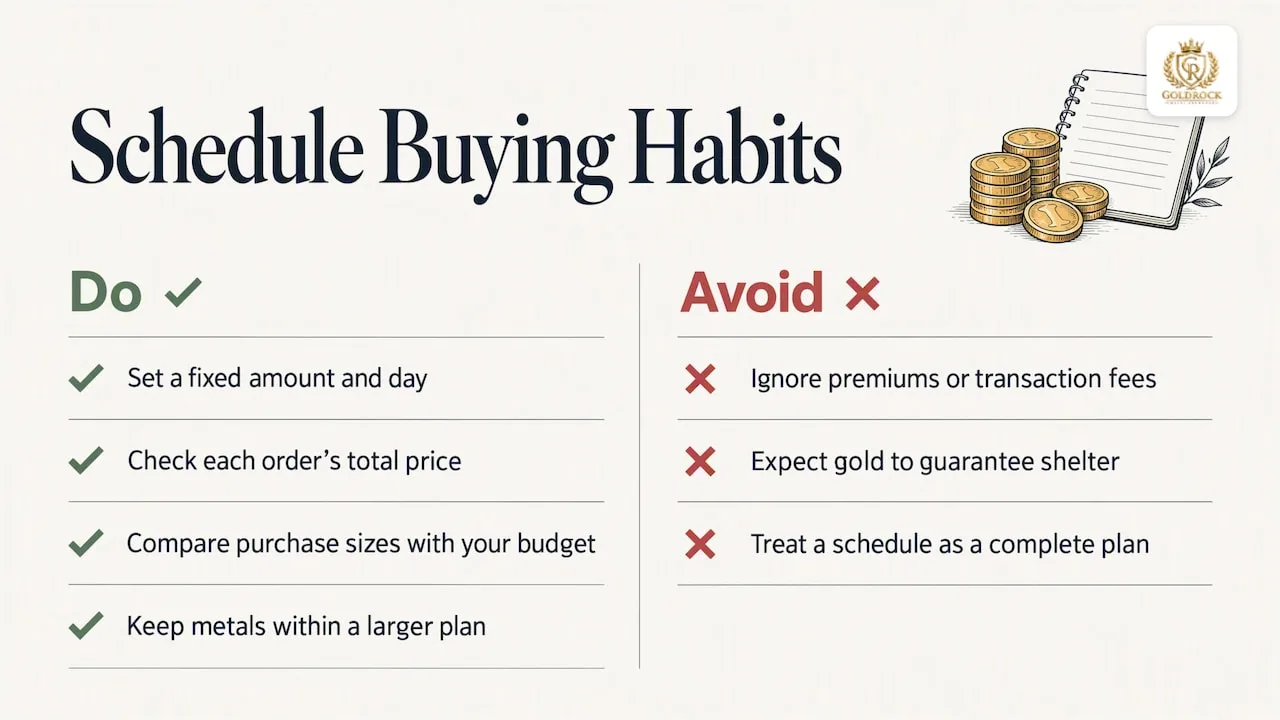
What we try to keep honest is the cost side. A schedule that looks smooth on paper can be expensive if each small order carries a high premium or a per-transaction fee. So we encourage people to see the total price of an order before they place it, and to think about whether fewer, larger purchases fit their budget better than many small ones.
We also want people to treat metals as one piece of a larger plan. The regulators quoted above are right that gold is volatile and not a guaranteed shelter. We would rather you buy with realistic expectations than with a promise we could not keep. Our in-house IRA department and personal consultations exist to help you understand the process and the paperwork. Decisions about how much to own, and what it means for your taxes, stay with you and your own advisers.
— Blake
Buying on a schedule with GoldRock Metal Exchange
We sell physical gold, silver, platinum and palladium, and we offer insured private delivery. Our team can also help with Precious Metals IRA setup and rollovers. If you want to talk through how a recurring purchase might work for you, call (888) 859-0978.
Request a Free Precious Metals Consultation
Common mistakes with gold DCA
- Treating DCA as protection. The strategy spreads timing risk. It does not stop losses.
- Ignoring premiums. Paying a high percentage on each small order can overwhelm the benefit of averaging.
- Stopping when prices fall. The schedule only works if you follow it, and that is hard emotionally. If a dip makes the plan uncomfortable, that is a sign your amount or allocation may be too high.
- Skipping the target allocation. Without a goal, a schedule can drift into overconcentration. Our gold price outlook article discusses risk as well as opportunity.
- Rushing a rollover. Deadlines apply, as the 401(k) rollover best practices explain.
FAQ
Does dollar-cost averaging work for gold?
It works as a method for spreading your purchase prices over time, which can reduce the risk of buying everything at one high point. It does not make gold rise, and it cannot protect you if prices fall over a long period. Costs such as premiums and fees also affect the result.
How much should I invest in gold each month?
There is no single right amount. It depends on your goals, your overall portfolio and what you can set aside without straining other needs. The SEC’s guidance on asset allocation suggests spreading money across asset classes, and a licensed financial professional can help you decide on a share for your situation.
Is it better to buy gold weekly, monthly or quarterly?
Monthly suits most paychecks. More frequent buying gives more entry points but may add per-order costs, while less frequent buying means fewer premiums and wider gaps between purchases. Ask for the total cost of an order at each frequency before choosing.
Can I dollar-cost average into gold inside an IRA?
In many cases, yes, as contributions arrive, but the metals must be IRS-eligible and held by an approved custodian or trustee, and annual contribution limits apply. Fees may apply to each transaction. Confirm the details with your custodian and a tax professional.
Educational disclaimer
This article is for general education only. It is not personalized investment, tax or legal advice, and it does not promise returns, safety, tax benefits or price appreciation. Precious metals prices can fall as well as rise. Consult a qualified financial, tax or legal professional about your own situation.
Request a Free Precious Metals Consultation or call (888) 859-0978.
Sources
- Dollar Cost Averaging, Investor.gov
- Asset allocation, Investor.gov
- Investor Bulletin: 10 Things to Ask Before Buying Physical Gold, Silver or Other Metals, FINRA
- Investor Alert: Self-Directed IRAs and the Risk of Fraud, FINRA
- Gold Is No Safe Investment, CFTC
- Precious Metal Frauds, CFTC
- Publication 590-A, IRS
- Publication 590-B, IRS
- Retirement plans FAQs regarding IRAs, IRS