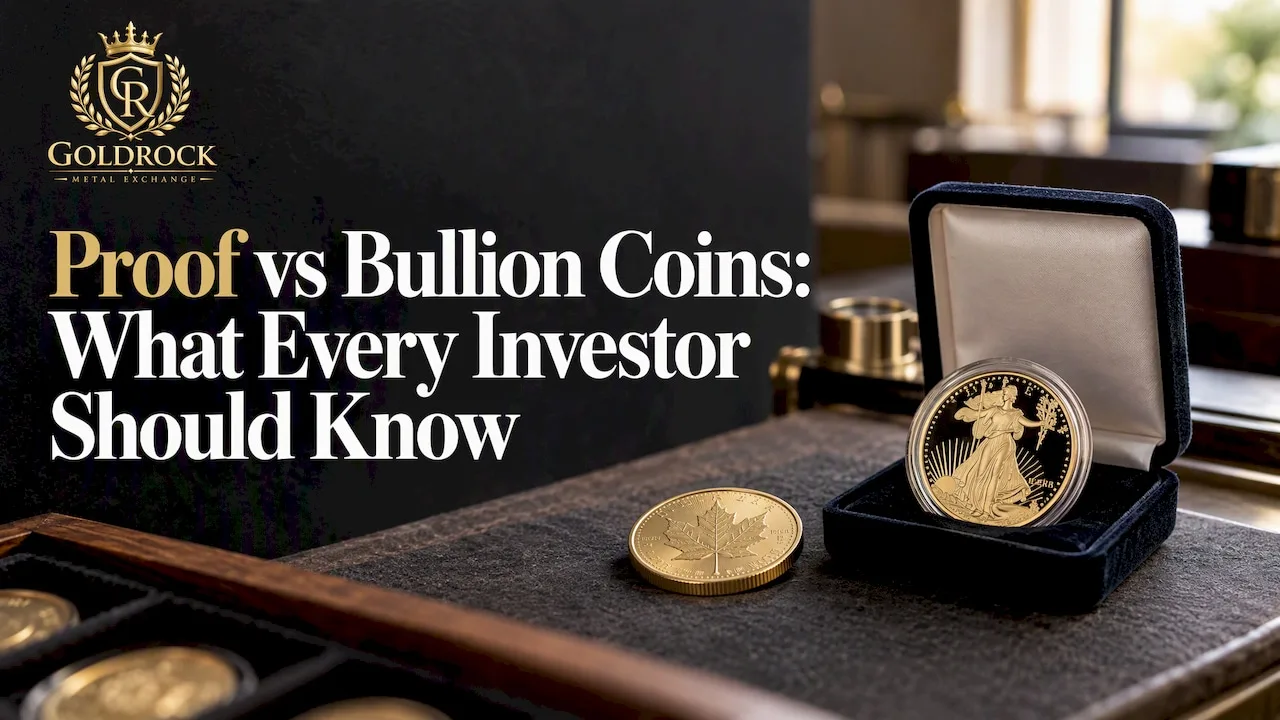
Bullion coins are priced mostly on the metal they contain. Proof coins are made for collectors, so you pay extra for finish, packaging and limited mintage. If your goal is to own gold, silver, platinum or palladium as a store of value, bullion is usually the simpler and lower-cost way to get ounces. If you enjoy collecting, a proof coin can make sense, as long as you understand that the extra price is for the collectible, not for more metal.
This guide walks through how the two differ, how to read the premium you are quoted, where junk silver and palladium fit, and what changes when the coins are meant for a retirement account.
TL;DR
- Bullion coins are sold to investors and track the daily spot price plus a premium. Proof coins are struck for collectors and carry a higher premium for finish and scarcity.
- A higher premium does not mean more metal. Ask for the premium over spot and the dealer’s buy-back price in writing before you pay.
- Collectible and “semi-numismatic” coins are a common feature of the pitches regulators warn about, especially for retirement accounts.
- In an IRA, the IRS only allows certain bullion that meets fineness rules. Many proof and collectible coins do not qualify, so confirm eligibility before you buy.
- This article is educational. It is not investment, tax or legal advice.
Table of Contents
- What “proof” and “bullion” actually mean
- Proof vs bullion at a glance
- How the premium works, and why it decides the outcome
- Are proof coins a good investment?
- Bullion vs numismatic: spotting the sales tactics
- Junk silver: how it compares
- Palladium coins vs bars
- What changes inside a retirement account
- A five-step way to decide
- Request a Free Precious Metals Consultation
- Our perspective on proof vs bullion
- Where GoldRock fits
- FAQ
- Sources
What “proof” and “bullion” actually mean
The CFTC’s customer advisory sorts physical metals into two groups. Bullion is coins or bars of a specific weight and purity. “Numismatic” or collectible items are rare or old coins, or special proofs that are newly made. That split is the cleanest way to think about the whole topic.
Bullion coins
The U.S. Mint describes bullion coins as precious metal coins intended for investors. It also notes that it does not sell them directly to the general public. They reach buyers through dealers across the country. Their value rests on weight and purity, and the price moves with the market.
Examples are the American Eagle series in gold, silver and platinum, and similar government-minted coins and bars. Our gold coin examples guide shows what these look like in practice.
Proof coins
Proofs are made with specially prepared dies and blanks, and they are struck more than once so the design comes out sharper. The result is a mirror-like background with a frosted design. The U.S. Mint says proof and uncirculated coins are collected for their limited mintage numbers, while bullion coins are a way to invest in the metal itself.
Proofs usually come in a presentation case with a certificate. That packaging, the handling and the lower production run are all baked into the price.
Where “BU” fits
BU stands for brilliant uncirculated. These coins have never been in circulation and usually come from the same production as bullion coins, without the proof treatment. Bullion-grade American Eagles are generally sold in this condition. A proof is a different product with a different purpose, even when the design looks the same.
Proof vs bullion at a glance
| Factor | Bullion coin | Proof coin |
|---|---|---|
| Made for | Investors who want metal | Collectors who want condition and scarcity |
| Main price driver | Spot price of the metal | Spot price plus collector demand, mintage, condition |
| Premium over spot | Typically lower | Typically higher |
| Finish | Standard strike, may show small marks | Mirror fields, frosted design, sharp detail |
| Packaging | Tubes, monster boxes, sleeves | Presentation case and certificate |
| Resale | Priced off the day’s spot price | Depends on finding a buyer who values the collectible |
| Retirement account | Eligible if it meets IRS rules | Often not eligible |
How the premium works, and why it decides the outcome
Every physical purchase has two prices. The spot price is the cash price of the metal per troy ounce. The premium is what the dealer adds for fabrication, distribution and margin. You can check current spot levels on our live prices page, and our explainer on gold premium over spot covers the pieces that make up the number.
The figure that matters most is the spread: the gap between what you pay and what a dealer would pay you for the same metal. FINRA’s bulletin on buying physical metals notes that legitimate spreads are often below 20%, while fraudulent sellers can charge spreads above 300% on coins they call exclusive.
Here is a simple illustration with made-up round numbers, not a quote. Suppose spot is $100 per ounce of a metal.
- A bullion coin sold at a small premium costs a little over $100, and a dealer will typically buy it back at a price close to spot.
- A proof coin sold at a large premium might cost $160. To break even you need the market to rise enough to cover the extra $60, or a buyer who pays for the collectible, before you earn anything on the metal.
The metal is the same in both. The difference is how much of your money is buying something other than metal.
Are proof coins a good investment?
It depends on what you mean by investment. As a way to hold a fixed amount of metal at a low cost, proofs are generally a poor fit, because you pay for features the metal market does not reward. As a collectible, a proof can be worth owning if you value it and can afford to hold it for its own sake.
Two cautions apply either way:
- Value is harder to pin down. Bullion is priced off a public number. A collectible’s worth depends on condition, demand and the buyer in front of you.
- No metal is risk-free. FINRA reminds investors that precious metals are often promoted as safe havens, but prices can be volatile and unpredictable. Ask for all fees, storage costs and buy-back spreads in writing, so you can see whether the purchase still works after costs.
No one can promise that any coin will rise in value, proof or bullion.
Bullion vs numismatic: spotting the sales tactics
Some numismatic coins are truly rare, and serious collectors buy them from specialists for good reasons. The trouble starts when a seller uses collector language to justify a markup on ordinary coins.
The CFTC advisory warns that an unsolicited pitch or high-pressure push to buy “collectible” or “semi-numismatic” coins for a retirement account is a major red flag. It also says such terms can be used to hide large markups on coins with no real rarity, which makes a profit nearly impossible because of the gap between retail price and buy-back.
Questions worth asking any seller, including us:
- What is the spot price today, and what premium am I paying over it?
- What would you pay me for this exact item if I sold it back today?
- Is this coin valued for its metal or for its collectible status?
- Are there fees for storage, insurance, shipping or account setup, and what are they in dollars?
- Can I have all of this in writing before I pay?
A seller who answers plainly and does not rush you is behaving the way a careful buyer should expect. Our gold dealer selection best practices guide goes deeper on the process.
A caution that applies to any collectible market, not only American coins: valuation and resale are hard when few buyers exist. A Spanish-language article on whether coins or banknotes are worth investing in makes a similar point about liquidity and premiums on collectibles.
Junk silver: how it compares
People searching for junk silver usually mean older circulated U.S. silver coins that have no collector premium and are valued for the silver they contain. The appeal is straightforward: you are buying metal, and the price tracks the silver market rather than a collectible market.
Some points to weigh:
- It behaves like bullion, not like a proof. Pricing is about silver content, so the premium question is the same one you would ask on any bullion purchase.
- It is bulkier and less uniform. Wear and mixed denominations make counting and verifying a little harder than with sealed, standardized products.
- Retirement accounts are stricter. IRS rules set a minimum fineness for silver. Always confirm eligibility for the specific product before an IRA purchase. Our guide to IRA-approved silver and .999 fineness explains the standard.
If you want to browse standardized products, see our silver category.
Palladium coins vs bars
The same logic holds for palladium. A coin carries a government mint’s name, which many buyers find easy to recognize and resell. A bar usually carries a lower premium per ounce, though the exact figure varies with size, brand and market conditions. Neither format changes what you are buying, which is the metal.
For a retirement account, a coin’s origin does not settle eligibility. As our guide on palladium coins in an IRA explains, a 99.95% purity figure does not by itself guarantee approval. You can view current options in our palladium category, and platinum buyers can read our platinum IRA guide.
What changes inside a retirement account
This is where the proof vs bullion choice stops being a matter of taste. Federal law treats most coins and metals as collectibles, and collectibles are generally barred from IRAs. The IRS explains that the exception covers certain bullion that meets required fineness, and that if an IRA acquires a collectible that does not qualify, the acquisition can be treated as a distribution, with consequences for the account holder.
The details that matter in practice:
- Eligibility depends on the product’s metal, fineness and form, so check each item rather than assuming.
- Many proof and collectible coins do not qualify. Our checklist for collectible coins in a U.S. IRA shows the questions to put to a custodian.
- Our pages on Section 408(m) rules, gold IRA rules and gold IRA eligibility lay out the framework in plain language.
- Verify what you own. The CFTC advisory notes that fraudulent actors have charged storage and insurance fees on metal that was never bought, and tells IRA owners to check holdings against the custodian’s statement.
What any of this means for your taxes is a question for a qualified tax professional. We do not give tax advice.
A five-step way to decide
- Name your purpose. Are you holding metal as part of a diversified plan, or collecting? Bullion fits the first, proofs the second.
- Pick the metal and the account. Gold, silver, platinum and palladium each have different prices and rules. Decide whether the metal will be held at home, delivered privately, or held in a self-directed IRA.
- Get the full price. Ask for spot, premium, any fees and the buy-back price in writing.
- Check eligibility if it is for retirement. Confirm the exact product against IRS requirements with your custodian.
- Take your time. Be wary of anyone who pressures you to act now. Consider speaking with a licensed financial professional about your own situation.
Request a Free Precious Metals Consultation
If you would like to talk through bullion options, premiums or IRA eligibility without pressure, Request a Free Precious Metals Consultation or call (888) 859-0978.
Our perspective on proof vs bullion
Most questions we hear come from people who were shown a handsome proof set and told it was special. Our view is that the first job of a dealer is to explain what the customer is paying for. When someone wants to own metal, we point them toward bullion, because the price is tied to something they can check against spot.
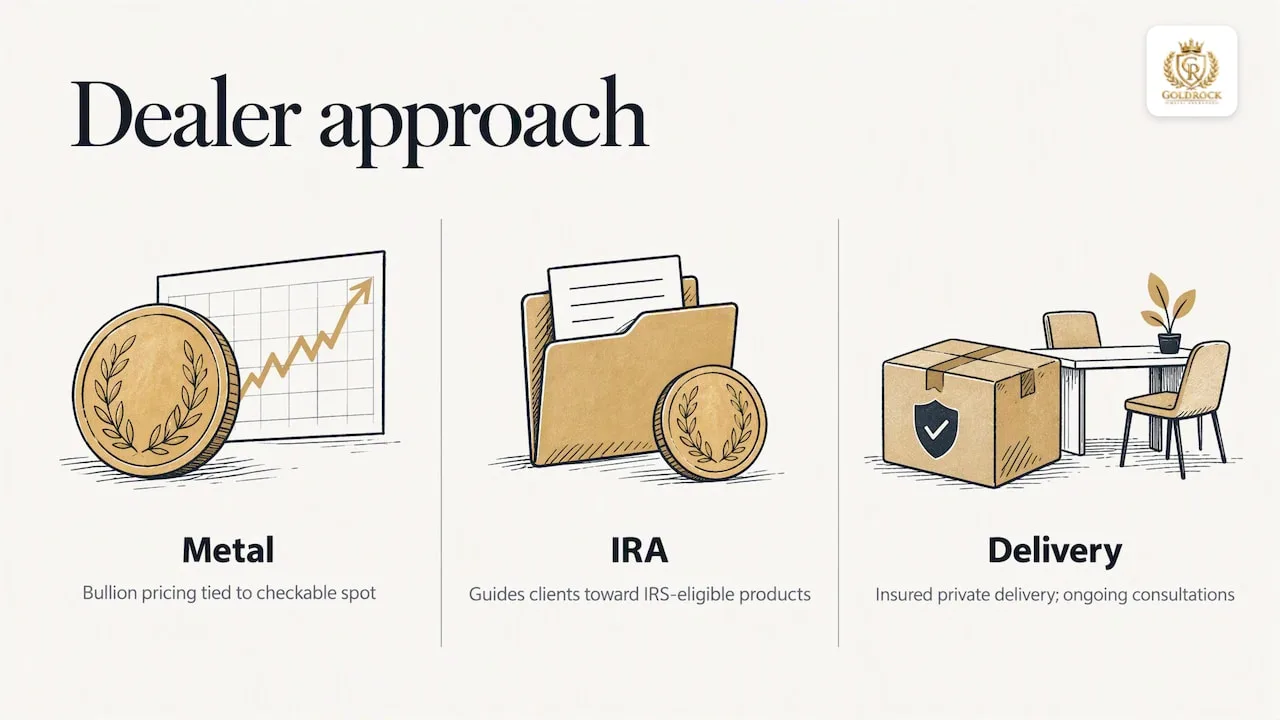
We also think retirement money deserves extra care. Our in-house IRA department handles transfers of retirement accounts into physical metals, and part of its work is steering clients toward products that meet IRS requirements, so an eligibility mistake does not surface months later. We do not promise returns, safety or tax outcomes, and we would rather you ask questions than trust us blindly.
For metal held outside an IRA, we offer insured private delivery, and we stay available for ongoing consultations after the purchase. That is how we think a dealer should work: transparent about costs, patient, and honest about risk.
— Blake
Where GoldRock fits
GoldRock Metal Exchange is a full service dealer of physical gold, silver, platinum and palladium. We also help investors set up and fund a Precious Metals IRA and arrange private delivery for metal bought outside a retirement account. If you are ready to begin, you can open a Precious Metal IRA or Request a Free Precious Metals Consultation at (888) 859-0978.
FAQ
What is the difference between proof and bullion coins?
Bullion coins are made for investors and priced mainly on their metal content and the daily spot price. Proof coins are made for collectors, with polished dies, multiple strikes, presentation packaging and lower production runs. That is why proofs usually cost more over spot.
Are proof coins worth more than bullion?
They usually cost more, but that is not the same as holding more metal or being worth more when you sell. A proof’s price includes a collector premium, and getting that premium back depends on finding a buyer who values the coin. Ask any dealer what they would pay you for it today.
Can I put proof coins in an IRA?
Often not. The IRS treats most coins as collectibles, with an exception for certain bullion that meets fineness requirements. The IRS has said that buying a non-eligible item can be treated as a distribution. Check the specific product with your custodian, and ask a tax professional about your situation.
What is the difference between bullion and numismatic coins?
Bullion is valued by weight and purity. Numismatic coins are valued for rarity, age, condition or special production. Be cautious when a seller uses “semi-numismatic” to justify a higher price for an ordinary coin, as regulators have warned.
Is junk silver the same as bullion?
In pricing terms it works like bullion, because the value comes from the silver content and not a collectible premium. It is less uniform than standardized products, and not every form qualifies for an IRA, so confirm eligibility first.
Sources
- CFTC customer advisory on gold and silver schemes targeting retirement savings
- FINRA: 10 things to ask before buying physical gold, silver or other metals
- FINRA: 4 tips to know before buying physical precious metals
- IRS letter ruling on collectibles and bullion in IRAs
- U.S. Mint: coin differences FAQ
- U.S. Mint: collectible and investment coins
Educational disclaimer: This article is for general education only. It is not personalized investment, tax or legal advice, and it does not promise returns, safety, tax benefits or appreciation. Precious metals prices can fall as well as rise. Consult a qualified professional about your own circumstances.