Gold and palladium do different jobs. Gold is a large, liquid store of value that investors have held through many market cycles. Palladium is a smaller, more volatile metal whose price follows industrial demand, mainly from automakers. Neither is “better” in the abstract. The right choice depends on your goal, your time horizon and how much price swing you can tolerate.
This guide compares the two on the points that matter when you buy physical metal: what drives each price, how volatile each is, what you pay to buy and sell, and what the IRS requires if you want either metal inside a self-directed IRA. It is educational, not personal advice.
TL;DR
- Gold is driven mostly by monetary policy and investor sentiment. Palladium is driven mostly by industrial demand, with roughly 80% of consumption tied to the auto industry.
- The gold market is far larger than the palladium market, so palladium prices can move faster and further in either direction.
- Many investors treat the two as complements: gold as the core holding, palladium as a smaller, cyclical position, if they hold it at all.
- Both can be held in an IRA only if the metal meets IRS rules and sits with an approved trustee, not at home.
- No metal is guaranteed to rise or protect you from loss. Compare premiums, storage and selling costs before you buy.
Table of Contents
- The short answer: different tools, different risks
- Gold vs palladium at a glance
- What drives the price of each metal
- Where the gold-to-palladium ratio stands
- Volatility and liquidity: what you can expect
- The real cost of owning either metal
- Holding gold or palladium in an IRA
- How to decide: five criteria
- Our perspective
- Buying with guidance, delivery and an IRA option
- Protect yourself when buying
- FAQ
- Final step: talk it through
- Sources
The short answer: different tools, different risks
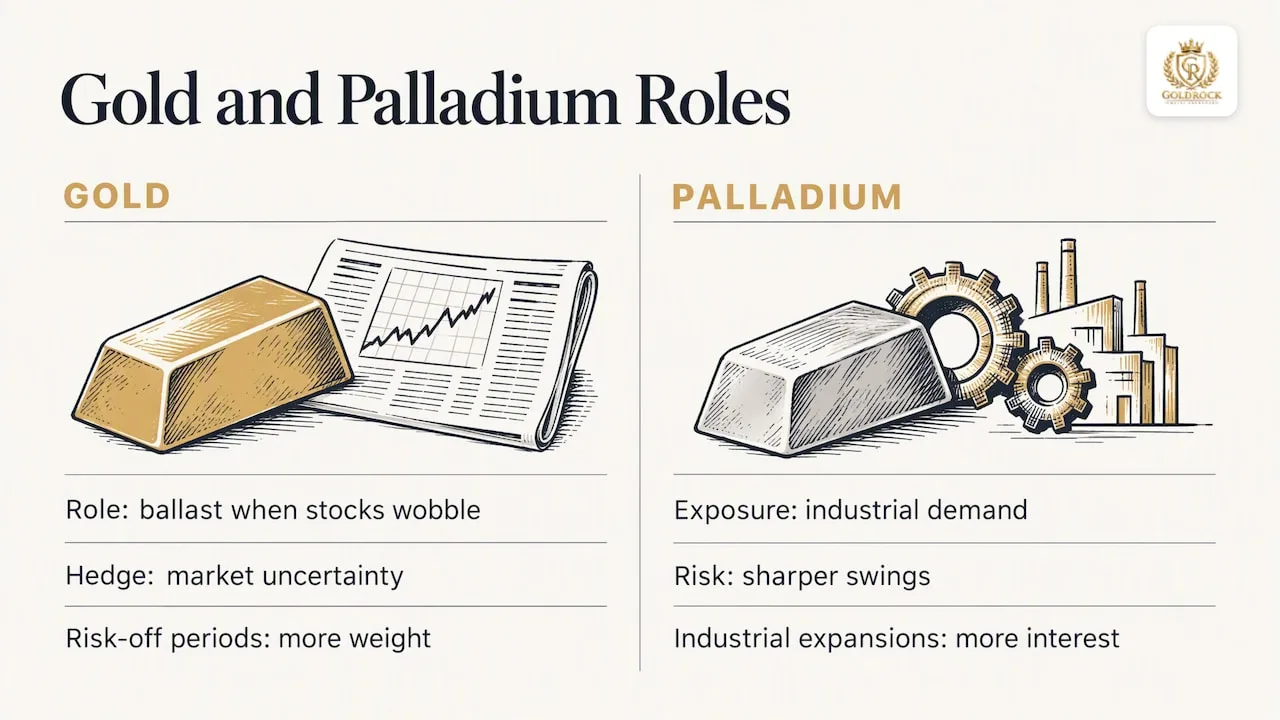
If you want a metal that has historically served as ballast when stocks wobble, gold is the usual starting point. Research on U.S. recessions has pointed to the continued prominence of gold as a hedge against market uncertainty compared with the more industrially sensitive palladium and platinum.
If you want exposure to industrial demand and accept sharper swings, palladium is a different kind of bet. Commodities strategists describe gold, platinum and palladium as complements rather than substitutes: gold tends to get more weight in risk-off periods, while platinum-group metals attract interest during industrial expansions.
That framing answers the common questions readers ask. Is palladium better than gold? Not as a general rule. Is it better to invest in palladium or gold? It depends on what you need the metal to do, and that is a question to weigh with a licensed financial professional who knows your full situation.
Gold vs palladium at a glance
| Factor | Gold | Palladium |
|---|---|---|
| Main price driver | Monetary policy, real rates, investor demand | Auto catalysts and other industrial use, supply from a few regions |
| Market size | About $5 trillion | About $16 billion |
| Typical role | Core store of value, liquidity | Smaller cyclical or diversifying position |
| Volatility | Lower | Higher |
| Physical form | Coins and bars | Coins and bars, less widely available |
| IRA eligibility | Yes, if the product meets IRS standards | Yes, if the product meets IRS standards |
The market-size figures come from a third-party estimate and move with prices, so treat them as orders of magnitude, not exact values.
What drives the price of each metal
Gold: policy, sentiment and a deep market
Gold is both a precious metal and a monetary asset. Its price responds to interest-rate expectations, currency strength, inflation worries and central bank behavior. Because the market is so large, a single industry rarely moves it much. That depth is a big reason gold is considered the more liquid of the two.
Gold is not risk-free. The CFTC warns that gold and other precious metals may not be as safe as some promoters make them out to be. Prices can fall, sometimes for long stretches. For more on how metals have behaved when growth slows, see our piece on how metals move in a recession.
Palladium: cars, chips and concentrated supply
Palladium is a precious metal and a working industrial input. Its best-known use is in catalytic converters. The U.S. Geological Survey also lists it among the minerals used in serverboards and circuitry in data centers, where corrosion-resistant conductors matter.
Because supply comes from a few concentrated regions and demand is tied to manufacturing, palladium is more sensitive to supply-chain disruptions and to shifts in auto production than gold is. A change in vehicle technology or a mine disruption can matter a great deal for a market this small.
That is why palladium has had sharp runs and sharp drops. One widely cited ranking snippet notes a period when palladium traded above gold. Today the picture is quite different, as the next section shows.
Where the gold-to-palladium ratio stands
The gold-to-palladium ratio tells you how many ounces of palladium one ounce of gold buys. As of October 16, 2026, GuruFocus shows a ratio of 3.67, with gold at $4,152.25 per ounce and palladium at $1,130.00 per ounce. The same page puts the 20-year mean at 1.94.

A high ratio means palladium is cheap relative to gold by its own history. It does not mean palladium is a bargain. The ratio can stay stretched for years, and palladium may be cheap for reasons such as weaker auto demand or substitution by other metals. Think of the ratio as one data point about relative pricing, not a buy signal. Check live prices before you act, because these numbers change daily.
Our spot price guide explains how those quoted prices relate to what you actually pay for a coin or bar.
Volatility and liquidity: what you can expect
A smaller market means thinner trading. For palladium, that can translate into wider price swings and, at times, wider gaps between what a dealer charges and what a dealer pays. Gold’s deep market usually means easier resale and more predictable pricing.
This matters more the shorter your horizon. If you might need to sell in a few years, a volatile metal can leave you selling at a bad moment. If you hold a small slice for diversification and can wait, volatility is easier to live with. We cover palladium’s behavior in more detail in palladium’s role during market stress.
The real cost of owning either metal
When you buy physical metal you pay the spot price plus a premium. The CFTC explains that the spot price must rise enough to offset the premium, storage and selling costs before you break even. Premiums vary by product, size and seller, so compare them before you commit. Our explainer on the gold premium over spot walks through the math.
A simple way to think about it:
- Buy price: spot plus premium, plus any shipping or insurance.
- Holding cost: storage, either a secure depository for an IRA or your own arrangements outside one.
- Sell price: typically spot minus a dealer spread.
The gap between steps 1 and 3 is the hurdle the metal has to clear. Smaller or less common products often carry larger spreads. If you want a wider lens on cost discipline and sizing exposure, this risk-math primer on gold trading is a useful reference, though it is aimed at traders, not physical buyers.
If you are considering a retirement account, there are also account fees. Our gold IRA fees guide breaks down typical first-year and annual ranges.
Holding gold or palladium in an IRA
Both metals can be held in a self-directed IRA, but the rules are strict. The IRS says certain gold, silver, platinum and palladium coins and bullion are excluded from the definition of a collectible, provided they meet its standards. If an IRA buys something that counts as a collectible, the purchase is treated as a distribution.
Two practical points follow:
- Product eligibility: the metal must meet the IRS fineness and product requirements. The relevant statute is Section 408(m) of the Code, and the IRS letter ruling text shows how it treats certain coins.
- Custody: the metal must be held by an approved trustee. It cannot sit in your home safe.
These rules are why product choice inside an IRA is narrower than outside one. For platinum-group specifics, see our guides on the 99.95% rule for platinum and coins for retirement. How a rollover or distribution is taxed depends on your circumstances, so speak with a qualified tax professional before moving funds.
How to decide: five criteria
Ask yourself these before choosing either metal:
- What is the job? Stability and liquidity point toward gold. Cyclical exposure points toward palladium, usually in smaller size.
- How long can you hold? A longer horizon tolerates more volatility.
- How much of your portfolio is this? Most of the discussion about palladium assumes it is a minor position, not the foundation.
- What will it cost round trip? Premium, storage and the sell spread.
- Where will it be held? Inside an IRA with a trustee, or outside with insured delivery and your own storage.
Our overview of reducing portfolio risk with precious metals and the guide to palladium’s role in retirement go deeper on sizing questions.
Our perspective
We talk with investors every week who ask this exact question, and the honest answer is rarely “one or the other.” For most people who come to us worried about volatility or inflation, gold is the metal that fits that concern. It is liquid, widely understood and has the deepest market behind it.
Palladium has a place for some investors, but we encourage people to treat it as a smaller, deliberate allocation and to understand why it is cheap or expensive before buying. A low ratio to gold is not a reason by itself.
We also want you to know what you are buying. We explain premiums up front, we help you confirm whether a product qualifies for an IRA before you place an order, and our in-house IRA department handles the paperwork so a rollover does not stall. We do not promise returns, and neither should anyone selling metal. Our job is to give you clear information and personal attention, then let you decide.
— Blake
Buying with guidance, delivery and an IRA option
If you decide to buy, you can browse gold and palladium, along with silver and platinum. Purchases outside a retirement account can ship by insured private delivery, which we explain in our guide to private metals delivery. To hold metal in a retirement account, our Precious Metals IRA service gives you a dedicated in-house team to guide the transfer.
Request a Free Precious Metals Consultation or call (888) 859-0978 to talk through your questions.
Protect yourself when buying
Whichever metal you choose, be careful about how you buy. The CFTC warns about leveraged or financed metal sales and notes that a seller claiming to store metal for you may not actually hold any. It also describes cases where most retail customers lost money on financed transactions. Insist on real, physical metal, clear pricing and written terms. The CFTC’s account of a fraud trial involving precious metals firms shows how paper-only schemes were marketed as physical sales.
Our dealer selection checklist lists the questions to ask any seller.
FAQ
Is palladium better than gold?
Not in general. Gold is more liquid and has a much larger market, while palladium is more volatile and tied to industrial demand. Which one suits you depends on your goals, time horizon and risk tolerance.
Why is palladium so cheap compared with gold right now?
As of October 16, 2026, the gold-to-palladium ratio is 3.67, well above its 20-year mean. Palladium’s price reflects industrial demand and supply conditions, so a low price may reflect weaker fundamentals as much as opportunity. Prices change daily.
What are the disadvantages of palladium?
It is more volatile, its market is smaller, and its price depends heavily on auto demand. Resale spreads can also be wider than for gold. None of this rules it out, but it argues for smaller position sizes.
Can I hold gold and palladium in an IRA?
Yes, if the metal meets IRS requirements and is held by an approved trustee. The IRS collectibles guidance explains which coins and bullion are excluded from the collectible definition. Confirm eligibility before you buy.
Do I have to choose one?
No. Many investors hold more than one metal, and strategists often see them as complements. Any allocation should reflect your own finances, ideally reviewed with a licensed professional.
Final step: talk it through
If you would like to compare metals for your own situation, our team can walk you through products, premiums, delivery and IRA options with no pressure. Request a Free Precious Metals Consultation or call (888) 859-0978.
Educational disclaimer: This article is for general information only. It is not investment, tax or legal advice, and it does not recommend any particular purchase. Precious metals prices can fall as well as rise, and no return or tax outcome is guaranteed. Consult a licensed financial, tax or legal professional about your circumstances.
Sources
- Gold/Palladium Price Ratio, GuruFocus
- What Is Palladium and How Does It Compare to Gold? EBC Financial Group
- Decoding Key Signals in the Relative Prices of Precious Metals, Neuberger
- Academic analysis of gold as a hedge in U.S. recessions
- Key Minerals in Data Centers, U.S. Geological Survey
- The Risks of Buying Gold, Silver & Platinum, CFTC
- CFTC press release on the Hunter Wise fraud trial
- Investments in collectibles in individually directed qualified plan accounts, IRS
- IRS letter ruling on Section 408(m)