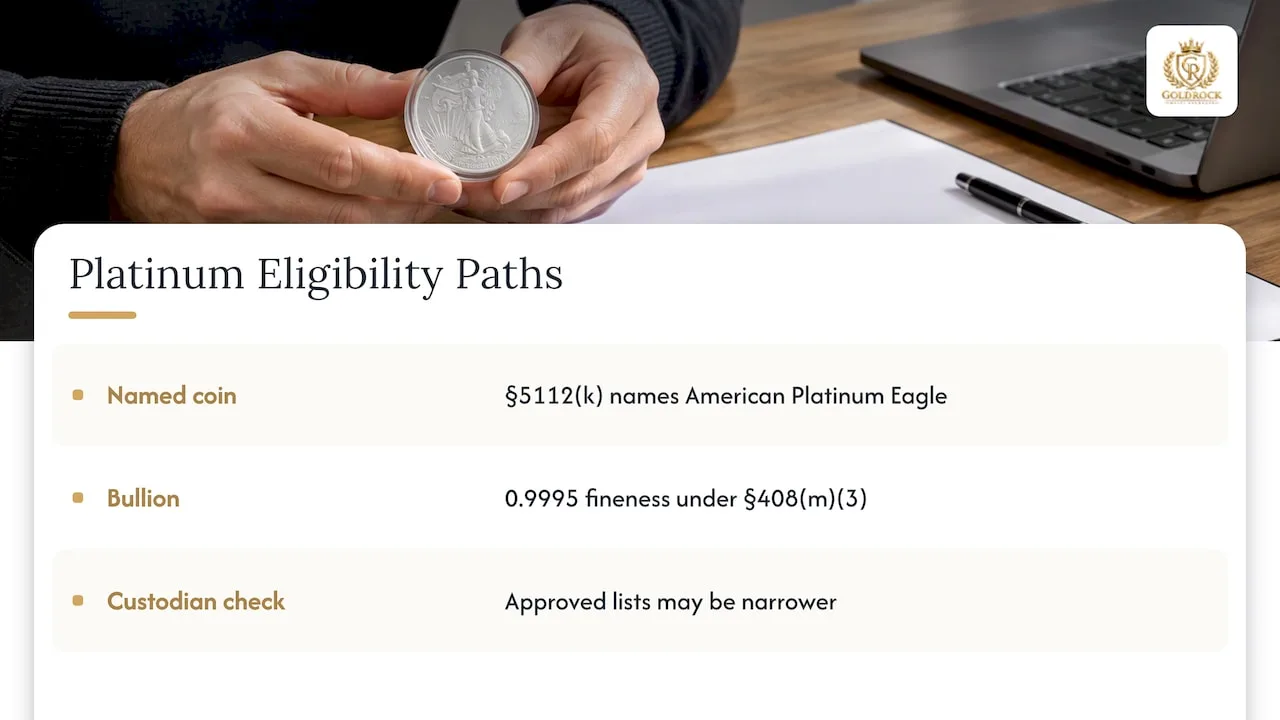
A platinum coin is IRA eligible when it meets one of two IRS tests under 26 U.S.C. §408(m)(3): it is the specific coin named in 31 U.S.C. §5112(k), the American Platinum Eagle, or it is platinum bullion refined to at least 0.9995 fineness. Several widely held sovereign coins and LBMA Good Delivery bars meet that fineness test. Whichever path applies, a qualified trustee or approved nonbank depository has to hold the metal for your IRA.
TL;DR:
- Custodians may reject products that meet IRS rules, so confirm the exact coin series or bar refiner, serial number, and intake documents before buying.
- A depository approved by the custodian must store the metal; personal possession can count as a distribution and prohibited transaction, potentially triggering taxes and penalties.
- The 2026 contribution limit is $7,500, plus $1,100 for people aged 50 or older; rollovers and transfers are common funding routes.
- Before payment, get written confirmation of the depository, storage type, insurance coverage, inventory audits, and how the custodian will record the asset.
Table of Contents
- Which specific platinum coins and bars meet the IRS tests
- The legal basis behind the 0.9995 rule
- Custody and storage rules you need to follow
- Step-by-step: adding platinum to a self-directed IRA
- Common acceptance problems and questions to ask your custodian
- How platinum fits a retirement metals allocation
- Request a free consultation to confirm your platinum IRA options
- FAQ
- Sources
Which specific platinum coins and bars meet the IRS tests
The American Platinum Eagle sits in its own category. It does not need to pass a fineness test to qualify, because Congress named it directly in 31 U.S.C. §5112(k), and the U.S. Mint describes the coin as guaranteed for weight, content, and 0.9995 purity. It was first issued in 1997 and is sold in a one-troy-ounce bullion tier, the size most commonly held in retirement accounts.
Other sovereign platinum coins qualify through the second path, the fineness test, rather than by name. We regularly see these come up in IRA conversations:
- Canadian Platinum Maple Leaf: struck at 0.9995 fine, qualifying through the bullion fineness standard rather than a named-coin exception.
- Austrian Vienna Philharmonic Platinum: also minted to 0.9995, accepted on the same fineness basis.
- Australian Platinum Koala: check with your custodian whether this coin is accepted for IRA purposes.
A coin’s eligibility depends on its purity, not its origin, which is an important distinction when you are comparing products from different mints.
Platinum bars may qualify if they meet the applicable fineness standard. Confirm whether your custodian accepts the specific bar and refiner. Refiners commonly associated with Good Delivery platinum include PAMP, Valcambi, Credit Suisse, and Argor-Heraeus. As with coins, the one-troy-ounce size is the most common format investors choose for IRA holdings, though bars are also available in larger sizes. Before you commit to a bar purchase, confirm with your custodian that the specific refiner and serial number are on their accepted list. Our Precious Metals IRA page walks through IRA setup if you want to learn more before buying.
The legal basis behind the 0.9995 rule
The eligibility rule traces back to 26 U.S.C. §408(m)(3), the section of the tax code that otherwise treats collectibles, including most coins, as a prohibited IRA investment. The statute carves out two exceptions. The first names specific coins directly, which is how the American Platinum Eagle gets its eligibility. The second admits bullion that meets the minimum fineness a regulated commodities exchange requires for physical delivery of futures contracts.
That second exception is why 0.9995 matters so much for platinum. The Chicago Mercantile Exchange, where platinum futures contracts settle, sets 0.9995 as its physical-delivery fineness requirement, and the IRS ties IRA eligibility to that same standard. LBMA Good Delivery requirements align with this threshold, which is part of why Good Delivery bars from accredited refiners generally clear the bar for IRA use.
Separately, 31 U.S.C. §5112(k) authorizes the U.S. Mint to produce platinum bullion coins at all, and it is the statute that specifically creates the American Platinum Eagle program. That is the legal basis for treating the Eagle as eligible without running it through a fineness calculation, since Congress named the coin itself rather than setting a purity floor for it to clear.
It is worth separating two different things here: what the statute makes eligible, and what a given custodian will actually accept. Meeting the IRS test is necessary but not sufficient. Custodians and depositories still maintain their own approved-product lists, and those lists can be narrower than what the law technically permits.
Custody and storage rules you need to follow
IRS guidance is direct on this point: platinum held in an IRA has to sit with a qualified trustee or an approved nonbank depository, not in your home, a safe deposit box you control, or anywhere else you can access directly. Taking personal possession of IRA-owned platinum is treated as a distribution and a prohibited transaction, which can trigger taxes and penalties depending on your situation.
In practice, two parties handle your metal. The custodian administers the IRA itself, reports to the IRS, and keeps records of what the account owns. The depository is the secure facility that physically stores the platinum. When you use insured private delivery through our team, the coins or bars can be shipped to the depository your custodian has approved, so the metal does not pass through your hands while it is IRA property. Our storage options guide breaks down how custodian and depository roles differ in more detail.
Before you finalize a purchase, confirm a few things in writing:
- Storage location: which depository will hold the metal and whether it is segregated or commingled storage.
- Insurance coverage: what the depository’s policy covers and whether it matches the value of your holding.
- Inventory procedures: how often the depository audits holdings and how that gets reported back to you.
- Transfer documentation: how the custodian records the purchase and booking into your account.
Pro Tip: Ask for written confirmation of acceptance and storage terms before you send payment, not after.
Step-by-step: adding platinum to a self-directed IRA
Getting platinum into a retirement account follows a fairly consistent sequence, whether you are starting fresh or moving existing retirement funds.
- Open or confirm a self-directed IRA custodial account that accepts platinum, and verify its acceptance procedures before you proceed.
- Fund the account through a rollover or transfer from an existing retirement account. Most investors use this route rather than new cash contributions, since the 2026 annual IRA contribution limit is $7,500, with an additional $1,100 catch-up contribution allowed for investors age 50 and older.
- Choose an eligible product, either the American Platinum Eagle or a coin or bar that meets 0.9995 fineness, and confirm the exact refiner, series, and serial numbers with your custodian in advance.
- Arrange the purchase through your dealer and have the product shipped directly to the depository your custodian has approved. At no point should the metal come to your personal address while it is IRA property.
- Confirm receipt and booking, meaning the depository has logged the item into inventory and your custodian has recorded it as an IRA asset.
Opening the account is usually the step that takes the most lead time, since custodians have their own paperwork and verification process. Our Precious Metals IRA page outlines our IRA services.
Common acceptance problems and questions to ask your custodian
Meeting the statutory fineness or named-coin test does not guarantee a specific custodian or depository will accept a given item. Approved-product lists vary by institution, and a coin that is technically IRA eligible under the tax code can still be turned away if it is not on your custodian’s list.
Before you buy, confirm these details directly with your custodian:
- Exact coin series and year, since mints occasionally change specifications between releases.
- Refiner name and bar serial numbers, which the depository needs for intake and inventory.
- Assay certificates or documentation proving fineness, especially for bars.
- Packaging requirements, since some custodians require original mint packaging or tamper-evident seals.
- Graded or numismatic coin policies, since most custodians reject graded, slabbed, or collectible coins even when the underlying metal meets fineness, because the premium on those coins reflects rarity rather than bullion content.
A short list of questions to a custodian can head off delays: does this exact product appear on your approved list, is the refiner or mint accredited for IRA purposes, and what documentation will the depository require at intake?
How platinum fits a retirement metals allocation
Platinum behaves differently from gold in the market, with pricing more closely tied to industrial demand from sectors like automotive catalysts, which can make its price movements less correlated with the broader precious metals market. That difference is one reason some investors look at platinum as a way to diversify within a precious metals allocation, rather than as a substitute for gold or silver. We are not in a position to tell you what allocation is right for your account, but our in-house IRA department can provide personal guidance, arrange insured private delivery, and walk through custody requirements so the logistics are not something you have to sort out alone.
— Blake
Request a free consultation to confirm your platinum IRA options
If you are considering platinum for a retirement account, we can provide personal guidance and discuss delivery logistics.

Our in-house IRA department provides guidance on setup, rollovers, and custody, and insured private delivery is available for purchased metals. Request a Free Precious Metals Consultation by reviewing our Precious Metals IRA page or browsing our platinum offerings. We are glad to confirm acceptance details before you commit to a purchase.
This article is general information, not a substitute for advice from a qualified financial advisor. Consult a qualified financial professional about your own circumstances before acting on anything here.
FAQ
How much is a $100 platinum coin worth today?
You may be thinking of the American Platinum Eagle. Its face value is nominal, and its market value depends on factors such as its platinum content and the current market price. The U.S. Mint describes the coin. Its actual worth depends on the spot price of platinum at the time of sale, not its stamped denomination.
Which gold coins are IRA eligible?
Gold coin eligibility depends on the applicable statutory requirements and the custodian’s acceptance policies. Confirm the specific coin with your custodian before purchasing.
Can I invest in precious metals in my IRA?
Yes, a self-directed IRA can hold physical gold, silver, platinum, and palladium, provided each metal meets the IRS fineness or named-coin requirements and is stored with a qualified trustee or approved depository. A standard IRA through a typical brokerage usually does not offer this option, which is why investors set up a self-directed account specifically for metals.
How much is a 1 oz platinum coin worth?
The value of a one-troy-ounce platinum coin tracks the spot price of platinum at the time of purchase or sale, plus a premium that varies by mint, coin series, and dealer. Because platinum prices move with industrial demand as well as investment demand, the value can shift from day to day.
Sources
- Investments in collectibles in individually directed qualified plan accounts | Internal Revenue Service
- Govinfo
- American Eagle Platinum Bullion Coins
This article is for general educational purposes only and does not constitute investment, tax, or legal advice. Consult a qualified tax or financial professional about your individual circumstances before making retirement account decisions.