
A weekend price lock for gold is an agreement that fixes the price of a physical gold order at a quoted level, so a Saturday or Sunday order is not repriced by the time it is processed. It is not a market feature. It is a term of the order between you and your dealer, so the details (how long it holds, what you must pay to secure it, what happens if you cancel) are whatever your dealer’s written terms say. This guide explains what to ask, step by step, before you rely on one.
TL;DR
- A weekend price lock is a dealer order term, not an exchange rule. Its length, payment requirements and cancellation terms must be confirmed in writing before you commit.
- Gold does not stop trading on weekends everywhere. Some futures contracts now trade through Saturday and Sunday, while many physical and spot-based quotes are set when your dealer’s desk reopens.
- A locked price covers the metal’s price. Premiums, shipping, insurance and fees are separate lines to confirm.
- For a retirement account, the lock must also fit the custodian’s process, because the IRA funds, not your own cash, pay for the metal.
- This article is educational and is not investment, tax or legal advice.
Table of Contents
- What a weekend price lock actually means
- Does gold trading stop over the weekend?
- How a weekend price lock typically works
- What to confirm before you accept a lock
- How prices can move while you wait
- Weekend price locks and retirement accounts
- Protect yourself when you buy physical metals
- A worked example of reading a locked quote
- Request a Free Precious Metals Consultation
- Our perspective
- Where GoldRock fits
- FAQ
- Educational disclaimer
- Sources
What a weekend price lock actually means
When you buy physical gold, the price you pay has two parts: the spot price of the metal and a premium over spot that covers minting, distribution and the dealer’s service. Our guide to the gold premium over spot walks through that second part.
The spot price moves while markets are open. If you decide to buy on a Saturday, you face a simple question: which price will your order be filled at? A price lock answers it. The dealer quotes a price, you accept it, and the order is held at that quote under the terms you agreed to.
That is the whole idea. It is a promise about timing and price, and like any promise it is only as clear as its written terms. Two orders that both call themselves “locked” can differ in how long the quote holds, whether payment is due immediately, and what happens if funds arrive late.
For a broader explanation of the mechanism, see our page on how a gold order price lock works.
Does gold trading stop over the weekend?
It depends on which market you mean, and this is the source of most confusion.
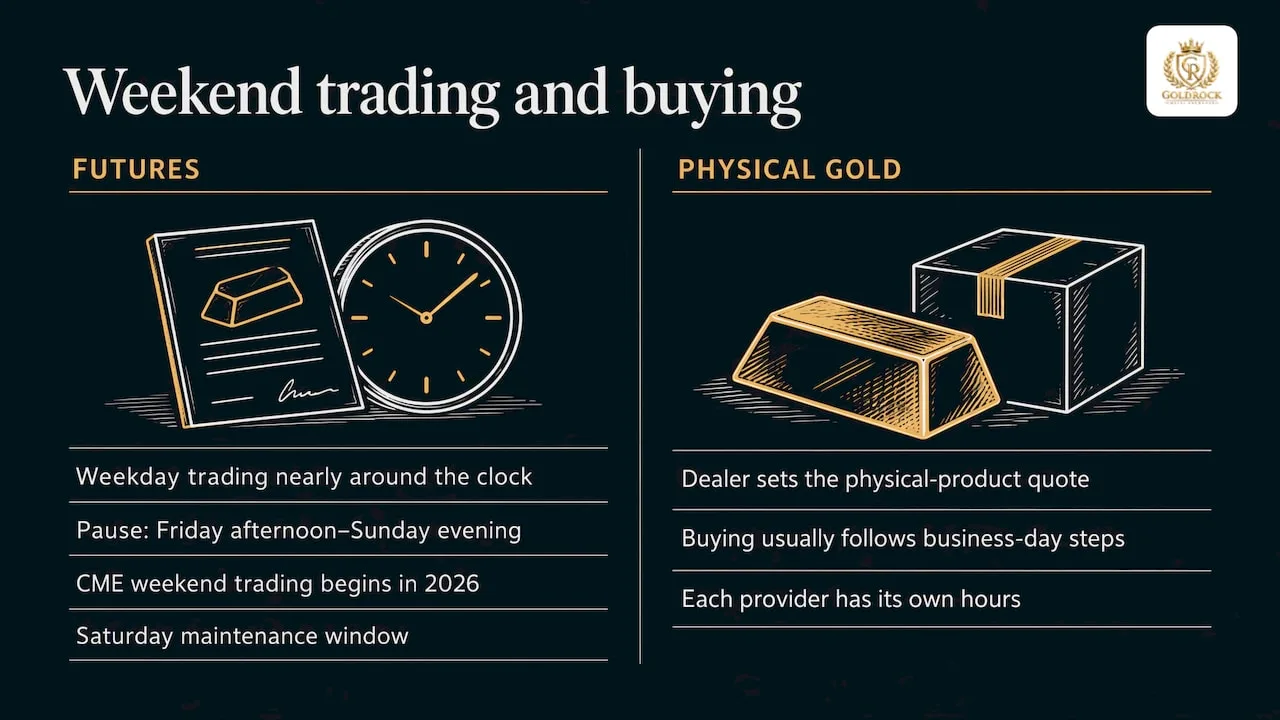
The traditional pattern is that major gold futures trade nearly around the clock on weekdays and pause from Friday afternoon until Sunday evening. That pattern is changing in parts of the market. CME Group published a notice in 2026 stating that its one-ounce gold futures would begin production weekend trading, with a schedule that covers Saturdays and Sundays and includes a Saturday maintenance window. If you want background on how after-hours and weekend sessions work in another market, this explainer on after-hours trading and weekend access is a reasonable starting point.
This matters for you in a practical way, but not the way many readers assume. A futures contract is a financial instrument. Buying a one-ounce gold coin or bar is a different transaction: you are purchasing a physical product, and a dealer sets the quote for it. Weekend futures trading does not automatically mean a physical order can be priced, funded, verified and shipped on a Saturday. Dealers, banks, wire systems and custodians have their own operating hours.
So the honest answer is: parts of the gold market now trade on weekends, but the process of buying physical metal usually still runs on business-day steps. A price lock is how a dealer bridges that gap.
How a weekend price lock typically works
Terms vary from dealer to dealer, so treat the following as a framework of what to confirm, not as a description of any one company’s policy.
- You request a quote. You name the metal, product, quantity and delivery method.
- The dealer gives a price. It should state the spot basis, the premium per item, any fees, and the total.
- You accept and the order is recorded. Ask for the quote and its terms in writing, by email or on an order confirmation.
- Payment is arranged. Many locks depend on funds arriving within a stated window. Wire transfers, checks and card payments each clear on different timelines.
- The order is confirmed and fulfilled. Shipping, insurance and delivery follow once payment clears.
The step where most misunderstandings happen is the fourth. A quote can be accurate and still lapse if payment does not arrive within the agreed period. That is why the lock window and the payment deadline should be read together.
What to confirm before you accept a lock
A short checklist keeps the conversation calm and specific. Ask each of these and note the answers.
How long does the lock last?
A lock might hold for hours, until the next business day, or for a set number of days. Ask for the exact expiry as a date, time and time zone. “Over the weekend” is not an expiry.
What must you do to keep it?
Some locks require payment to be initiated or received by a deadline. Others require a signed order. Know which one applies and what counts as “received.”
What is locked and what is not?
The lock may cover the spot component, the full per-item price, or only the total quote. Confirm whether the premium, shipping, insurance and any handling fees are part of the locked total. This is the most useful single question you can ask.
What happens if you cancel or the payment is late?
Ask whether the order can be cancelled, whether any fee applies, and what price applies if funds arrive after the lock expires. A calm, written answer is a good sign.
How and when is the order delivered?
A lock fixes price, not delivery. Ask when the order ships, how it is insured in transit, and who signs for it. If privacy matters to you, ask about private delivery options.
How prices can move while you wait
Gold’s price is set by trading, and trading is driven by news, currency moves and interest-rate expectations. If part of the market is open on a weekend, or if news breaks on a Saturday, the price at which the market reopens can differ from where it closed on Friday. Our gold price outlook discusses the factors that drive these moves.
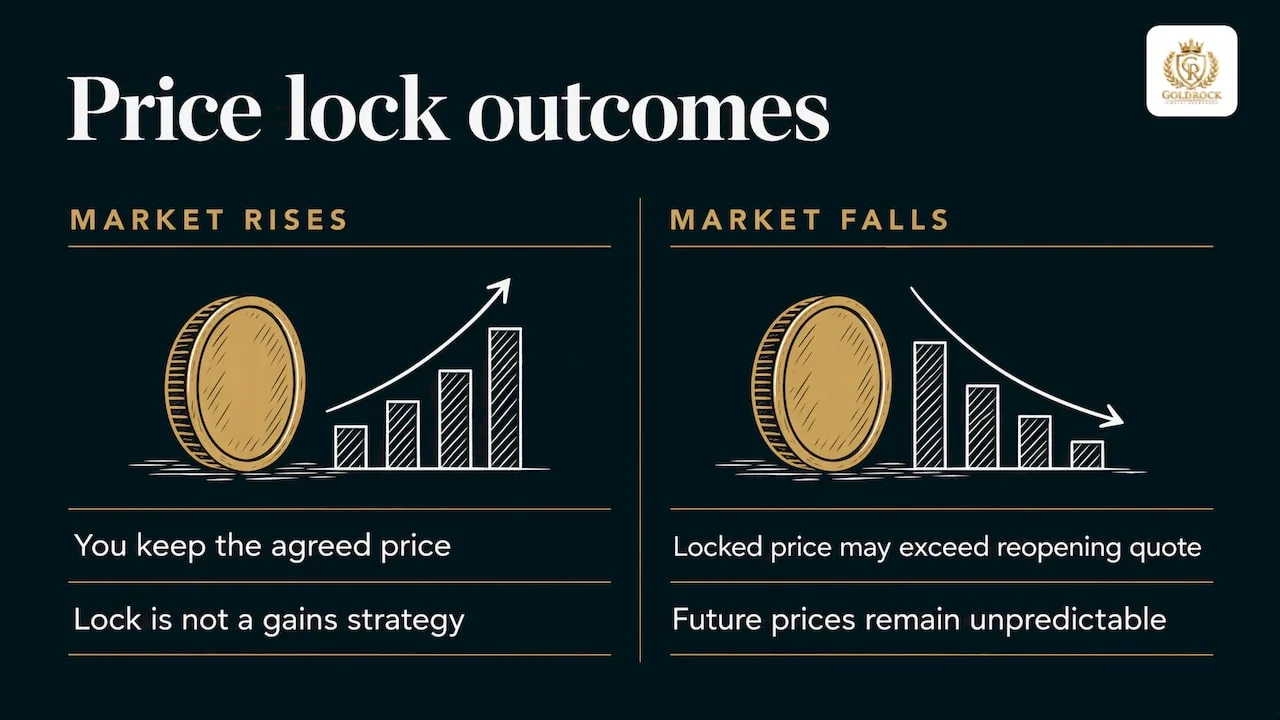
A lock works in both directions. If the market rises after you lock, you keep the agreed price. If the market falls, you may find that the locked price is higher than the quote you would receive when markets reopen. Neither outcome is predictable, and a lock does not predict or promise anything about future prices. It only removes one source of uncertainty: the price at which your order will be priced.
That is also why a lock is a tool for certainty, not a strategy for gains. If your concern is timing in general, a schedule can be a calmer approach: our guide to dollar-cost averaging gold explains how buying in regular amounts works.
Weekend price locks and retirement accounts
If you are buying gold inside a self-directed IRA, the order is not paid from your pocket. It is paid by the account, and a custodian, the financial institution that administers the IRA, has to authorize each step. That changes the timeline.
The IRS explains in its guidance on rollovers of retirement plan and IRA distributions that moving retirement money has its own rules and deadlines. Questions about how those rules apply to your situation belong with a qualified tax professional, and we do not give tax advice here.
For the pricing side, a few practical points are worth raising with whoever is helping you:
- Funding source. Is the money already in the self-directed IRA, or is a rollover or transfer still in progress? A lock cannot be funded by money that has not arrived.
- Custodian hours. Ask when the custodian can release funds and whether weekend requests wait until the next business day.
- Metal eligibility. Not every coin or bar qualifies for an IRA. Our guide to investing in coins for retirement covers what to check.
- Storage. IRA metals are generally held by an approved depository rather than at home. Confirm the arrangement before you buy.
This is where a team that handles the IRA side in-house helps. Our dedicated IRA department works on the transfer of retirement accounts into precious metals, so the person guiding the paperwork and the person discussing the order are working together.
Protect yourself when you buy physical metals
The CFTC and FINRA have jointly issued an investor bulletin on 10 things to ask before buying physical gold, silver or other metals. It notes that metals prices fluctuate like other investments and warns about overpriced sales and excessive fees, especially in retirement-account purchases. It also advises against responding to cold calls or unsolicited offers.
Two habits follow from that guidance and apply to any price lock:
- Get the full price in writing, including the spot basis, premium and every fee.
- Make sure you started the contact. Decide on your own schedule, not under time pressure created by a “limited” quote.
A calm process is a good process. A lock should reduce pressure, not add to it.
A worked example of reading a locked quote
Suppose you request a quote on a Saturday for a one-ounce gold coin. The dealer sends this by email (figures are illustrative only and not a GoldRock price):
| Line | What to check |
|---|---|
| Spot basis | Which spot price is used, and at what time |
| Premium per coin | Is it fixed for the lock period? |
| Shipping and insurance | Included in the total or added later? |
| Payment deadline | Date, time and time zone |
| Lock expiry | Date, time and time zone |
| Cancellation terms | Fees, if any, and how to cancel |
If every row has a clear answer, you know what you are agreeing to. If one row is blank, ask before you accept. That single habit solves most disputes before they start.
Request a Free Precious Metals Consultation
If you would like to talk through how an order is priced, how funds are arranged, or how a self-directed IRA purchase fits together, our team can walk you through it. Request a Free Precious Metals Consultation or call (888) 859-0978.
Our perspective
We think the most useful thing a dealer can do about weekend pricing is make it plain. A quote should show the metal’s price, the premium, the delivery cost and the timing, with nothing left to interpretation.
Our approach is personal service. We are a full-service dealer for gold, silver, platinum and palladium, and our in-house IRA department helps investors move retirement accounts into physical metals. When you are buying for a retirement account, one team that understands both the order and the account paperwork keeps the process clear.
We also offer insured private delivery for purchased metals, and ongoing consultations after the purchase. We do not promise returns or safety, and we do not give tax or legal advice. We do try to make every step understandable before you commit.
Blake
Where GoldRock fits
GoldRock Metal Exchange sells physical gold, silver, platinum and palladium, and sets up self-directed accounts through our Precious Metals IRA service. Purchases can be sent by insured private delivery.

If you are weighing metals for retirement, our guide to gold’s role in a retirement portfolio is a good companion read, and you can start an account on our open an IRA page.
FAQ
Does a weekend price lock guarantee a profit?
No. A lock fixes the price your order is based on. It does not predict whether the market will rise or fall afterward, and it does not promise any return.
Can I lock a price for an IRA purchase?
That depends on your dealer’s terms and on your custodian’s process. Because IRA funds must be released by a custodian, confirm the funding timeline before you rely on any lock. Our team can explain how our IRA process works if you call (888) 859-0978.
Is a price lock the same as weekend gold futures trading?
No. Futures are financial contracts traded on an exchange, and CME Group’s one-ounce gold futures now have a schedule that includes weekends. A price lock is a term in a physical purchase between you and a dealer.
What should I get in writing?
Ask for the spot basis, premium, fees, shipping and insurance, the payment deadline, the lock expiry with time zone, and the cancellation terms. Written terms prevent most misunderstandings.
Is a lock worth using?
It is a convenience that adds price certainty for a stated period. Whether it suits you depends on your goals and circumstances, so consider discussing your situation with a licensed financial professional.
Educational disclaimer
This article is for education only. It is not investment, tax or legal advice, and it does not promise returns, safety, tax benefits or appreciation. Precious metals prices can rise and fall. Speak with a qualified professional about your own situation.
Sources
- CME Group: one-ounce gold futures 24/7 trading notice
- CFTC and FINRA: 10 things to ask before buying physical gold, silver or other metals
- IRS: Rollovers of retirement plan and IRA distributions
- Darkbot: after-hours and weekend trading explained