Yes, an LLC or a trust can generally own physical gold and silver bullion, provided the governing document allows it and the metals are titled in the entity’s name and recorded in its books. The work is in the paperwork: a written assignment, an inventory, a storage plan and a clear tax classification. Retirement accounts follow a separate set of IRS rules, and mixing the two is where owners get into trouble. This guide explains each piece in plain terms so you can walk into a conversation with your own attorney and tax professional prepared.
TL;DR
- An LLC or trust can hold bullion if its operating or trust agreement permits tangible investments and the metals are titled in the entity’s name and logged in its records.
- Bullion has no deed or title registry, so a trust is funded with a written assignment that identifies the metals, and an inventory keeps the record straight.
- Metals held in an IRA must be in the physical possession of a bank or approved non-bank trustee. An LLC you control at home does not satisfy that rule.
- Keep records and storage details in separate places, and name a successor who knows how to reach both.
- This article is educational. It is not tax, legal or investment advice.
Table of Contents
- Why investors look at an LLC or a trust
- Owning bullion personally versus through an entity
- How an LLC holds bullion
- How a trust holds bullion
- Documenting ownership: a step-by-step routine
- Storage, insurance and access
- How taxes treat bullion held in an entity
- Why a retirement account is a different case
- Request a Free Precious Metals Consultation
- Our perspective
- A checklist before you buy through an entity
- FAQ
- Sources
Why investors look at an LLC or a trust
Most people who ask about holding bullion in an entity want one of three things: a cleaner way to pass metals to family, a way to keep investment assets separate from a business or personal life, or a single structure that documents what they own and where it sits. Each goal points to a different tool.
A trust is usually about succession. Because bullion has no central registry, deed or title document, moving it into a revocable living trust takes a written assignment of personal property that identifies the metals. Once the metals are titled in the trust, they pass to beneficiaries without probate court supervision, unlike personally owned bullion, which goes through probate.
An LLC is usually about organization and separation. Under Michigan law, for example, an LLC may be formed for any lawful purpose, including holding physical gold. Other states have their own LLC statutes, so the specifics depend on where the entity is formed.
Owning bullion personally versus through an entity
When you own bullion personally, the metals are simply yours. There is no separate paperwork beyond your purchase records, and when you die the metals are part of your estate. That is simple, and for many buyers it is enough.
An entity adds a layer. The LLC or trust becomes the legal owner, and you act for it as a member, manager or trustee. That has practical consequences:
| Question | Owned personally | Owned by an LLC or trust |
|---|---|---|
| Who is the legal owner? | You | The entity |
| What proves ownership? | Purchase records | Purchase records plus a written assignment or entity records |
| What happens at death? | Metals go through probate | Trust-titled metals pass under the trust terms without probate court supervision |
| What must be maintained? | Receipts and storage | Governing documents, books, inventory and storage records |
The extra layer is only worth having if you keep it in good order. An entity that holds metals in a drawer with no records is harder to defend than a personal holding with clean receipts.
How an LLC holds bullion
Three points matter most.
The agreement must allow it. Check that the operating agreement permits tangible investments such as gold, and that the metals are titled in the entity’s name and recorded in its books and in any insurance or inventory records. If the agreement limits the LLC to a specific business, an amendment may be needed first.
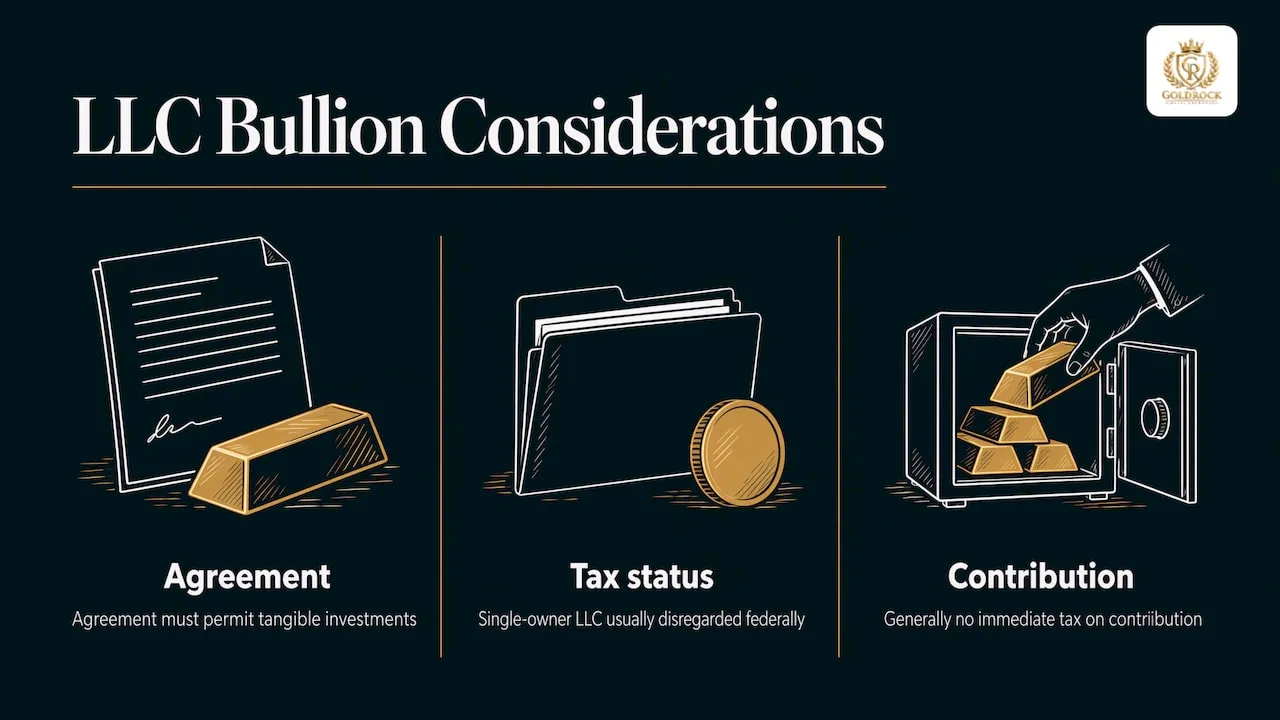
Federal tax classification. The IRS explains in Publication 1635 that an LLC with one individual owner is automatically treated as a sole proprietorship for federal income tax purposes unless it is classified otherwise. In plain terms, a one-person LLC is usually “disregarded,” meaning the IRS looks through it to the owner. An IRS private letter ruling reached the same conclusion for a single-member LLC: it is disregarded unless it elects association status, and an individual owner reports all income on personal returns. A private letter ruling is guidance issued to one taxpayer, so it illustrates how the IRS reads the rules rather than setting a rule for everyone. Multi-member LLCs are classified differently, and that is a question for a tax professional.
Moving metals in. Contributing gold to a single-member pass-through LLC generally triggers no immediate tax, with gains flowing through to the members when the LLC sells. Whether that holds for your situation depends on facts we cannot assess here.
How a trust holds bullion
A trust is a legal arrangement in which a trustee holds assets for beneficiaries under written terms. A revocable living trust is one you can change during your lifetime. For federal income tax, a revocable trust is considered a grantor trust under IRC section 676, which means its income is generally attributed to the person who created it.
The IRS has also addressed what happens when LLC interests move into a trust. In one letter ruling, after the original owners transferred their LLC interests to a trust, the trust became the sole owner and the LLC remained disregarded unless it elected otherwise. Some owners therefore place the LLC inside the trust, so that the LLC holds the metals and the trust holds the LLC. Whether that layering suits you is a decision for your attorney.
Documenting ownership: a step-by-step routine
Because nothing registers bullion automatically, your records are the proof. A workable routine looks like this:
- Confirm authority. Read the operating agreement or trust agreement and confirm it allows tangible investments.
- Buy in the right name. Where the entity will own the metals, the invoice, payment and delivery details should match the entity, not you personally. Ask your attorney or tax professional how the purchase should be paid and titled.
- Sign a written assignment for metals you already own. To fund a trust with untitled metals, execute a written assignment that identifies the metals and assigns ownership to the trust.
- Build an inventory. List each item, its approximate value and date, the storage location, access information and purchase documents. Include product type, weight, purity and any serial numbers on bars.
- Write a letter of instruction. Tell the successor trustee or manager how to reach storage, which dealer or appraiser to trust, whether any items carry sentimental value, and whether to sell or distribute the metals in kind.
- Update after every purchase or sale. An inventory that stops matching reality loses its value.
If you are buying new metals for the entity, the order process is where our team helps most: we can walk you through product choices across gold, silver, platinum and palladium and provide the purchase documentation for your records.
Storage, insurance and access
An entity needs a storage plan that someone other than you can follow. Three principles help.
Separate the map from the treasure. Do not keep the inventory in the same place as the metals. In the words of one estate-planning firm’s guidance, the aim is that someone who finds the metals should not also find a roadmap to the collection. Store the records with your attorney, in a safe-deposit box or in another secure location.
Match insurance to title. Insurance and inventory records should show the entity as owner, as the entity’s agreement is expected to reflect. Policies differ in what they cover for metals kept at home versus in a vault, so read the terms before assuming coverage.
Plan delivery with care. Moving metals is a risk point. We offer insured private delivery for purchases, and our guide on discreet gold shipping and the USPS cap explains why high-value orders often need more than standard mail.
How taxes treat bullion held in an entity
We do not give tax advice, and nothing here applies to your situation without a professional’s review. The following are general, published IRS positions.
- Long-term gains. IRS Notice 2023-27 states that the sale of a collectible held more than one year, defined to include coins and bullion otherwise excepted under section 408(m)(3), is subject to a maximum 28% capital gains rate.
- How the IRS describes it. The IRS’s capital gains topic page says net capital gains from selling collectibles, such as coins or art, are taxed at a maximum 28% rate, while net short-term gains are taxed as ordinary income.
- Disregarded entities. As noted above, a one-owner LLC is generally looked through for income tax. In one ruling involving a disregarded LLC, rent payments between the owner and the LLC produced no taxable income or deduction for the owner. Transactions between you and your own disregarded entity are therefore not treated as between two taxpayers.
What these positions mean for a given entity, a given holding period or a given state, including whether state sales tax applies to a purchase, is a question for a CPA or tax attorney.
Why a retirement account is a different case
This is the most common mistake in the topic. Owning bullion in an LLC with your own money is one thing. Owning it with IRA money is governed by another set of rules entirely.
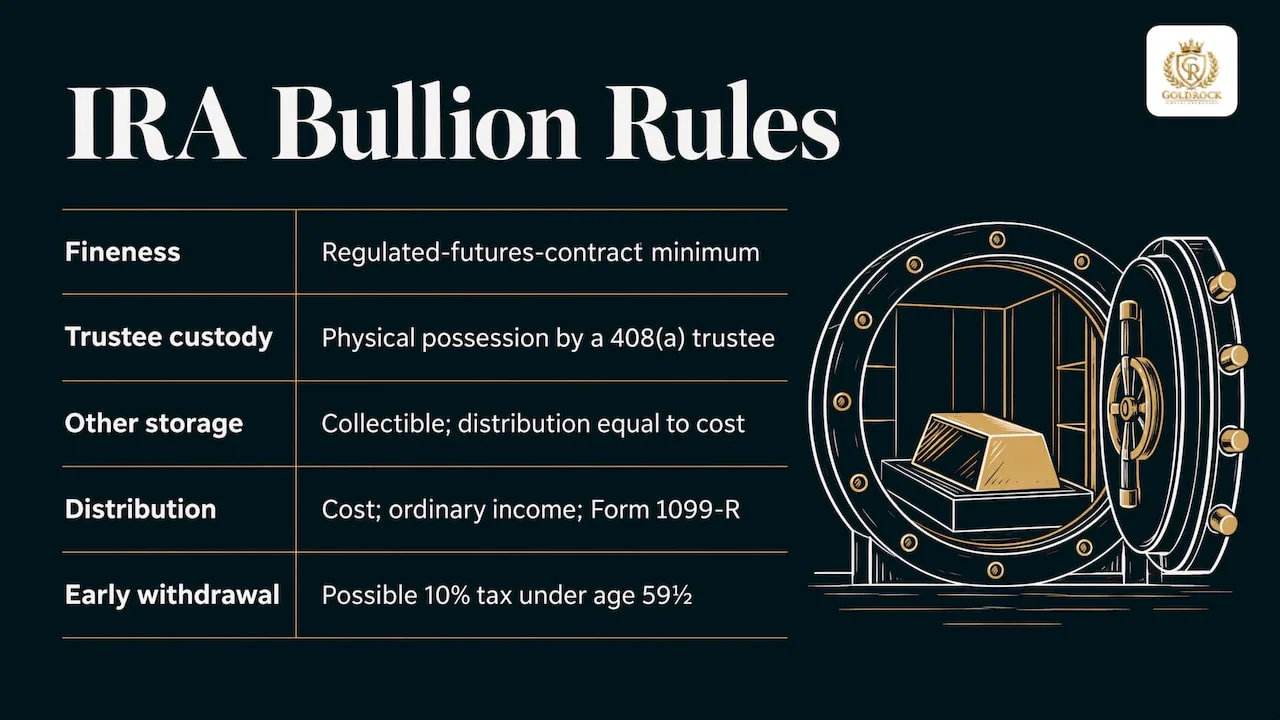
Under IRC section 408(m)(3)(B), as quoted in an IRS ruling, an IRA may hold gold, silver, platinum or palladium bullion only if it meets the minimum fineness for a regulated futures contract and is in the physical possession of a trustee described in section 408(a). In that ruling, the IRS found that bullion held by a non-bank safekeeping company rather than the IRA trustee was a collectible, and treated its deposit as a distribution equal to its cost.
The consequences are spelled out by the IRS. Acquiring a collectible in an individually directed account is treated as an immediate distribution equal to its cost, reported on Form 1099-R and generally taxed as ordinary income, with a possible 10% early-withdrawal tax if the participant is under 59½. The bullion exception applies only when a bank or approved non-bank trustee keeps physical possession.
The “checkbook LLC” case
Some promoters have suggested an IRA can own an LLC that you manage, with a bank account you control, to buy metals. The U.S. Tax Court addressed exactly that in McNulty v. Commissioner (157 T.C. No. 10, November 18, 2021). It held that an IRA owner who bought American Eagle coins through a checkbook LLC and stored them at home received a deemed distribution, because the owner had unfettered command over the assets without independent custodian oversight. A CPA firm’s summary of the decision notes the court reasoned that placing an LLC between the IRA and the coins created a situation ripe for abuse.
The takeaway is about structure, not about metals: retirement bullion belongs with an independent, qualified custodian and an approved depository. For a closer look at what that means, read our guides on why IRA gold should not be stored at home, the two section 408(m) rules and gold IRA rules for U.S. investors.
Request a Free Precious Metals Consultation
If you want to buy physical metals, whether for an entity you already have or inside a retirement account, we can talk through your options. GoldRock Metal Exchange is a full service precious metal dealer. We offer physical gold, silver, platinum and palladium, insured private delivery, and a dedicated in-house IRA department for self-directed Precious Metals IRAs.

If the money comes from a retirement account, our Precious Metals IRA service is built for that route, and you can open a Precious Metal IRA with personal guidance. For metals you will hold outside a retirement account, we can talk through private delivery. Request a Free Precious Metals Consultation or call (888) 859-0978.
Our perspective
Most of the questions we hear about LLCs and trusts come from people who are really asking one thing: how do I make sure what I own is protected, documented and easy for my family to handle? Structure helps with documentation, but it does not replace the basics.
Our view is that the dividing line is the source of the money. If it is after-tax savings you will hold personally or through an entity your attorney sets up, you have flexibility, and what matters is clean records, a sensible storage plan and insured delivery. If it is retirement money, the independent custodian and approved depository are the structure, and that is the job of our in-house IRA department.
We built GoldRock around personal service because these decisions are not one-size-fits-all. We explain the process, answer questions in plain language, and leave the legal and tax specifics to your attorney and tax professional. We make no promises about returns, safety or tax outcomes, and we would rather you understand your choices than rush into one.
Blake
A checklist before you buy through an entity
- Does the operating or trust agreement allow tangible investments?
- Is the entity’s tax classification confirmed by your tax professional?
- Will the invoice, payment and delivery details match the entity?
- Is there a written assignment for any metals you already own?
- Is the inventory current, and kept apart from the metals?
- Does your insurance record the entity as owner?
- Does a successor know how to reach the metals and the records?
- If any of the funds come from an IRA or 401(k), have you confirmed an approved custodian and depository will hold the metals?
For retirement holdings, two of our checklists add detail: the segregated versus commingled storage checks and the depository insurance checklist.
Educational disclaimer. This article is for general education only. It is not personalized investment, tax or legal advice, and it does not promise returns, safety, appreciation or tax benefits. Laws and IRS positions change, and state rules vary. Consult a qualified attorney and tax professional about your own situation.
FAQ
Can an LLC own gold and silver bullion?
Generally yes, if the LLC’s operating agreement allows it and state law permits the purpose. The metals should be titled in the LLC’s name and recorded in its books and insurance or inventory records. Your attorney can confirm what your state and your agreement require.
Can a trust own bullion?
Yes. Because bullion has no title registry, the usual method is a written assignment that identifies the metals and assigns them to the trust, supported by an inventory. Metals titled in a trust pass to beneficiaries under its terms without probate court supervision.
Can my IRA own bullion through an LLC I control?
The IRS rules require IRA bullion to be in the physical possession of a bank or approved non-bank trustee. In McNulty, the Tax Court treated coins bought through a checkbook LLC and stored at home as a deemed distribution. Our in-house IRA department can explain how a self-directed Precious Metals IRA with an approved custodian works.
Is there sales tax on bullion bought for an LLC or trust?
Sales tax treatment of bullion differs by state, and the rules can depend on the product, the amount and the buyer. We do not give tax advice, so check with your state’s department of revenue or a tax professional before you order.
How is bullion owned by an entity taxed when sold?
That depends on the entity’s tax classification and your circumstances. The IRS describes a maximum 28% rate for long-term gains on collectibles, including bullion, and short-term gains as ordinary income. A tax professional can tell you how this applies to you.
Sources
- Turning Gold into Legacy: Tax-Savvy Ways to Gift and Manage Precious Metals
- Funding a Trust with Gold, Silver and Precious Metals
- IRS Publication 1635
- IRS Private Letter Ruling 199922053
- IRS Private Letter Ruling 200339026
- IRS Private Letter Ruling 200102037
- IRS Notice 2023-27
- IRS Topic no. 409, Capital gains and losses
- IRS Private Letter Ruling 200217059
- IRS: Investments in collectibles in individually directed qualified plan accounts
- IRA Checkbook Control in the Crosshairs? | Groom Law Group
- Don’t try this at home | TMH