

The best defense against a high-pressure gold sale is time and paper. Do not decide on the first call, get the price, fees and commissions in writing, and compare the quote with the metal’s spot value before you pay. Regulators describe the same pattern again and again: urgency, fear and big promises. A dealer who welcomes your questions and gives you room to think is the opposite of that pattern, and that is how we aim to work at GoldRock Metal Exchange.
This guide covers the tactics to recognize, a routine you can follow on any purchase, the math that exposes inflated pricing, and the extra care needed when the money comes from a 401(k), IRA or Thrift Savings Plan.
TL;DR
- Pressure to act today, claims of limited quantities, and fear-based talk about market collapse are the classic warning signs regulators list.
- Never respond to cold calls, unsolicited emails or ads that sound like government agencies. Start the contact yourself.
- Get every fee, commission and the agreed price in writing before you sign or send money.
- Check the premium: (sales price minus spot value) divided by spot value, times 100.
- If you already signed under pressure, you can still verify values, get a second opinion and report concerns to the CFTC.
Table of Contents
- What high-pressure gold sales look like
- A routine for slowing any purchase down
- Request a Free Precious Metals Consultation
- Check the price with simple math
- Extra care when the money is in a 401(k), IRA or TSP
- Storage, custody and delivery: what to verify
- Warning signs versus calm service
- How we can help
- If you already signed or started a transfer under pressure
- Educational disclaimer
- FAQ
- Sources
What high-pressure gold sales look like
Precious metals are volatile, and that makes them an easy subject for emotional selling. The CFTC’s advisory on gold as an investment notes that past performance does not predict future returns, and that pitches built on doom and gloom or high-pressure tactics could be setting you up for fraud.
The patterns are consistent across regulators:
- False urgency. The CFTC’s precious metals fraud advisory gives the example of claims that only a couple of units are left and you must sign up today. It also lists discounts on commissions if you buy now.
- Dangling big profits. FINRA tells investors to be cautious of pitches that promise large profits or imply limited quantities, and of anyone who says you must act now or miss out.
- Social proof and false credentials. Claims that other savvy investors are already in, or that the salesperson holds credentials that are hard to verify, appear in the same CFTC advisory.
- Fear. A Connecticut state guide on precious metals scams lists cold calling, fear-based ads, appeals to political or religious affinity, false urgency, advice to liquidate existing investments, loan financing and failure to disclose commissions in writing as red flags.
- Official-sounding names. The CFTC advises caution with TV, radio or internet offers that use names sounding like government agencies.
Notice what these have in common: each one is designed to shorten the time between hearing the pitch and sending money. Your goal is to lengthen it.
A routine for slowing any purchase down
Use these steps whether you are buying a few coins, a larger order, or funding a precious metals IRA. They put you in control of the pace.
1. Start the contact yourself
The CFTC’s 10 things to ask before buying says never to respond to cold calls, unsolicited emails, junk mail, late-night commercials, social media posts, or pop-up and home-visit dealers. Choose who you speak with, and when. When you call us at (888) 859-0978 or visit goldrockmetalexchange.com, you are the one setting the conversation in motion.
2. Say you need time
A fair offer can survive a night’s sleep. Tell the salesperson you will review the terms and call back. If the response is a new deadline, a shrinking supply or a discount that vanishes at midnight, you have learned something important about the sale.
3. Ask for everything in writing
The CFTC advises requesting all fees, costs, commissions and the agreed retail price in writing before you sign or pay. Fees that are not available in writing before purchase are a red flag. FINRA adds that firms may charge account opening fees, sales commissions, storage fees and management fees, so ask about each one by name and ask what return you would need just to break even.
4. Ask how the salesperson is paid
The CFTC suggests asking the dealer how the salesperson is compensated, how the company earns its profit, and what its buy-back price would be. These are ordinary business questions. A calm, direct answer is what you should expect.
5. Verify the firm and the people
FINRA recommends requesting the salesperson’s and firm’s names, address and phone number, searching online for complaints, and using the U.S. Mint’s searchable database of coin sellers where relevant. The CFTC adds that you can check with your state attorney general or securities regulator for complaint history.
6. Compare the price to spot value
This is the single most useful number in the transaction, so it gets its own section below.
7. Get a second opinion before you commit
The Wisconsin Department of Financial Institutions suggests independently verifying the metal’s value and getting a second opinion. For retirement money, that means a licensed tax professional, financial adviser or attorney who does not profit from your decision.
Request a Free Precious Metals Consultation
If you want to walk through these questions with a person instead of a script, our team offers personalized guidance and ongoing consultations. Request a Free Precious Metals Consultation or call (888) 859-0978. There is no clock running on the conversation.
Check the price with simple math
Dealers sell above the spot price (the market price of the raw metal) and buy back below it. The gap is called the spread, and it covers the dealer’s costs and margin. The question is how wide it is.
The CFTC reports that dealer spreads can often be 10 percent or more, which means the metal must rise by more than that just for you to break even, before storage and insurance. In its 10 things advisory it notes that fraudulent dealers have charged spreads above 300 percent, while others charge less than 20 percent. Wisconsin’s regulator says bullion is typically sold at spreads of about 1% to 10%.

The formula from Wisconsin’s alert is:
(sales price minus spot value) divided by spot value, times 100
Here is an illustration with made-up numbers. Suppose the metal in a coin, by weight times spot price, is worth $2,000. A quote of $2,100 gives a premium of (2,100 minus 2,000) divided by 2,000, times 100, which is 5%. A quote of $2,900 gives 45%. The second number should prompt a lot of questions, and it should never be accepted on the strength of a deadline.
To run this yourself, you need three things: the weight of pure metal in the product, a live spot price from a market source, and the written quote. Because spot moves throughout the trading day, compare the quote against spot at the moment you receive it, and ask for the quote with the product named exactly.
| What to compare | Why it matters | Where it should appear |
|---|---|---|
| Product and metal content | Confirms what you are buying | Written quote |
| Price per item and total | Lets you calculate the premium | Written quote |
| Commissions and fees | Fees not in writing are a red flag | Written terms |
| Buy-back policy | Shows the spread on the way out | Written terms |
| Delivery and insurance terms | Shows who is responsible in transit | Written terms |
Our own guide to what a gold IRA costs walks through the kinds of fees that can apply to retirement accounts, and our piece on math steps regulators recommend goes deeper on the premium calculation.
Extra care when the money is in a 401(k), IRA or TSP
Pressure is most intense when a sale involves retirement savings, because the amounts are larger and the rules feel complicated. The SEC’s investor alert on the Thrift Savings Plan warns that fraudsters use scare tactics to move TSP money into self-directed IRAs, and describes a case in which investors were persuaded to sell securities and buy gold and silver coins, with most proceeds going to markups that significantly depleted their retirement assets.
The CFTC makes two points worth remembering. First, money can be rolled from a 401(k) or other retirement account into a self-directed IRA without penalty, but a self-directed IRA has no fiduciary or adviser built in to guard against bad investments. Second, rollover rules are complex, so consider consulting a tax professional or financial adviser. We do not give tax or legal advice, and a pressured salesperson should not be your source for it either.
The joint SEC, NASAA and FINRA alert on self-directed IRAs adds that custodians typically do not investigate the assets or the promoters, that you should be wary of unsolicited offers, and that any promise of guaranteed or risk-free returns is a hallmark of fraud.
A few practical habits follow from this:
- Never let anyone rush a transfer. Moving retirement funds is not a same-day decision. Our guide to IRA rollover versus transfer explains the two methods so you know which questions to ask.
- Be wary of advice to liquidate everything. Connecticut’s guide lists this as a red flag. A measured conversation about how much of a portfolio, if any, belongs in physical metals is different from a push to sell it all.
- Know the rules first. Our gold IRA rules overview and 401(k) rollover guide cover how the process works in general terms.
- Watch the statement. The Connecticut guide warns that a first statement can show the metal’s value reduced by the seller’s spread, in some cases by as much as 75%. Knowing the spread before you buy removes that surprise.
For retirement accounts, the IRS also draws a line between qualifying bullion and collectibles. IRS Notice 2023-27 states that an IRA’s acquisition of a collectible is treated as a distribution equal to its cost, and that only certain coins and qualifying bullion are excluded from that definition. Which products qualify is a question to settle in writing before funding, and a tax professional can tell you how it applies to your situation.
Storage, custody and delivery: what to verify
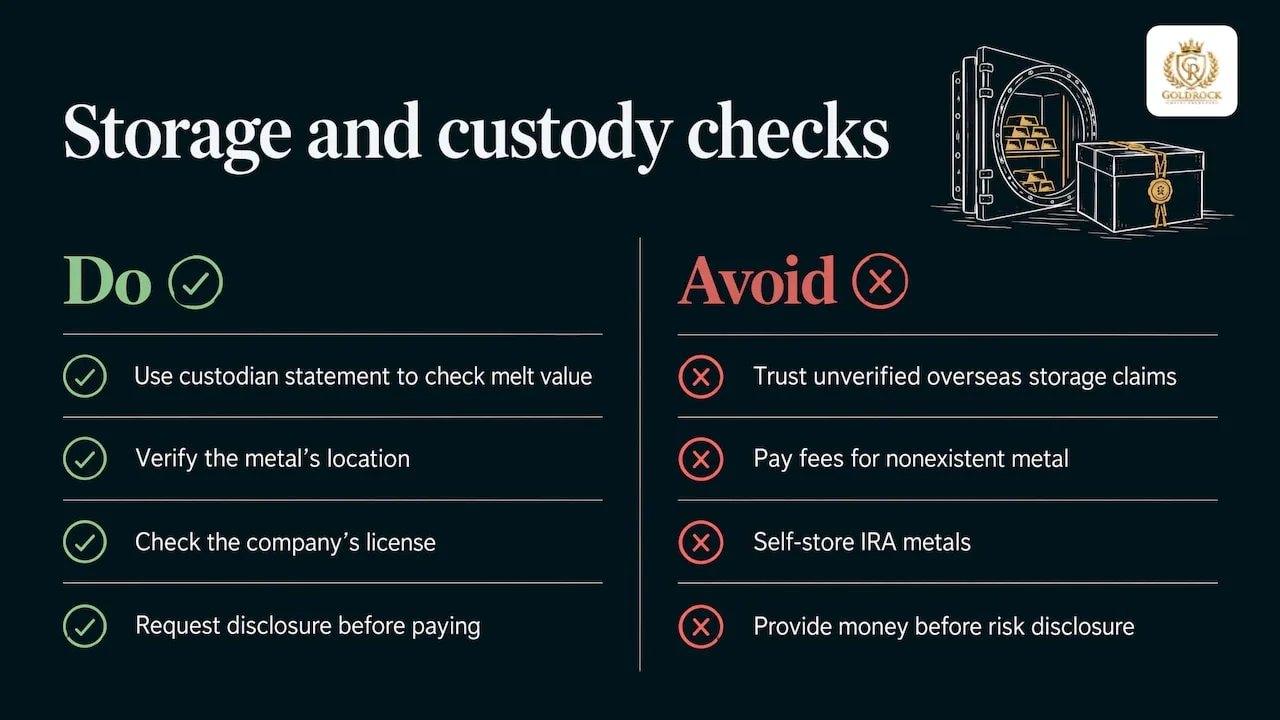
Pressure sometimes hides in the logistics. The CFTC says metals in a self-directed IRA must be held by the IRA trustee or custodian, and that the custodian’s statement shows the metals’ melt value, which you can use to check the bullion received and the price paid. It also warns that fraudsters have charged storage and insurance fees for metal that never existed.
The CFTC’s fraud advisory lists agreements that do not identify where the metal is located, claims of overseas storage and difficulty verifying a company’s license as warning signs. FINRA also names loss or theft risk from self-storage and the risks of leverage, and says to ask for a risk disclosure statement before providing any money.
For metals you take possession of outside an IRA, delivery is part of the purchase. We offer insured private delivery for purchased metals. Our guides on private metals delivery, delivery options and home insurance for bullion explain what to think through. If metals are held inside an IRA, our overview of segregated versus commingled storage lists three checks to run.
Warning signs versus calm service
| Pressure pattern | Calm, transparent pattern |
|---|---|
| Deadline today, limited units | Quote you can review and return to |
| Promises of big gains or no risk | Plain talk that prices move both ways |
| Advice to liquidate existing holdings | Discussion of what fits your goals |
| Fees explained later | Fees and commissions set out before you pay |
| Unsolicited call or ad | You contact the firm |
| Vague storage location | Clear custody and delivery terms |
Our view on pressure-free buying
People come to physical metals for different reasons: market volatility, inflation worries, a wish to diversify retirement savings. None of those reasons is served by a rushed decision. We believe the right pace is the one that lets you understand what you are buying, what it costs and where it will be held.
That is why we focus on personal service. Our in-house IRA department handles retirement account transfers, so you deal with the same group from the first question through the move into precious metals. Our approach is transparent service without paid endorsements, and we offer ongoing consultations after your purchase because questions do not stop at checkout.
We do not promise returns, safety or tax benefits, and we do not think anyone should. Metals can be one part of a diversified plan, and you should decide how large a part with your own tax or financial adviser.
Blake
How we can help
If you want physical metals without the pressure, we sell gold, silver, platinum and palladium, set up self-directed Precious Metals IRAs, and arrange insured private delivery for purchased metals. Questions about a rollover go to our in-house IRA department.

Start with the Precious Metals IRA page if retirement funds are involved, or browse gold and silver for direct purchases. You can also call (888) 859-0978 to Request a Free Precious Metals Consultation.
If you already signed or started a transfer under pressure
If a purchase or transfer felt rushed, you still have steps available. The Connecticut guidance says to independently verify the value of the metals, get a second opinion, check the background of the firm and its representatives, and compare premiums and fees. It also says suspicious activity can be reported to the CFTC toll-free at (866) 366-2382, and that you can contact your state securities regulator with concerns about an offer.
Gather your paperwork first: the quote, any agreement, statements and notes from calls. If retirement money is involved, speak with a tax professional, adviser or attorney about your specific situation before taking further action. Our guide on avoiding IRA rollover mistakes explains why direct transfers and careful timing matter.
Educational disclaimer
This article is for general education only. It is not investment, tax or legal advice, and it does not promise returns, safety, appreciation or tax benefits. Precious metals prices fluctuate, and direct purchases of physical metals are not covered by SIPC, according to the Texas State Securities Board’s summary of FINRA tips. Consult a qualified tax professional, adviser or attorney about your own circumstances.
FAQ
What counts as a high-pressure gold sale?
It is any pitch that pushes you to decide before you can think or check. Regulators point to false urgency, limited-supply claims, fear-based predictions, promises of large profits and discounts that expire immediately. A sale that gives you time and written terms does not fit the pattern.
Is it a red flag if a dealer calls me first?
Yes, the CFTC advises never responding to cold calls, unsolicited emails, junk mail or ads that arrive without your asking. Choose the firm yourself and start the conversation on your schedule. That keeps you in control of the pace and the questions.
How do I know if the price is fair?
Calculate the premium: subtract the metal’s spot value from the quoted price, divide by spot value, and multiply by 100. Regulators cite spreads from about 1% to 10% for bullion at the lower end and warn about dealers charging far more. Always base the calculation on a written quote.
Can a salesperson rush me into rolling over my 401(k) or TSP?
They should not, and you should not let them. The SEC warns that scare tactics are used to move TSP and 401(k) money into self-directed IRAs. Rollover rules are complex, so take time, review the written terms and speak with a tax professional or adviser about your situation.
What should I do if I feel pressured right now?
Tell the salesperson you need time, ask for everything in writing, and end the call if the pressure continues. You can verify the firm through your state securities regulator, and report concerns to the CFTC at (866) 366-2382.
Sources
- FINRA: 4 Tips to Know Before Buying Physical Precious Metals
- CFTC: Precious Metals Fraud
- CFTC: Gold Isn’t Always a Safe Investment
- CFTC: 10 Things to Ask Before Buying Physical Metals
- CFTC: Understand Risks and Markets before Trading Metals
- Connecticut: Precious Metals and Coin Investments
- Wisconsin DFI: Investor Alert on Precious Metals Schemes
- Investor.gov: Self-Directed IRAs and the Risk of Fraud
- Investor.gov: Protect Your TSP Account From Fraud
- IRS Notice 2023-27
- Texas State Securities Board: Physical Precious Metals Tips