

Counterparty risk in gold is the chance that another party in your transaction, such as an issuer, broker, custodian, dealer or carrier, fails to do what it promised. Physical metal that you own outright, with a clear record of ownership, depends on far fewer promises than a paper claim on gold. The risk does not vanish, though. It moves to the dealer you buy from, the place the metal is kept and the way it travels. At GoldRock Metal Exchange we handle precious metals purchases, Precious Metals IRA rollovers and insured private delivery, so these are the questions we walk investors through.
TL;DR
- Counterparty risk is dependence on someone else’s promise. Futures and other paper gold carry it by design; owning identified physical metal reduces it.
- The World Gold Council notes that taking delivery or using allocated holdings can minimize this risk.
- Allocated storage names you as the owner of specific metal. Unallocated storage does not.
- In a self-directed IRA, the custodian does not vet the dealer, so your due diligence on the dealer, fees and storage matters.
- This article is educational and is not investment, tax or legal advice.
Table of Contents
- What counterparty risk means for a gold owner
- Paper gold versus physical gold
- Allocated versus unallocated: the question that matters most
- Where counterparty risk hides when you buy physical metal
- Counterparty risk in a gold IRA or 401(k) rollover
- Request a consultation
- Our perspective
- Questions to ask before you buy
- FAQ
- Educational disclaimer
- Sources
What counterparty risk means for a gold owner
Every investment sits on a chain of promises. If you hold a gold bar in your own safe, the chain is short: you and the metal. If you hold a futures contract, a certificate or a fund share, the chain is longer, and your result depends on each link.
The World Gold Council’s 2011 research paper describes counterparty risk as the risk that the other side of a contract cannot fulfil it. It says gold can be subject to this risk, especially when accessed through futures markets, and that investors can minimize it by taking delivery or holding gold in allocated accounts.
For a retail buyer, the parties that can matter are:
- The issuer or fund sponsor, if you hold a paper claim on gold.
- The broker or account provider, which holds your assets or cash.
- The dealer, who sets the price you pay and what you receive.
- The custodian and depository, in a retirement account.
- The carrier, while metal is in transit.
Paper gold versus physical gold
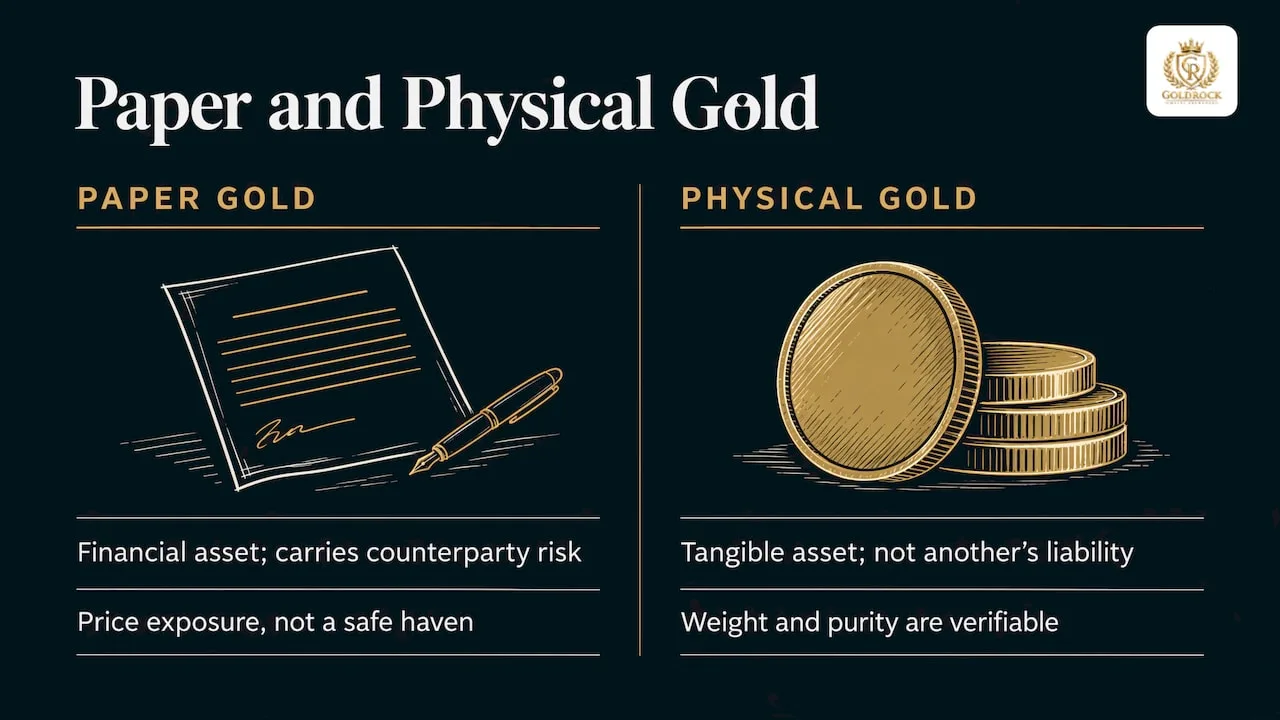
The STEP Journal describes paper gold, including ETFs and futures, as a financial asset that carries counterparty risk, while physical gold is a tangible asset. It points to the 2011 collapse of MF Global, when customer accounts were frozen, as an illustration of what can happen when a firm in the middle fails. The same article says paper gold gives exposure to the gold price but is not a safe haven in itself.
That is the core reason many investors choose physical metal: they want an asset that is not someone else’s liability. Coins and bars from our gold category, silver, platinum and palladium are physical items with weight and purity you can verify.
One point on purity: the FTC’s investor guide says the U.S. Mint has produced gold and silver bullion coins for investors since 1986 and platinum bullion coins since 1997, and that the Mint guarantees the weight, content and purity of the coins it produces. Government-minted bullion is a clear example of metal whose quality does not rest on a seller’s word.
How a gold ETF handles the same risk
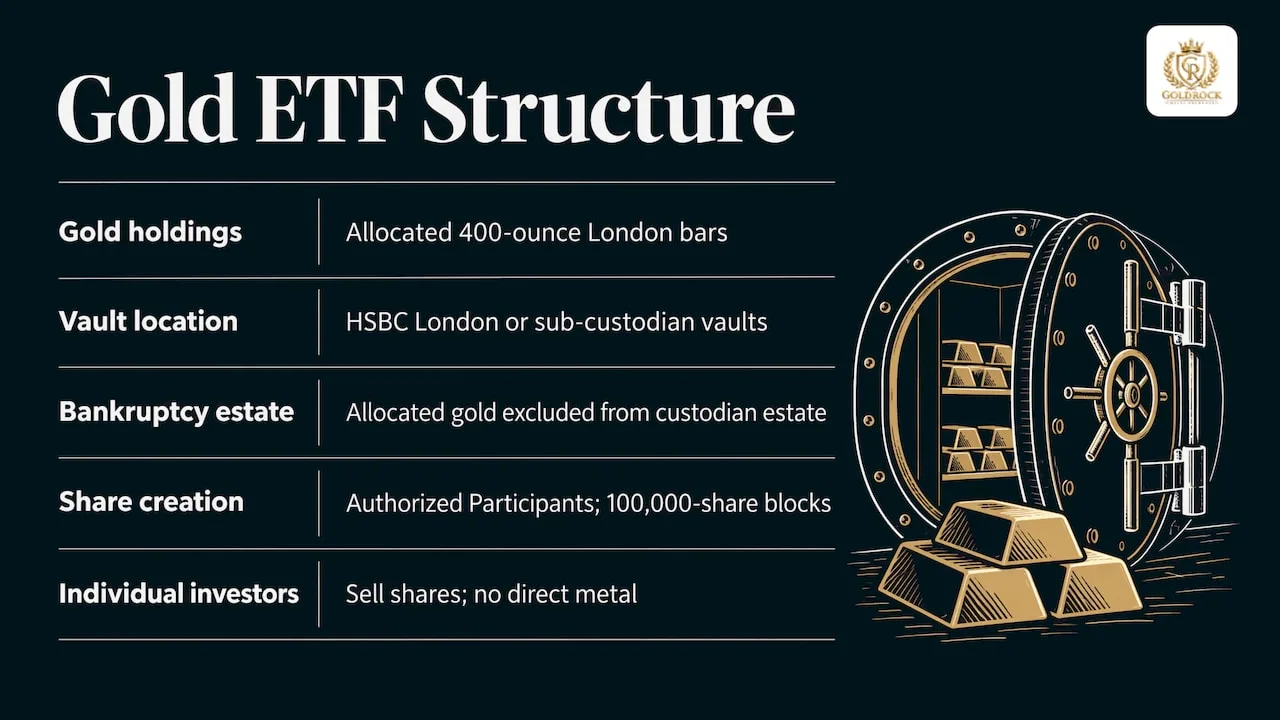
You may also see gold exchange-traded funds in your research. A gold ETF share is a claim on a trust that holds metal, and the structure has its own counterparty terms. In the SEC-filed document for the SPDR Gold Trust, the gold is held as allocated 400-ounce London Good Delivery bars in HSBC Bank USA’s London vault or sub-custodian vaults. The same filing says allocated gold is not part of the custodian’s bankruptcy estate and lists risks including custodian insolvency, sub-custodian failure and a lack of adequate recovery sources, including a lack of insurance.
A later SEC-filed document explains that only Authorized Participants, large institutions, can create or redeem shares, in blocks of 100,000 shares. Individual investors sell their shares on the secondary market and do not take metal directly. State regulators add that these trusts may carry hidden costs that dilute a holder’s interest; see the Maine Bureau of Securities guide. Anyone weighing a fund should read its current prospectus and speak with a tax professional about how fund gains are treated.
In short, a fund share is one more layer between you and the metal. Owning the metal yourself removes those layers.
Allocated versus unallocated: the question that matters most
When metal is stored for you, the account type decides what you actually own. The STEP Journal separates allocated storage, where a defined and recorded owner is attached to identified metal, from unallocated storage, where no specific metal is identified for a customer.
| Feature | Allocated | Unallocated |
|---|---|---|
| Specific bars or coins identified to you | Yes | No |
| Your position | Owner of identified metal | Claim on the holder |
| Counterparty exposure | Lower | Higher |
Before you commit funds, ask any seller or storage provider in writing which of these applies. Our guide to precious metal storage options explains the choices in more detail.
Where counterparty risk hides when you buy physical metal
Holding physical metal reduces issuer risk. A few exposures remain, and each has a practical check.
The dealer
Your dealer sets the markup over the metal’s value, and the dealer describes what you are buying. The FTC advises asking for the coin’s melt value, getting an independent appraisal because a seller’s appraisal might be inflated, and always getting a receipt. It also advises walking away from pitches that minimize risk or press you to act immediately. The CFTC and FINRA joint advisory lists storage, insurance and administrative fees among the costs to ask about before buying.
A calm, itemized quote is a good sign. Our article on gold dealer selection practices lists the questions to put to any dealer, and how to spot gold IRA scams shows how to run the numbers on a quote.
Storage and insurance
If someone else holds your metal, you depend on their solvency, their controls and their insurance. The FTC guide says that when you buy metals without taking delivery, you should take extra precautions to confirm the metal exists, matches the quality described and is properly insured. Our 8-step depository insurance checklist turns that into questions you can ask.
Delivery
Metal in transit is exposed to the carrier. Insured private delivery keeps the handoff documented from our hands to yours. Read how it works in our private metals delivery overview, and learn how to track a bullion shipment from order to doorstep.
Counterparty risk in a gold IRA or 401(k) rollover
Many readers come to this topic because they are considering moving retirement savings into metals. The structure adds parties: an IRA custodian, a dealer and a depository.
The CFTC and FINRA advisory notes that money can be rolled from a 401(k) or other retirement account into a self-directed IRA without penalty, but that once the money is there you are largely on your own, without a fiduciary or advisor guarding against bad investments. The Arkansas Securities Department adds that custodians do not vet precious metals dealers or their sales practices, and that the account owner is responsible for due diligence. It also notes that a custodian accepting an asset is not an endorsement of the dealer or the quality of the investment.
That is a useful rule for the whole process: the custodian processes, the depository stores, and you choose the dealer. So choose the dealer with the same care you would give the metal.
A due diligence routine for a rollover
- Ask for the full cost picture in writing. Request the price per item against the metal’s value, plus setup, custodian, storage, insurance and shipping fees. Compare it with our overview of gold IRA fees and shipping fees.
- Confirm what you will own. Ask for the exact products, their weights and purity, and whether they qualify for an IRA. Our guides on gold IRA rules and Section 408(m) cover eligibility.
- Confirm storage terms. Ask whether your metal is held allocated, in your name, and who insures it and for what.
- Get everything in writing. Keep every receipt, confirmation and statement.
- Check registrations and warnings. The CFTC suggests verifying that advisors and pool operators are registered, and suspicious activity can be reported to the CFTC at (866) 366-2382, a number listed by the Arkansas Securities Department.
- Take your time. Rolling over retirement funds has tax rules that depend on your situation. Speak with a qualified tax professional or your plan administrator before you move money.
If you hold a 401(k), a TSP or an IRA, the same routine applies to all of them. See how to open a precious metal IRA.
Request a consultation
We sell physical gold, silver, platinum and palladium, and our dedicated in-house IRA department helps investors move retirement accounts into a Precious Metals IRA. We also offer insured private delivery for metals bought for home delivery, along with personal guidance and ongoing consultations.

If you would like to talk through your options with a person, Request a Free Precious Metals Consultation or call (888) 859-0978.
Our perspective
Counterparty risk is a good lens because it forces one plain question: if someone else fails, what do I still own? We built our approach around that question. We sell physical metal, so the product itself is not a promise from a fund or issuer.
The questions that follow are about the pieces around the metal: the price you pay, the paperwork, the storage and the delivery. Our in-house IRA department exists so that rollovers are not handed from one party to another. You deal with the same team through the rollover, and we offer insured private delivery and ongoing consultations after the purchase.
We also prefer to be transparent and to work without paid endorsements. Ask us for a written, itemized quote and compare it with whatever else you are reading. A clear quote earns trust better than a sales pitch.
Blake
Questions to ask before you buy
Use this short list with any physical metals purchase:
- What exactly will I own, and in what weight and purity?
- Is the metal held in my name, and is it allocated?
- Who stores it, and who insures it?
- What are all the costs, one-time and yearly?
- How will it be delivered, and who is responsible in transit?
- What happens when I want to sell?
If you would like help answering these for your own situation, call (888) 859-0978.
FAQ
Does physical gold have counterparty risk?
Physical gold you hold yourself has no issuer behind it, so it does not depend on another party’s promise to pay. The STEP Journal contrasts this with paper gold. Dependencies can still arise through the dealer, the storage provider and shipping, which is why written terms matter.
Are gold ETFs safe to invest in?
They are regulated products with their own risk factors. The SEC-filed document for one large gold trust lists custodian insolvency, sub-custodian failure and loss risks, and state regulators warn about hidden costs. Read the prospectus before deciding.
What is the difference between allocated and unallocated gold?
Allocated gold is specific metal recorded as yours. Unallocated storage gives you a claim on a pool rather than identified bars or coins, so your exposure to the holder is higher.
Does a custodian protect me from a bad dealer in a gold IRA?
No. The Arkansas Securities Department says custodians do not vet dealers, and the account owner is responsible for due diligence. Choose your dealer first and get the costs in writing.
Educational disclaimer
This article is for education only. It is not investment, tax or legal advice, and it does not promise returns, safety, tax benefits or price appreciation. Precious metals prices can fall, and costs affect results. Talk with a qualified financial, tax or legal professional about your own situation before you act.
Sources
- World Gold Council, Gold: a commodity like no other (2011)
- STEP Journal, Papering over cracks (2014)
- FTC, Investing in Gold? What’s the Rush?
- CFTC and FINRA, 10 Things to Ask Before Buying Physical Gold, Silver or Other Metals
- Arkansas Securities Department, Precious Metals and Coin Investments (2024)
- SEC filing, SPDR Gold Trust (2008)
- SEC filing, How SPDR GOLD Shares are Created and Redeemed (2014)
- Maine Bureau of Securities, Gold: What Every Investor Needs to Know