You can verify a gold dealer in about an hour with free public tools: confirm who the business and its salespeople are, check regulator and complaint records, get every price and fee in writing, and confirm where the metal will be held. There is no single federal license for retail metal dealers, so the checking falls to you. A dealer that is comfortable being checked, explains its spread plainly and gives you a named person to talk to is behaving the way a careful buyer should expect. That is the standard we hold ourselves to at GoldRock Metal Exchange, where a dedicated in-house IRA department and personal guidance are part of how we work.
TL;DR
- Retail metal dealers are not regulated at the federal level, so identity, history and complaint checks are your job.
- Use the free public tools: your state attorney general, FINRA BrokerCheck, the SEC’s investor.gov, the NFA’s BasicNet and the U.S. Mint’s database of coin sellers.
- Get the retail price, fees, commissions and buy-back terms in writing before you pay.
- Treat cold calls, pressure, guarantees, financing with a small down payment and vague storage as reasons to stop.
- For a retirement account, the metal must be held by the trustee or custodian, and your statement should match what you paid for.
Table of Contents
- Why the checking falls to you
- Step 1: Confirm who you are dealing with
- Step 2: Check regulators and complaint records
- Step 3: Read the way the dealer reaches you
- Step 4: Know the warning signs in the terms
- Step 5: Understand the spread and the price
- Request a Free Precious Metals Consultation
- Step 6: Get it in writing
- Step 7: Choose how you pay, and why it matters
- If the purchase is for a retirement account
- Where GoldRock fits
- Our perspective
- FAQ
- Sources
Why the checking falls to you
A bank or a registered broker answers to a federal or state regulator in a way that is easy to look up. A retail dealer who sells coins and bars usually does not. The CFTC and FINRA say so directly in their joint advisory, 10 Things to Ask Before Buying Physical Gold, Silver, or Other Metals: retail metal dealers are not regulated at the federal level.
That does not mean every dealer is a risk. It means the credentials a dealer shows you are only as good as your ability to confirm them elsewhere. A badge on a website, a banner reading “IRA expert” or a list of logos proves nothing until you have matched it to a record kept by someone else.
The routine below works for a first coin purchase, a larger bar order, or a rollover from a 401(k) or IRA into a Precious Metals IRA. The larger the amount, the more of it you should complete.
Step 1: Confirm who you are dealing with
Start with the basics a legitimate business gives without hesitation.
- The firm. Get the legal business name, a physical street address (not just a post office box) and a main phone number. FINRA’s guidance on buying physical precious metals, updated March 24, 2026, recommends requesting the firm’s address and phone number along with the salesperson’s name and contact details.
- The person. Get the full name of the salesperson you are speaking with. The CFTC advises searching the names of owners and salespeople online for prior complaints or criminal allegations, and, when you shop online, verifying the dealer’s physical address and operating history.
- The track record. Ask how long the business has operated and under what names. The Texas Attorney General’s consumer page suggests researching how long a dealer has been in business, along with its Better Business Bureau rating and complaint count.
Write these down in one place. If a later step turns up a different name or address, you will notice.
Step 2: Check regulators and complaint records
No one database covers everything, so use several. Each answers a different question.
| What you want to know | Where to look |
|---|---|
| Complaints about the business | Your state attorney general, local consumer organizations, and the attorney general in the dealer’s home state |
| Whether a salesperson is a registered broker | FINRA BrokerCheck |
| Whether someone is a registered investment adviser | SEC’s investor.gov |
| Whether someone is a commodity trading adviser or the firm is financing metal purchases | NFA BasicNet |
| Whether a coin seller is listed by the Mint | The U.S. Mint’s searchable database of coin sellers |
The CFTC’s page on precious metal frauds names these exact tools. It tells you to use them when a dealer presents as a financial adviser or an “IRA expert”: BasicNet for commodity trading advisors, investor.gov for investment advisers, BrokerCheck for broker-dealers, and the attorney general in the dealer’s home state for complaint history. FINRA’s guidance adds that the U.S. Mint maintains a searchable database of coin sellers and that BrokerCheck is free.
When registration matters
Selling a one-ounce coin is a retail sale. Telling you what to buy, how much, or when is different. According to the CFTC and FINRA advisory, a salesperson who persuades you to buy or suggests what, how much or when is giving advice, and may need to be registered with the CFTC, SEC, FINRA or a state regulator. Ask directly whether the person is registered, confirm it with the regulator, and read any disciplinary history that comes up.
If a salesperson says they are licensed, that is a claim you can test in a few minutes. The CFTC’s precious metals fraud advisory lists a company whose license is hard to verify, and salespeople who cannot prove licensure from a government agency, among its warning signs. It also gives a CFTC number, 866.366.2382, for questions about registration status, business background and disciplinary history.
Trade groups and grading services
The Texas Attorney General advises independently verifying a dealer’s membership in the American Numismatic Association or the Professional Numismatists Guild, and checking whether the dealer is an authorized dealer of the PCGS or NGC grading services. The word “independently” matters. Go to the organization’s own member or dealer listing, not the logo on the dealer’s site.
Step 3: Read the way the dealer reaches you
How a dealer first contacts you is itself a credential. The CFTC and FINRA advisory tells consumers never to respond to cold calls, unsolicited emails, junk mail, late-night infomercials, social media posts or pop-up dealers, and calls these common scam tactics. FINRA adds that you should say no to pushy salespeople who dangle large profits or imply limited quantities, and be particularly wary of unsolicited pitches and fraud tied to precious metals IRAs.
The pressure pattern is not unique to gold. Urgent deadlines, “only a few left” and promised upside show up in many kinds of investment fraud. A guide on pump-and-dump warning signs shows how the same urgency tactics work in small-cap stocks, which makes them easier to recognize when a gold pitch uses them.
A calmer pattern looks like this: you contacted the dealer, you get time to think, nobody tells you what the price will do, and the person on the phone is happy to put everything in an email.
Step 4: Know the warning signs in the terms
Credentials can be genuine and the terms still wrong. These are the deal structures and claims the regulators flag.
- Financing with a small down payment. The CFTC lists arrangements where you pay only 15% to 25% of the purchase price, company-arranged loans, and promises that the company will store the metal in a facility or “bank.” The problems it describes include no metal actually being purchased, phony interest or storage fees, and a failure to disclose that you must send more money if prices move against you.
- Unclear location of the metal. Agreements that do not identify the lending institution or where the physical metal sits, and claims of overseas storage or delivery, are on the CFTC’s list.
- Claims that regulators do not cover it. A statement that precious metals transactions are not regulated by the CFTC or NFA is another listed sign.
- Guarantees. The Texas Attorney General says not to do business with a dealer who guarantees that purchases are totally safe, will go up in value or cannot go down. Any honest dealer, including us, will not promise appreciation, safety or returns, because no one can.
- Break-even math that does not work. The same office says that if coins bought as an investment would have to double or triple in value before you could realize a gain, you may have been a victim of fraud.
- Delivery that does not happen. If a dealer does not pay you, return your coins or deliver your purchase within 30 days or less, the Texas office says you may have been a victim of fraud.
- Big returns for little risk. The CFTC’s advisory Gold Isn’t Always a Safe Investment tells investors to beware of claims of big returns for very little risk.
If you are weighing a retirement rollover, our guide on how regulators suggest spotting gold IRA scams walks through the math checks in more detail.
Step 5: Understand the spread and the price
Every dealer sells above the market price of the metal, called spot, and buys back below it. The gap is the spread, and it is how the dealer is paid. It is not hidden in an honest transaction, but it is easy to leave unexplained.
The CFTC and FINRA advisory gives the range: some fraudulent dealers have charged spreads of more than 300 percent, while others charge less than 20 percent. It also describes a case in which a customer rolled over a $300,000 IRA and the dealer allegedly took $150,000 in fees and commissions.
A simple check before you pay:
- Find the metal’s weight, in troy ounces, and its purity.
- Multiply the weight by the current spot price. Spot moves all day, so use the figure at the moment of your quote.
- Compare that number to the retail price you were quoted. The difference is the dealer’s markup.
- Ask what the dealer would pay to buy the same item back, and how its salespeople are paid.
The U.S. Mint’s bullion consumer awareness page adds two points: research the reputation of the dealer or retailer before you complete a purchase, and confirm with the seller the weight, the precious metal content and that all key features are present on the coin.
For the physical item itself, see our walkthrough on how to verify gold bars before you buy, sell or accept delivery.
Request a Free Precious Metals Consultation
If you would like to talk through these checks with a person before you commit to anything, call (888) 859-0978 or request a free precious metals consultation. Our team gives personal guidance on gold, silver, platinum and palladium purchases and on self-directed IRAs. This is education, not personalized investment, tax or legal advice.
Step 6: Get it in writing
Verbal assurances do not survive a dispute. The CFTC and FINRA advisory says to get all fees, costs, commissions and the agreed retail price in writing before you sign or pay. Make sure the paperwork covers:
- The exact products, quantities, weights and purity
- The total price, with every fee and commission itemized
- The dealer’s buy-back terms
- The delivery method, who insures it in transit, and the expected date
- For a retirement account, who the custodian is and where the metal will be held
A document that leaves any of these out is unfinished. Ask for it to be completed before you send money.
Step 7: Choose how you pay, and why it matters
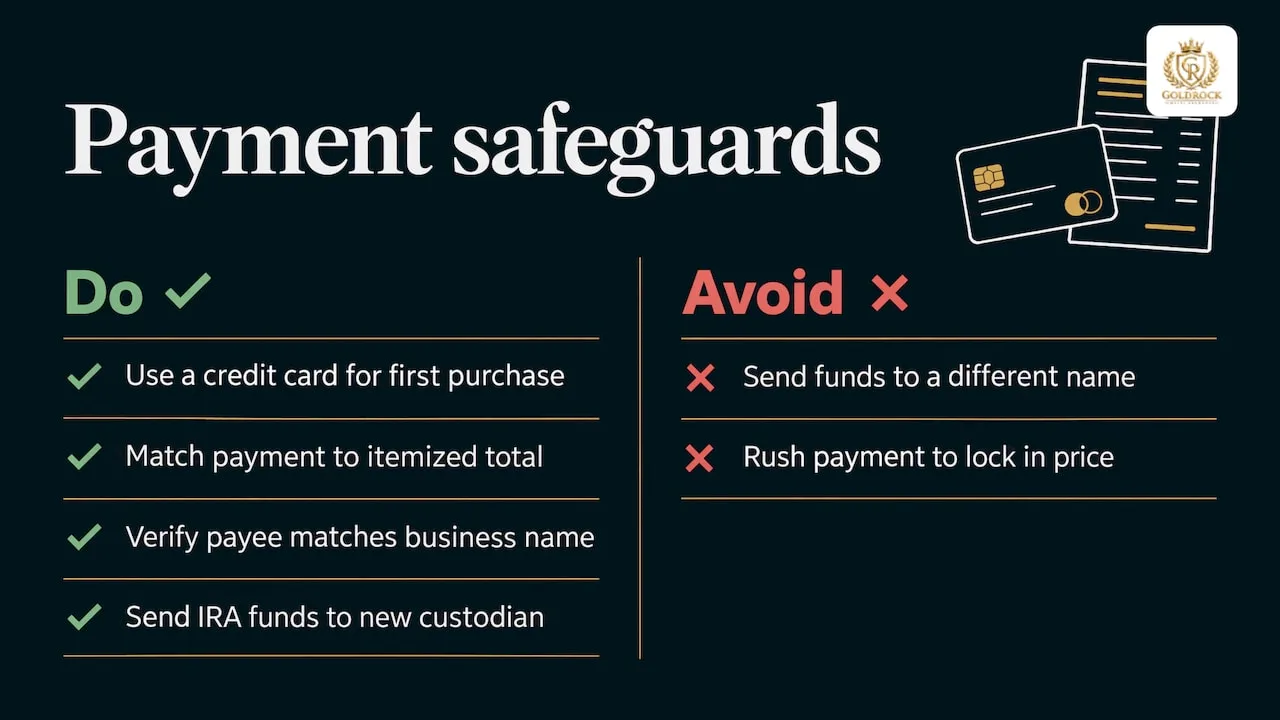
How you pay changes what you can do if something goes wrong. The only payment guidance in the sources we rely on comes from the Texas Attorney General, who advises using a credit card for first transactions because credit card companies offer extended fraud protection. For a first purchase with a new dealer, that is a sensible way to keep your options open.
Whatever method you use, tie it to the written invoice. The amount you send should match the itemized total, and the payee should match the business name you verified in step 1. If a salesperson asks you to send funds to a different name, or to hurry a payment so a price is not lost, go back to the warning signs above.
For retirement money the payment is different. The funds move from your old account to the new custodian, not from you to the dealer. See Gold IRA fees for the kinds of charges that can apply in a Precious Metals IRA.
If the purchase is for a retirement account
With a self-directed IRA, you do not take the metal home. The CFTC and FINRA advisory states that the metals must be held by the account’s trustee or custodian. After the purchase, read your account statement and confirm that you received all the bullion you paid for and did not pay an overinflated price.
Three questions keep an IRA purchase on solid ground:
- Who holds the metal? Learn the steps to verify an IRS-approved depository.
- How is it stored? Understand segregated versus commingled storage and what each means for your account.
- Is it insured? Use our depository insurance checklist.
Storing IRA metal at home is a separate topic with its own rules, covered in why IRA gold should not be stored at home. For the broader framework, read Gold IRA rules and Gold IRA eligibility. Questions about how a rollover affects your taxes belong with a qualified tax professional.
Where GoldRock fits
We are a full-service precious metals dealer. You can buy gold, silver, platinum and palladium for direct delivery, or set up a Precious Metals IRA with help from our in-house IRA department, which handles the transfer of retirement accounts into precious metals. Purchases can go out through insured private delivery, and you can keep talking with us afterward through ongoing consultations.

The checks in this article apply to every dealer you consider. Run them, keep the answers in writing, and give yourself time. Our own approach is built on transparent service without paid endorsements. If you want a person to walk you through a purchase or a rollover, request a free precious metals consultation or call (888) 859-0978.
Our perspective
Most buyers who come to us are not worried about gold. They are worried about being misled while buying it. That is a reasonable worry, and the way to settle it is with clear steps, not reassurance.
We believe a buyer should never need to take our word for anything. The tools regulators publish are free, and a purchase of physical metal, especially one funded from retirement savings, deserves the time those tools take.
That is why we keep our IRA work in a dedicated in-house department and why personal service sits at the center of what we do: one team, one conversation, and consultations that continue after the order is placed. We offer insured private delivery for the same reason. Physical metal should reach you in a way you can understand and track.
We do not promise returns, safety or appreciation, and we do not use paid endorsements to make a case for ourselves. We would rather explain the spread, the storage and the paperwork plainly and let you decide.
Blake
FAQ
Is there a federal license that proves a gold dealer is legitimate?
Not for retail dealers. The CFTC and FINRA advisory notes that retail metal dealers are not regulated at the federal level. Registration can apply when a salesperson gives advice or when a company finances purchases, so check BrokerCheck, investor.gov and NFA BasicNet, and ask your state attorney general about complaints.
What payment method is safest for a first purchase?
The Texas Attorney General recommends a credit card for first transactions, because card companies offer extended fraud protection. Whatever you use, match the payee and amount to a written, itemized invoice.
How do I know the price I was quoted is fair?
Multiply the metal’s weight by the spot price at the time of your quote and compare that number with the retail price. The gap is the dealer’s markup. The CFTC and FINRA advisory notes that spreads vary widely, so get the figure, and the buy-back price, in writing.
Should I be concerned if a dealer calls me first?
The regulators advise never responding to cold calls, unsolicited emails, junk mail, infomercials, social media posts or pop-up dealers. Start with a dealer you chose and researched, and take your time.
Can I hold IRA gold myself?
The CFTC and FINRA advisory says IRA metals must be held by the trustee or custodian. Our page on home storage for IRA gold explains the issue in more detail.
This article is for education only. It is not personalized investment, tax or legal advice, and it promises no returns, safety, tax benefits or appreciation. Consult a qualified professional about your own situation.
Sources
- CFTC and FINRA: 10 Things to Ask Before Buying Physical Gold, Silver, or Other Metals
- CFTC: Precious Metals Fraud
- CFTC: Precious Metal Frauds
- CFTC: Gold Isn’t Always a Safe Investment
- Texas Attorney General: Investing in Gold Coins
- FINRA: 4 Tips to Know Before Buying Physical Precious Metals
- U.S. Mint: Bullion Consumer Awareness
- Pump-and-dump warning signs