
Signature-required gold delivery means the carrier will not leave your package at the door. A qualifying person has to sign for it, and for some service levels show photo ID, before the parcel is released. For physical gold, silver, platinum or palladium, that signature is the moment responsibility passes from the sender and carrier to you. Plan to be home, or name someone who can sign, and know the insurance limits that apply to your shipment. At GoldRock Metal Exchange, private delivery is one of the services we offer for metals you purchase, and our team can walk you through the delivery terms for your order.
TL;DR
- A signature-required parcel is held by the carrier until someone signs. The package is never left unattended on a porch.
- Adult Signature Required means the signer is 21 or older and shows an acceptable government photo ID. Digital IDs are not accepted.
- If nobody signs, the carrier typically leaves a notice and holds the parcel for a limited time before returning it to the sender.
- Carrier insurance has ceilings. USPS Registered Mail covers declared value up to $50,000, and UPS also tops out at a declared maximum per package.
- Our team can explain how your specific order will be delivered. Request a Free Precious Metals Consultation at (888) 859-0978.
Table of Contents
- What signature-required delivery means for bullion
- Who can sign, and what ID do they need?
- What happens if no one is home to sign
- Does the signature insure your gold?
- Preparing for the day the package arrives
- If the box looks damaged or tampered with
- Where private delivery fits
- Our view on delivery
- Talk to us before you order
- Frequently asked questions
- Sources
What signature-required delivery means for bullion
A signature requirement turns delivery into a recorded event. The carrier hands the parcel to a person, that person signs, and the carrier logs the time and place. For a package that may be worth thousands of dollars, that record matters to everyone involved.
The United States Postal Service defines its top signature tier in the Domestic Mail Manual. Adult Signature Required means delivery to a person 21 or older who presents an acceptable primary form of identification and signs for the item. The carrier also records electronic confirmation of delivery, or of the attempt.
There are usually three levels you will see on a precious metals shipment:
- Signature Required: any person at the address can sign.
- Adult Signature Required: the signer must be an adult of a stated minimum age and show ID.
- Registered or restricted delivery: the item is tracked and secured at each handoff, and delivery can be limited to the addressee or an authorized agent.
Which level applies depends on the carrier, the declared value and the arrangements made when the order is placed.
Who can sign, and what ID do they need?
For Adult Signature services, the USPS Postal Bulletin says the item cannot be left at the address without the signature of an adult 21 or older. The recipient must show government-issued photo identification that includes a date of birth, such as a driver’s license or passport.
The USPS identification FAQ adds the details that trip people up:
- Acceptable primary photo IDs include U.S. state or federal government ID and U.S. or foreign passports. Limited cases include university or corporate ID.
- Digital or electronic IDs, such as a photo of a license on your phone, are not accepted.
- Adult Signature 18 and 21 services require an ID that shows a date of birth.
Keep your ID somewhere you can reach it at the door. If you are expecting a delivery and have a household member who is 21 or older, tell them the package is coming and what they will need.
Restricted delivery
USPS describes Registered Mail as its most secure mail service, protected by safes, cages, sealed containers, locks and keys. It requires a signature on delivery. With Registered Mail Restricted Delivery, the parcel goes only to the addressee or the addressee’s authorized agent. That is the tightest control available, and it is slower. USPS notes that Registered Mail is processed manually, which naturally slows its travel, so it is not the choice when speed is the priority.
What happens if no one is home to sign
This is the most common problem, and it is easy to handle if you know the timeline.
According to USPS, extra-service items such as Registered Mail and Adult Signature Required are held for 15 days after the first delivery attempt. A second notice goes out 5 days after the first. The item waits at your local Post Office until close of business on the return date, then goes back to the sender.
For UPS, the rules for restricted services are stricter. UPS’s value-added services guide states that Direct Delivery Only packages may not be re-routed, redirected or delivered to an alternate address. The exception is a shipper request to hold the package for will call at a UPS Customer Center. Hold for Pickup requires government-issued photo ID. A representative may need company letterhead authorization or a company ID, and unclaimed packages are returned after five business days.
In practice:
- Read the delivery notice the same day and note the return date.
- Do not ask a neighbor to sign unless the service level allows it. Adult and restricted services generally require the named person or an eligible adult with ID.
- Contact the sender early if you will be away. Changing the plan before the first attempt is easier than rescuing a returned parcel.
Does the signature insure your gold?
No. The signature proves delivery. Insurance is a separate layer, and each carrier sets its own ceiling.
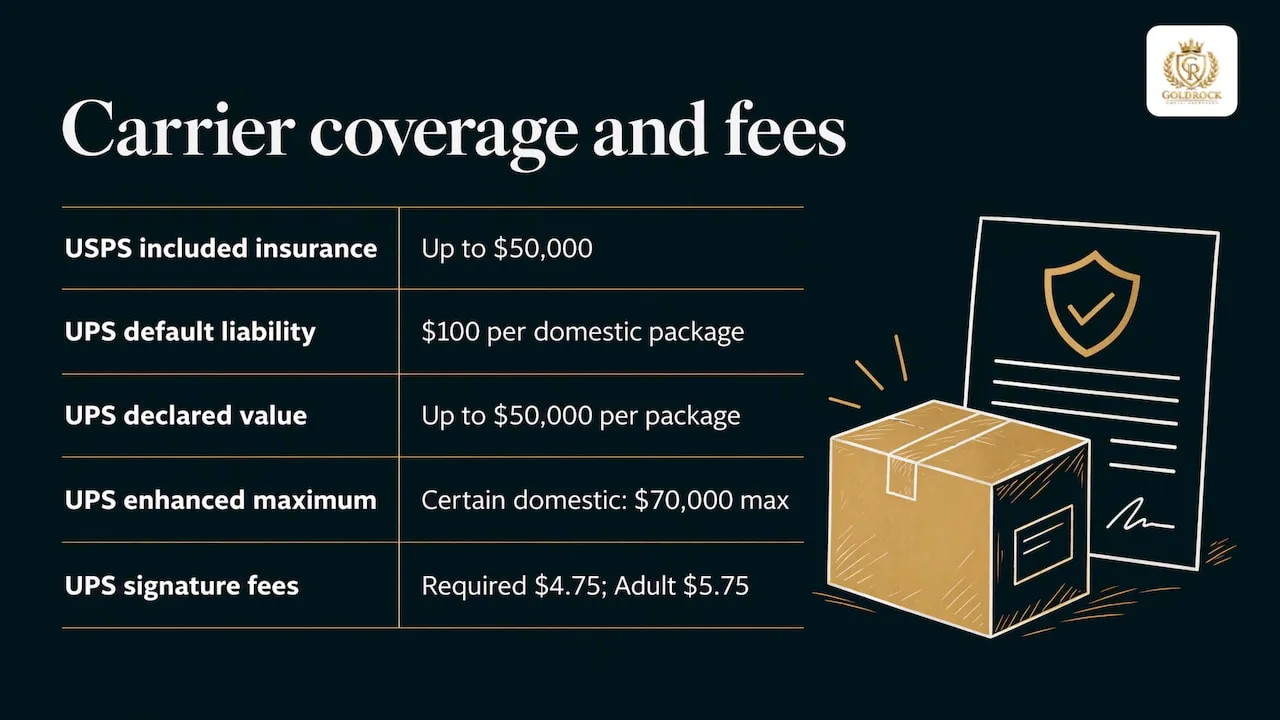
For USPS Registered Mail, the official FAQ says insurance matching the declared value is included up to $50,000. An article declared above $50,000 can still be registered, but compensation for loss or damage is capped at $50,000. Jewelry, gems and precious metals are declared at market value or cost.
UPS publishes different terms. Its value-added services document states that liability for loss or damage is limited to $100 per domestic package unless you declare a value. Declared value can be raised to a maximum of $50,000 per package, with an enhanced $70,000 maximum for certain domestic packages. In the same document, Signature Required costs $4.75 and Adult Signature Required costs $5.75, so the signature itself is a small fee compared with the declared value.
The practical lesson is to compare the value of your order with the carrier ceiling before you choose a delivery method. A large order can exceed what a standard carrier will cover. We cover this in more depth in our guide to discreet gold shipping and the $50,000 USPS cap.
A worked example
Suppose you buy gold coins worth $65,000 and ship them as a single parcel by Registered Mail with the full value declared. Under the USPS terms above, compensation for loss or damage would be capped at $50,000, which leaves $15,000 outside that coverage. Splitting an order, choosing a different delivery arrangement or discussing insured private delivery before you buy are all ways to address the gap. This is a simple illustration of how the cap works, not a recommendation for any individual’s situation.
Preparing for the day the package arrives
A little preparation makes a signature-required delivery uneventful.
- Confirm the address and the named recipient. The name on the order should match the name on the ID the signer will show.
- Pick a signer. Decide who in your household is 21 or older and will be there.
- Watch the tracking. Our guide on how to track a bullion shipment from order to doorstep shows what each status means.
- Have ID ready. A physical government photo ID with a date of birth. A phone image will not do.
- Choose a safe spot to open the package. Keep the box, the labels and the packing materials until you have checked the contents.
If the box looks damaged or tampered with
A signature does not remove your ability to raise a problem, but timing matters. Before you sign, look at the box. Torn tape, re-taped seams, crushed corners, a different weight than you expect or a broken seal are reasons to pause.
Sensible steps, in order:
- Photograph the outside of the box, the label and any damage before you open it.
- If the damage is obvious at the door, tell the carrier and ask how to note it on the delivery record before signing.
- Keep every piece of packaging. Carriers generally want to inspect it if a claim is filed.
- Contact the seller right away so the claim can start with the shipper, who is usually the party that files with the carrier.
- Do not use or sell the contents until the matter is sorted out.
Once the package is open, our authentication checklist for delivered gold explains what to check on the pieces themselves.
Where private delivery fits
Standard carriers are built for volume. A private, insured delivery is built around one shipment and one recipient. For investors who want both the signature record and coverage that is not tied to one carrier’s published ceiling, that difference is worth understanding before ordering. Our overview of precious metals delivery options and our guide to gold shipping methods lay out the choices in plain terms.
If your goal is to hold metals inside a retirement account, delivery works differently. Metals in a self-directed IRA are handled under IRS custodial rules rather than being sent to your door. Our article on depository versus home storage explains why that distinction matters. This article is educational and is not tax or legal advice. Speak with a qualified tax or legal professional about your own account.
Our view on delivery
We think delivery is part of the purchase, not an afterthought. A buyer who has just committed real savings to physical metals should know, before the order is placed, who will sign, what the carrier will and will not cover, and what happens if the day goes sideways.
That is why we offer insured private delivery and stay in contact with clients through the shipment. We believe personal service is what separates an informed purchase from a confusing one. You should be able to call a person, ask a plain question and get a plain answer.
For clients who are rolling over retirement funds, our in-house IRA department handles the paperwork side of the transfer, so you can focus on understanding what you are buying. We do not promise returns or outcomes. We aim to make the process clear, calm and well documented.
Blake
Talk to us before you order
If you are planning to buy gold, silver, platinum or palladium and want to know how your delivery will work, we can go through it with you. Our team offers insured private delivery on metals you purchase and personal guidance from first call to arrival. You can browse gold, silver, platinum and palladium, or read about our Precious Metals IRA if retirement funds are involved.

Request a Free Precious Metals Consultation or call (888) 859-0978.
Frequently asked questions
Do I always have to be home for a gold delivery?
For signature-required services, someone who qualifies must be there to sign. For Adult Signature services that person must be 21 or older with an acceptable photo ID. If you cannot be present, USPS holds extra-service items for up to 15 days, but a returned parcel means delay and extra handling. Contact the sender before the first attempt if you know you will be away.
Can someone else sign for my gold?
That depends on the service level. Basic Signature Required can often be signed by any person at the address. Adult Signature requires an adult with ID, and restricted delivery limits release to the addressee or an authorized agent. Ask about the level that applies to your order before it ships.
Can I redirect a signature-required package to another address?
Usually not. UPS states that Direct Delivery Only packages cannot be re-routed or delivered to an alternate address, apart from a shipper request to hold the package for pickup at a UPS Customer Center. Changes are best made through the sender before shipment.
Does signing for the package mean it is insured?
No. The signature documents delivery. Coverage comes from the declared value and the carrier’s terms. USPS Registered Mail covers declared value up to $50,000, and UPS offers declared values up to its own maximums per package. Compare these ceilings to the value of your order.
What if the package looks tampered with?
Photograph it, keep all packaging, raise the issue with the carrier at the door if you can, and contact the seller immediately. Do not discard anything until the claim is resolved.
Educational disclaimer: This article is for general education only. It is not investment, tax or legal advice, and it does not promise returns, safety, tax benefits or appreciation. Carrier rules and insurance limits change, so confirm current terms with the carrier and consult a qualified professional about your own situation.
Sources
- USPS Domestic Mail Manual, 500 Additional Mailing Services
- USPS Registered Mail: The Basics
- USPS Acceptable Forms of Identification
- USPS Postal Bulletin, Policies, Procedures, and Forms Updates
- USPS Second and Final Notice and Return Dates for Redelivery
- UPS Value-Added Services pricing