

You can’t buy physical gold inside the Thrift Savings Plan. You can, however, roll eligible TSP money into a self-directed IRA that holds IRS-approved physical metals. A direct rollover, where the TSP sends the money straight to the new IRA custodian, is the cleanest route. The steps are simple. The details are where people trip: which balance you hold, whether you are married, how you take the distribution, and which metals qualify.
This guide walks through the process in plain language so you can decide whether the idea fits your own plans. It is educational only. It is not investment, tax or legal advice.
TL;DR
- The TSP has no physical gold option. A rollover to a self-directed IRA is the way federal employees and service members can hold physical metals with TSP-sourced money.
- A direct rollover goes from the TSP to the IRA custodian. A check paid to you triggers 20% federal withholding and a 60-day deadline.
- Traditional TSP money goes to a traditional IRA. Roth TSP money goes to a Roth IRA or an eligible employer plan’s Roth account.
- Only certain metals qualify for an IRA, and they must be held by an approved custodian and storage facility, not at home.
- Nothing here promises returns, safety or tax outcomes. Talk to a qualified tax professional before you move money.
Table of Contents
- Why the TSP can’t hold gold directly
- Which TSP money can be rolled over
- Direct vs. indirect rollover
- Step-by-step: from TSP to a Precious Metals IRA
- Mid-article: talk it through with a specialist
- What a Precious Metals IRA can hold
- Comparing metals for a retirement account
- IRA metals vs. metals you own outside an IRA
- Costs and trade-offs to understand before you move money
- Our perspective
- How GoldRock Metal Exchange can help
- FAQ
- Request a Free Precious Metals Consultation
- Sources
Why the TSP can’t hold gold directly
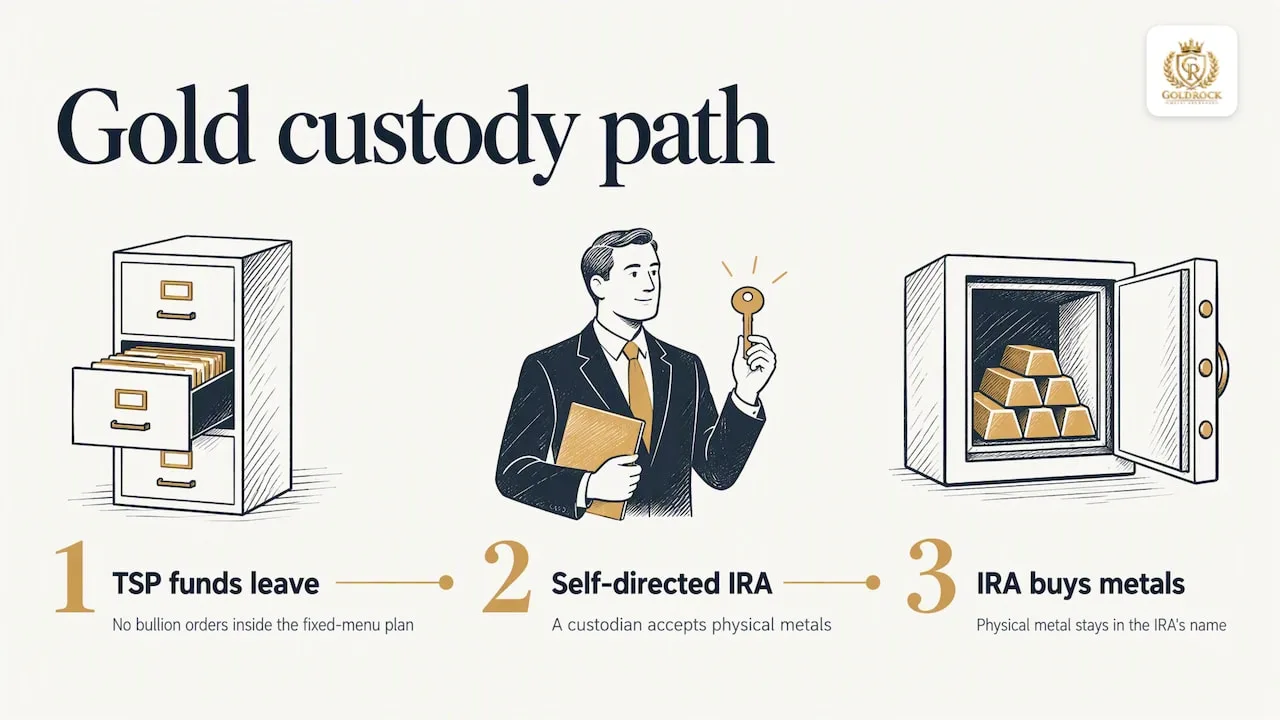
The TSP is a government-run defined contribution plan with a fixed menu of funds. There is no precious metals fund and no way to place a bullion order from inside the account. Money that leaves the TSP has to go somewhere else before it can be used to acquire physical metal.
That “somewhere else” is a self-directed IRA. Unlike a typical brokerage IRA, a self-directed IRA is set up with a custodian that accepts alternative assets, including physical gold, silver, platinum and palladium. The metal is purchased by the IRA, not by you personally, and it stays in the IRA’s name.
Which TSP money can be rolled over
Not every TSP dollar is treated the same way, and the TSP’s own booklet on payments is the place to confirm your situation. Per the TSP’s guide to payments, an eligible rollover distribution from a traditional balance may be rolled into a traditional IRA. Roth TSP money may be rolled into a Roth IRA or an eligible employer plan’s Roth account that accepts Roth rollovers.
Three situations come up often:
- Still working, age 59½ or older. A participant in this position who has not separated from Government service can take an age-based withdrawal. Under 5 CFR § 1650.31, a request must be at least $1,000 unless it covers the entire vested balance or the entire traditional or Roth balance. It counts as an eligible rollover distribution, and up to four age-based withdrawals per account are allowed each calendar year.
- Separated from service. Former employees and retirees can request a withdrawal and direct it to an IRA. The TSP publication above explains the forms and elections.
- Court-ordered payments. According to the same TSP publication, a spouse or former spouse may request a direct rollover of the portion awarded to them into an eligible IRA.
If you are married, federal law adds a step. The TSP generally requires spousal consent before certain distribution elections can be processed. Ask the TSP which forms apply to you before you start so the request is not delayed.
Direct vs. indirect rollover
This is the most important decision in the process, and it is mostly about mechanics.
| Feature | Direct rollover | Indirect rollover |
|---|---|---|
| Who receives the money | The new IRA custodian | You, personally |
| Federal withholding | Not applied to the rolled amount | 20% of the taxable amount is withheld |
| Deadline | Handled by the two institutions | You must deposit the full amount within 60 days |
| Risk of a mistake | Low | Higher, because you handle the funds |
According to the TSP’s payments booklet, if an eligible rollover distribution is paid to you, the TSP is required to withhold 20% of the taxable amount for federal income tax. To avoid taxation on the full amount, you would need to deposit the entire gross figure into the IRA within 60 days, which means covering the withheld portion from other funds. The TSP’s tax notice on payments adds that any amount not rolled over in time is taxable and may be subject to the 10% early withdrawal penalty if you are under 59½.
For most people, the direct route avoids those pressure points. We steer clients toward direct transfers for exactly that reason. How any of this affects your taxes is a question for a CPA or tax attorney, not for us.
Step-by-step: from TSP to a Precious Metals IRA
- Confirm your eligibility with the TSP. Check your balance type (traditional, Roth or both), your employment status and, if married, any spousal paperwork required.
- Open a self-directed IRA. The IRA must be set up with a custodian that accepts physical metals. Our in-house IRA department helps with the setup so you are not guessing at paperwork. Learn more on our Precious Metals IRA page.
- Match account types. Traditional TSP money goes to a traditional IRA; Roth TSP money goes to a Roth IRA. Mixing them up creates avoidable problems.
- Request a direct rollover from the TSP. Specify that payment goes to the IRA custodian. Provide the custodian’s name, address and your new account number exactly as the TSP form requires.
- Select your metals. Once funds arrive, you direct the purchase of eligible gold, silver, platinum or palladium. You can browse the categories on our site: gold, silver, platinum and palladium.
- Arrange approved storage. The custodian coordinates delivery of the metal to an approved depository.
- Keep your records. Expect tax forms. The IRS notes that distributions, including direct rollovers, are reported on tax returns, typically with a Form 1099-R from the plan administrator and a Form 5498 from the receiving IRA custodian.
Mid-article: talk it through with a specialist
If you would rather have a person walk you through the forms, we are happy to. Our team can explain how the IRA process works and answer questions about metals and storage. Call (888) 859-0978 or Request a Free Precious Metals Consultation.
What a Precious Metals IRA can hold
The IRS generally treats an IRA’s purchase of a collectible as a distribution of the amount paid. Under the IRS rules on collectibles in individually directed accounts, that is the baseline. Congress carved out exceptions for certain gold, silver, platinum and palladium coins and bullion that meet specified standards, so the rule is that eligibility depends on the specific product, not on the metal alone.
What that means in practice:
- Not every coin or bar sold to the public is IRA-eligible. Numismatic and collectible items often are not.
- Metal must meet IRS standards for form and purity to qualify.
- The IRA, not you, must hold title, and the metal must be stored by an approved custodian arrangement. Keeping IRA metal at home is not how a compliant IRA works.
Because eligibility is product-specific, we recommend confirming each item with your IRA team before purchase. That is part of what a dedicated IRA department is for.
Comparing metals for a retirement account
Each metal behaves differently, and none comes with a guarantee. These are general differences to think about, not predictions.
- Gold is the metal most people associate with retirement diversification. It is dense in value, so a meaningful amount takes up little storage space.
- Silver costs less per ounce, so the same dollar amount buys more physical volume. That can mean more bulk to store and insure.
- Platinum and palladium are tied more closely to industrial demand, such as in vehicle components, and their markets are smaller than gold and silver.
Many investors hold more than one metal. How much of any metal fits your goals is a personal question for a licensed financial professional. Our consultants can discuss what products are available.
IRA metals vs. metals you own outside an IRA
A rollover is one way to own physical metals. It isn’t the only one, and the two work differently.
| Metals inside a self-directed IRA | Metals bought with after-tax dollars | |
|---|---|---|
| Funding source | Rolled-over retirement money | Personal savings |
| Where it is held | Approved depository, titled to the IRA | Your choice, including private delivery |
| Access | Governed by IRA distribution rules | Yours to hold directly |
| Process | Custodian, rollover, then purchase | Direct purchase |
If you want physical metal in hand, we also offer insured private delivery on purchases. You can read about it on our private delivery page. Some owners also look into storing physical gold overseas for metals held outside a retirement account. That is a separate topic from an IRA, which has its own custody requirements.
Costs and trade-offs to understand before you move money
A responsible rollover plan looks at the full picture. The points below are questions to raise, not reasons to stop.
- Account fees. The TSP publishes low investment expense ratios. A self-directed IRA typically involves custodian and storage fees. Ask for a written fee schedule from any custodian so you can plan around it.
- Penalty rules differ between plans. The TSP notice cited above says taxable amounts not rolled over in time may face the 10% early withdrawal penalty if you are under 59½. Separately, the rules that let some federal employees take penalty-free TSP withdrawals after leaving service at certain ages may not carry over to an IRA. Ask a tax professional how that applies to your age and job category before you decide how much to roll.
- Spousal rights. Married participants have survivor annuity rights that affect distribution elections.
- One-way street. A total TSP distribution can limit your ability to move money back into the TSP later. Confirm the current rule with the TSP.
- Pricing moves. Metals prices rise and fall. Nothing in this article promises appreciation, protection from inflation or any specific outcome.
Partial rollovers are often discussed as a way to keep part of a balance in the TSP while moving only a portion. Whether that suits you is worth asking your advisor.
Our perspective
Most of the TSP rollover questions we hear come from people who like the idea of owning something physical but dread the paperwork. That is the part we try to take off their plate.
We built a dedicated in-house IRA department because a transfer shouldn’t mean being passed between call centers. You get one team that helps with the account setup, the rollover request and the metals selection, and stays available for follow-up consultations afterward.
We think a calm, educational approach beats pressure. We don’t make promises about returns, and we don’t give tax advice. We explain the process, the metals and the delivery options, including insured private delivery, so you can decide with clear information and your own advisors.
Blake
How GoldRock Metal Exchange can help
We are a full-service precious metals dealer. We offer personalized guidance on self-directed IRAs, a dedicated in-house IRA department for retirement account transfers, and gold, silver, platinum and palladium for investors. Metals purchased outside an IRA can be sent by insured private delivery.

Start with our Precious Metals IRA page, or call (888) 859-0978 to talk with someone about your questions.
FAQ
Can I roll my TSP directly into a gold IRA?
Yes, eligible TSP money can be rolled into a self-directed IRA that is set up to hold physical metals. A direct rollover sends the funds from the TSP to the IRA custodian. Traditional and Roth balances must go to matching account types.
What happens if the TSP sends the check to me?
The TSP is required to withhold 20% of the taxable amount for federal income tax on an eligible rollover distribution paid to you. You then have 60 days to deposit the full gross amount into the IRA to avoid taxation on it. A direct rollover avoids this step.
Can I roll over my TSP while I am still working for the government?
Possibly, if you are 59½ or older. An age-based withdrawal of at least $1,000, or the entire balance, is an eligible rollover distribution, with up to four per account each calendar year. Check current rules and forms with the TSP.
Can I keep my gold at home if it is in an IRA?
No. IRA metal is titled to the IRA and held by an approved custodian arrangement. If you want metal at home, that is a separate purchase made outside the IRA, and we can deliver it with insured private delivery.
Do I owe taxes on a TSP to gold IRA rollover?
We can’t give tax advice. The IRS treats direct rollovers as reportable, and the TSP’s materials explain when amounts become taxable. A CPA or tax attorney can tell you how the rules apply to you.
Request a Free Precious Metals Consultation
Ready to ask questions about moving retirement savings into physical metals? Request a Free Precious Metals Consultation or call (888) 859-0978.
Educational disclaimer: This article is for general education only. It is not investment, tax or legal advice, and it does not promise returns, safety, tax benefits or appreciation. Precious metals prices can fall as well as rise. Consult a licensed financial, tax or legal professional about your own situation.