
Gold no longer qualifies for a Section 1031 like-kind exchange. Since January 1, 2018, the rule applies only to real property held for business or investment, so swapping one gold holding for another, or selling real estate and moving the proceeds into bullion, does not receive 1031 treatment. This guide explains what changed, what the IRS said about gold before then, how inherited gold is treated differently, and how a self-directed Precious Metals IRA rollover differs from a 1031 exchange.
This article is educational. It is not tax, legal, or investment advice, and your own situation belongs with a qualified tax professional.
TL;DR
- Section 1031 now applies only to real property held for business use or investment. Gold, silver, platinum, and palladium are personal property, so they fall outside it.
- Even before 2018, the IRS ruled that bullion-type and numismatic-type gold coins were not like-kind with each other.
- A retirement account rollover into physical metals is a separate process with its own rules. It is not a 1031 exchange.
- Inherited assets follow a different basis rule (Section 1014), which is the topic people usually mean by “step-up basis.”
- Ask a tax professional about your numbers. We can walk you through the metals and the IRA paperwork.
Table of Contents
- What a 1031 exchange is, and what it covers now
- Gold was already a difficult fit before 2018
- Real estate and gold: two different asset classes
- How gold is generally taxed when sold
- Step-up basis and inherited gold
- Is a gold IRA or 401(k) rollover a 1031 exchange?
- Request a Free Precious Metals Consultation
- Choosing among the four metals
- Ownership methods compared
- Our perspective
- Our Precious Metals services
- FAQ
- Request a Free Precious Metals Consultation
- Sources
What a 1031 exchange is, and what it covers now
Section 1031 of the Internal Revenue Code lets an investor postpone recognizing gain when one qualifying asset is exchanged for another of like kind. For decades, many people applied the idea loosely to anything held for investment, including precious metals and collectibles. That is no longer the case.
The IRS instructions for Form 8824 state that, since 2018, Section 1031 applies only to real property held for business use or investment, not property held primarily for sale. The IRS real estate tax tips on like-kind exchanges add that exchanges of personal property, including artwork and collectibles, generally no longer qualify for non-recognition. A transition rule covered certain exchanges completed by December 31, 2017.
The change came from the Tax Cuts and Jobs Act, which amended Section 1031 to limit it to exchanges of real property, according to the Treasury’s Federal Register notice.
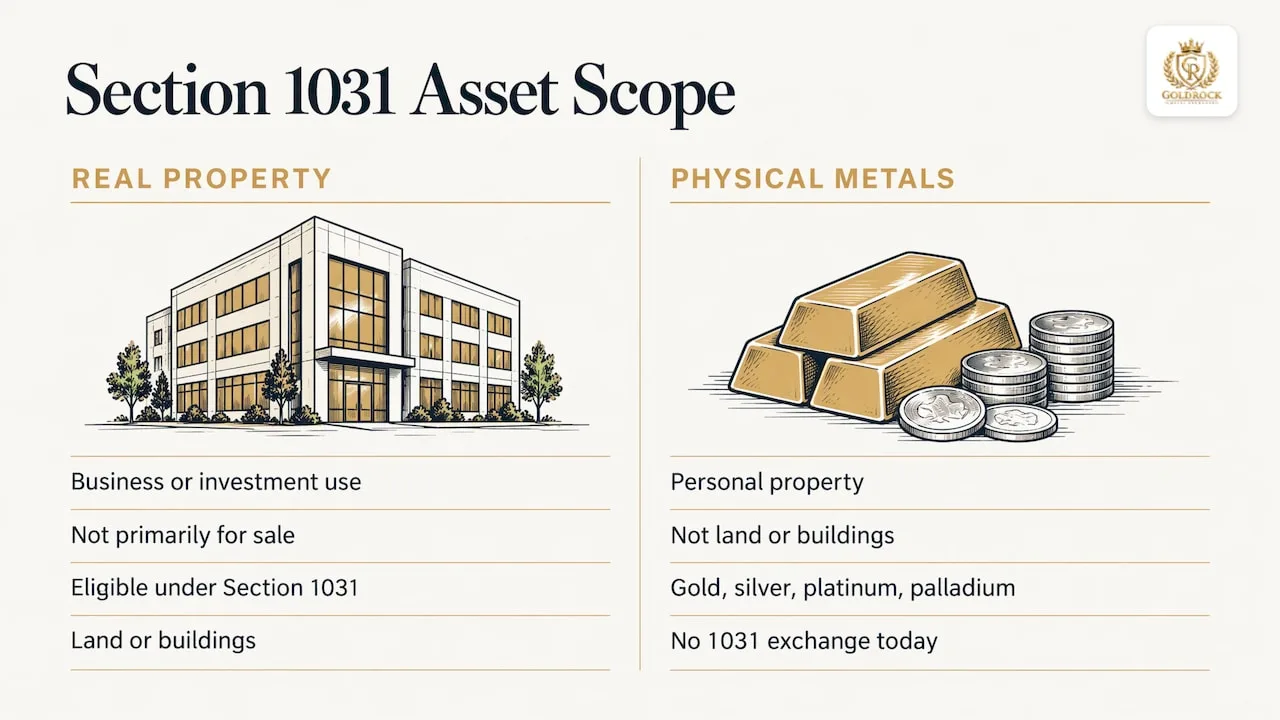
Physical gold, silver, platinum, and palladium are personal property. They are not land or buildings. So the plain answer to the question in the headline is no: today there is no 1031 exchange for gold.
Gold was already a difficult fit before 2018
It helps to know the history, because many older articles still say gold can be exchanged.
In Revenue Ruling 79-143, the IRS considered an exchange of U.S. $20 numismatic-type gold coins for South African Krugerrand bullion-type gold coins. It concluded the exchange did not qualify for Section 1031 non-recognition, because the two assets represented different types of underlying investment. In other words, two items that both contain gold were not automatically “like kind.”
That ruling shows how narrowly the concept was read even when personal property was eligible. It also explains why an older web page claiming that any gold-for-gold swap is tax-free should be treated with caution. Whatever the pre-2018 rules allowed, the current statute does not extend to metals at all.
Real estate and gold: two different asset classes
People searching for this topic are often real estate owners. They have an investment property with a large gain and wonder whether gold could be the destination for the proceeds. Under current law, a 1031 exchange must stay inside real property. If proceeds from a property sale are used to buy metals, that purchase is simply a purchase.
The definition of real property, and how a property is valued for exchange purposes, has its own practical details. If you are on the real estate side of the question, an appraisal for a 1031 exchange is one example of the documentation that real property transactions can involve. Questions about whether a particular sale qualifies belong with a qualified intermediary and your tax professional.
A few features separate a real estate exchange from anything involving metals:
| Feature | Real property 1031 exchange | Buying physical metals |
|---|---|---|
| Eligible asset type | Real property held for business or investment | Personal property (coins, bars, rounds) |
| Governing rule | Section 1031 | Ordinary purchase; tax treatment depends on how and when you later sell |
| Intermediary | Typically a qualified intermediary holds proceeds | None required |
| Deadlines | Fixed exchange periods set by the IRS | No exchange deadlines |
| Storage or delivery | Not applicable | Insured delivery to you, or custody if held in an IRA |
The point of the table is not that one is better. They are different tools for different assets, and neither substitutes for the other.
How gold is generally taxed when sold
Because 1031 deferral is not available, it is useful to understand the general framework the IRS describes for gains on metals. This is general information, not a calculation for your situation.
According to IRS Topic no. 409, net capital gains from selling collectibles, a category that includes coins, are subject to a maximum federal capital gains rate of 28%. The same page explains that short-term gains, from assets held one year or less, are taxed as ordinary income at graduated rates. Whether a particular bar or coin is treated as a collectible, and which rate applies to you, is a question for a tax professional.
Two record-keeping points come up often:
- Holding period. The IRS explains that the holding period begins the day after you receive the property and includes the day you dispose of it.
- Basis records. IRS Publication 544 explains that you need accurate records of the purchase price and any adjustments to figure your adjusted basis when you sell.
For anyone buying physical metals, the practical lesson is simple: keep every invoice, shipping record, and confirmation, with dates and amounts. We provide order documentation so your records are complete when you or your tax professional need them.
Step-up basis and inherited gold
Many people who search for a gold 1031 exchange are really thinking about a different idea: what happens to the cost basis of gold that is passed to heirs. This is governed by Section 1014, not Section 1031.
The IRS has confirmed, in a 2012 private letter ruling, that the basis step-up rule in Section 1014(a) applies to property acquired by bequest, devise, or inheritance. In general, the basis of inherited property is its fair market value at the decedent’s death. A 1999 IRS document notes that the value reported for estate tax purposes is presumed to be fair market value, although that presumption can be rebutted by clear and convincing evidence.
The IRS also notes, in its Capital Gains Lesson Plan, that if the estate’s representative chooses an alternative valuation date, that date can be used to determine the basis of inherited property.
Three cautions apply:
- These are general descriptions of IRS positions, and private letter rulings apply to the taxpayer who requested them.
- Whether a step-up applies to a given asset, and how the value is set, depends on the facts of the estate.
- Estate and basis questions belong with an estate attorney or tax professional.
What we can say as a metals dealer is that good documentation of what was owned, where it is held, and how it was acquired makes life easier for families. Physical holdings are tangible, so heirs benefit from a clear inventory.
Blake
Is a gold IRA or 401(k) rollover a 1031 exchange?
No. They are separate concepts with separate rules, and mixing them up is the most common source of confusion.
A 1031 exchange swaps one qualifying real property for another. A retirement account rollover moves money between retirement accounts. The IRS explains rollovers as payments from a retirement plan or IRA that can be deposited in another plan or IRA within 60 days, or transferred directly by the financial institution or plan. A direct transfer between institutions is described as a trustee-to-trustee transfer, with no taxes withheld from the transfer amount. The IRS also notes that its rollover chart summarizes which rollover transactions are allowed.
In a self-directed Precious Metals IRA, the account owns approved physical metals instead of, or alongside, other investments. The account follows IRS rules on eligible metals, custody, and reporting. Because the structure is an IRA, not an exchange of real property, none of the 1031 timelines, intermediaries, or like-kind tests apply.
How an account rollover into metals generally works
- Review your current account. Identify the type (traditional IRA, 401(k), 403(b), TSP, or similar) and check with its administrator what transfer options exist, especially for an account at a current employer.
- Open a self-directed IRA. This is the account that is permitted to hold approved physical metals, with an IRS-eligible custodian.
- Request a direct transfer or rollover. Ask the current administrator to move funds directly where possible, and follow the IRS rollover rules above.
- Choose eligible metals. Not every coin or bar is eligible for an IRA, so selection matters.
- Arrange custody. Metals held in an IRA are stored through the custodial arrangement, not shipped to your home.
- Keep records. Save statements, confirmations, and transfer paperwork.
Our in-house IRA department handles the coordination so you are not passing paperwork between offices on your own. If you want details, see our Precious Metals IRA page.
Request a Free Precious Metals Consultation
If you are weighing metals against other holdings, we are glad to walk through how physical gold, silver, platinum, and palladium work, how a self-directed IRA rollover is handled, and what documentation to keep. There is no obligation, and we do not give tax or legal advice. Request a Free Precious Metals Consultation or call (888) 859-0978.
Choosing among the four metals
Because there is no exchange mechanism, the choice among metals comes down to purpose, not tax treatment. Here is a plain way to compare them.
| Metal | Common reasons investors consider it | Things to weigh |
|---|---|---|
| Gold | Long history as a store of value; widely recognized | Higher price per ounce means a smaller number of ounces for the same budget |
| Silver | Lower price per ounce; also used in industry | Bulkier to store per dollar of value; prices can move sharply |
| Platinum | Rarer than gold; industrial demand | Smaller market; demand tied partly to industry |
| Palladium | Used heavily in industrial applications | Concentrated demand and a smaller market |
No metal is guaranteed to rise in value, and past performance does not predict future prices. Metals are often discussed as a way to diversify, which is a different thing from a promise of returns or safety.
Questions to ask yourself before buying
- What is the purpose: diversification, retirement, or holding a portion outside the financial system?
- Will the metals be held at home, delivered privately, or held in an IRA?
- How long do you expect to hold them?
- Which share of your overall portfolio is appropriate for you, according to your financial professional?
- Do you have a clear system for records?
Ownership methods compared
Since a 1031 exchange is off the table, the real decision is how you own metals. The options differ in custody, access, and rules.
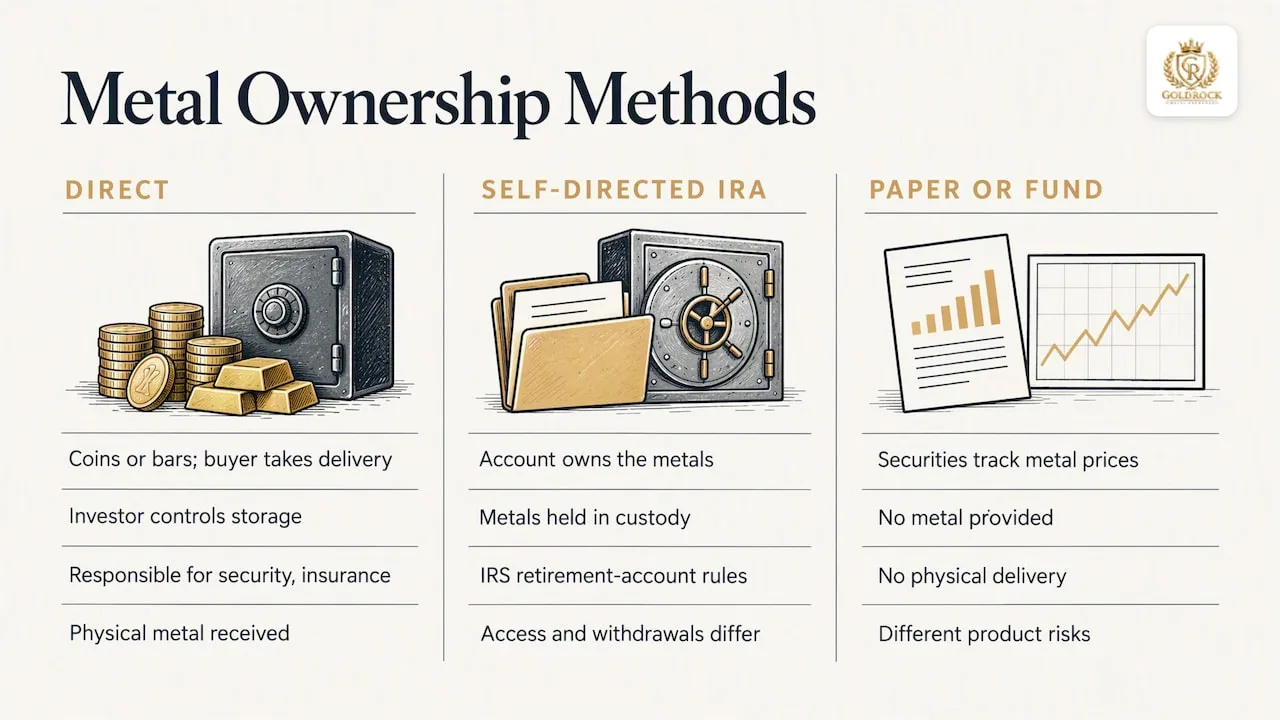
Physical metals held directly. You buy coins or bars and take delivery. You control storage and are responsible for security and insurance of what you keep. We offer insured private delivery so the shipment is covered in transit.
Physical metals in a self-directed IRA. The account owns the metals, which are held in custody under IRS rules. The structure follows retirement account rules, so access and withdrawals work differently from direct ownership.
Paper or fund exposure. Certain securities track metal prices without giving you the metal. The SEC and FINRA publish investor education on commodity-linked products, and the CFTC publishes consumer material on commodities. These products carry different risks and no physical delivery.
Each method has trade-offs. Our focus is physical ownership, either delivered or inside a retirement account, and we are happy to explain how each works.
Our perspective
We hear this question from real estate owners, retirees, and people who inherited coins. The honest answer is the same each time: a 1031 exchange is a real property tool, and physical metals work differently. We would rather say that plainly than let anyone build a plan on an outdated idea.
What we can offer is clarity about the part we know. Physical gold, silver, platinum, and palladium are tangible assets, and some investors choose them to diversify against market volatility and inflation. We do not promise returns, safety, or tax outcomes. Those depend on markets and on your personal situation, and tax questions belong with your tax professional.
Our approach is personal. You speak with people, not a form. Our dedicated in-house IRA department coordinates account rollovers so the process stays organized, and our delivery is insured and private. If you are exploring metals, we will explain the options at your pace.
Blake
Our Precious Metals services
If you decide physical metals fit your plan, we can help in three ways:
- Precious Metals IRA: guidance and in-house coordination for moving eligible retirement funds into a self-directed account. Learn about the Precious Metals IRA.
- Direct purchase with insured private delivery: physical metals shipped to you with insurance. See our private delivery options.
- Ongoing consultation: questions answered after your purchase as well as before. Prices are not published on our category pages, so call (888) 859-0978 for current availability.
FAQ
Can I do a 1031 exchange with gold?
No. Since January 1, 2018, Section 1031 applies only to real property held for business use or investment. Gold and other metals are personal property, so they generally do not qualify. A tax professional can confirm how this applies to your situation.
Can I sell a rental property and put the money into gold tax-free?
A 1031 exchange requires the replacement asset to be real property, so buying gold with sale proceeds is not an exchange. How the sale is taxed is a question for your tax professional. We can explain how physical metals are purchased and delivered.
What does step-up basis mean for gold?
In general, property acquired by inheritance receives a basis equal to its fair market value at the decedent’s death under Section 1014. How that applies to a particular estate depends on its facts, so check with an estate attorney or tax professional.
Is a gold IRA rollover the same as a 1031 exchange?
No. A rollover moves funds between retirement accounts under IRS rollover rules, such as a direct trustee-to-trustee transfer or a 60-day rollover. A 1031 exchange swaps real property. They have different rules and deadlines.
Does GoldRock give tax advice?
No. We provide education on metals, IRA processes, and delivery. For tax, legal, or investment advice specific to you, speak with a qualified professional.
Request a Free Precious Metals Consultation
Whether you are rolling over a retirement account, diversifying with physical metals, or just sorting out what the tax rules do and do not cover, we can help you understand the options. Request a Free Precious Metals Consultation or call (888) 859-0978.
Educational disclaimer: This article is for general education only. It is not tax, legal, or investment advice and does not promise returns, safety, tax benefits, or appreciation. Precious metals prices can fall as well as rise. Consult a qualified tax, legal, or financial professional about your own circumstances.
Sources
- Instructions for Form 8824 (2025), IRS
- Like-kind exchanges: real estate tax tips, IRS
- Statutory Limitations on Like-Kind Exchanges, Federal Register
- Revenue Ruling 79-143
- Topic no. 409, Capital gains and losses, IRS
- Reporting Capital Gains, IRS Fact Sheet 2007-19
- Publication 544, Sales and Other Dispositions of Assets, IRS
- IRS private letter ruling 1245006
- IRS document 199933001
- Capital Gains Lesson Plan, IRS
- Rollovers of retirement plan and IRA distributions, IRS
- Appraisal for a 1031 Exchange