Platinum and palladium are both rare precious metals, both belong to the platinum group, and both are tied closely to the auto industry. They are not interchangeable, though. Platinum has a broader industrial base and is typically easier to trade. Palladium leans heavily on gasoline-vehicle catalytic converters and tends to swing harder. Below we walk through how they differ on demand, price behavior, liquidity, ownership methods and retirement account rules, so you can decide whether either deserves a place in your plan.
TL;DR
- Platinum has more varied uses (jewelry, fuel cells, diesel and industrial catalysts). Palladium is used mainly in gasoline catalytic converters.
- Both are driven more by industry than by safe-haven demand, and both can be volatile. Neither is a substitute for gold’s role.
- Platinum is typically more liquid than palladium, but both are less liquid than gold, and physical metal carries dealer spreads plus storage and insurance needs.
- Both can be held in a U.S. self-directed IRA when the bullion meets IRS fineness rules and a qualified trustee holds it.
- Nothing here is a promise of returns or a personal recommendation. Talk with a licensed professional about your own situation.
Table of Contents
- Platinum vs palladium at a glance
- What platinum and palladium actually are
- What moves their prices
- How much is an ounce worth?
- Volatility and liquidity compared
- Ways to own them: physical metal, funds and retirement accounts
- Platinum and palladium in a U.S. self-directed IRA
- Our perspective
- Request a Free Precious Metals Consultation
- How to decide: a simple framework
- Frequently asked questions
- Educational disclaimer
- Sources
Platinum vs palladium at a glance
| Factor | Platinum | Palladium |
|---|---|---|
| Main demand | Autocatalysts (especially diesel), jewelry, fuel cells, industry | Gasoline autocatalysts |
| Market character | More balanced and diversified | More volatile, supply-driven |
| Liquidity | Typically better than palladium | Typically thinner |
| Weight and feel | Much denser | Roughly half the weight of platinum for the same volume |
| Long-term question mark | Hydrogen technology could add demand | Battery electric vehicles could reduce demand |
| Typical IRA fineness standard | 99.95% pure for futures-delivery bars, a benchmark used in IRA context | Same 99.95% benchmark |
The first two rows of the table follow USA Today’s investor comparison, which describes platinum as the more balanced, diversified metal and palladium as the more explosive, supply-driven one. The density point is basic metallurgy: platinum is the heavier metal, and palladium is about half its weight in coin form, as even coin-identification guides note.
What platinum and palladium actually are
Both metals sit in the platinum group, a family of scarce metals that are mined in a few places and recovered in small quantities. They look similar to the eye: silvery white, resistant to tarnish, and dense compared with silver. That is where the resemblance ends for investors.
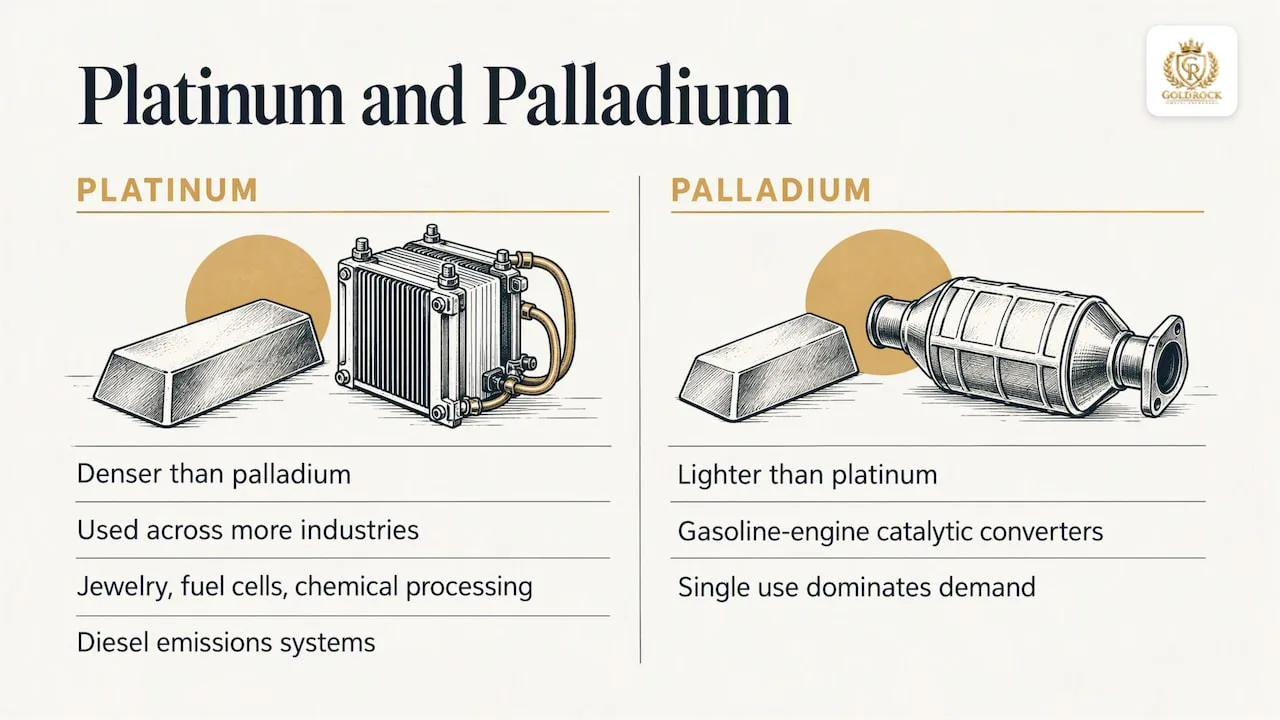
Platinum is denser, a bit more expensive to fabricate into coins and bars per ounce of weight, and used across more industries. Jewelry, fuel cells, chemical processing and diesel emissions systems all use it.
Palladium is lighter and was long the metal of choice for gasoline-engine catalytic converters. That single use dominates its demand picture, which is why its story is so closely tied to what cars people buy.
Is palladium a precious metal? Yes. Like platinum, it is a rare precious metal, but, as OCBC’s overview of the two metals points out, their demand drivers are more industrial than rooted in the safe-haven role gold plays. That distinction matters when you think about what you want a metal to do in a portfolio. If your goal is a store of value during market stress, our guide to palladium’s role during market stress and platinum’s role in wealth protection cover what each can and cannot be expected to do.
What moves their prices
The two metals share a driver: the automotive sector. The USA Today piece cites the U.S. Geological Survey in noting that prices are driven primarily by industrial demand and are sensitive to supply disruptions in concentrated regions such as South Africa and Russia. Palladium demand is tied to gasoline vehicles. Platinum is used in diesel vehicles and in broader applications.
Supply concentration is the second force. OCBC Group Research describes these metals as high-beta, meaning their prices tend to move more sharply than the broader market, and sensitive to that concentration. When a few countries supply most of a metal and production cannot respond quickly, a disruption can move prices fast.
The third force is technology change, and here the two metals diverge:
- Battery electric vehicles. OCBC’s May 2026 research calls BEV adoption a structural headwind for autocatalyst demand, especially for palladium. SFA (Oxford) likewise reports that rising BEV market share is reducing palladium demand.
- Hydrogen. The same OCBC research says hydrogen technologies offer longer-term optionality for platinum. “Optionality” is the key word: it is a possibility, not a guarantee.
No central bank buys these metals as reserves. One analysis notes that the lack of official-sector demand removes a large, price-insensitive buyer and contributes to volatility. Gold has that buyer; these metals do not.
How much is an ounce worth?
Prices move every trading day, so any number printed in an article goes stale quickly. For context, the U.S. Geological Survey’s Mineral Commodity Summaries 2026 estimates the 2025 annual average price at $1,200 per troy ounce for platinum and $1,100 per troy ounce for palladium. The same report shows the U.S. imported 99,000 kilograms of platinum and 92,000 kilograms of palladium in 2025, a reminder that the U.S. relies on foreign supply.
Two practical points about price:
- The spot price is a benchmark for the raw metal, not what you pay. A coin or bar usually costs spot plus a premium that covers fabrication, distribution and the dealer’s margin. Premiums tend to be wider on thinner markets, which is one reason palladium and platinum can cost more to buy and sell than gold.
- The buy and sell prices differ. The gap between what a dealer charges and what it will pay you is the spread. You need the metal to rise by at least the spread before you break even, before storage and insurance.
For the live price, ask us. We quote current pricing by phone at (888) 859-0978, and our platinum and palladium pages show what is available.
Volatility and liquidity compared
Both metals are less liquid than gold. Platinum is typically more liquid than palladium, according to the USA Today analysis. Less liquidity generally means wider bid-ask spreads and a longer wait for the right buyer when you sell.
On volatility, the research points the same way. Platinum is described as more balanced. Palladium is the more explosive trade. OCBC’s research characterizes platinum as a more constructive investment than palladium because of tighter market balances and lower stock buffers, while acknowledging possible short-term choppiness. That is one analyst house’s view, not a forecast we can stand behind, and views like it change as supply and demand data change.
What this means in practice: a position that is small relative to your whole portfolio is easier to live with than a large one in a metal that can move sharply in either direction. Our beginner’s resource on starting a precious metals portfolio explains how investors think about sizing.
Ways to own them: physical metal, funds and retirement accounts
Physical coins and bars
Direct ownership of a tangible asset is the main appeal. The tradeoffs are real. Per the USA Today report, physical holdings carry higher transaction costs and storage and insurance requirements. Sharon Wu, CFEI, notes in that article that secure storage and insurance can add significant ongoing costs. Fraud is also a risk when you buy from sellers you cannot verify. Where metal arrives at your door, delivery security matters too. We offer insured private delivery, and our guide to precious metals delivery options explains the choices.

Exchange-traded funds
Funds are convenient. Carnegie Mellon’s William Gogolak, quoted by USA Today, identifies them as the most convenient exposure for most investors, while noting they charge fees and give no physical possession. InvestmentKit reports that platinum and palladium ETFs carry expense ratios around 0.60% and lower liquidity than gold funds, leading to wider bid-ask spreads. If owning the actual metal matters to you, a fund is a different thing. We walk through that logic for gold in Gold ETFs or IRAs, and much of it applies here.
A self-directed IRA
This is where many retirement savers look at platinum and palladium, and it has its own rulebook, covered next.
Platinum and palladium in a U.S. self-directed IRA
Yes, both can be held in an IRA, but not every product qualifies. Under IRS guidance on collectibles in individually directed accounts, gold, silver, platinum or palladium bullion of a required fineness is excluded from the collectibles prohibition under IRC Section 408(m)(3), provided a bank or approved non-bank trustee keeps physical possession. An IRS ruling letter says the same for platinum and palladium: the metal must meet the contract-market fineness minimum, and a trustee described in Section 408(a) must hold it.
That fineness minimum is 99.95% pure for platinum and palladium delivered against futures contracts, per the CME Group contract specifications. Three consequences follow:
- You do not keep the metal at home. The trustee holds it, usually in an approved depository.
- Purity alone is not the whole test. A product can be 99.95% pure and still need to fit one of the IRS paths. Our guides explain this for platinum IRAs, platinum coins, the 99.95% rule for palladium and palladium coins.
- Paperwork matters. Rollovers and transfers have their own steps, and mistakes can be costly. A dedicated team helps you avoid them.
We do not give tax advice. For questions about how any rollover or distribution is treated, speak with a qualified tax professional.
Our perspective
We talk with retirees and with younger investors, and the same pattern comes up with platinum and palladium. People often arrive because a chart looked interesting, then discover the metal behaves nothing like gold. We think that is the right moment to slow down.
Our view is simple. Gold usually anchors a precious metals allocation because of its long history as a store of value and its deeper market. Platinum and palladium are smaller markets with industrial exposure, so we treat them as supporting positions that a client chooses deliberately, not as the core. Between the two, platinum’s broader demand base makes it the easier one to explain, and palladium asks for more conviction about the future of gasoline engines. Our comparison of gold and palladium and gold and platinum purity note explain how we frame that choice.
We will not tell you a metal is safe or that it will rise. We will tell you what it is, what it costs to hold, and what the IRS requires, and we will answer your questions as often as you have them.
— Blake
Request a Free Precious Metals Consultation
If you are weighing platinum, palladium or both for a self-directed IRA or a direct purchase, our in-house IRA department can walk you through eligible products, the transfer process and insured delivery options. There is no obligation. Request a Free Precious Metals Consultation or call (888) 859-0978. You can also read how we handle opening a precious metals IRA.
How to decide: a simple framework
Use these steps as a thinking tool, not as advice tailored to you.
- Name the job. Do you want a store of value, industrial exposure or diversification? Gold fits the first best. Platinum and palladium fit the second and third, with higher variability.
- Pick your tolerance for swings. If a 20% move in either direction would make you sell in a panic, a smaller position, or none, may suit you better.
- Choose the ownership method. Physical metal, a fund or an IRA each carry different costs, tax rules and levels of control. Compare fees, spreads and storage.
- Check liquidity. Ask what the buyback process looks like and how wide the spread is before you buy, not after.
- Verify eligibility. For an IRA, confirm the exact product meets IRS requirements and will be held by an approved trustee.
- Think about the technology story. BEV growth cuts against palladium’s main use, while hydrogen may help platinum over a long horizon. Treat both as open questions.
- Talk to professionals. A licensed financial adviser and a tax professional can address your circumstances. We can handle the purchase mechanics.
Frequently asked questions
Is platinum or palladium the better investment?
Neither is better in every case. Platinum has a more diversified demand base and is typically more liquid, while palladium is more tied to gasoline cars and has been more volatile. Which one fits depends on your goals, time horizon and risk tolerance, so consider speaking with a licensed adviser.
Why is palladium sometimes priced differently from platinum?
The prices reflect supply, industrial demand and sentiment for each metal separately, so the gap between them changes over time. USGS data show platinum averaged about $1,200 per troy ounce in 2025 and palladium about $1,100. Palladium has at times traded above platinum, which shows how much the relationship can shift.
Can I hold platinum and palladium in an IRA?
Yes, if the bullion meets the IRS fineness requirement and a qualified trustee holds it. The bullion cannot be kept at your home. We can confirm which specific products are eligible before you commit.
Is palladium a precious metal?
Yes. Palladium is a rare precious metal in the platinum group. Its price, however, follows industrial demand, particularly from automotive manufacturing, more than the safe-haven buying that supports gold.
Should I buy physical metal or an ETF?
They serve different purposes. ETFs are convenient but charge fees and give no physical possession, while physical metal gives direct ownership but brings spreads, storage and insurance considerations. Consider which of those tradeoffs matters most to you.
Educational disclaimer
This article is for general education only. It is not investment, tax or legal advice, and it does not promise returns, safety, tax benefits or appreciation. Precious metals prices can fall as well as rise. Consult a licensed financial, tax or legal professional about your own circumstances.
Sources
- Platinum vs palladium as precious metals investments, USA Today
- Mineral Commodity Summaries 2026: Platinum-Group Metals, U.S. Geological Survey
- ESG-FX Platinum; Palladium, OCBC Group Research, May 2026
- The Palladium Standard 2026, SFA (Oxford)
- Getting to know your metals: platinum and palladium, OCBC
- Platinum and Palladium: Market, Industry and Tax
- Precious Metals Investing guide, InvestmentKit
- Investments in collectibles in individually directed qualified plan accounts, IRS
- IRS ruling letter on platinum and palladium bullion in IRAs
- Platinum Futures contract specifications, CME Group