

Most bullion purchases in the United States cannot be returned the way a sweater can. Gold and silver are priced to a live market, so dealers typically offer either no returns at all or a very short window, often counted in days from delivery, sometimes with a restocking fee or a charge for any drop in price. No federal law gives you a general right to cancel an online or phone order for metal. Your protection is the written policy you agree to, so read it before you pay. This guide explains how those policies work, what to ask, and how to handle a return if you ever need one.
Table of Contents
- TL;DR
- Why bullion is treated differently from other purchases
- What the law does and does not give you
- The five terms that define a bullion return policy
- Typical bullion return structures at a glance
- Return policy versus buyback: two different things
- A step-by-step way to protect yourself before you buy
- If you need to make a return
- Our perspective
- Request a Free Precious Metals Consultation
- Special considerations for gold and silver
- Buying for a retirement account
- Red flags in a dealer’s terms
- FAQ
- Sources
TL;DR
- There is no general federal cooling-off right for bullion bought online or by phone, so the dealer’s written policy is what governs your order.
- Bullion returns, where allowed at all, usually come with a short window, a restocking fee or a market-loss charge, and exclusions for certain items.
- Because prices move every minute, the cancellation window often matters less than the moment your price is locked.
- Ask for the policy in writing before you pay, and keep the invoice, packaging and tracking records.
- For our current terms, call GoldRock Metal Exchange at (888) 859-0978 before you order.
This article is educational. It is not investment, tax or legal advice, and it promises no return, safety or price movement.
Why bullion is treated differently from other purchases
A shirt has the same value on the shelf as in your closet. A one-ounce gold coin does not. Its price follows the spot market, and the dealer who sold it to you has usually secured the metal at that price, sometimes hedged it, and bears the risk until you pay. If you could send the coin back a week later after the market fell, the dealer would be absorbing your price risk for free.
That is the logic behind the common bullion rules: short windows, final-sale items, and market-loss language. It is also why a policy that looks strict is not necessarily unfair. What matters is that it is clear, written down, and understood before you commit.
What the law does and does not give you
Two U.S. rules come up often, and neither works the way many buyers assume.
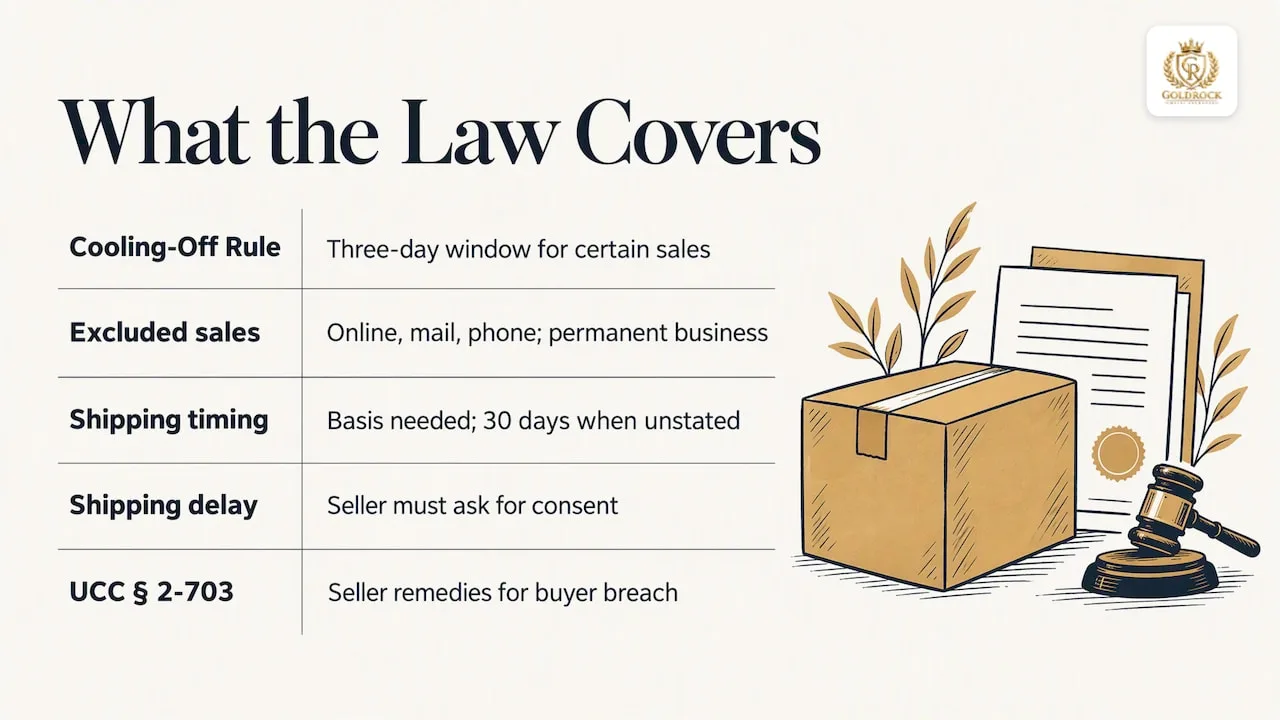
The Federal Trade Commission’s Cooling-Off Rule offers a three-day cancellation window for certain sales, but it does not apply to purchases made entirely online, by mail or by telephone. It also does not cover sales completed at a seller’s permanent place of business. So for most bullion orders, there is no automatic federal right to change your mind.
The FTC does regulate delivery timing. Under its Mail, Internet, or Telephone Order Merchandise Rule, a seller needs a reasonable basis for any shipping time it states, and if it states none, for believing it can ship within 30 days. If it cannot, it must ask for your consent to the delay. This protects you from undelivered orders, not from buyer’s remorse. Non-delivery is a real concern in this industry: in 2016 the FTC charged a gold and silver marketing operation with fraud, alleging the defendants often failed to deliver goods.
Contract law fills the rest. Sales of goods in the U.S. are generally governed by the Uniform Commercial Code, and under UCC § 2-703 a seller generally has remedies, including cancellation, when a buyer wrongfully rejects goods, fails to pay or repudiates the contract. In plain terms: once you agree to terms and the order is placed, backing out without the dealer’s permission can put you in breach unless the policy lets you out. That is why the policy you accepted at checkout matters so much.
If you want to know where a specific situation stands, ask a licensed attorney. We cannot give legal advice.
The five terms that define a bullion return policy
Policies differ from one dealer to the next, but the same handful of terms decide almost every outcome. Look for each one.
1. The return window
Among published bullion policies, windows tend to be short. Some allow a request only within a few days of delivery, others count in business days, and some treat bullion as final sale entirely. Check whether the clock starts at the order date, the ship date or the delivery date. Delivery is the most favorable for you, and it is worth confirming in writing.
2. The price lock
Most online and phone orders are priced at the moment you pay, or at the moment you and the representative confirm. Find out exactly when the price locks, how long you have to send payment after a phone quote, and what happens if funds arrive late. A wire, a check and a card can each lock the price at a different point.
3. Restocking fees and market-loss charges
Where returns are accepted, expect one of two costs. A restocking fee is usually a percentage of the order or a flat minimum. A market-loss charge makes you cover any decline in the metal’s price between your purchase and the dealer receiving the return. Some policies have both. Ask how the price is determined on the return date and whether a gain would be passed to you or kept by the dealer.
4. Excluded items
Some items are commonly marked final sale: certain collectible or numismatic coins, special-order or pre-order products, custom items, and orders that exceed a size threshold. Bullion that has been opened, scratched, removed from sealed packaging or otherwise altered may also be refused. If you are buying a specific product, ask whether it is returnable by name.
5. Refund and exchange method
A refund normally returns to the original form of payment, and the timeline begins when the dealer receives and inspects the metal, not when you ship it. Find out whether an exchange for other products is possible instead of a refund, and whether shipping charges are refundable.
Typical bullion return structures at a glance
The table below describes structures buyers encounter, not any one company’s terms.
| Structure | How it works | What to watch |
|---|---|---|
| Final sale | No returns or cancellations once the order is placed | Price lock timing and your certainty about the product |
| Short window | Return request allowed within a few days of delivery | Whether days are business or calendar days |
| Window with a fee | Return allowed after a deduction, often a percentage or a flat minimum | The minimum, and whether it applies to small orders |
| Market-loss policy | You cover any price decline between sale and return | How the return price is set and the date it applies |
| Exchange only | Credit or swap for other products rather than cash | Whether premiums are repriced on the new item |
Return policy versus buyback: two different things
Buyers often mix these up. A return policy covers undoing a recent purchase. A buyback is the dealer purchasing metal from you later, at a price based on the market at that time, and it is a separate decision.
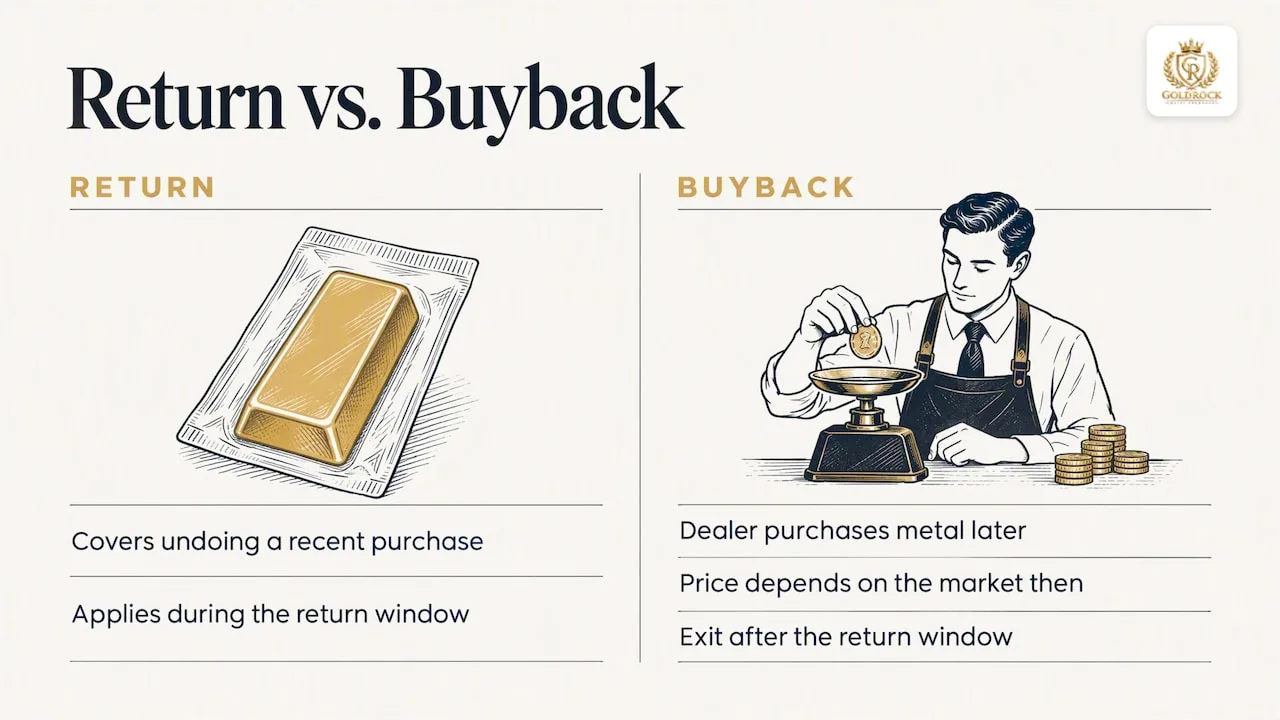
Once your return window has passed, selling is how you would exit the position. The price you receive then depends on spot price, the product and the dealer’s buy-side spread. Understanding how the premium over spot works helps explain why the price you pay and the price a buyer offers are not the same number. If your metals are in a retirement account, it is worth reading how to verify dealer buyback policies and get a written formula before you fund anything.
A step-by-step way to protect yourself before you buy
- Request the full policy in writing. Ask for it by email or find it on the order page, and save a copy dated the day you order.
- Confirm the price lock. Ask the representative when your price is fixed and what payment deadline applies.
- Identify the exact product. Coin name, year if relevant, weight, purity and quantity. Mistakes in the product are easier to resolve when the invoice is precise.
- Ask about delivery. Find out the carrier, the insurance coverage while in transit and whether a signature is required. Our overview of precious metals delivery options covers the choices.
- Inspect on arrival. Open the package on video if you can, check the count and condition, and report any discrepancy right away.
- Keep everything. Retain the invoice, tracking, original packaging and any seals until your return window has closed.
If you need to make a return
If something is wrong, act the same day. Most windows are short, and a delay can end your options.
- Contact the dealer first. Do not ship anything before you receive written authorization and, if the dealer uses one, a return number.
- Document the problem. Photographs of the package, the seals and the product, along with weights where relevant.
- Ship with tracking and full insurance. You usually carry the risk until the dealer receives the package, so insure it for the full value and require a signature.
- Follow the packing instructions. Metals returned in altered condition can be rejected.
- Track the refund. Confirm in writing the date the dealer received the metal and the date a refund is expected.
If the product arrives damaged, short or not as described, that is a different conversation from changing your mind. Report it immediately, and keep the carrier’s claim information.
Our perspective
We have talked with buyers who were surprised at how firm bullion terms can be, and the pattern is nearly always the same: they assumed a store-style return policy applied, and nobody had shown them the actual terms. We think that is a failure of explanation, not of the buyer.
Our view is simple. A bullion purchase should be a deliberate decision made with the numbers in front of you. That is why we encourage a conversation before an order, not after: we walk through the product, the premium over spot, delivery and, for retirement accounts, how the rollover works through our in-house IRA department. We would rather you ask the uncomfortable questions on day one than discover an unfamiliar term on day six.
We also think delivery deserves as much attention as price. Our private, insured delivery option exists because a package that arrives safely and as expected is the best “return policy” there is: nothing to return. Whatever dealer you consider, do not judge it on a headline price alone.
— Blake
Request a Free Precious Metals Consultation
If you are weighing a purchase and want the return, price-lock and delivery terms explained before you commit, speak with us. We will go through the current policy for the specific products you are considering, answer questions about physical gold, silver, platinum and palladium, and explain how our insured private delivery works. Call (888) 859-0978 or Request a Free Precious Metals Consultation.
Special considerations for gold and silver
Gold
Gold carries higher dollar values per order, so the market-loss exposure on a return is larger even for a small percentage move. Large orders can also fall under different payment and shipping terms. If you are comparing sizes, remember that the premium on small coins is typically higher per ounce than on larger formats, which affects both your cost and the economics of any later sale. Browse our gold selection to see the product types we carry.
Silver
Silver orders are heavier and bulkier for their value, which makes shipping and insurance a bigger share of the cost. Returns involve moving that weight twice, so the shipping cost of a return can matter more than the fee. Silver is also commonly sold in sealed tubes or boxes, and a broken seal may affect whether a return is accepted. See our silver products for what is available.
Coins that are not simple bullion
Proof and collectible coins are priced on more than metal content, so they often carry stricter terms. If you are unsure which category a product falls into, our guide to proof versus bullion coins explains the difference.
Buying for a retirement account
When metals are purchased through a self-directed IRA, the process involves more parties: a custodian, a depository and the dealer. Timing and paperwork are different from a direct purchase, and a return may not be as simple as sending a package back, since the metal is typically held by a depository and not by you. Ask how a cancellation would work at each step before funds move. Our Precious Metals IRA page outlines the setup, and the depository insurance checklist lists the questions to ask about storage. We do not give tax advice, so speak with a qualified tax professional about how your account’s rules apply to you.
Red flags in a dealer’s terms
A clear policy is a sign of a dealer who expects to be held to it. Be cautious when you see any of these:
- No written policy, or one that changes depending on who answers the phone.
- Pressure to pay immediately to “lock” a price without confirming terms.
- Refusal to say when the price is fixed.
- Vague references to fees with no percentage, minimum or formula.
- Promises that your metal will rise in value or that a purchase is risk-free. No one can promise that.
- A price far from the going spot-plus-premium range with no explanation.
Our guides on choosing a gold dealer and spotting gold IRA scams go deeper on due diligence.
FAQ
Can I return gold or silver bullion after I buy it?
It depends entirely on the dealer’s written policy. There is no general federal right to cancel an online or phone bullion order, so many dealers treat bullion as final sale or allow returns only within a short window. Ask for the terms before you pay and save a copy.
Will I pay a fee if a return is accepted?
Often, yes. Policies commonly include a restocking fee, a market-loss charge covering any drop in price, or both. Ask how each is calculated and what the minimum is, so you can estimate the cost before you buy.
Does the FTC three-day cooling-off rule cover bullion?
Not for online, mail or phone orders. The FTC says the rule does not apply to purchases made entirely by those methods, nor to sales completed at the seller’s permanent place of business. Your protection comes from the contract you accepted and from rules on delivery timing.
What should I do if my order arrives damaged or incorrect?
Contact the dealer right away, before shipping anything back, and send photographs of the packaging and product. Keep the carrier’s information in case a claim is needed. Prompt reporting matters because windows are short.
What is GoldRock’s return policy?
Terms can depend on the product and the order, so we go through them with you before you buy. Call (888) 859-0978 and we will explain the current policy in plain language.
Sources
- FTC: Buyer’s Remorse, the FTC’s Cooling-Off Rule
- FTC: Business Guide to the Mail, Internet, or Telephone Order Merchandise Rule
- FTC: Charges Gold, Silver Investment Scheme with Fraud (2016)
- Uniform Commercial Code § 2-703, Seller’s Remedies in General