
Whether you pay sales tax on silver depends on your state, the form of the silver and the size of the purchase. The federal government does not charge a sales tax. Each state decides, and many exempt qualifying bullion or coins, often with conditions such as a minimum invoice, a fineness standard or a cap on the premium over the metal’s value. Selling silver is a separate question, handled under federal income-tax rules rather than sales tax.
This guide explains how those state rules are built, shows what four states actually say, and covers what happens at sale. It is educational information, not tax advice.
TL;DR
- There is no federal sales tax on silver. Each state sets its own rules, and many exempt qualifying bullion or coins under stated conditions.
- The conditions matter more than the headline. Look for a minimum invoice amount, a fineness requirement, a limit on the premium over metal value and seller registration.
- Coins, bars and rounds can be treated differently, and jewelry or art made from silver is usually taxable even where bullion is not.
- A sales-tax exemption does not remove possible federal or state income tax on a gain when you sell.
- Confirm the current rule with your state revenue department before you order, because thresholds change.
Table of Contents
- The short answer: it depends on where you live and what you buy
- What four states actually say
- Coins, bars and rounds: why the form changes the answer
- How to check what applies to your order
- Request a Free Precious Metals Consultation
- What changes when you sell silver
- Silver inside a retirement account
- Delivery, storage and records
- Our perspective on silver and tax questions
- FAQ
- Educational disclaimer
- Ready to talk it through?
- Sources
The short answer: it depends on where you live and what you buy
Sales tax is a state and local tax. The Streamlined Sales and Use Tax Agreement, which participating states follow, defines exemptions either by the product or by the buyer’s use, and leaves the actual exemption to state law. In practice that means no single national answer exists. A $5,000 order of silver bars can be fully exempt in one state, taxed in the next, and partly taxed in a third.
Four patterns cover most cases:
- Full exemption for qualifying bullion and coins. The state exempts them by product definition, sometimes with paperwork rules for the seller.
- Exemption above a threshold. Small orders are taxed, larger single invoices are not.
- No general sales tax. A few states do not levy a broad statewide sales tax at all, so there is nothing to exempt.
- Taxed unless a narrow exception applies. Some states tax silver bullion by default and carve out only specific cases.
Because the rules are written by each state, the safest habit is to read the state revenue department’s own guidance, not a summary of it.
What four states actually say
Looking at primary guidance shows how much the details differ.
Colorado: exempt, with a warning attached
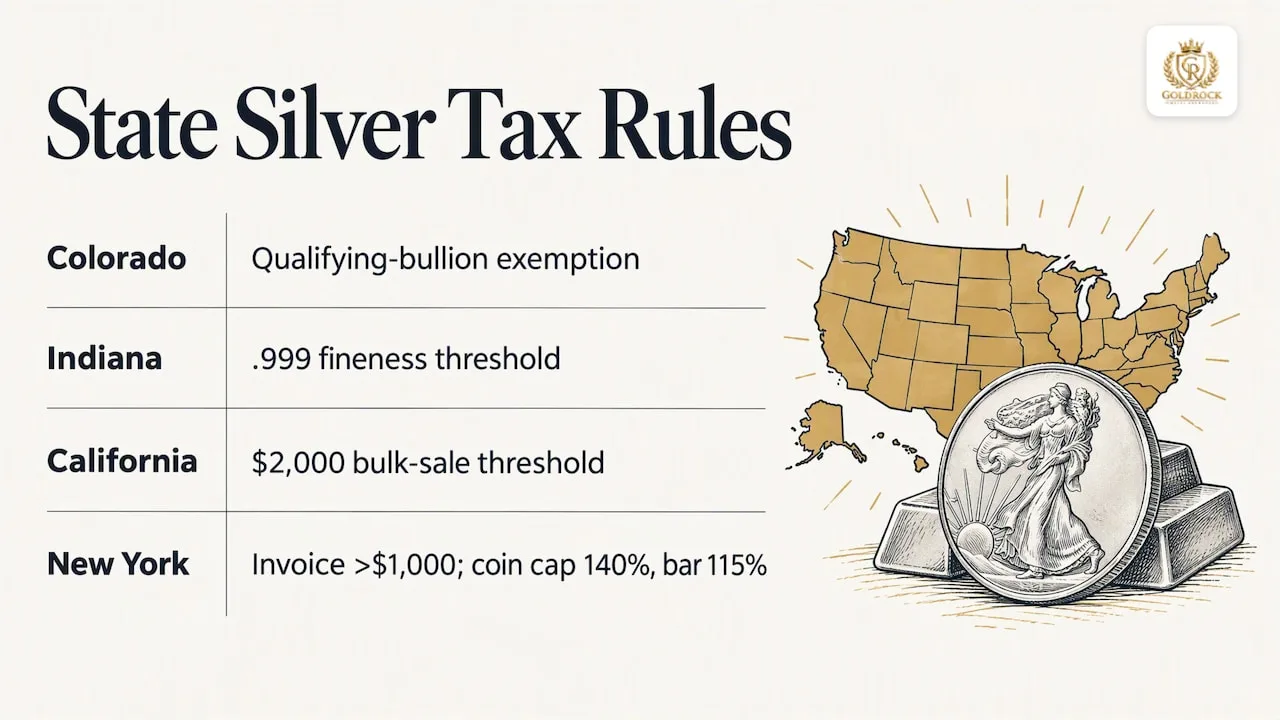
The Colorado Department of Revenue says sales, storage, use and consumption of qualifying coins and precious-metal bullion are exempt from state and state-administered local sales and use tax. Art, jewelry and commemoratives made from coins or bullion stay taxable. Colorado defines qualifying silver coins as monetized bullion or other metal money designated as a medium of exchange under U.S., Colorado or foreign law. The same page notes that the sales-tax exemption is separate from income-tax treatment, so a gain on sale can still matter.
Indiana: exempt, but defined by fineness
Indiana’s Department of Revenue, in Sales Tax Information Bulletin #50 from October 2023, says sales of qualifying coins, bullion and legal tender are exempt. The exemption covers silver coins, bars and rounds that meet at least 999 parts per 1,000 fineness. Bullion below that fineness stays taxable unless another legal-tender exemption applies. Retailers must register and keep documentation supporting exempt sales. The practical lesson: a bar stamped .999 fine and a bar stamped .925 are not the same product for tax purposes.
California: taxable unless an exemption fits
California starts from the opposite direction. Under Regulation 1599, sales of gold or silver bullion are taxable unless an exemption applies. A bulk-sale exemption covers monetized bullion, nonmonetized gold or silver bullion and numismatic coins in a single transaction of at least $2,000 (or the adjusted amount), provided the seller meets the registration condition. The regulation also distinguishes coins transferred solely as legal tender from coins sold as investments. A buyer ordering $1,500 of silver in one invoice and a buyer ordering $2,500 can therefore see different tax outcomes.
New York: invoice size and premium limits
New York’s regulation, 20 NYCRR § 528.29, exempts investment bullion when the single invoice exceeds $1,000, the price depends only on metal content, the retailer meets registration requirements and the purchaser keeps the bullion in the purchased form. Silver coins count as metal-content bullion when the price does not exceed 140% of the greater of the preceding business day’s closing silver price or the applicable face value. Bars and ingots use a 115% limit on the metal price.
Here is an illustration with round numbers, not a quote. If a coin’s silver value is $100 based on the prior day’s close, the 140% ceiling is $140. A coin priced above that is treated as carrying a collectible premium and falls outside the metal-content test. The same logic applies to bars at 115%.
Coins, bars and rounds: why the form changes the answer
The same ounce of silver can be taxed differently depending on its shape and how it is sold. Three distinctions come up repeatedly.
Legal tender versus investment sale. California treats coins transferred solely as legal tender differently from coins sold as investments. Colorado ties its coin exemption to monetized bullion and other metal money.
Fineness. Indiana’s 999 standard is a clear example. Government-minted bullion coins and many refined bars are .999 or higher, but older or decorative pieces may not be. Our guide to .999 fineness and custody for U.S. IRAs covers how the same purity question arises for retirement accounts.
Premium over metal value. Where a state limits the price to a percentage of metal value, a rare or heavily marked-up item can fall outside the exemption even though it is silver. If you are weighing collectible-style coins, the difference between proof and bullion coins is worth understanding before you buy.
Jewelry, art and commemorative items made from silver are a separate category. Colorado, for example, says they remain taxable even when made from exempt coins or bullion.
How to check what applies to your order
You do not need to be a tax professional to ask the right questions. Work through these steps before placing an order.
- Identify the delivery state. Sales tax generally follows where the purchase is delivered or used, so confirm your own state’s rule, not the seller’s.
- Find the state revenue department’s page on bullion and coins. Search for the department’s guidance on precious metals, coins or bullion exemptions. Official pages are the ones to trust.
- Check the product definition. Does the rule name coins, bars, rounds or all three? Is there a fineness standard? Is there a premium cap?
- Check the threshold. Is the exemption tied to a single invoice amount? If so, ask whether splitting an order across invoices would change the result, and ask the dealer how they invoice.
- Ask about documentation. Some states require the seller to register or keep records. A dealer who handles these rules routinely can tell you what appears on the invoice.
- Keep your invoice. You will want purchase records later, whatever the sales-tax result was.
- Ask a licensed tax professional about your own situation. We cannot tell you how a rule applies to you, and neither can a general article.
If you want a plain-language look at the same questions for gold, see what U.S. buyers owe on gold and when. Many of the state patterns are the same.
Request a Free Precious Metals Consultation
If you are comparing silver coins, bars and rounds and want to understand how the product type, size of the order and delivery method fit together, our team can walk through the options with you. We sell physical silver, gold, platinum and palladium, and we offer insured private delivery. We can explain how products are invoiced, though we do not give tax advice.
Request a Free Precious Metals Consultation or call (888) 859-0978. You can also browse our silver products first.
What changes when you sell silver
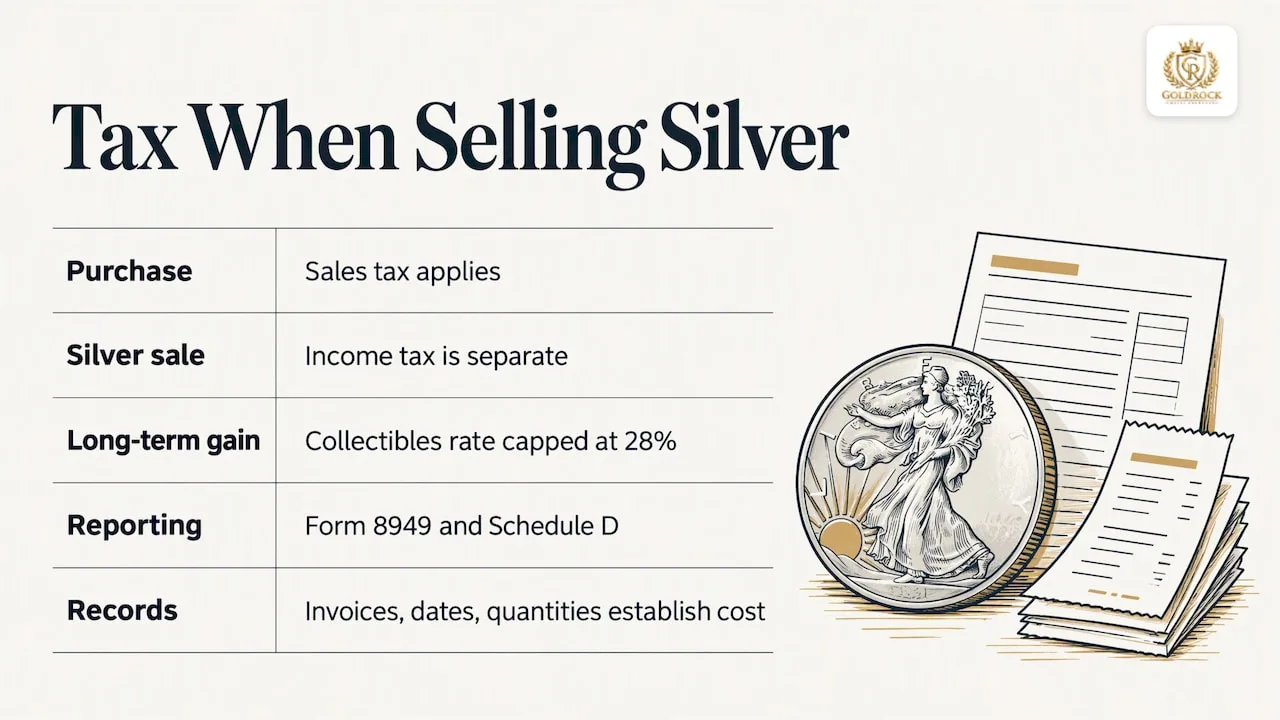
Sales tax applies at purchase. When you sell, the question becomes income tax, and it is separate. Colorado’s guidance says expressly that its exemption does not eliminate possible federal or state income tax on capital gains realized when bullion or coins are sold.
Two points are widely discussed, and both are worth knowing as background.
Physical silver is generally a collectible for federal income-tax purposes. The AICPA’s Tax Adviser explains that physical precious metals are generally collectibles, so long-term gain can be subject to a maximum rate of 28%. That is a ceiling, not a flat rate, and your own rate depends on your circumstances. The same article notes that collectibles held inside an IRA follow separate rules. Holding period and the character of the gain matter more for physical silver than the usual stock framework might suggest, which is one reason to talk with a CPA before you sell. Our overview of the 28% collectibles rate for gold explains the same framework for another metal.
Gains and losses are reported on your return. IRS Publication 550 directs taxpayers to report gains or losses from sales of investment property using Form 8949 and Schedule D where applicable. Keeping purchase invoices, dates and quantities makes that reporting far easier, because your records establish what you paid.
Does the dealer report your sale to the IRS?
Often not, but that does not make a sale tax-free. The IRS instructions for Form 1099-B say a sale of precious metal, including silver, is generally not reportable on Form 1099-B unless the form and quantity meet a CFTC-approved regulated futures contract delivery requirement. Sales for one customer within a 24-hour period are aggregated when testing that exception, and the exception does not apply when the seller knows or has reason to believe sales are being structured to avoid reporting.
The absence of a form from a dealer does not change your own obligation to report a gain on your return. We lay out the recent reporting rules in our guide to bullion reporting rules for U.S. investors.
Silver inside a retirement account
Sales tax is a separate matter when silver is purchased through a self-directed IRA, because the account’s custodian arranges the purchase and the metal is held by an approved depository. IRA rules focus on eligibility, such as fineness and custody, and on the account’s own tax treatment. Investors often find that eligibility rules and state sales-tax rules look similar on the surface, since both lean on purity standards, but they come from different laws and serve different purposes.
If retirement savings are your goal, start with our overview of the Precious Metals IRA and the two Section 408(m) rules that affect which metals qualify. Our in-house IRA department handles the transfer paperwork and can explain the process step by step. It does not advise on your taxes, and a tax professional should confirm how a rollover affects you.
Delivery, storage and records
Once you know the sales-tax treatment, the remaining decisions are practical. Insured private delivery gets physical silver to your door without a long chain of handoffs, and we explain how it works on our private delivery page. If you would rather not keep metal at home, storage options are worth comparing on cost, access and insurance.
Whichever route you choose, keep a simple file for each purchase: invoice, date, product description, quantity, price paid and delivery confirmation. If you want a reference point for the metal’s value on the day you buy, our live prices page shows current figures.
Our perspective on silver and tax questions
Most buyers who ask us about tax are really asking two things: what will this order cost me today, and what will I owe later. We think the honest answer to both starts with the same habit, which is reading the rule yourself before you trust a summary. State guidance is specific, and the details that decide your result, such as fineness, invoice size and premium limits, are exactly the ones that get lost in a headline.
We also think tax should not be the reason you choose a metal or a product. Silver is bought for many reasons, including diversification and holding something tangible, and no tax rule changes the fact that prices move in both directions. We do not promise returns, tax benefits or safety, and we would be uneasy with any dealer who does.
What we can do is keep the buying process clear. We explain what you are buying, how it is invoiced, how it will be delivered and insured, and what records to keep. Our IRA team does the same for retirement accounts. For the tax question itself, we encourage you to speak with a CPA or a state revenue department.
— Blake
FAQ
Is there sales tax on silver bullion?
It depends on the state. Some states, such as Colorado and Indiana, exempt qualifying bullion and coins, while others, such as California and New York, tax it unless an exemption such as an invoice threshold applies. Check your state revenue department’s guidance before ordering.
Are silver coins taxed differently from silver bars?
Sometimes. New York, for example, uses a 140% price limit for coins and 115% for bars and ingots, and California separates coins sold as legal tender from coins sold as investments. Indiana’s exemption covers coins, bars and rounds that meet a 999 fineness standard.
Is silver taxed when I sell it?
Selling can create a taxable gain at the federal level and possibly in your state, even where the purchase was exempt from sales tax. Physical silver is generally treated as a collectible, so long-term gains can face a maximum federal rate of 28%. A CPA can tell you how this applies to you.
Will the dealer report my silver sale to the IRS?
Usually a silver sale is not reportable on Form 1099-B unless it meets specific futures-contract delivery requirements, and sales for one customer within 24 hours are aggregated for that test. Even without a form, you are still responsible for reporting any gain on your own return.
Educational disclaimer
This article is for general education only. It is not personalized investment, tax or legal advice, and it does not promise returns, appreciation, safety or tax benefits. Tax rules and state thresholds change, so confirm current requirements with your state revenue department and a qualified tax professional before you buy or sell.
Ready to talk it through?
If you would like to learn how buying physical silver works, from product selection to insured delivery or an IRA rollover, Request a Free Precious Metals Consultation or call GoldRock Metal Exchange at (888) 859-0978.
Sources
- Colorado Department of Revenue: Coins and Precious Metal Bullion
- Indiana Department of Revenue: Sales Tax Information Bulletin #50
- California CDTFA: Regulation 1599
- New York: 20 NYCRR § 528.29, Precious Metal Bullion
- Streamlined Sales and Use Tax Agreement
- IRS: Instructions for Form 1099-B
- IRS: Publication 550
- The Tax Adviser: The taxation of collectibles