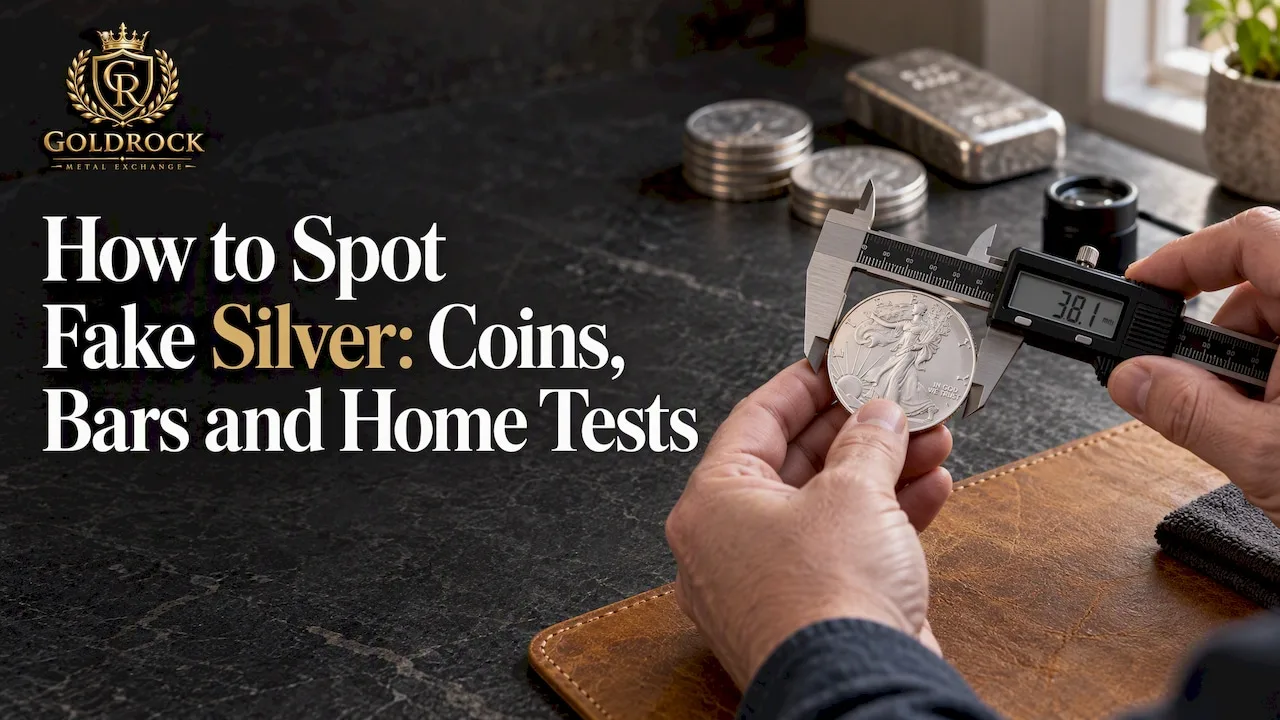
To spot fake silver, start with the numbers. Weigh the piece on an accurate scale, measure its diameter and thickness, and compare both to the official specifications. Then add a few simple checks: markings, a magnet, and the sound the piece makes when struck. No single home test proves a piece is genuine, so treat each one as a filter, not a verdict. When real money is involved, the most reliable protection is knowing exactly where your metal came from.
This guide walks through each check in the order we would use it, explains what each one can and cannot tell you, and covers the related question of platinum bars. It is educational only and is not investment, tax or legal advice.
TL;DR
- Weight and dimensions are your strongest home checks. A genuine 1-ounce American Eagle silver coin weighs 31.103 grams and measures 1.598 inches across.
- A magnet, a ping test and a visual inspection help, but relying on one test alone is the most common mistake.
- Jewelry rules differ from bullion rules: “sterling” or “925” means at least 92.5% silver, while bullion is usually marked .999.
- Overpriced real metal can cost you more than a fake. Ask for the spot price, the premium and all fees in writing.
- When in doubt, stop and get the piece tested by a professional using non-destructive methods before you buy, sell or accept delivery.
Table of Contents
- What “fake silver” actually means
- Know the standards before you test
- Seven checks, in the order we recommend
- Fake silver bars and coins: what changes with size
- A note on fake platinum bars
- The bigger risk: real metal at the wrong price
- Red flags in the sale itself
- Our perspective
- How GoldRock handles authenticity and delivery
- What to do when something looks wrong
- Frequently asked questions
- Sources
What “fake silver” actually means
The word covers several different problems, and the right test depends on which one you are facing.
Counterfeit bullion. A copy of a recognized coin or bar made from a cheaper metal, sometimes plated with a thin silver layer. These are designed to fool buyers at first glance.
Silver-plated or silver-colored items. Real objects with a thin coat of silver over a base metal, or items that never contained silver. The FTC explains that silver plate carries only a thin layer of silver, and German or nickel silver contains no silver at all.
Replicas and copies. Items sold openly as souvenirs or reproductions that later get passed along as the real thing. The U.S. Mint publishes guidance on telling genuine U.S. coins from replicas for exactly this reason.
Genuine silver sold the wrong way. A real coin sold at a collector markup you were never told about. This is not a fake, but it can hurt just as much, and we cover it below.
Know the standards before you test
You cannot spot a fake without knowing what real looks like. Silver comes in a few common grades.
| Type | Silver content | Where you see it |
|---|---|---|
| Investment bullion | Typically .999 (99.9%) | Bars, rounds, American Eagles |
| Sterling | At least 92.5% | Jewelry, flatware, marked “925” |
| Coin silver | 90% | Older U.S. coins, some flatware |
| Silver plate | A thin surface layer only | Decorative and household items |
| German or nickel silver | None | Copper, zinc and nickel alloy |
The sterling, coin silver and German silver figures come from the FTC’s jewelry guidance. The bullion fineness of an official coin is printed on the coin itself, so read it first.
If you are weighing coins against bars for retirement purposes, our guide to investing in coins for retirement explains why the type of coin matters for an IRA.
Seven checks, in the order we recommend
1. Read the markings and look closely
Start with your eyes, ideally with a magnifier and good light. A genuine bullion coin shows the issuing country, the weight, the metal and the fineness. Bars normally carry a refiner’s mark, the weight, the purity and often a serial number.
Look for:
- Blurry or soft lettering, uneven rims, or details that look cast instead of struck.
- Fonts that differ from images of the genuine item on the issuer’s website.
- Edges with seams or tool marks where the coin should be cleanly reeded.
- Wear that looks painted on, or bright flaking where plating has peeled.
Compare your piece with official photos. The U.S. Mint’s pages for the American Eagle silver proof coin show the design and the mint mark placement for that product.
2. Weigh it on an accurate scale
A kitchen scale is not enough. Use a scale that reads to at least 0.01 grams. Silver is dense, so a counterfeit made from a lighter base metal is often noticeably light, and a counterfeiter who matches the weight often has to compromise on size.
The benchmark for the most popular coin is clear. The U.S. Mint states that a genuine 1-ounce American Eagle silver coin has a diameter of 1.598 inches (40.60 mm) and weighs 31.103 grams. Even a small deviation is a red flag. Keep in mind that circulated coins can lose a little weight to wear, so a tiny shortfall on a very old coin is different from a coin that is clearly off.
3. Measure diameter and thickness
Use digital calipers. This pairs well with the weight check because a fake has to get both right. If the weight is perfect but the diameter is off, the piece fails. A counterfeit made from a different metal at the correct diameter will usually be too thick or too thin for its weight.
Write the figures down and compare them with the issuer’s published specifications, not with a listing from a seller.
4. Try a magnet
Silver is not magnetic. Jewelers Mutual lists the magnet test among its home checks for silver: if a strong magnet grabs the piece, it is not solid silver.
The catch is what the test cannot do. A piece can fail to react to a magnet and still be fake, because many non-magnetic metals and alloys exist. Passing the magnet test only means the piece is not an iron or steel fake.
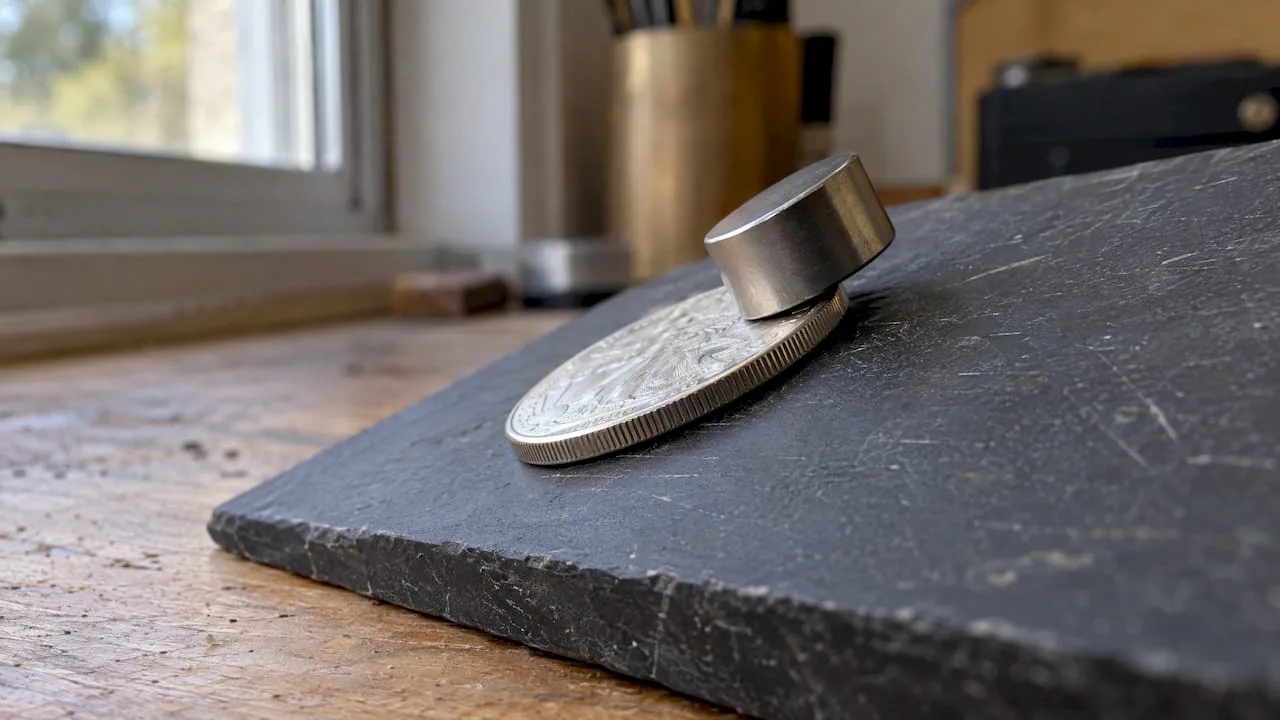
A useful variation is the slide test. Tilt a coin at a shallow angle and set a strong magnet on it. A genuine silver coin slides slowly, because moving magnets induce small currents in a conductive metal like silver, which creates drag. A coin that sticks or slides freely deserves a second look. Treat this as another filter, not proof.
5. Listen to it
Many people strike a silver coin lightly and listen. Genuine silver coins tend to ring with a clear, sustained tone, and many fakes sound dull or short. The sound varies with the coin’s thickness, wear and how you hold it, so compare against a coin you know is genuine of the same type.
Be gentle. Do not drop coins on hard surfaces or tap bars with metal tools. You can dent the piece or damage a coin’s surface, and damage reduces what a buyer will pay for it.
6. Check the finish and the feel
Genuine silver tarnishes, usually toward gray or black, and the tarnish wipes away with a soft polishing cloth. Plated items can show a different color underneath where the surface has worn through, often at edges and high points. Avoid scratching the piece to look underneath. A scratch can destroy value on a genuine one.
We would also avoid acid kits and file tests on anything you plan to hold as an investment. They damage the surface, and the damage can lower resale value.
7. Know when to stop and get it tested
Home tests screen out obvious fakes. They do not certify real ones. Jewelers Mutual notes that no single home test is a guarantee. Professionals use non-destructive methods such as X-ray fluorescence (XRF) analysis, which reads the metal’s composition without harming it, and specific gravity testing, which compares weight to volume. If the piece is valuable, or if two checks disagree, take it to a qualified tester before you buy, sell or insure it.
Fake silver bars and coins: what changes with size
Bars are harder to check at home than coins. A coin has a published design and tight specifications. A bar has a refiner’s stamp, a weight and sometimes a serial number, and a convincing counterfeit copies all of that.
For bars, we suggest:
- Check the serial number and stamp against what the refiner or issuer says is genuine.
- Weigh and measure the bar and compare it with the published specification for that exact product.
- Examine any sealed packaging. Broken or resealed packaging on a bar that is supposed to be sealed is a reason to pause.
- Ask for paperwork that traces the item back to a mint or refiner.
Industry guidance from refiners makes the same point: counterfeiters are getting more sophisticated, so traceable, serialized items from verified sources are the definitive protection. For the gold equivalent of this checklist, see our article on verifying gold bars before you buy, sell or accept delivery. Much of it applies to silver as well.
A note on fake platinum bars
Readers also ask how to authenticate platinum bars. The logic is the same: platinum is dense, expensive and widely imitated with cheaper metals, so weight and dimension checks matter even more, and so does provenance. A bar that is the right size but the wrong weight is a warning sign. Because platinum is far harder to test at home than silver, we would not rely on household tests for it. Buy from a source that documents where each bar came from, and get professional testing if anything feels off.
If you plan to hold platinum in a retirement account, purity and form also matter for eligibility. Our guides on the 99.95% rule for platinum in a U.S. IRA and U.S. Platinum IRA rules and setup go through the details.
The bigger risk: real metal at the wrong price
Most people searching for fake silver worry about counterfeits. Regulators point to a more common loss: paying far too much for genuine metal.
The CFTC advises that bullion should be priced at the spot price plus a modest premium, typically 5% to 10%, while some sellers push “numismatic” or collectible coins with premiums that can run from 40% to 200%. The same advisory recommends asking for the spot price and the retail offer in writing, and confirming the dealer’s buy-back price before you commit.
The CFTC has also described schemes that use financing, where customers put down only a fraction of the price and are then charged interest and storage fees. In its announcement of enforcement actions, it reported more than $500 million in illegal sales by fraudulent precious metals firms over a decade. And in a separate advisory about retirement savings, it warned that collectible coins are often hard to resell except back to the dealer at a fraction of the price paid, and that only certain bullion coins can be held in an IRA.
To understand the pricing pieces, read our explainers on what silver premium means and on how spot price works when buying physical metals. If you are unsure whether a coin is a bullion or collector item, our piece on proof versus bullion coins helps.
Red flags in the sale itself
A fake rarely arrives alone. It usually comes with a sales process that discourages checking. Watch for:
- Promises of guaranteed returns, or claims that a purchase is safe or carries little risk. Consumer guidance on predatory schemes lists these among the hallmarks of a bad deal.
- Pressure to act today or to keep the deal confidential.
- A refusal to put the price, the spot price and all fees in writing.
- Unclear or missing buy-back terms.
- Payment methods that cannot be traced or reversed.
- Items with no serial numbers, no refiner or mint identification and no paperwork.
The CFTC notes that retail metal dealers are not regulated at the federal level and suggests checking with consumer organizations and your state attorney general. Our article on choosing a gold dealer lists criteria you can apply to any seller, and the one on types of precious metal advisors explains how to judge who is advising you.
Our perspective
We talk with buyers who are nervous about being fooled, and we think the nervousness is healthy. But we also see people put all their effort into a ping test and none into the questions that matter more: where did this metal come from, what exactly am I paying over spot, and what happens when I want to sell?
Our view is simple. Authenticity is mostly decided before the metal reaches your hands. Buying products from recognized mints and refiners, getting the price and fees in writing, and receiving the order through a tracked, insured channel removes most of the risk that home testing tries to catch afterward. Home tests are still worth knowing, because they help you check what arrives and spot an obvious problem fast.
We also believe a retirement account should never be a place for guesswork. Because an IRA holds metal through a custodian and an approved depository, eligibility and form are as important as authenticity. That is why we run a dedicated in-house IRA department, so you can ask questions before you move anything.
— Blake
How GoldRock handles authenticity and delivery
We sell physical gold, silver, platinum and palladium, and we offer insured private delivery for orders. Our team provides personal guidance before you buy, and our in-house IRA department helps with self-directed Precious Metals IRA setup and rollovers. You can browse our silver products, look at our Precious Metals IRA service, or read how private delivery works. Prices change with the market, so we give them to you directly when you ask.
Request a Free Precious Metals Consultation or call (888) 859-0978.
What to do when something looks wrong
- Stop. Do not send more money, sign anything or accept further delivery until you understand the problem.
- Document it. Photograph the item, the packaging, the invoice and any messages. Record the weight and dimensions.
- Compare with official specifications. Use the issuer’s own published figures.
- Get a non-destructive test. A qualified tester using XRF or specific gravity can give a clearer answer than any household method.
- Contact the seller in writing and ask for their return policy and a written response.
- Report it if you believe fraud occurred. The CFTC advises checking with your state attorney general and consumer organizations. If you used a card, ask the issuer about your dispute options.
If you are deciding whether to sell metal you already hold, our guide to selling gold safely and comparing quotes after fees covers the process, and the same questions apply to silver. For where to keep metal once you have verified it, see our overview of precious metal storage options.
Frequently asked questions
Can I test silver at home without damaging it?
Yes. Weighing, measuring, a magnet check, a visual inspection and a gentle sound test do not harm a piece. Avoid acid, filing and scratching on anything you hold as an investment. None of these checks proves authenticity, so use them to screen, and use a professional for anything valuable.
Is a magnet enough to prove silver is real?
No. Silver is not magnetic, so a magnetic piece is not solid silver. But many non-magnetic metals exist, so a piece that ignores the magnet can still be fake. Combine the magnet with weight, size and marking checks.
What does .999 or 925 mean on silver?
The number is fineness, in parts per thousand. .999 means 99.9% pure, common on investment bullion. 925 means at least 92.5% silver and is the sterling standard the FTC describes for jewelry and flatware.
Is a silver dollar without a mint mark fake?
Not necessarily. Mint marks depend on the coin’s series and year, and some genuine coins do not carry one. Check the specific coin’s design details and specifications against the issuing mint’s own information, and get a second opinion if the weight or dimensions are off.
How can I avoid buying fake silver in the first place?
Buy from sellers who document the source of the metal, provide serial numbers where applicable, and put the spot price, premium and fees in writing. Confirm buy-back terms, and be wary of pressure or guarantees. Our team can answer questions at (888) 859-0978.
Request a Free Precious Metals Consultation: talk with GoldRock Metal Exchange about silver, private delivery or a self-directed Precious Metals IRA.
Educational disclaimer: This article is for general education only. It is not investment, tax or legal advice, and it does not promise any return, safety or appreciation. Precious metals prices can fall as well as rise. Speak with a qualified professional about your own situation before you buy or move retirement funds.
Sources
- Identifying Genuine U.S. Coins, U.S. Mint
- American Eagle Silver Proof Coin, U.S. Mint
- Buying Platinum, Gold, and Silver Jewelry, FTC
- Customer Advisory: 10 Things to Ask Before Buying Physical Gold, Silver, or Other Metals, CFTC
- CFTC press release 8881-24
- Customer Advisory: Beware of Gold and Silver Schemes Designed to Drain Your Retirement Savings, CFTC
- How to Tell if Silver Jewelry is Fake, Jewelers Mutual
- Johnson Matthey