24K gold is essentially pure gold, about 99.9% by Aditya Birla Capital’s purity breakdown. 22K gold is about 91.67% gold, with the rest made up of other metals such as copper, silver or zinc. The extra alloy makes 22K harder and more resistant to wear. For jewelry, that often decides the question. For investors buying bullion, the better question is which product is eligible for your goal, what you pay over spot, and how you will store it.
This guide explains the difference in plain terms, then covers what it means if you buy physical gold or hold it in a self-directed IRA. It is educational, not personal advice.
TL;DR
- 24K is about 99.9% gold. 22K is about 91.67% gold, with alloy metals added for hardness.
- Higher purity does not automatically mean a better purchase. Premium over spot, liquidity and eligibility matter as much.
- The American Gold Eagle is a 22-karat coin that federal code explicitly permits in self-directed IRAs. Other gold products must meet fineness rules.
- Metals held in an IRA must sit with an IRS-approved third-party depository, not in a home safe.
- Confirm any rollover rules with your plan administrator and a qualified professional before moving funds.
Table of Contents
- What the karat number means
- The practical differences
- Why 22K is not “worse” for coins
- What this means for a Precious Metals IRA
- Premiums matter more than the karat
- A simple way to decide
- Our perspective
- Request a Free Precious Metals Consultation
- Moving retirement money into gold
- Buying physical gold outside an IRA
- FAQ
- Sources
What the karat number means
Karat measures how many parts out of 24 are gold. The U.S. Geological Survey explains that 24 karat is pure gold, while 12K is half gold and half copper or other metals. So 22K means 22 parts gold and 2 parts other metal.
Many bullion products also carry a fineness number, which is parts per thousand. The two scales line up like this:
| Karat | Gold content | Fineness mark | Typical use |
|---|---|---|---|
| 24K | About 99.9% | 999 | Bullion bars and coins, investment metal |
| 22K | About 91.67% | 916 | Daily-wear ornaments, some bullion coins |
The 22K figures come from the same Aditya Birla Capital guide, which also notes that 22K gets its durability from added alloy metals.
The practical differences
Durability
Pure gold is soft. Alloying it makes it harder, which is why 22K holds up better to scratching and bending. That matters for something worn every day. It matters much less for a sealed bar or a coin kept in protective packaging.
Appearance
24K has a deeper, brighter yellow tone. 22K looks slightly different because of the other metals in it, and the tone varies with the alloy mix.
Price per ounce of gold
A 24K item contains more gold per gram, so it costs more per gram than a 22K item of the same weight. That comparison alone can mislead you. A 22K coin and a 24K coin can both be priced on their actual gold content, and the cost above that content is where the real differences show up.
Why 22K is not “worse” for coins
It is a common assumption that a lower karat means a lower-quality investment. Bullion coins show why that is not so.
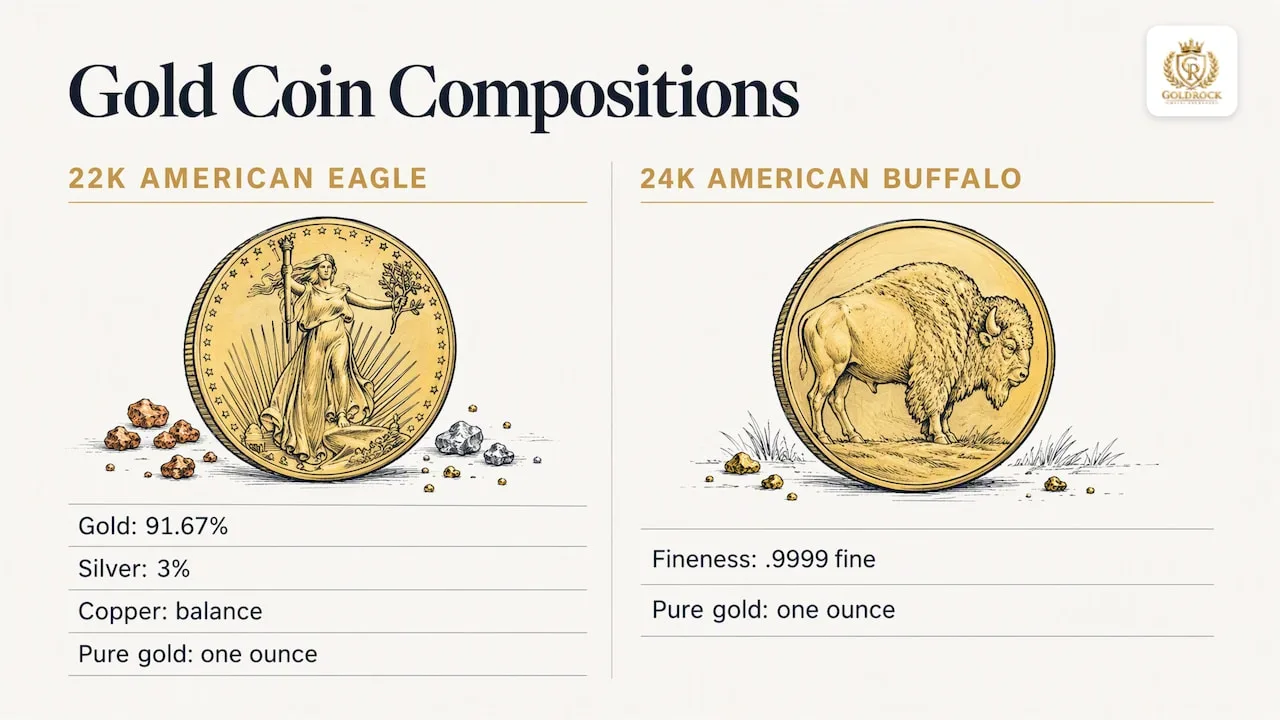
The U.S. Mint’s American Eagle gold bullion coins are 22-karat gold with small amounts of alloy, which the Mint says makes harder coins that resist scratching. The coins contain their stated weight in pure gold. According to the Mint’s specifications, the composition is 91.67% gold, 3% silver and the balance copper.
On the other side, the Mint also strikes 24-karat coins. Its American Buffalo gold coin is .9999 fine 24-karat gold, according to the Mint’s product page for the proof version.
So the same national mint makes both. A 22K Eagle holds one ounce of gold. A 24K Buffalo holds one ounce of gold. They differ in how much alloy shares the coin, not in how much gold you own by weight.
What this means for a Precious Metals IRA
This is where 22K versus 24K stops being a jewelry question and becomes a rules question.
Gold held in a self-directed IRA has to meet fineness standards under Internal Revenue Code section 408(m)(3). American Gold Eagles are the notable case: they are 22K, yet they are explicitly permitted by statute. Other bullion must meet minimum fineness standards, so a lower karat product that is not a named exception can fail to qualify. The IRS document linked above is a private letter ruling that deals with IRA treatment of bullion, and it states that depositing a collectible in an IRA is treated as a distribution.
In short:
- A 22K product is not automatically ineligible, because the American Gold Eagle is the exception.
- A 24K product is not automatically eligible, because form, mint and custody also matter.
- Collectible or high-premium coins may not qualify at all, so eligibility should be verified independently before funds move.
For a deeper walk-through, see our pages on IRS rules for American Eagle IRAs and the two Section 408(m) rules. If you are checking whether you can fund an account at all, Gold IRA eligibility covers who qualifies.
Storage is a separate rule
Purity does not change where an IRA’s metal has to live. Reporting from USA Today notes that IRA metals must be held by an approved third-party depository, and that keeping them in a personal safe is generally treated as a distribution. That can carry consequences, so it is worth discussing with a qualified tax professional before you act.
Premiums matter more than the karat
When you compare a 22K coin to a 24K bar, the sticker price rarely tells the whole story. What you pay above the spot price of gold, the premium, and the gap between the dealer’s selling price and buy-back price, the spread, shape your real cost.
The CFTC’s customer advisory on gold and silver schemes says bullion premiums typically run 5% to 10% over spot, that spreads can reach 10% or more, and that markups on numismatic or proof coins can be far higher, from 40% to 200% over spot. The same advisory cautions that some dealers are commission-paid salespeople, not fiduciaries.
That gives you a practical checklist for either karat:
- Ask what the premium over spot is on the exact product, in writing.
- Ask for the buy-back price, also in writing, so you can see the spread.
- Favor standard bullion over collectible or proof versions unless you specifically want a collectible.
- Confirm IRA eligibility of the specific product before funding.
Our explainer on what a gold premium over spot means goes through the math. If you ever want to check what a collectible coin has actually sold for, a tool for sold-comp coin pricing can help you see real sales rather than guide figures.
A simple way to decide
Use your purpose to choose, not the karat number.
| Your goal | What usually matters most |
|---|---|
| Owning physical gold to hold | Premium over spot, buy-back terms, secure delivery |
| Funding a self-directed IRA | Fineness rules, named exceptions, approved depository |
| Wearing or gifting jewelry | Durability, look, craftsmanship |
| Collecting | Rarity, condition, and a clear understanding of the markup |
Neither 22K nor 24K promises appreciation or protection from losses. Gold prices move, and the CFTC warns about hype and urges investors to understand the underlying holdings, fees and storage before committing retirement capital.
Our perspective
We talk with buyers every week who start with this exact question, and it usually turns out to be a different one. They are not really asking which karat is better. They are asking which product fits their goal without a surprise later.

For most of them the answer starts with the purpose. If the metal is going into a retirement account, eligibility and custody come before everything else. If it is for personal ownership, premium, buy-back and delivery matter most. We would rather walk you through those points on a call than push a product, and our in-house IRA department handles the paperwork side so the process stays orderly.
We are also direct about limits. We do not promise returns, and we do not give tax or legal advice. We explain how the products and the rules work, point you to the IRS and the CFTC, and encourage you to check your situation with a qualified professional.
— Blake
Request a Free Precious Metals Consultation
Not sure whether a 22K Eagle, a 24K bar or another product suits your plan? Our team can explain the options, the premiums and the IRA rules in plain language, with no pressure. Request a Free Precious Metals Consultation or call (888) 859-0978.
Moving retirement money into gold
Many readers asking about karat are also asking how to fund gold from a 401(k) or IRA. The mechanics matter more than the metal here.
The IRS rollover guidance describes two routes: you can redeposit a distribution within 60 days, or have your financial institution or plan transfer the payment directly to another plan or IRA. Missing the 60-day window can leave the amount subject to income tax and, in some cases, additional tax. A direct trustee-to-trustee transfer avoids that deadline, which is why it is commonly used.
Some things to settle first:
- In-service rollovers. If you still work for the employer sponsoring your 401(k), your plan may or may not permit moving funds out. Ask your plan administrator.
- Roth accounts. A Roth 401(k) has its own rules. Confirm the treatment with your plan administrator and a tax professional.
- Direct-to-metal purchases. USA Today notes that you cannot move 401(k) money into physical gold that you hold yourself without risking taxes and penalties.
Our pages on gold IRA rules, moving a 401(k) to gold and 60-day rollovers cover these steps in more detail. When you are ready, you can open a precious metals IRA with our in-house IRA department.
Buying physical gold outside an IRA
If you want metal in your own hands, product choice and delivery become the focus. You can browse our gold, silver, platinum and palladium categories. We offer insured private delivery, and you can read how it works in our guide to private metals delivery.
A few habits protect you, whatever karat you choose:
- Keep a record of product, weight, fineness and the premium paid.
- Confirm in writing how the order will be delivered and insured.
- Decide in advance where you will store the metal.
FAQ
Is 22K gold worth buying?
It can be, depending on the purpose. For jewelry, its durability is a real advantage. For investment, 22K bullion coins such as the American Gold Eagle contain their stated weight in gold, so judge them on premium, buy-back terms and your goals. This is general education, not personal advice.
Is 24K gold the same as 999 gold?
Close. 24K means pure gold, and 999 fineness means 99.9% gold. Some bullion is marked even finer, such as .9999. The marks tell you the gold content of the product.
What is the disadvantage of 24K gold?
It is soft, so it scratches and bends more easily than alloyed gold, which makes it less practical for daily-wear jewelry. For sealed bullion, softness matters less. It also does not guarantee a lower premium or IRA eligibility.
Can I put 22K gold in an IRA?
The American Gold Eagle is a 22K coin that federal code explicitly permits in self-directed IRAs. Other 22K products may not qualify, so verify eligibility before funding. Our team can walk you through the product list.
Can I move my 401(k) to gold while I still work?
That depends on whether your plan allows in-service rollovers. Ask your plan administrator, and talk to a qualified tax professional about your situation.
Educational disclaimer: This article is for general education only. It is not investment, tax or legal advice, and it does not promise returns, safety, tax benefits or price appreciation. Precious metals prices can fall as well as rise. Consult a qualified professional about your own circumstances.
Sources
- Aditya Birla Capital: 22K vs 24K gold
- U.S. Geological Survey: karat marks on gold
- U.S. Mint: American Eagle gold bullion coins
- U.S. Mint: American Buffalo gold proof coin
- IRS: bullion IRA ruling
- USA Today: rolling over a 401(k) into a gold IRA
- CFTC: gold and silver schemes advisory
- CFTC: understand risks before reacting to internet hype
- IRS: rollovers of retirement plan and IRA distributions