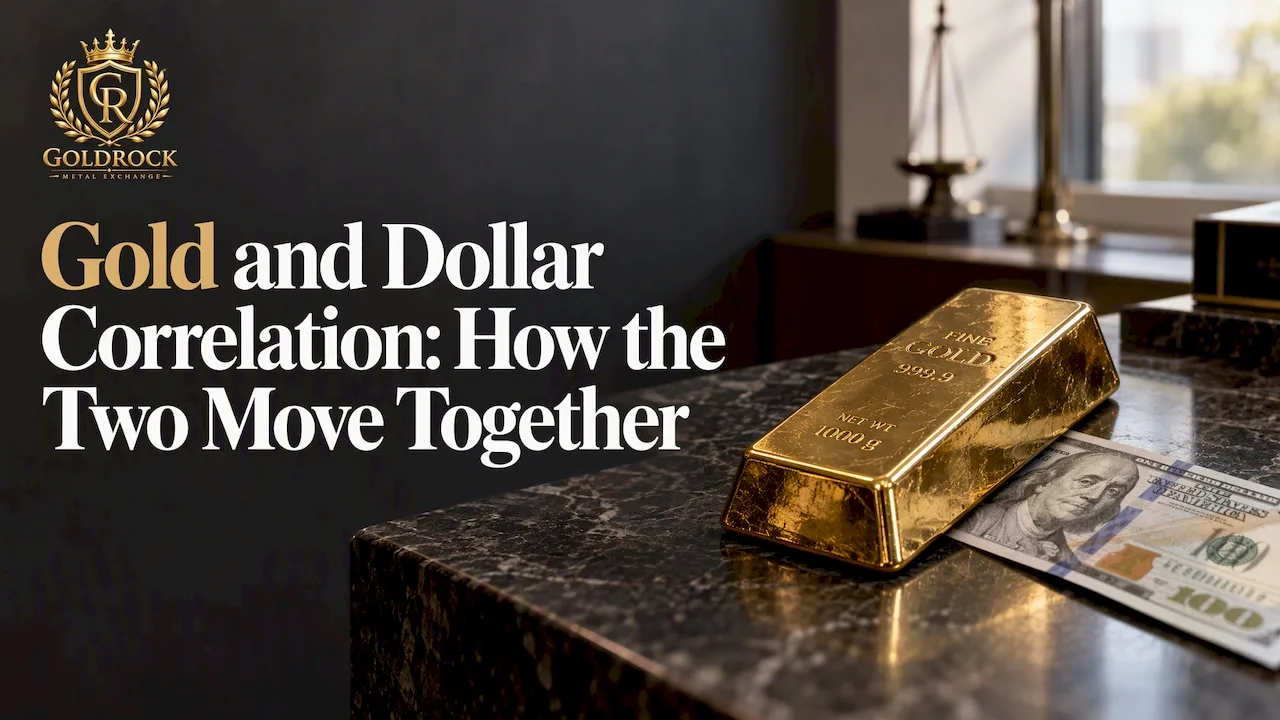
Gold and the U.S. dollar have tended to move in opposite directions: when the dollar strengthens, gold often softens, and when the dollar weakens, gold often firms. The link is a tendency, not a rule. Safe-haven demand, geopolitical tension and interest rates can push both the same way, and real interest rates often explain more of gold’s moves than the dollar does.
This guide explains why the inverse pattern exists, when it fails, how real yields and inflation fit in, and what it means for someone who holds or is considering physical metals. It is educational and does not predict where gold or the dollar will go.
TL;DR
- Gold is priced in U.S. dollars worldwide, so a stronger dollar tends to make it costlier for foreign buyers and a weaker dollar cheaper. That is the core of the usual inverse link.
- The link breaks at times. Crises, central bank buying and geopolitical stress can lift gold and the dollar together.
- Real interest rates are a major driver. The Chicago Fed found a strong inverse relationship between long-term real rates and gold.
- Inflation and gold do not move in lockstep. The relationship has changed from decade to decade.
- Treat correlation as one input among several, not a trading signal. Physical metals are a long-term holding decision.
Table of Contents
- Why gold and the dollar often move in opposite directions
- What the dollar index (DXY) measures
- How strong is the correlation, really?
- When gold and the dollar rise together
- Real interest rates and gold
- Does gold track inflation?
- Putting it together: a simple checklist
- What this means for physical gold, silver, platinum and palladium
- Our perspective
- Explore physical metals with GoldRock
- How to approach a metals decision when the dollar is in the headlines
- FAQ
- Educational disclaimer
- Sources
Why gold and the dollar often move in opposite directions
The simplest explanation is pricing. Gold trades globally in U.S. dollars. When the dollar rises against the euro, yen or pound, a buyer who earns those currencies needs more of them to buy the same ounce. That can reduce demand and put downward pressure on the dollar price. When the dollar falls, the reverse can happen: gold becomes cheaper for foreign buyers, which can support demand. This is the explanation given in a 2026 overview of the gold and dollar relationship.
There is a second layer. Both assets are often treated as stores of value. When confidence in the dollar’s purchasing power weakens, some investors look to a tangible asset with no issuer behind it. When confidence is high and dollar yields look attractive, the case for holding a non-yielding metal can feel weaker.
Neither effect is guaranteed. They are tendencies that show up on average over long periods, and they can be swamped by other forces in any given month.
What the dollar index (DXY) measures
When people discuss gold against the dollar, they usually mean the U.S. Dollar Index, or DXY. It tracks the dollar against a basket of six major foreign currencies, with the euro the largest weight by a wide margin. That makes it a measure of the dollar against other developed-market currencies, not against every currency in the world.
The composition matters for interpretation. Because the euro dominates the index, a large part of any DXY move reflects the euro and the dollar. For a closer look at how that pairing reacts to Federal Reserve expectations, this EUR/USD analysis of market and Fed sentiment shows how the currency side of the equation can shift.
A trade-weighted dollar index published by the Federal Reserve is a broader alternative, covering more trading partners. Charts that overlay gold with either index tend to show the same general picture: a loose inverse relationship that tightens and loosens over time.
How strong is the correlation, really?
The common shorthand is “inverse,” and that is a fair starting point. But the strength is not fixed. Some analyses of gold against DXY describe it as strong but imperfect, and academic work has found evidence of a short-run positive correlation between gold and the dollar under extreme market conditions, meaning they can rise together when markets are stressed.
A practical way to read the number:
| What you see | What it usually means |
|---|---|
| Dollar up, gold down | The textbook pattern, often with rising real yields behind it |
| Dollar down, gold up | Weaker dollar plus lower real rates or rising inflation worries |
| Both up | Safe-haven demand across assets, or a gold-specific driver such as official-sector buying |
| Both down | Broad selling, often a liquidity squeeze |
Because the relationship is a statistical average, a single week or month tells you very little. Longer windows give a more reliable picture, and even then the correlation drifts.
When gold and the dollar rise together
Several situations have broken the pattern.
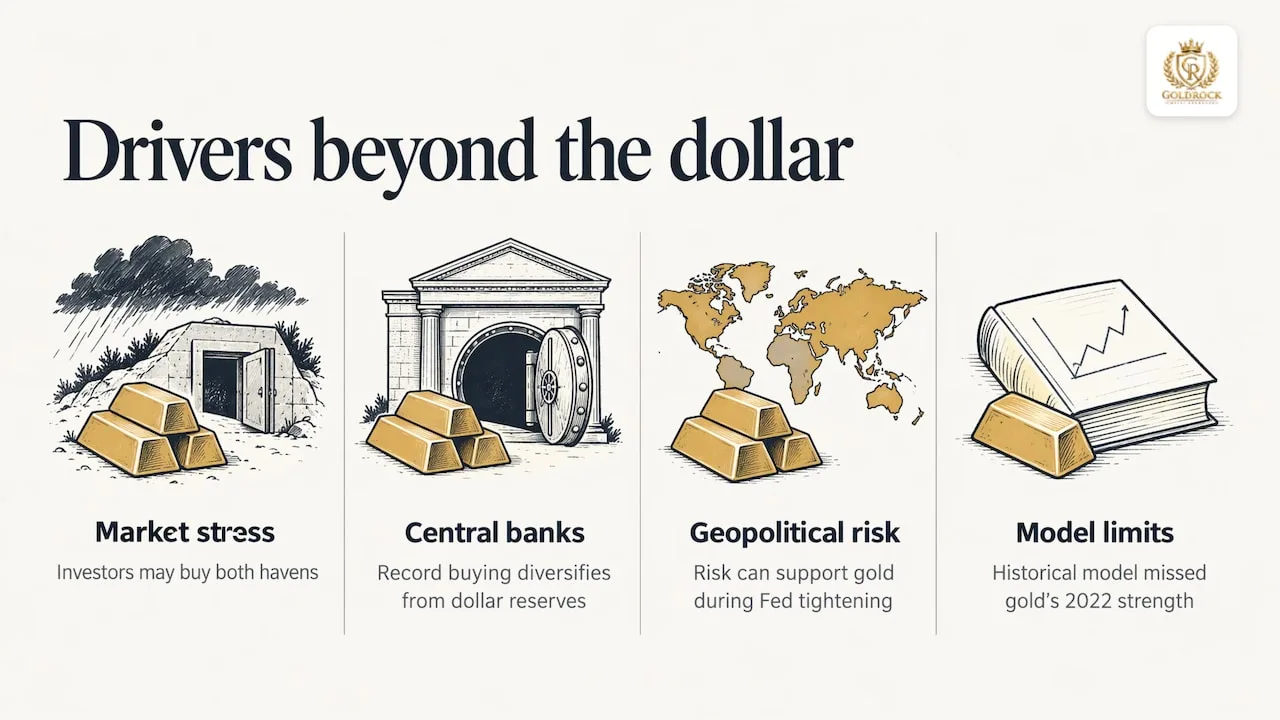
Acute market stress. In a sharp risk-off event, investors may buy both the dollar and gold as havens. The early weeks of the 2020 pandemic panic are often cited as an example of both moving up at once.
Central bank diversification. CME Group notes that record central bank gold buying, aimed at diversifying away from dollar reserves, has supported prices even in strong-dollar periods. Official-sector demand does not respond to the dollar the way a foreign jewelry buyer might.
Geopolitical risk. The Banque de France observes that gold can appreciate during Federal Reserve tightening cycles when geopolitical risks support demand despite higher real rates.
Models that stop working. Invesco’s 2023 analysis says gold’s correlation with inflation expectations was inconsistent over time and that its historical model did not explain gold’s strength in 2022.
The lesson is not that the relationship is useless. It is that the dollar is one driver among several, and the weights on each driver change.
Real interest rates and gold
If you want one variable that has often explained more than the dollar, look at real interest rates: the yield on inflation-protected Treasuries, or nominal yields minus expected inflation. Gold pays no interest, so when real yields rise, holding it costs more in forgone income. When real yields fall or turn negative, that opportunity cost shrinks.
The Federal Reserve Bank of Chicago expected a strong inverse relationship between long-term real rates and gold. In its empirical work, a one percentage point rise in the long-term real rate was associated with a 13.1% lower real gold price. That is a historical estimate from one study and period, not a forecast.
The dollar and real yields are linked. Higher U.S. real yields tend to attract foreign capital, which can lift the dollar. So the dollar’s inverse relationship with gold is partly the real-rate relationship seen from another angle. Chicago Fed researchers also found that pessimism about future economic activity has supported gold and, since 2001, has been a dominant factor alongside long-term real rates.
Does gold track inflation?
Gold is widely described as an inflation hedge, but the record is mixed. The Banque de France reports that gold’s correlation with inflation was sometimes positive from the mid-1970s through the 1980s, yet nil or negative in the 1990s and 2000s. It also notes that higher real rates raise gold’s opportunity cost.
The Chicago Fed adds that long-term inflation expectations in the U.S. have stayed relatively stable near 2% since 2000, which helps explain why real rates, not headline inflation, have often dominated gold’s behavior in that period.
So a fair summary is this: inflation can matter, especially when it surprises and pushes real rates down, but gold has not reliably moved one-for-one with consumer prices. Anyone describing gold as a guaranteed inflation shield is going further than the evidence does.
Putting it together: a simple checklist
If you follow gold, a few questions give a more balanced read than the dollar alone:
- Which way is the dollar moving, and why? A dollar rally driven by rising real yields has different implications from one driven by a flight to safety.
- What are real yields doing? Check inflation-protected Treasury yields alongside DXY.
- Is there stress in markets? Haven flows can lift both gold and the dollar.
- Is official-sector buying in the news? Central bank demand can offset dollar strength.
- What is your time horizon? Short-term correlations are noisy. Long-term holders usually care about the role metal plays in a portfolio.
No checklist predicts prices. It helps you understand why a move happened after the fact and avoid leaning on a single chart.
What this means for physical gold, silver, platinum and palladium
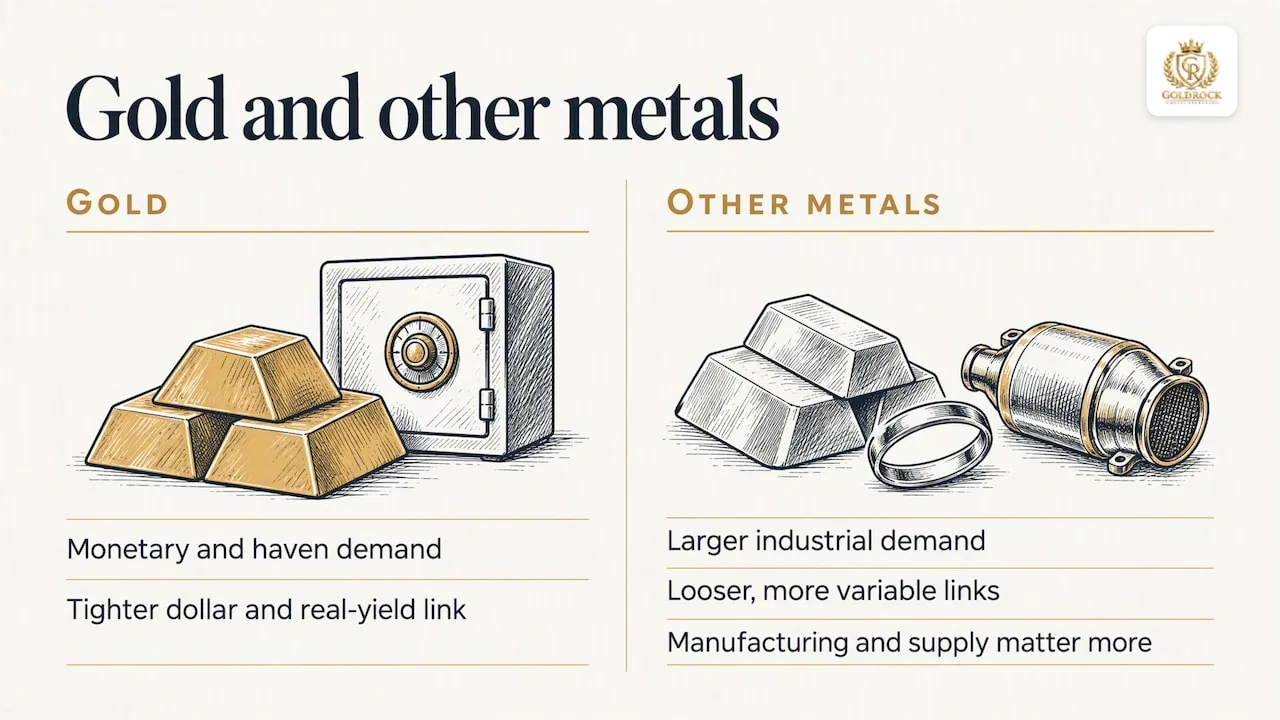
The gold and dollar correlation is mostly about the gold price. Other metals behave differently. Silver, platinum and palladium are also priced in dollars, so the currency effect is present, but they have larger industrial demand components. Their prices respond more to manufacturing and supply conditions, so their link to the dollar and to real yields can be looser or more variable than gold’s.
For an investor, that makes the metals different tools. Gold is the one most associated with monetary and haven demand. Others carry more economic sensitivity. Choosing among them is a decision about your goals, time horizon and tolerance for price swings, not a bet on the dollar.
It also helps to separate the price of the metal from the way you own it. You can hold physical metal directly, with insured private delivery, or inside a self-directed IRA where the metal is held by a custodian. Each route has its own rules, costs and paperwork, and the right fit depends on your circumstances.
Our perspective
Clients often ask us whether they should wait for the dollar to weaken before buying metals. We understand the instinct, but we think it puts too much weight on one chart. The relationship between gold and the dollar is real, yet the research shows it shifts with real rates, central bank demand and market stress.
What we focus on instead is why someone wants metals at all: diversification, a tangible asset, a hedge against market volatility. Those goals do not depend on guessing the next move in an index. They depend on understanding what you own, how it is held and how it is delivered.
That is why we pair every conversation with personal guidance. Our dedicated in-house IRA department helps people who want to move retirement funds into physical gold, silver, platinum or palladium, and we offer insured private delivery for metals bought outright. We never pay for endorsements, and we would rather explain the market plainly than promise an outcome.
Blake
Explore physical metals with GoldRock
If you are weighing physical metals as a way to diversify, we can walk you through the options. Browse our gold, silver, platinum and palladium categories, or learn how a Precious Metals IRA works with our in-house IRA department.
Metals bought outright can arrive through our insured private delivery service. To talk it through, call (888) 859-0978 or Request a Free Precious Metals Consultation.
How to approach a metals decision when the dollar is in the headlines
Headlines about a falling or surging dollar can create urgency. A calmer process tends to serve people better.
- Define the purpose. Are you diversifying a retirement account, holding a tangible asset, or both? The purpose shapes the metal, the form and the ownership method.
- Decide how you want to hold it. Direct ownership with insured delivery and a self-directed IRA are different structures with different rules. Ask about custody, storage, fees and eligible products for each.
- Think in allocations, not timing. Many investors who add metals do so gradually rather than in a single purchase. Whether that suits you is a question for your own advisor.
- Understand the costs. Dealers charge a premium over the spot price, and IRAs involve account-related fees. Ask for every cost in writing before you commit.
- Get qualified advice. For questions about your own finances, taxes or legal position, speak with a licensed financial professional, a tax professional or an attorney.
The CFTC and SEC both publish investor education on commodities and retirement investing, and they are worth reading before any purchase. Neither a dollar chart nor a correlation figure substitutes for understanding your own situation.
FAQ
What is the relationship between gold and the dollar?
Gold and the dollar have tended to move in opposite directions. Because gold is priced in dollars, a stronger dollar can make it more expensive for foreign buyers and weigh on demand, while a weaker dollar can have the opposite effect. It is a tendency rather than a fixed rule.
Does gold go up when the dollar goes down?
Often, but not always. A weaker dollar can support gold by making it cheaper for buyers using other currencies, yet real interest rates, geopolitical events and central bank buying can push gold in a different direction. Looking at several factors together gives a more accurate picture.
What happens to gold when the dollar is strong?
Gold can face downward pressure, since it becomes more expensive in other currencies. There have been periods when gold held up or rose despite a strong dollar, including when official-sector buying and geopolitical risk supported demand.
Do real interest rates matter more than the dollar for gold?
For long stretches they have. The Chicago Fed found a strong inverse relationship between long-term real rates and gold, because higher real yields raise the opportunity cost of holding a metal that pays no interest. The dollar and real yields are also connected, so the two often move together.
Does gold track inflation?
Not consistently. Official research shows gold’s correlation with inflation was sometimes positive in the 1970s and 1980s but nil or negative in the 1990s and 2000s. Real rates and economic sentiment have often mattered more.
Educational disclaimer
This article is for educational purposes only. It is not investment, tax or legal advice, and it does not recommend any specific purchase for your situation. Precious metals prices can rise or fall, and past relationships between gold, the dollar, real rates and inflation do not guarantee future results. GoldRock Metal Exchange does not promise returns, safety or appreciation. Consult a licensed professional about your own circumstances. To speak with our team, call (888) 859-0978 or Request a Free Precious Metals Consultation.
Sources
- Gold and the U.S. dollar: Why they often move in opposite directions
- Nonlinear dynamics of gold and the dollar
- What Drives Gold Prices? Federal Reserve Bank of Chicago
- How can we account for the increase in the price of gold? Banque de France
- Gold and the U.S. Dollar: An Evolving Relationship? CME Group
- Why is gold so expensive? Invesco
- EUR/USD analysis: market and Fed sentiment