
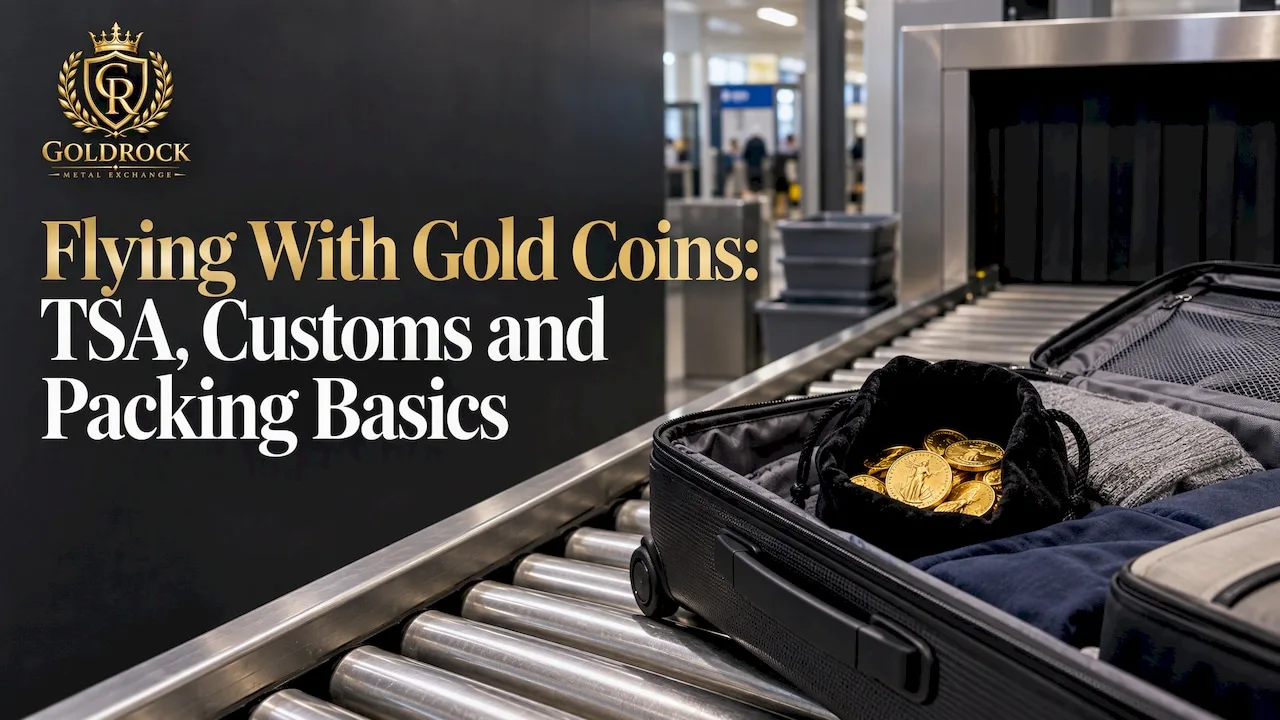
Yes, you can fly with gold coins. On a domestic U.S. flight, TSA’s published guidance on valuables allows them in carry-on and checked bags, and it advises keeping valuables with you in the cabin. Crossing a U.S. border is different: CBP says that if you carry more than $10,000 in currency or monetary instruments, which includes coins, you must report it. This guide covers how to pack, what happens at the checkpoint, when a report is due, and when shipping with insured delivery may be easier than carrying.
TL;DR
- Domestic flights: TSA has no value limit on coins in published guidance we found, and the officer at the checkpoint makes the final call on any item.
- Keep coins in your carry-on, not in a checked bag, and ask for a private screening if you want discretion.
- International trips: reporting on FinCEN Form 105 is required when you carry more than $10,000 in monetary instruments into or out of the U.S. That includes U.S. and foreign coins.
- Keep purchase records and a simple inventory. Rules and TSA procedures change, so confirm on the official pages before you travel.
- If you would rather not carry metal at all, ask us about insured private delivery.
Table of Contents
- Domestic flights: what the rules say
- Carry-on or checked bag?
- What happens at the security checkpoint
- Flying internationally with gold coins
- Records and security for the trip
- When shipping is easier than carrying
- Online or local dealer: what to check
- Our perspective
- Plan your purchase and delivery with us
- A simple pre-flight checklist
- FAQ
- Sources
Domestic flights: what the rules say
Within the United States, there is no customs step. You are moving between two U.S. points, so the border reporting rule does not apply. CBP’s guidance on money and monetary instruments ties the more-than-$10,000 reporting rule to entering or leaving the country, not to ordinary travel between U.S. points.
The security side belongs to TSA. TSA’s page on jewelry and valuables says jewelry is allowed in both carry-on and checked bags. It also advises travelers to keep valuable items with them rather than in checked baggage, and it notes that you may request private screening. The page carries a last-updated date of 2017, and it is written about jewelry rather than coins specifically. Coins are metal objects of the same kind as valuables, but the page does not name them. That is why the practical advice below leans on how TSA officers treat anything that needs a closer look.
Two points follow from that guidance:
- The officer at the checkpoint has the final say on whether an item can go through. Staying calm, polite and cooperative is the fastest route through.
- TSA’s own item-by-item database is the right place for a specific question. TSA’s March 2025 travel tips point travelers to the MyTSA “Can I Bring” tool and to AskTSA for item-specific questions.
Airlines add their own rules about declared value and liability for checked baggage. Those vary by carrier and by ticket, so read your airline’s baggage terms before you decide how much value to put in any bag.
Carry-on or checked bag?
Carry-on, in almost every case. TSA’s guidance is to keep valuable items with you at all times instead of in checked baggage. The reasoning is simple: a checked bag leaves your sight, passes through several hands and can be delayed or misrouted. A carry-on stays under your control from the curb to your seat.
A few practical habits help:
- Pack coins inside the carry-on, not in your pockets. TSA’s Travel Checklist tells passengers to empty their pockets before screening, and TSA’s 2025 travel tips say coins and other pocket items should go inside the carry-on rather than into a bin at the checkpoint. Loose coins in a gray bin are easy to lose and easy to attract attention.
- Keep the bag with you everywhere. That includes the restroom, the gate area and the plane. Do not leave it with a stranger, and do not put it in an overhead bin far from your seat if you can fit it under the seat in front of you.
- Use neutral luggage. A plain bag with a cheap-looking pouch inside draws less interest than a metal case with a conspicuous lock.
- Do not discuss contents in public. Not at the gate, not in the shuttle line, not on social media before you land.
Packing the coins themselves
Gold coins are dense. A handful is heavier than it looks, and a single ounce of gold in a coin is a small object that is easy to misplace. Keep them in their original protective capsules, flips or tubes so the surfaces are not scratched, then group them in a padded pouch. Place the pouch toward the middle of the bag, surrounded by clothing, not at the top where it is first to be seen when the bag is opened.
If you are carrying more than a few coins, a short written inventory helps in two ways: you can confirm nothing went missing at each leg of the trip, and you have a record that matches your purchase paperwork. Carry the inventory separately from the coins.
What happens at the security checkpoint
Dense metal shows up on the X-ray as a solid, opaque shape. Officers see this regularly. A bag with a stack of coins may be pulled for a hand check, which is routine and does not mean anything is wrong.
- Remove only what the officer asks you to remove. Follow the posted instructions and the officer’s directions for laptops, liquids and anything else.
- If the bag is flagged, answer simply. “Those are my coins” is enough. You do not need to give a speech, and you do not need to volunteer the value unless asked.
- Ask for private screening if you want discretion. TSA’s customer guidance, as quoted by a travel site, says you may request a private screening of valuable items that need physical inspection. TSA’s jewelry page also lists private screening as an option. If an officer wants to open pouches and count items, a private area keeps other passengers from seeing what you carry.
- Stay with your items. Watch the bag, the pouch and any case throughout the inspection and repack before you step away.
- Accept the officer’s decision. If an officer says an item must be handled in a particular way, follow it and ask a supervisor if you have a concern.
Arriving early matters. A secondary inspection added to a tight connection is where most of the stress comes from, not the inspection itself.
Flying internationally with gold coins
The picture changes when your trip crosses a U.S. border, in either direction. Gold coins are legal to travel with, and no U.S. rule sets a maximum amount. What the law asks for is a report once the total passes a threshold.
The $10,000 reporting rule
USA.gov states that there is no limit to the amount of money you can travel with, but if you carry more than $10,000 in currency or monetary instruments, you must report it to a CBP officer when you enter or exit the U.S. The report can be filed on FinCEN Form 105, online, printed before travel, or completed at customs. CBP’s page on money and monetary instruments says the reportable items include U.S. or foreign coins.
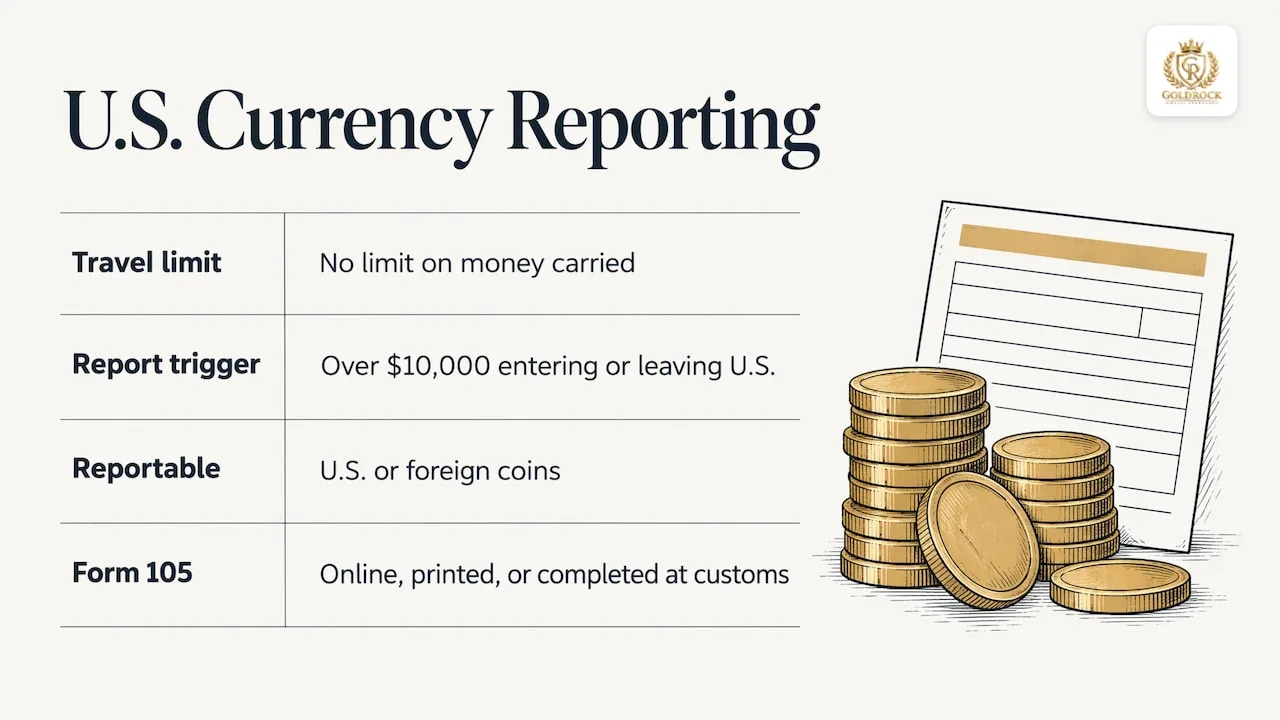
CBP has also used gold coins as an example when describing what must be reported, in a press release about seizures. Whether a specific coin counts depends on how the rule defines a monetary instrument. If you are unsure about a particular coin, the careful choice is to ask CBP before you travel or to declare it at the border. A report costs you a few minutes. A missed report can cost much more.
What a missed report can cost
USA.gov warns that failing to report amounts over $10,000, or reporting falsely, can lead to confiscation of all the currency or monetary instruments, a fine of up to $500,000 and up to 10 years in prison. CBP also says that travelers may bring any amount if it is properly declared, while a failure to report can lead to seizure, in its guidance on declaring what you bring.
Worked examples
These are illustrations of how the threshold reads, not advice for your situation.
| Situation | Does the rule point to a report? |
|---|---|
| Domestic flight from Dallas to Denver with coins in your carry-on | No customs step, because both points are in the U.S. |
| Flight from Miami to Toronto carrying coins worth more than $10,000 in total | The rule points to a FinCEN Form 105 report when you leave the U.S. |
| Return flight to the U.S. with coins worth $9,000 | Under the $10,000 line, so no report is required on this rule alone |
| Return flight to the U.S. with coins worth exactly $10,000 | The wording is “more than $10,000,” so the line is not crossed at that amount |
Two more points matter. First, the total counts everything reportable you carry, so cash and other monetary instruments add to the coin value. Second, one analysis from a legal explainer says the threshold is applied to a group traveling together, so a couple each carrying $6,000 would together pass the line. If you travel with family, treat the total as shared and confirm the point with CBP.
Where the coins come from
The other international question is origin. Some restrictions apply to items connected to sanctioned countries, which are administered through the Treasury’s sanctions office. If your coins came through a normal U.S. purchase, paperwork showing where you bought them is the simplest thing to keep with you. For an unusual piece or a coin acquired abroad, contact CBP before you fly.
Records and security for the trip
A short paper trail does a lot of the work for you.
- Purchase receipts. Keep the invoice from the dealer that shows what you bought, the quantity and the date. Carry copies, not the originals, and keep the originals at home.
- A coin inventory. List each item, its weight and its mint year, plus any serial numbers on packaging.
- CBP Form 4457 for personal property. CBP’s Form 4457 lets travelers register personal property before departure. The form is voluntary, CBP does not keep copies, and you must show the signed form to CBP each time the registered articles come back into the United States. It is mainly useful for items you take abroad and bring home again.
- Insurance review. Ask your insurer in writing whether your policy covers coins in transit, and for how much. Many household policies set sub-limits for valuables, so find the number before the trip, not after.
If you are interested in how professionals think about moving valuable objects, this explanation of handling valuables in transit covers the principles of tracking, packing and keeping high-value items under control, and many of them carry over to a flight.
When shipping is easier than carrying
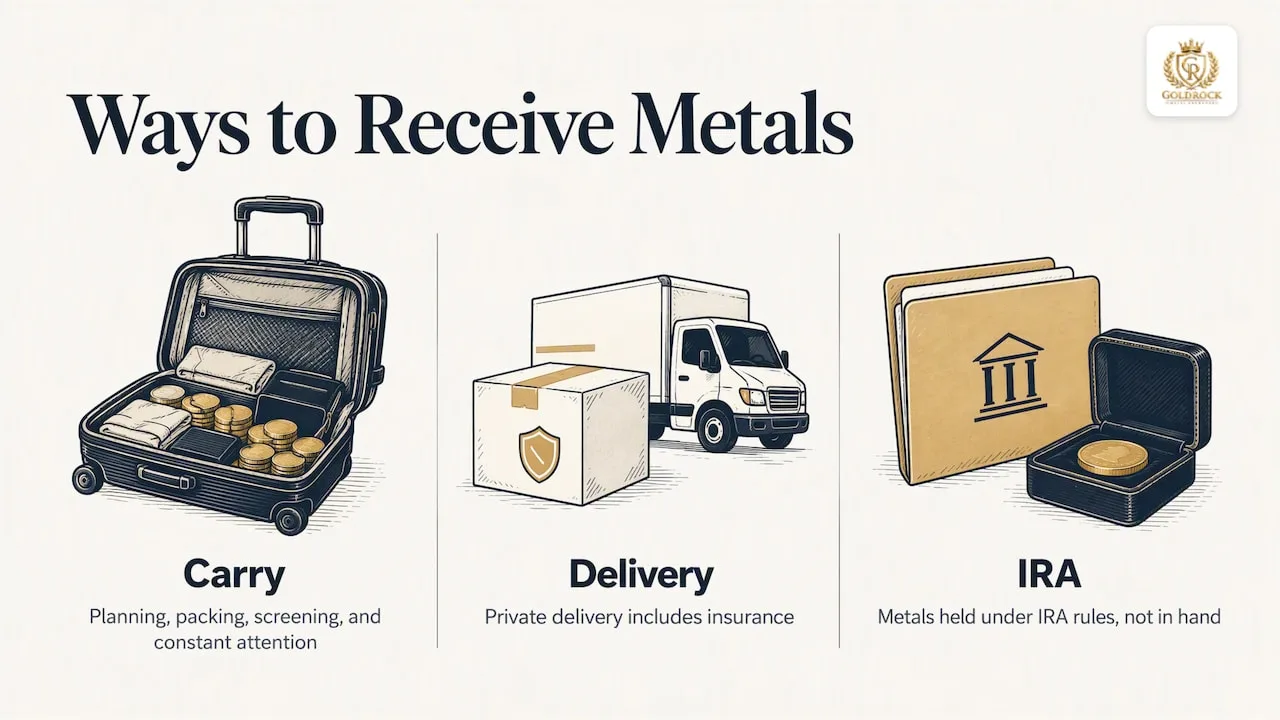
Carrying coins on a plane is lawful, but it asks a lot of you: planning, packing, screening, record-keeping and constant attention. If your goal is to receive metal you bought, you may not need to travel with it at all.
That is the reason we built insured private delivery into our service. When you buy gold, silver, platinum or palladium from us, the metals can reach you through private delivery with insurance, so you are not carrying them through airports. You also avoid the question of what a baggage handler can see in a checked bag.
For retirement savers the question is different again. In a self-directed IRA, the metals are held under the rules of the IRA, not in your hands, so there is no flight to plan. Our in-house IRA department helps with the paperwork for moving a retirement account into physical metals. We can walk you through how the process works and what each step involves, but we do not give tax or legal advice, and you should talk to a qualified tax professional about your own situation.
Online or local dealer: what to check
Many people who ask about flying with coins are really asking where to buy and how to get the metal home. Buying locally means you can inspect and collect in person, and then the flight home is yours to plan. Buying online or by phone means delivery, so the dealer’s shipping process matters. Either way, the checks are the same, and they come from a neutral source.
The CFTC’s customer advisory on buying physical metals says retail metal dealers are not regulated at the federal level. Its advice includes:
- Verify the dealer’s physical address and how long it has been in business.
- Search for complaints or criminal history tied to the owners or salespeople, and ask local consumer organizations and your state attorney general or securities regulator about complaints.
- Get fees, costs, commissions and the agreed price in writing, and compare the retail price with the spot price.
- Ask what the buy-back price is and how the salesperson is paid.
- Do not respond to cold calls, unsolicited emails or pop-up dealers.
On the delivery side, whichever way you buy, ask four things: who insures the metal in transit and for what amount, whether delivery is private and trackable, who must sign for it, and what happens if a package is damaged or does not arrive. A written answer to each is a good sign. We are glad to answer these for our own service, and you can reach us at (888) 859-0978.
Our perspective
Most people who search for this topic are not collectors with a trade show on the calendar. They bought metal, or are about to, and want to know whether getting it from one place to another will cause a problem. Our view is that the safest travel plan for coins is often the one where you do not travel with them.
That is why we put personal service and insured private delivery at the center of what we do. A person on the phone should be able to explain how your order will move, who is responsible at each step, and what you will need to sign. Our in-house IRA department does the same for retirement rollovers, so the paperwork is handled by people who do it every day.
We keep our guidance educational and calm. We do not promise returns, price moves or tax outcomes, and we will not tell you what is right for your finances. We will tell you how each option works, so you can decide with a clear picture and with your own advisors.
Blake
Plan your purchase and delivery with us
If you are buying gold, silver, platinum or palladium and want to avoid the logistics of traveling with it, our team can explain private delivery, insured shipping and the options for a self-directed Precious Metals IRA. You can browse gold, silver, platinum and palladium, or read about our Precious Metals IRA service.

We publish no prices for this service in advance, so talk to us about your own situation. Request a Free Precious Metals Consultation or call (888) 859-0978.
A simple pre-flight checklist
Use this list as a final pass before you leave for the airport. It combines the points above.
- Confirm whether the trip is domestic or crosses a U.S. border.
- If it crosses a border, add up the value of coins and any cash or other monetary instruments, and check it against the $10,000 line. File FinCEN Form 105 if you are over it, or ask CBP if you are unsure.
- Pack coins in protective holders, inside a padded pouch, inside your carry-on.
- Keep pockets empty at the checkpoint, as TSA’s checklist advises.
- Carry copies of receipts and a separate inventory.
- Check your insurance for coins in transit.
- Arrive early, and know that you can ask for private screening.
- Check the MyTSA “Can I Bring” tool or AskTSA for anything you are unsure of.
FAQ
Can I take gold coins in my carry-on on a domestic flight?
Yes. TSA’s guidance on valuables allows them in carry-on and checked bags, and it advises keeping valuables with you. The officer at the checkpoint makes the final decision on any item, so be ready for a hand inspection.
Do I have to declare gold coins on a domestic flight?
No customs report applies between two U.S. points. CBP ties its more-than-$10,000 reporting rule to entering or leaving the country. Always confirm with the official pages before you travel, because rules can change.
Do I have to declare gold coins when I fly abroad?
If you carry more than $10,000 in currency or monetary instruments, including coins, when you enter or exit the U.S., you must report it to CBP. USA.gov says the report can be filed on FinCEN Form 105. If you are unsure whether a coin counts, ask CBP or declare it.
Is it safer to ship gold coins than to fly with them?
That depends on the carrier, the insurance and the process, so ask for each in writing. Insured private delivery is designed so that you do not have to carry metal through an airport. We can explain how our delivery works if you call (888) 859-0978.
Can I take gold jewelry on a plane?
Yes. TSA says jewelry is allowed in carry-on and checked bags, but it advises keeping valuable items with you. You can ask for a private screening if an officer needs to look at it more closely.
Educational disclaimer: this article is general information about precious metals and travel. It is not investment, tax or legal advice, and it does not promise returns, safety, tax benefits or appreciation. Rules and procedures change, so check the official pages below and consult qualified professionals about your own situation.
Ready to talk through your options? Request a Free Precious Metals Consultation or call (888) 859-0978.
Sources
- TSA: Jewelry
- TSA: Travel Checklist
- TSA: Spring break preview and travel tips (March 14, 2025)
- CBP: Money and Other Monetary Instruments
- CBP: Seizes over $100K from travelers
- CBP: Why you should declare everything you bring into the United States
- CBP Form 4457
- USA.gov: How much money can you bring into and out of the U.S.?
- CFTC: 10 Things to Ask Before Buying Physical Gold, Silver, or Other Metals
- TravelClosely: Can you bring change and coins on a plane?
- LegalClarity: How much gold can you carry to the USA
- Easy Move Services: How a moving company handles valuables