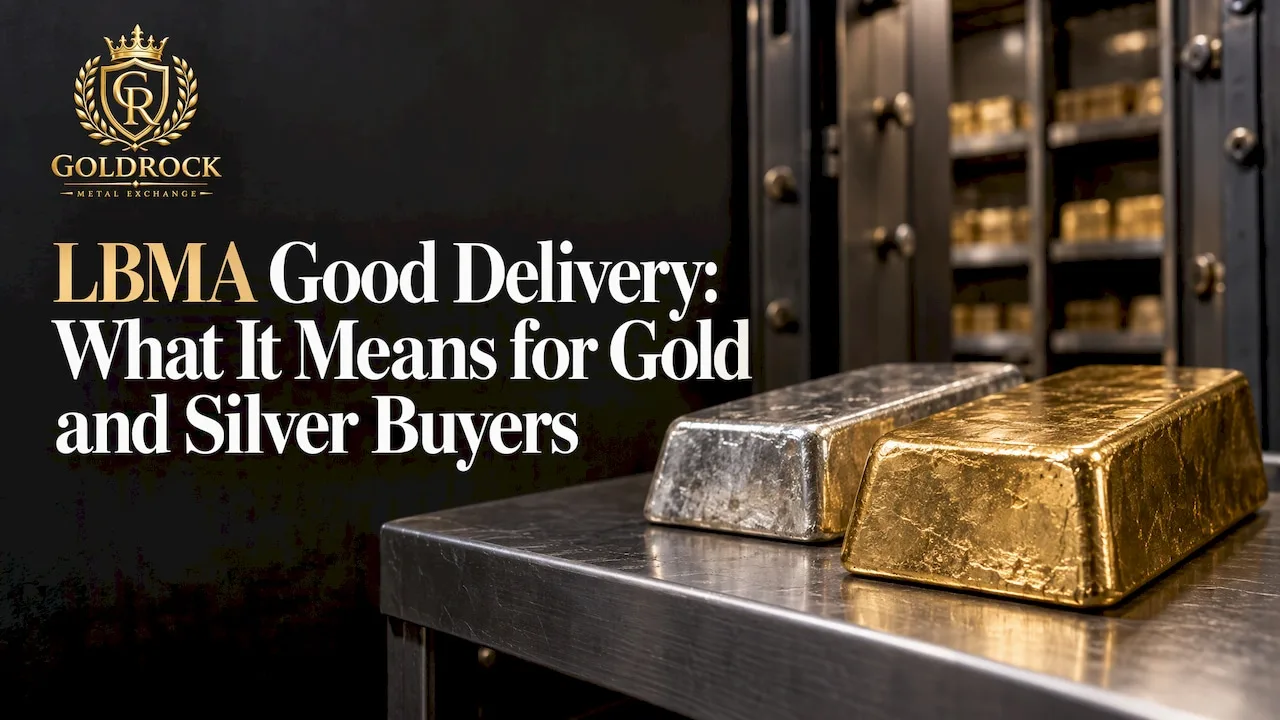
LBMA Good Delivery is the standard that defines which gold and silver bars are acceptable for wholesale settlement in the London bullion market. It applies to large bars and to the refiners that produce them. It is not a rating for every coin, round or small bar you might buy. This guide explains what the standard covers, how to read the list, and how it fits with owning physical metals, including inside a self-directed IRA.
TL;DR
- LBMA Good Delivery is a set of technical and process standards for gold and silver bars, used for Loco London settlement.
- It accredits refiners and their bars. It does not approve other products an accredited refiner may make.
- Gold Good Delivery bars hold 350 to 430 fine troy ounces at 995.0 minimum fineness. Silver bars weigh about 1,000 troy ounces at 999.0 minimum.
- You can check a refiner on the LBMA’s published current list.
- Good Delivery is one input in a purchase decision. Product form, premiums, delivery and storage matter too.
Table of Contents
- What LBMA Good Delivery actually means
- Good Delivery bar specifications
- What Good Delivery does not cover
- How to check whether a refiner is on the list
- Why the standard matters to retail investors
- Good Delivery and a self-directed Precious Metals IRA
- Request a Free Precious Metals Consultation
- Perspective: why we look past the label
- Platinum: what readers ask next
- Choosing metals: a simple decision framework
- Insured private delivery
- Educational disclaimer
- FAQ
- Sources
What LBMA Good Delivery actually means
The London Bullion Market Association (LBMA) maintains the Good Delivery system. According to the LBMA, it is a set of standards for gold and silver bars that enables global trade, and only bars meeting those standards are acceptable for Loco London settlement.
“Loco London” simply means metal held in London and traded under London market conventions. In practice, big institutions trading gold and silver need to know that any bar delivered to them will be accepted without re-testing. Good Delivery gives them that shared yardstick.
Two ideas are worth separating:
- The Good Delivery Rules describe the bar itself: weight, purity, size, markings.
- The Good Delivery List names the refiners whose bars have been accredited.
Both work together. A bar is Good Delivery because it meets the specification and comes from a refiner on the list.
Good Delivery bar specifications
The LBMA publishes the technical specifications for each metal. The headline numbers:
| Feature | Gold bars | Silver bars |
|---|---|---|
| Weight | 350 to 430 fine troy ounces | 1,000 troy ounces, +/- 10% tolerance |
| Minimum fineness | 995.0 | 999.0 |
| Markings | Specified marks required | Specified marks required |
A few details a careful reader should know:
- Silver bars made before 2025 that weigh 750 to 1,100 troy ounces remain acceptable.
- A 10 mm edge-marking rule applies to new bar changes and to refiners applying to the list from 1 January 2026, per the same specifications.
- Fineness is expressed in parts per thousand. A fineness of 995.0 means 99.5% pure gold.
The typical Good Delivery gold bar is the 400-ounce bar. At that size it is a wholesale item. Most individual investors buy smaller forms: one-ounce coins, small bars, or fractional pieces.
What Good Delivery does not cover
This is where buyers often get confused. Accreditation follows checks on a refiner’s history, financial standing, production and ability to meet LBMA standards. But the list covers gold and silver bars. It does not extend to other products from accredited refiners.
That has practical consequences:
- Coins are not Good Delivery items. Government-minted coins have their own specifications and mint guarantees. The U.S. Mint, for example, publishes its own product details for American Eagle coins.
- Small bars and rounds are outside the 350 to 430 ounce range, so they are not Good Delivery bars even when poured by an accredited refiner.
- Platinum and palladium are not part of the LBMA Good Delivery List for gold and silver. Their purity and form are judged on product-level specifications.
So “Good Delivery” on a listing for a one-ounce bar deserves a closer read. The accurate question is what the product’s own specification, assay and packaging say, and who made it.
How to check whether a refiner is on the list
The LBMA publishes a Good Delivery Current List of refiners whose bars are accredited. It includes 67 gold refiners and 86 silver refiners.
The list changes. The LBMA regularly monitors it, and refiners can be removed for failing to maintain standards, with reputational and financial consequences. Additions happen too. One example: a Hong Kong refinery was added to the silver list effective 8 April 2026.
A simple checking routine:
- Find the refiner’s name on the bar or its packaging.
- Open the LBMA current list for the right metal. Gold and silver are listed separately.
- Confirm the refiner appears, and note that the list refers to bars, not every item the refiner sells.
- Compare the serial number, weight and fineness on the bar with its paperwork.
- Ask your dealer to explain the product’s specification in writing.
Searches for “LBMA accredited refiners” and the “Good Delivery list gold” lead to this same page.
Why the standard matters to retail investors
Most people will never hold a 400-ounce bar. Still, the standard matters indirectly:
- Common benchmark. Refiners that meet the standard have shown they can produce metal to documented purity and marking rules.
- Liquidity expectations. Metals from recognized refiners are widely familiar to the market.
- Traceability. Required marks make it easier to identify a bar’s maker and fineness.
None of that guarantees a price outcome or protects against market declines. Metal prices move, and past performance does not predict future results. Good Delivery speaks to the quality and identity of the metal, not to its future value.
Good Delivery and a self-directed Precious Metals IRA
Retirement accounts add another layer. A self-directed IRA that holds physical metals follows IRS rules on what the account may own, and it uses a custodian and an approved depository. Those rules are separate from LBMA Good Delivery. Some bars acceptable to the London market may also meet IRA purity requirements, but the IRS rules, not the LBMA, decide eligibility.
Because the details depend on your account and situation, this is a conversation to have with your IRA custodian and a qualified tax professional. We do not give tax or legal advice. What we can do is walk you through the process:
- Open a self-directed IRA with a qualified custodian.
- Fund it through a transfer or rollover from an eligible retirement account.
- Choose metals that meet the eligibility rules.
- Have the metals shipped to and held at an approved depository.
Our in-house IRA department handles paperwork coordination so the transfer is organized from start to finish. You can read more on our Precious Metals IRA page.
Request a Free Precious Metals Consultation
If you want to talk through gold, silver, platinum or palladium, ask about product specifications, or understand how an IRA rollover works, our team is available at (888) 859-0978. Request a Free Precious Metals Consultation.
Perspective: why we look past the label
We hear “Good Delivery” often from people who are new to physical metals. It is a respected standard, and it is worth understanding. But we have learned that the label is only the start of a good purchase.
What clients really want to know is simple: what exactly am I buying, how will it reach me, and who can I call with questions? That is why we built GoldRock around personal service. Our in-house IRA department handles retirement transfers, and we offer insured private delivery for physical orders.
We prefer to explain products in plain terms: the metal, the form, the specification and the paperwork. We do not use paid endorsements, and we do not promise outcomes. We believe an informed client is the best client, and we are glad to keep talking after the order is placed.
Blake
Platinum: what readers ask next
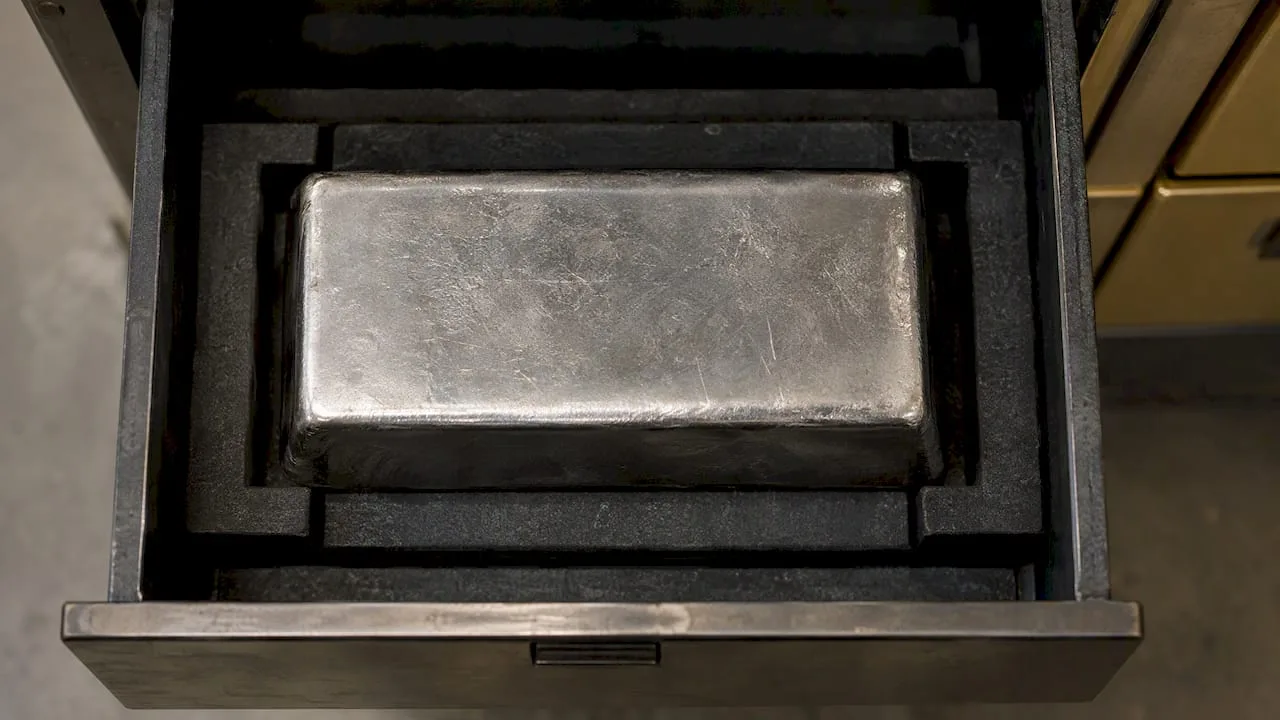
Many readers researching bar standards also look into platinum. It is a different market with different drivers, and it sits outside the gold and silver Good Delivery List. This section summarizes publicly available research. It is not a forecast of our own, and it is not a prediction of where prices will go.
What the latest industry report says
The World Platinum Investment Council (WPIC) publishes quarterly market data. In its Platinum Quarterly for Q2 2026, the 2026 market is forecast to show a surplus of 265 koz (thousand ounces), after three consecutive annual deficits from 2023 to 2025.
The same report notes that macroeconomic factors, including the conflict between the U.S. and Iran and higher energy prices, weighed on investor appetite, and platinum prices declined 24% in the first half of 2026.
Those are the WPIC’s figures and assumptions. Forecasts like this can change as new data arrives, so treat any outlook as one view rather than a certainty.
What drives platinum prices: supply
Per the same WPIC data, total platinum supply for 2026 is forecast to rise 2% year on year to 7,353 koz:
| Supply source | 2026 forecast |
|---|---|
| Mine supply | 5,551 koz, broadly unchanged |
| Recycling | 1,802 koz, up 8% |
| Total | 7,353 koz, up 2% |
What drives platinum prices: demand
The WPIC describes demand as coming from three broad areas: automotive and jewelry, both declining in its outlook, and industrial uses, which are rising. Investment demand adds volatility, particularly when exchange-traded fund holdings move in or out.
For a physical buyer, the takeaway is practical. Platinum can swing more than readers expect because its supply is concentrated and its demand is tied to industry as well as investment. That is one reason some investors consider it alongside, not instead of, other metals as part of a diversified approach. You can browse our platinum selection or palladium selection.
Choosing metals: a simple decision framework
Whether you are looking at bars, coins or an IRA, these criteria help you compare products without relying on a single label:
- Metal and purpose. Are you diversifying, preserving purchasing power or building a retirement allocation? Each metal behaves differently.
- Form. Coins are widely recognized and easy to divide. Bars often carry lower premiums per ounce at larger sizes.
- Specification. Check weight, fineness, mint or refiner, and any assay documentation.
- Cost. Compare the premium over the spot price, any fees, and shipping and insurance.
- Storage. Home storage, private delivery or an approved depository for IRA metals each carry different practical considerations.
- Support. Look for a team that answers questions before and after the sale.
For straightforward purchases, our gold and silver categories show what we offer.
Insured private delivery
For physical metals you plan to hold yourself, delivery is a real part of the decision. We offer insured private delivery for purchased metals, so your order is covered while it travels to you. Learn more about private delivery or call (888) 859-0978 and we will explain how it works for your order.

Educational disclaimer
This article is for educational purposes only. It is not investment, tax or legal advice, and it is not a recommendation to buy or sell any product. Precious metals prices can rise or fall, and nothing here promises returns, appreciation, safety or tax benefits. Consult a licensed financial, tax or legal professional about your own situation.
FAQ
Is LBMA Good Delivery the same as being IRA approved?
No. Good Delivery is an LBMA standard for wholesale gold and silver bars. IRA eligibility is set by IRS rules and enforced through your custodian. Some products may satisfy both, but each is a separate test. Our IRA team can walk you through eligible products.
Are coins and small bars Good Delivery?
No. Good Delivery bars are large, with gold bars at 350 to 430 fine troy ounces and silver bars around 1,000 troy ounces. Coins and small bars follow their own specifications, mint standards or refiner documentation.
Where can I see which refiners are accredited?
The LBMA publishes its Good Delivery Current List with gold and silver refiners. Check the metal-specific list and remember it covers bars, not every product a refiner makes.
Does Good Delivery mean a bar will hold its value?
No. The standard describes quality, identity and acceptability, not price performance. Metal prices move with market conditions, and no one can promise a result.
Can I talk to someone before I buy?
Yes. Call (888) 859-0978 to speak with our team about metals, delivery or IRA rollovers, or request a free precious metals consultation.