Most standard homeowners policies cover gold bullion only up to a small special limit, often $200 for theft. If you keep bars or coins at home, you generally need a higher-limit endorsement, a scheduled rider, or a separate specialty policy to insure them for their full value. This guide explains how that works, what insurers ask for, what coverage tends to cost, and how insured delivery protects metal on its way to you.
This article is general education, not personal insurance, investment, tax, or legal advice. Policies differ by insurer and state, so your own policy and a licensed insurance professional are the final word.
TL;DR
- Under the widely used Homeowners Special Form, the special limit on bullion, gold, and silver is $200, no matter how large your overall personal property limit is.
- Closing the gap usually means an increased-limit endorsement, a scheduled item rider, or a specialty valuables policy. Ask your agent which your insurer offers.
- Expect to provide receipts, photos, an inventory, and sometimes an appraisal. Keep these records away from the metal itself.
- Shipments need their own protection: USPS limits insurance on bullion sent outside Registered Mail to $15, so private insured delivery matters.
Table of Contents
- What a standard homeowners or renters policy covers
- Three ways to insure gold bullion at home
- What insurers typically ask for
- What gold bullion insurance costs
- Our perspective
- Insured delivery: protecting metal on its way to you
- Request guidance on insured delivery and your metals
- Is it legal to keep gold bullion at home?
- Home storage versus retirement account storage
- A simple plan for insuring gold at home
- FAQ
- Talk with us before your next purchase
- Sources
What a standard homeowners or renters policy covers
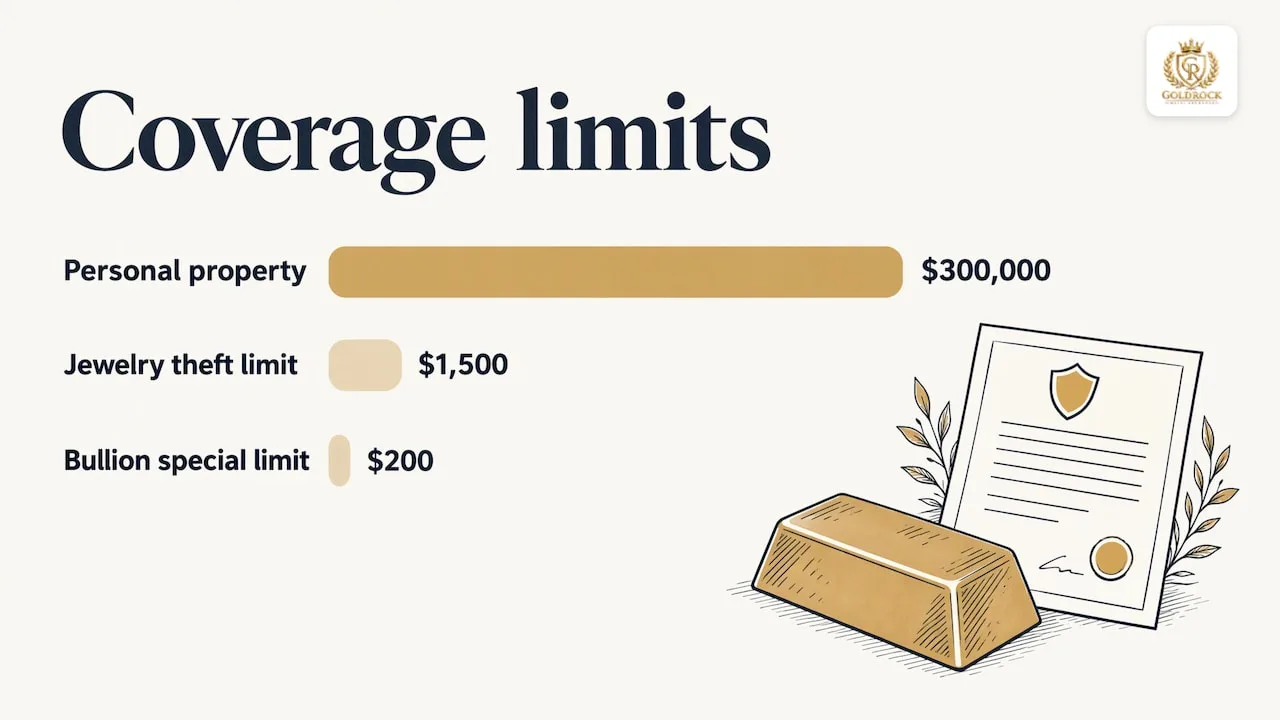
Gold bullion is not treated like your sofa or your laptop. Insurers place bullion in a “special limit” category. The New York Department of Financial Services explains that under the most common Homeowners Special Form, the limit for money, bank notes, bullion, gold, and silver is $200, while theft of jewelry, watches, furs, and precious stones is limited to $1,500.
The regulator also notes that a special limit is the total a company will typically pay for a loss in that category. So a policy with $300,000 of personal property coverage can still pay only a few hundred dollars toward stolen bars.
The United States Insurance Association describes the same pattern: homeowners policies commonly cap money, bullion, gold, silver, platinum, and coins at $200. Media coverage points the same way. Fortune notes that precious metals are a special-limit category that tends to cover only a portion of your holdings for theft, and that other kinds of loss may not be covered at all. Money advises investors to look for separate insurance for physical gold.
Renters policies work much the same way, with the same type of sub-limits. Your exact numbers sit in your policy’s special limits section, so read it or ask your agent.
Why the limit matters in practice
Imagine you own several one-ounce coins and a few bars. The total is well above $200, yet a standard policy may pay out only that special limit after a theft. That gap is simply how the category is written. The fix is to address it before anything happens, not after.
Three ways to insure gold bullion at home
Once you know the limit, you have a short list of ways to raise it. Which ones are available depends on your insurer and state.
| Option | How it works | Best suited to | Questions to ask your agent |
|---|---|---|---|
| Increased-limit endorsement | Raises the special limit for bullion on your existing policy | Smaller holdings | What is the new limit? Does it cover theft only, or more? |
| Scheduled rider (floater) | Lists specific items with a stated value | Defined sets of coins or bars | Is the metal valued at purchase price or current market price? |
| Specialty valuables or collectibles policy | Separate policy for high-value items | Larger holdings or numismatic pieces | What exclusions apply? Is there a deductible? |
A fourth path is to keep fewer ounces at home, with the rest held in a different storage arrangement. We cover those arrangements in our guide to precious metal storage options and in how to store physical gold safely for retirement.
Check the valuation method
Gold prices move daily. A rider that pays a fixed scheduled value can leave you under-covered after a rally, so ask how often the insurer lets you update values and whether the policy pays current market value. This is a question for the insurer, not something we can answer for your policy.
Check the deductible
Coverage is usually subject to your deductible. The United States Insurance Association gives an example: a $2,000 watch lost under a $5,000 deductible produces no payment because the loss never exceeds the deductible. It recommends considering a valuable articles policy to avoid that situation. The same logic applies to a few coins or a small bar.
What insurers typically ask for
When you add coverage, expect documentation requests. They vary by insurer, but a thorough file usually includes:
- Purchase receipts or invoices showing date, product, quantity, and price.
- Photos of each item, including bars with their serial numbers and mint marks.
- A written inventory listing metal, weight, purity, and form (coin, bar, round).
- An appraisal, when the insurer requires one. Rare or graded numismatic pieces are the most likely to need it.
- Details on where and how the metal is stored, such as a safe and its rating.
Insurers commonly ask for receipts, photos, a written inventory, and details such as weight, purity, and serial numbers before scheduling gold. Some also set security conditions, so confirm yours before you rely on a policy.
Keep a digital copy of this file in a place that is not your safe. If the metal is ever taken, the paperwork is what supports a claim. Every order from us comes with documentation, and our gold buying process guide walks through what to keep.
Quiet storage is part of protection
Insurance pays after a loss. Good habits reduce the chance of one: do not discuss your holdings publicly, avoid posting photos that show your storage spot, and keep inventory lists private. A bolted-down safe in a location that is not obvious is a sensible baseline. Your insurer may have specific rules about the safe, so ask.
What gold bullion insurance costs
Pricing depends on the insurer, the amount, the storage, and your location. As a general reference, CBS News reported in 2025 that insurance for gold bars typically runs 1% to 2% of total value per year. On a one-ounce bar valued at about $2,700 at that time, that works out to roughly $27 to $54 per year.
Treat that as a rough guide, not a quote. Your premium could differ, and the metal’s value changes. Ask your agent for a written quote that names the limit, the valuation method, the deductible, and the perils covered.
Questions to bring to your agent
- Does the bullion limit apply to theft only, or also to fire, water damage, and loss?
- Is the coverage “mysterious disappearance” inclusive?
- Does a safe change the terms or the price?
- Is there a per-item appraisal threshold, and what happens above it?
- How do I update the schedule when I buy more?
Our perspective
We talk with investors every week who bought metal first and thought about protection second. The pattern is consistent: they assume the homeowners policy they already pay for covers their bars, and the special limit comes as a surprise.
Our view is simple. Physical metal is a real, tangible asset, and it deserves the same planning you would give any valuable asset: documented purchases, a clear storage plan, and coverage that matches what you hold. That is why we put personal guidance ahead of the sale, and why our insured private delivery exists. The metal should arrive protected, and you should know your next step before it does.
For retirement investors, our in-house IRA department helps you understand how a self-directed Precious Metals IRA is set up, so you can weigh storage and coverage questions with a clear picture. We do not push a one-size answer. We explain the options, and we are transparent about how each works.
Blake
Insured delivery: protecting metal on its way to you
A shipment is the moment metal is most exposed, because it is out of your hands. Two questions matter: who insures it, and up to what amount.
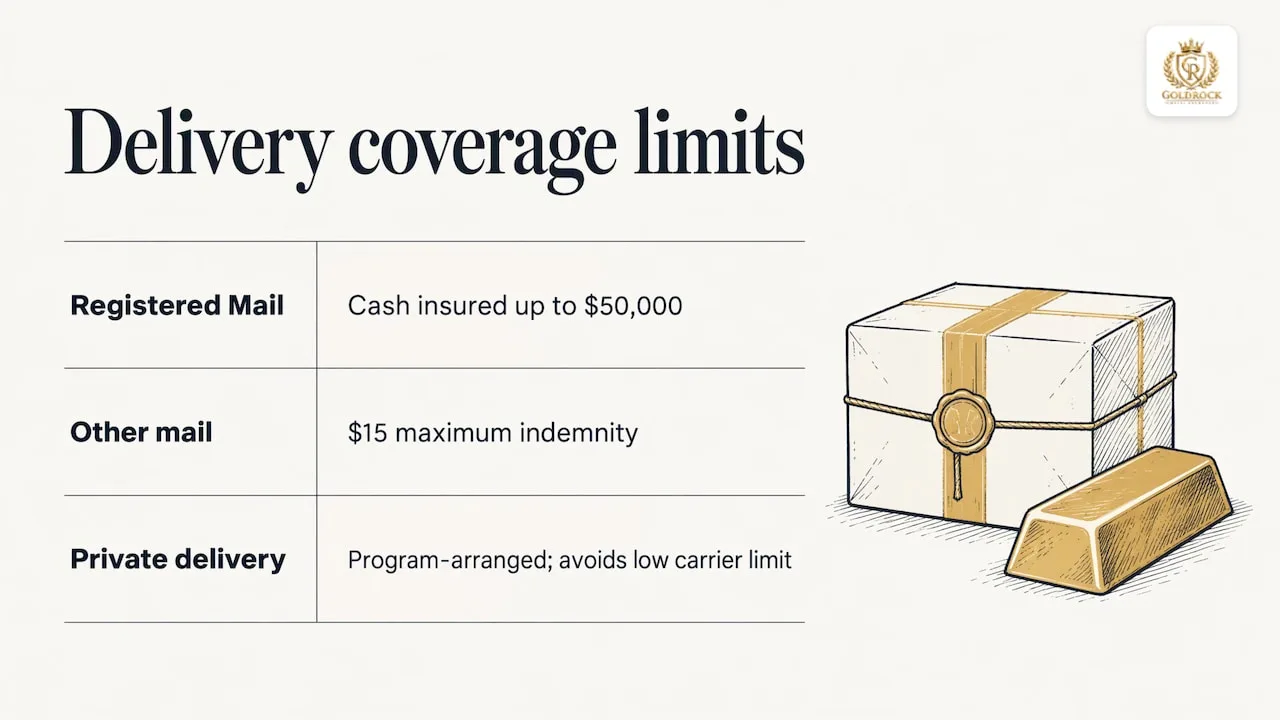
USPS publishes its limits. Cash sent by Registered Mail can be insured up to $50,000, but for other mail classes and services, the maximum indemnity for negotiable items, currency, or bullion is $15. That gap is why shipping method is a decision worth making deliberately.
With private insured delivery, the shipment is arranged through our program, so you are not relying on a low carrier limit. We cover the practical side in private metals delivery service for investors, delivery options explained for buyers, and our piece on discreet gold shipping and the $50,000 USPS cap.
If a shipment is lost, stolen, or damaged
Act quickly. Under USPS rules, for damaged or missing contents you should file a claim immediately and no later than 60 days from the mailing date. For a lost Registered Mail article, the claim window opens no sooner than 15 days and closes no later than 60 days from mailing. Keep the receipt, the tracking record, and photos of the packaging and contents at opening.
For a shipment from us, contact us first at (888) 859-0978 so we can walk you through the next step. And whenever you receive a package, record yourself opening it. If something is wrong, that record helps.
Request guidance on insured delivery and your metals
If you are buying gold, silver, platinum, or palladium and want the delivery protected from the start, our team can explain how insured private delivery works and answer your questions about purchase documentation. You can also browse our gold, silver, platinum, and palladium categories.

Request a Free Precious Metals Consultation or call (888) 859-0978.
Is it legal to keep gold bullion at home?
Yes. CBS News reports there is no federal limit on how much gold Americans can own, and that you can buy gold bars and store them at home with no federal restriction on keeping them on your property.
The old ban many people have heard about, Executive Order 6102 from 1933, was repealed in 1974 when President Ford signed Executive Order 11825.
Legal does not mean unreported in every case. Certain sales can trigger reporting, which we explain in our guide to bullion reporting rules. Tax questions are for a qualified tax professional.
Home storage versus retirement account storage
Holding metal at home and holding it in a self-directed IRA are different arrangements with different rules. Metal bought for an IRA follows IRA custody and storage rules, so the home-insurance question above applies to metal you own outside a retirement account. Our gold IRA rules guide and depository insurance checklist for gold IRAs explain how protection works on the retirement side. If you are exploring that route, see our Precious Metals IRA page or how to open a precious metal IRA.
A simple plan for insuring gold at home
- Find your special limit. Read the special limits section of your policy, or ask your agent for the bullion figure.
- Total your holdings. Add up the current value of everything you keep at home.
- Compare the gap. If your holdings exceed the limit, ask about an endorsement, scheduled rider, or specialty policy.
- Build your file. Gather receipts, photos, serial numbers, and an inventory. Store copies off-site or in secure cloud storage.
- Choose your storage. Pick a safe and a location you are comfortable describing to your insurer.
- Get it in writing. Confirm the limit, valuation method, deductible, and covered perils.
- Review yearly. Update the schedule after each purchase and when values change significantly.
- Protect new deliveries. Choose insured delivery for each shipment so coverage is in place from dispatch.
FAQ
Does homeowners insurance cover gold bullion?
Only to a small special limit under many standard policies. The common Homeowners Special Form limit for bullion, gold, and silver is $200. To cover more, ask your insurer about an endorsement, scheduled rider, or separate valuables policy.
How much does it cost to insure gold at home?
CBS News reported in 2025 that 1% to 2% of value per year is a typical range for gold bars. Your actual premium depends on the insurer, your location, and your storage, so get a written quote.
What documents do I need to insure my gold?
Insurers commonly ask for receipts, photos, a written inventory, and details such as weight, purity, and serial numbers. Some require an appraisal for higher-value or collectible items. Your insurer will confirm its own requirements.
Is shipped gold insured?
It depends on the method. USPS caps indemnity for bullion outside Registered Mail at $15, which is why we offer insured private delivery. Ask us how it works for your order.
Is there a limit on how much gold I can keep at home?
No federal limit exists, according to CBS News. Your insurer may still set its own limits on what it will cover.
Talk with us before your next purchase
Whether you are adding your first ounce or planning a larger move, we can walk you through delivery, documentation, and the self-directed IRA process in plain terms, with no pressure and no one-size answer.
Request a Free Precious Metals Consultation or call GoldRock Metal Exchange at (888) 859-0978.
Educational disclaimer: this content is for general information only. It is not investment, insurance, tax, or legal advice, and it does not promise returns, safety, tax benefits, or appreciation. Precious metals prices can rise or fall. Speak with a licensed insurance professional and a qualified tax or legal adviser about your own situation.
Sources
- New York DFS: Homeowners Insurance Basic Coverage
- USI: Protect Your Jewelry, Stones and Precious Metals
- Fortune: How to store and insure physical gold and silver
- Money: Insuring Your Gold
- Sun Insurance Services: Does Homeowners Insurance Cover Gold
- CBS News: Cost to insure 1-ounce gold bars
- USPS: Limits for Insuring Cash and Checks
- USPS: Filing Indemnity Claims for Loss or Damage
- CBS News: Is there a limit on how much gold you can own
- CBS News: Can you buy gold bars and store them at home
- LegalClarity: Executive Order 6102