
A silver supply deficit means that in a given year, demand for silver is larger than the new silver supplied by mining and recycling. It does not mean the world is running out of silver. Stocks held above ground cover the gap, and that is why the answer to “is there a silver shortage?” is more nuanced than most headlines suggest. For 2026, the Silver Institute estimates the deficit at 46.3 million ounces, the sixth in a row.
This guide explains how the deficit is measured, what the 2026 numbers show, why supply is slow to react, and why prices can fall even while the market is in deficit. It is educational, and it is written for people thinking about owning physical silver.
TL;DR
- A silver supply deficit is a yearly statistical gap between demand and new supply (mining plus recycling). It is not a physical shortage.
- The World Silver Survey 2026 puts the 2026 deficit at 46.3 million ounces, the sixth consecutive annual shortfall.
- Roughly 74% of silver is mined as a byproduct of other metals, so output does not rise quickly when silver demand does.
- Prices respond to interest rates, the U.S. dollar and investor demand as well as to the deficit, so a deficit does not guarantee higher prices.
- If you are considering physical silver, understand the trade-offs first. We are happy to walk through them with you.
Table of Contents
- What a silver supply deficit actually is
- Is there a silver shortage right now?
- The 2026 numbers: demand, supply and the gap
- Why silver supply is slow to respond
- Why silver prices can fall during a deficit
- What this means if you are considering physical silver
- Request a Free Precious Metals Consultation
- How GoldRock helps you buy silver
- Our perspective
- FAQ
- Sources
What a silver supply deficit actually is
Every year, analysts add up where silver goes (industrial use, jewelry and silverware, coins and bars, and other investment) and where it comes from (mine production and recycled scrap). When the first number is larger than the second, the market records a deficit.
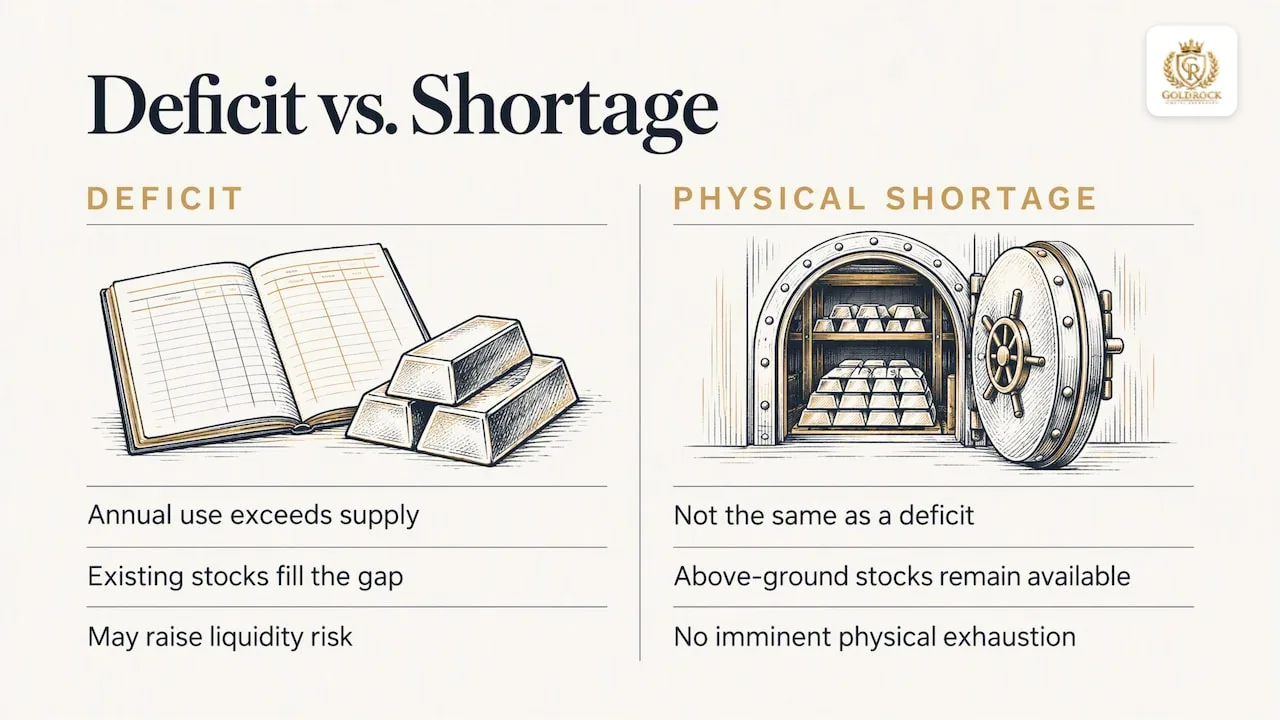
The deficit is an accounting gap. Someone has to fill it, and the usual source is metal that already exists: bars in vaults, inventories held by fabricators, and investor holdings that return to the market when owners sell. Reporting on the 2026 debate notes that a deficit is not the same as a physical shortage, because above-ground stocks are available to cover the difference.
There is also a measurement debate. One well-known analyst quoted in that coverage argues that deficit figures can mislead because they combine industrial consumption, which truly uses silver up, with investment demand. Silver bought by investors is not consumed. It stays above ground and can come back to market later.
The Silver Institute’s own view is balanced. A persistent annual deficit raises the risk of liquidity squeezes and price swings, but it is not a sign of imminent physical exhaustion, since large above-ground stocks remain, even if they are not all publicly visible.
Is there a silver shortage right now?
It depends on what you mean by shortage.
- Statistical deficit: yes, for six years running according to the Silver Institute’s estimates.
- Physical exhaustion: no. Stocks are being drawn down, but they have not run out.
- Tight liquidity and volatility: this is the real effect. The World Silver Survey expects price volatility and lease rates to stay elevated in 2026 because years of drawdown have left the market with less cushion than before.
So the honest answer to the question people type most often is this: the market is running a deficit and is thinner than it used to be, but nobody serious is claiming the world has no silver. The practical consequence is a market that can move sharply in either direction, not a guarantee of any outcome.
The 2026 numbers: demand, supply and the gap
Here are the headline figures from the World Silver Survey 2026, published by the Silver Institute with Metals Focus.
| Measure | 2026 estimate |
|---|---|
| Total global silver demand | About 1.11 billion ounces, down 2% |
| Coin and bar investment demand | Up 18% |
| Industrial and jewelry/silverware fabrication | Lower, partly offsetting the investment gain |
| Mine production | Effectively flat to slightly lower |
| Recycling | Higher |
| Market deficit | 46.3 million ounces (sixth straight year) |
Two details matter here. First, total demand is forecast to soften, yet a deficit remains, because supply is not growing enough to close the gap. Second, the one category growing strongly is physical investment in coins and bars. That is the part of demand that behaves differently from factory demand: it can be sold back, and it reacts to the economic mood.
The survey also estimates that about 762 million ounces have been drawn from above-ground stocks since 2021 to cover the annual deficits. That is a large figure, and it explains why analysts talk about thinner liquidity. It is not the same as saying the stock is gone.
Where U.S. silver goes
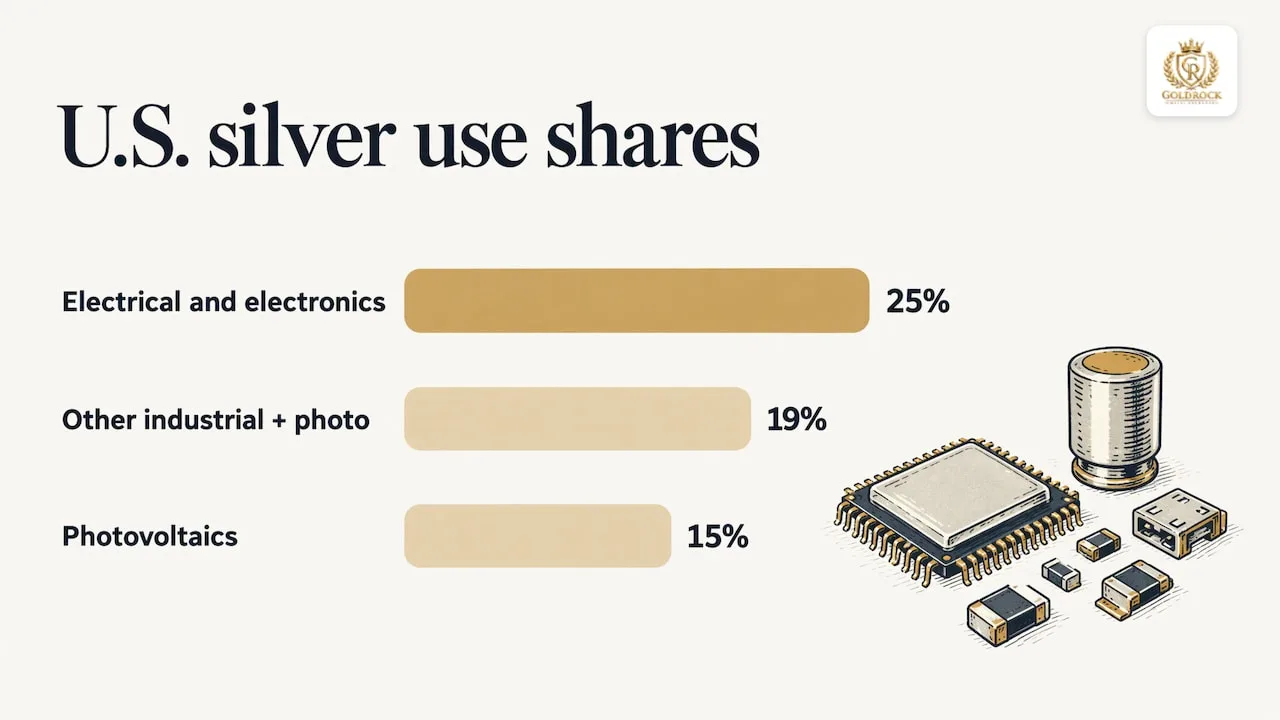
The U.S. Geological Survey’s Mineral Commodity Summaries 2026 reports that apparent U.S. silver consumption in 2025 was 9,400 tons. Of the estimated domestic uses, electrical and electronics took about 25%, other industrial uses and photography about 19%, and photovoltaics about 15%. In other words, a large share of the silver used in this country goes into products, which is why industrial trends matter so much to the supply picture.
Why silver supply is slow to respond
When demand for a metal jumps, you would expect miners to produce more. Silver does not work that way for one main reason: most of it is a byproduct. Roughly 74% of silver is produced alongside lead, zinc, copper and gold. Mining decisions at those operations follow the economics of the main metal, not the silver price.
That has several consequences:
- A higher silver price rarely triggers quick new output. A zinc mine does not expand because silver rose.
- New mines take years. Permitting, financing and construction are slow, so even a dedicated project does not help the current year.
- Ore grades and operating conditions matter. The World Silver Survey describes modest growth at some assets being offset by grade-related and operational pressures elsewhere, leaving 2026 production effectively flat.
- Recycling helps but is limited. Scrap supply is rising, but it depends on how much silver is embedded in products reaching the end of their life.
This structure is the core of why analysts describe the deficit as structural rather than a one-year blip.
Why silver prices can fall during a deficit
Many people assume a deficit means the price must rise. The 2026 market is a good reminder that it does not. Silver reached a record above $121 per ounce in January 2026, and by August 27, 2026 spot silver was about 44% below that peak, even though the deficit forecast was unchanged.
The reason is that the annual balance is only one input. When large stocks exist to fill the gap, the price is driven more by investment demand, and that demand is sensitive to the macro backdrop. The World Silver Survey points to Federal Reserve policy, real yields and the U.S. dollar as the forces that shape marginal investor demand, alongside industrial fabrication trends and the continued drawdown of stocks.
To put it plainly: a deficit describes the market’s physical balance, while the price reflects what buyers and sellers are willing to do on a given day. The two can move apart for long stretches. No one can tell you where silver will go next, and we will not try to.
What this means if you are considering physical silver
A deficit headline is not a reason to buy, and it is not a reason to wait. It is context. Here are the decision criteria we suggest people think through before buying any physical metal.
Your purpose
Are you diversifying a portfolio, holding a tangible asset, or looking for something to use inside a retirement account? Each purpose points to different products and amounts.
Volatility tolerance
Silver is more volatile than gold. The 44% drop from the January 2026 peak, described above, is a vivid example. If a swing like that would force you to sell at a bad time, size your position accordingly.
Form and ownership
Physical coins and bars you hold yourself, metal inside a self-directed IRA, and paper or fund exposure are different ownership methods with different costs, storage needs and rules. Physical metal carries no counterparty promise, but it needs secure storage and insurance. Paper exposure is easy to trade but is not the metal itself.
Costs
Look at the premium over spot, any storage fees, insurance, and, for retirement accounts, custodian and account fees. Ask for every cost in writing before you commit.
Delivery and storage
How will the metal reach you, and where will it live? Insured, private delivery matters when you are buying valuable metal, and storage choices should be settled before the order, not after.
Request a Free Precious Metals Consultation
If you want to talk through silver, gold, platinum or palladium with a person rather than a price chart, Request a Free Precious Metals Consultation or call us at (888) 859-0978. We will answer questions about products, delivery and how a self-directed IRA works, with no pressure.
How GoldRock helps you buy silver
We are a full-service precious metals dealer, and we built our approach around personal guidance and secure handling. You can browse physical silver, and if you also want to look at other metals, we offer gold, platinum and palladium.

Two services are worth knowing about:
- Insured private delivery. Purchased metals can be sent to you with insured, private delivery, so you are not left worrying about the journey. See how it works on our Private Delivery page.
- A dedicated in-house IRA department. If you want to hold silver inside a retirement account, our team helps you with the paperwork for a Precious Metals IRA, including rollovers from an existing retirement account. Eligibility, rules and tax treatment depend on your situation, so we encourage you to confirm those details with your own tax or legal professional.
We do not publish prices for metals on this page because they move with the market. Ask us for a current quote.
Our perspective
Most of the silver conversations we have begin with a headline about a shortage. Our first job is to slow that down. A deficit is a number on a spreadsheet. It tells you the market is thin and that supply cannot answer quickly, which is useful to know. It does not tell you what to do, and it certainly does not tell you what the price will do next.
What we can offer is a calm process. We help you decide why you want metal, which metals fit that reason, how much volatility you can live with, and how you want to own it: delivered to you, or held inside a self-directed IRA. Our in-house IRA team handles the rollover mechanics, so the paperwork does not become the hard part.
We believe the best purchase is one you understand fully before you make it. That is why we answer questions first and talk about products second, and why we stay in touch after the order is complete.
Blake
FAQ
Is there a silver shortage?
There is a statistical deficit, not a physical running-out. The Silver Institute estimates 2026 demand exceeds new supply by 46.3 million ounces, which is covered by existing above-ground stocks. The effect to watch is thinner liquidity, which can mean sharper price swings.
How is the silver deficit measured?
Analysts compare total annual demand (industrial, jewelry, silverware and investment) with total new supply (mine production and recycling). The difference is the surplus or deficit. Some analysts argue that counting investor purchases as demand overstates the gap, since that silver is not consumed and can return to the market.
Why is silver supply not rising when demand is?
About 74% of silver comes as a byproduct of mining other metals, so output follows the economics of lead, zinc, copper and gold, not silver. New mines also take years to build. That makes supply slow to respond.
Does a silver deficit mean the price will go up?
No. Silver fell about 44% from its January 2026 record by late August 2026, while the deficit forecast remained in place. Prices are shaped by interest rates, the dollar and investor demand as well as the physical balance. Nobody can promise a price outcome.
Can I hold silver in a retirement account?
A self-directed IRA can hold approved physical precious metals, subject to specific rules. Our in-house IRA department can explain the process and the steps. For questions about taxes or your personal situation, speak with a qualified tax or legal professional.
Sources
- World Silver Survey 2026, The Silver Institute
- World Silver Survey 2026, full report copy
- Analysts divided over claims of a looming silver supply shortage, Mining & Metal News
- Fed risk leaves silver 44% below peak despite 46.3Moz deficit forecast, Crux Investor
- Mineral Commodity Summaries 2026: Silver, U.S. Geological Survey
Ready to talk it through? Request a Free Precious Metals Consultation or call (888) 859-0978.
Educational disclaimer: this article is for general education only. It is not investment, tax or legal advice, and it does not promise returns, safety, tax benefits or price appreciation. Precious metals prices can fall as well as rise. Consult a qualified professional about your own circumstances before making any decision.