

You move metals between depositories by giving instructions to the facility that holds them (and, for an IRA, to your custodian), having the metal shipped or transferred under insurance, and confirming that the receiving facility has checked every item against your records. For retirement accounts, the move should go through your custodian as a direct transfer, not through your hands. At GoldRock Metal Exchange, our in-house IRA department guides investors through this process, so the paperwork and the sequence are handled with you instead of left to chance.
This guide explains the steps, who is involved, what a transfer can cost, and what to verify before and after. It is educational only and is not investment, tax or legal advice.
TL;DR
- A depository move is an instruction-and-verification process: the sending facility releases specific items, the receiving facility checks them against the deposit record, and you get a confirmation.
- If the metals sit in an IRA, the account’s custodian must be part of the move. Metal that passes through your own hands can be treated as a distribution rather than a transfer.
- Costs are usually shipping, insurance and storage at the new facility. One public example, the Texas Bullion Depository, publishes a fee schedule with 100% insurance on domestic shipments.
- Before you start, confirm the receiving depository’s approval status, insurance, segregation options and the exact bar and coin list being moved.
Table of Contents
- When a move between depositories makes sense
- The parties involved
- Step-by-step: moving metals between depositories
- Request a Free Precious Metals Consultation
- Moving metals in an IRA, 401(k) or TSP
- What a depository move can cost
- How long does it take?
- What to verify before and after the move
- Common mistakes
- Why we think the process works best with a guide
- Work with our team
- FAQ
- Educational disclaimer
- Ready to talk it through?
- Sources
When a move between depositories makes sense
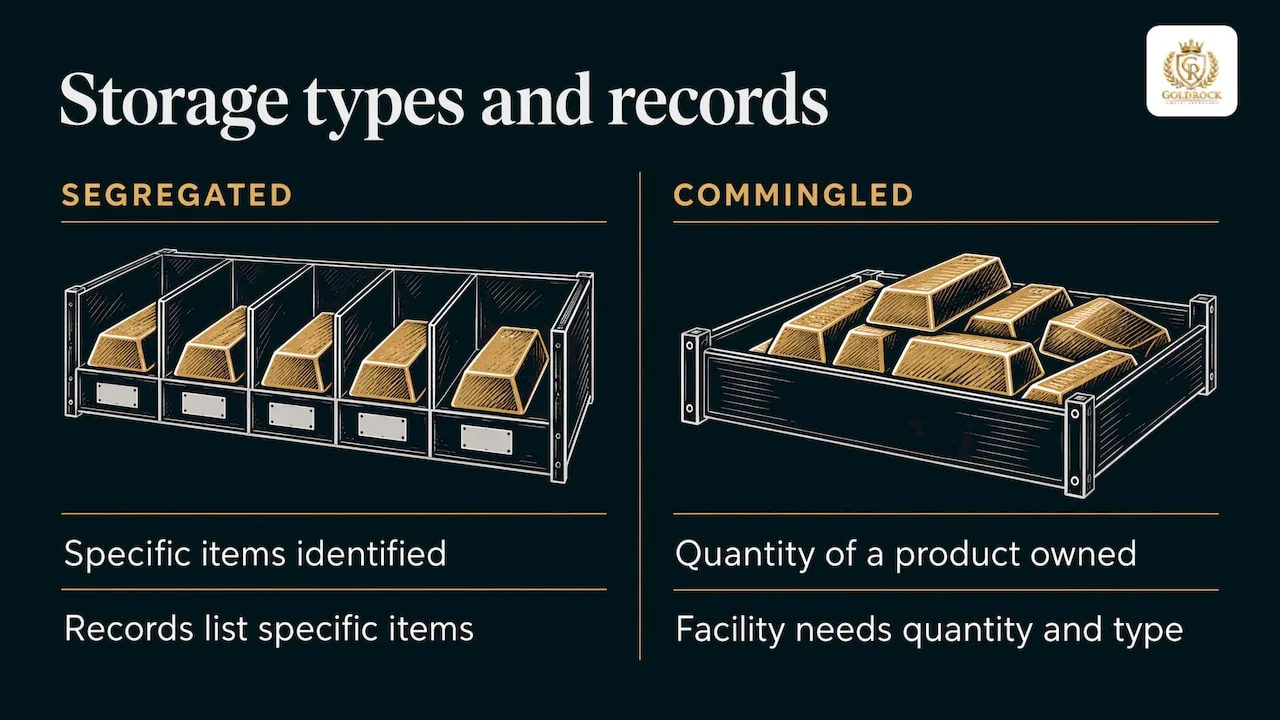
Investors move metal for practical reasons. They may want storage closer to home, a different fee structure, a facility that offers segregated storage (your specific bars and coins kept separate and identified as yours), or a change of custodian that requires a different approved facility. Some move holdings because they consolidated several accounts into one.
A move is a logistics event, not an investment decision. The metal you own stays the same. What changes is where it sits, who is responsible for it while it travels, and which records name it.
Two situations look similar but work differently:
- Moving metal you own outright (non-retirement): you instruct the storage facility, and the paperwork is between you and the two facilities.
- Moving metal held in a self-directed IRA: the IRA custodian is the account holder of record, so the custodian and the depository both take part. Your instructions go through the custodian.
If you are not sure which category your metals fall into, check your latest account statement, which names the account holder.
The parties involved
A typical move involves four roles:
- You, the owner or beneficial owner, who signs the instructions.
- The sending depository, which releases the specific items and prepares them for shipment or internal transfer.
- The receiving depository, which receives, inspects and records the deposit.
- The custodian (for IRAs), which holds the account and must approve and document any change of storage location. Your dealer or an IRA specialist coordinates between them.
The central rule is that every party needs to agree on the same list of items. A mismatch in weight, serial number or description is the most common reason a transfer stalls.
Step-by-step: moving metals between depositories
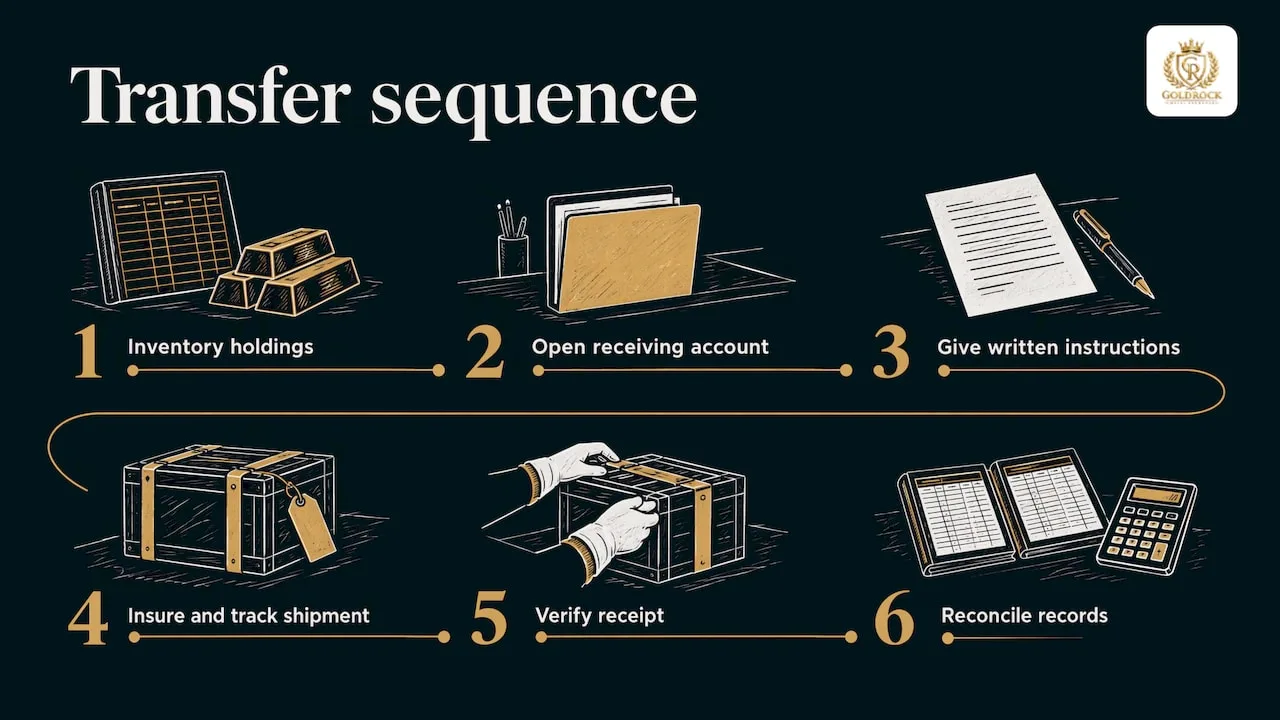
Step 1: Take inventory of what you hold
Pull your most recent statement and list each item: metal, product name, weight, quantity and, for bars, serial numbers. If you hold segregated metal, the records identify specific items. If your metal is in commingled (pooled) storage, you own a quantity of a given product rather than specific pieces, and the receiving facility will want the quantity and product type.
Why it matters: this list becomes the deposit record at the new facility. The Federal Reserve Bank of New York, in its published gold custody procedures, asks for bar-by-bar information on incoming shipments. Commercial depositories work the same way in principle, because verification depends on a precise list.
Step 2: Confirm the receiving depository and open the account
Before anything moves, the new facility needs an account in your name (or, for an IRA, in your custodian’s name for your benefit). For an IRA, the facility must be one your custodian accepts. Our guide on how to verify an IRS-approved depository walks through the checks, and the depository insurance checklist covers what to ask about coverage.
You will get an account number. That number is what ties an incoming shipment to you. The Texas Bullion Depository, a state-operated facility, instructs senders to put the depository account number on the packing slip inside the package, which shows how much depends on that one identifier.
Step 3: Give written instructions to the right party
For non-IRA metal, you send transfer or withdrawal instructions to the sending depository. For IRA metal, you instruct your custodian, who then instructs the facility. Expect a signature, account details for both ends and the item list from Step 1.
Lead time matters. For official-sector gold held at the New York Fed, both parties must send instructions at least two business days before a transfer between customer accounts, and withdrawals and incoming shipments require notice of three business days. Private facilities set their own timelines, but advance notice is the norm, so ask each one for its cutoff times.
Step 4: Choose the transfer method
There are two ways metal gets from A to B:
- Internal book transfer when both accounts are at the same facility. The facility amends its records, and nothing travels.
- Physical shipment between facilities. This is the usual route between different depositories and is where insurance and packaging matter most.
For a shipment, the sending facility or an armored carrier handles transport. Ask who arranges the carrier, who pays, and at what point responsibility passes to the receiving facility. At the New York Fed, responsibility for a deposit passes when it signs the armored carrier’s manifest. Other facilities draw that line elsewhere, so get it in writing.
Step 5: Insure the shipment
Insurance should cover the full replacement cost of the metal for the whole journey, not just the destination. The Texas Bullion Depository’s instructions recommend fully insuring the replacement cost of all shipments and using nondescript packaging. Metal prices move, so declare value on the day of shipment, not from an old statement.
For a detailed look at what to ask about coverage, see our 8-step depository insurance checklist. Our private delivery option, which is insured, applies to metals you buy for delivery to you. Retirement-account metal must stay in the custodial chain.
Step 6: Track the shipment
Keep the tracking number and send it to the receiving facility if it allows. The Texas Bullion Depository, for example, lets the sender provide a tracking number that the customer can upload. Our walkthrough on how to track a bullion shipment from order to doorstep explains what each tracking status means.
Step 7: Receipt, verification and confirmation
When the package arrives, staff open it and check the contents against the deposit record. The Texas Bullion Depository states that it does not accept responsibility for an inbound shipment until it has been received, verified and the deposit approved by the account holder. It also inventories and photographs items and, for IRA deposits, confirms contents with the IRA custodian.
That last point is the reason the order of events matters. Until the receiving facility confirms in writing, treat the metal as in transit, and keep the sending facility’s release record until the confirmation arrives.
Step 8: Reconcile your records
Once confirmed, compare the new statement to your Step 1 list, line by line. File the confirmation, the shipping documents and the insurance record together. If anything differs, raise it with the receiving facility right away, in writing.
Request a Free Precious Metals Consultation
If your metals sit in an IRA and you are weighing a change of storage, a conversation before you sign anything can save weeks of back-and-forth. Request a Free Precious Metals Consultation or call (888) 859-0978 and talk it through with our team.
Moving metals in an IRA, 401(k) or TSP
This is the part where the vocabulary matters, so here it is in plain terms.
- A transfer (trustee-to-trustee) moves money or assets directly from one financial institution to another. You never receive the funds. The IRS describes this as asking the institution holding your IRA to send the payment directly to another IRA or plan, with no taxes withheld from the transfer amount.
- A rollover generally means a distribution is paid to you and then put into another account. Rules apply to timing and frequency. For instance, the IRS says you generally cannot make more than one rollover from the same IRA in a 1-year period, and that this limit does not apply to trustee-to-trustee transfers.
- A distribution is a withdrawal. Taking metal out of an IRA and into your own possession is a distribution, which has its own consequences. A tax professional can tell you how that applies to you.
Changing the depository where your IRA metal is stored is not, by itself, a distribution, as long as the metal stays in the custodial chain and the custodian directs the move. That is why Step 3 routes instructions through the custodian. If the metal went to your home and then to a new facility, the IRS could view that as something very different. Our article on depository versus home storage explains the risk in more detail.
If you are moving a 401(k) or Thrift Savings Plan balance into metals for the first time, the order is different: the plan balance moves to a self-directed IRA first, and the metals are purchased and sent to the depository afterward. Our Precious Metals IRA page outlines that sequence, and our IRA department supports it.
Which metals can be held?
The IRS treats most metals held in an IRA as collectibles, with an exception for certain gold, silver, platinum and palladium coins and bullion. Publication 590-A says an IRA investing in collectibles is treated as having distributed the invested amount to you in the year invested, and lists the permitted exceptions. Product eligibility is therefore worth confirming before any move. Our guides on Section 408(m) gold rules, palladium purity and collectible coins cover the details.
What a depository move can cost
Costs vary by facility, so ask each one for its current fee schedule in writing. Three line items usually appear:
| Cost | What it covers | Example: Texas Bullion Depository (schedule effective April 1, 2026) |
|---|---|---|
| Shipping and handling | Outbound shipment from the facility | $17.95 plus 0.0018 × spot value, within stated limits |
| Insurance | Coverage while in transit | Included at 100% on domestic shipments |
| Storage at the new facility | Ongoing custody | 0.49% annually for accounts under $500,000, billed quarterly, $25 quarterly minimum |
The same schedule lists no withdrawal fee. These figures are one public example, published for a specific period, and not what any other facility charges. Your own quote, in writing, is the right benchmark.
A worked example makes the structure clear. Take a shipment valued at $10,000 at spot, under the shipment limits. Under that schedule, the formula is $17.95 plus 0.0018 × $10,000, which is $17.95 plus $18, or $35.95. Your actual quote will depend on the facility, the declared value and the metal on the day.
Also ask about:
- Fees the custodian charges to process a change of storage location.
- Whether the sending facility charges a release or handling fee.
- Minimums at the new facility, since quarterly minimums can matter for small accounts.
How long does it take?
There is no single answer. The timeline combines notice periods, carrier time and verification at the receiving end. The New York Fed’s published procedures show how structured it can be: shipment details at least three business days ahead and withdrawal requests at least three business days before the value date. Commercial and state facilities set their own cutoffs. Ask each side for its steps, and add custodian processing time if the account is an IRA.
Avoid scheduling a move around a deadline that you cannot adjust, such as a date when you need to sell. Metal in transit generally cannot be sold or delivered against until it is received and verified.
What to verify before and after the move
Before
- Approval and eligibility. For an IRA, confirm the receiving facility is acceptable to your custodian.
- Insurance. Ask what the policy covers, the limits, and whether metal is covered at replacement cost.
- Segregated or commingled storage. Know which one you are moving into and whether you can change it later.
- Responsibility during transit. Get the exact point where liability passes in writing.
- Fees. Collect a complete written schedule, including minimums.
- Item list. Reconcile quantities, weights and serial numbers on both sides.
After
- Match the receiving facility’s confirmation to your list.
- Check that the custodian’s statement shows the new location.
- Confirm the old facility has released the account and is no longer billing.
- Save photos or inventory reports if the facility provides them.
Common mistakes
- Handling IRA metal yourself. Receiving it personally can change how the move is treated. Keep it in the custodial chain.
- Under-declaring value. Insure for replacement cost on the shipping date.
- Vague item lists. Incomplete serial numbers or weights cause delays at verification.
- Skipping the written confirmation. A phone call is not a record.
- Ignoring minimum fees. A move to a facility with a high quarterly minimum can raise costs on small accounts.
Why we think the process works best with a guide
A depository move is simple on paper and unforgiving in practice. One missing serial number, one instruction sent to the wrong party, one shipment insured at last month’s value, and a routine move turns into weeks of phone calls.
That is why we built a dedicated in-house IRA department. The people who help you set up and transfer a retirement account into physical metals are the same people you can call when questions come up later. We believe personal service and insured delivery are what investors want when they hold something tangible, and we stand behind that approach.
Our tone with clients is calm and transparent. We explain the process, tell you who needs to sign what, and leave the decisions to you.
Blake
Work with our team
If you hold, or plan to hold, physical gold, silver, platinum or palladium in a self-directed IRA, our team can guide you through setup, transfer and storage questions, with personal attention from start to finish. Our Precious Metals IRA page explains how the process begins, and you can browse gold, silver, platinum and palladium.

For metals you buy for delivery to you rather than for an IRA, we offer insured private delivery, so the shipment is protected while it travels.
FAQ
Can I move metals between depositories without tax consequences?
In general, a direct trustee-to-trustee transfer handled by your custodian is distinct from a distribution, and the IRS says no taxes are withheld from a transfer amount. How rules apply to your situation is a question for a qualified tax professional.
Do I need my custodian to move IRA metals?
Yes. The custodian is the account holder of record for an IRA, so it must approve and document the new location. Receiving the metal personally during the move can change its treatment, so keep the custodian in the loop from the first instruction.
How do I know the new depository received everything?
The receiving facility checks the contents against the deposit record and sends a confirmation. The Texas Bullion Depository, for example, inventories and photographs items and notifies the account holder. Compare that confirmation with your item list.
What does it cost to move metals?
Expect shipping, insurance and new storage fees. One state-run example publishes $17.95 plus 0.0018 × spot value for domestic shipping, with insurance included. Other facilities set their own rates, so request a written schedule.
Can I take delivery of metals instead of moving them?
Non-retirement metal can be shipped to you, and our private delivery option is insured. IRA metal is different: taking it into your possession is a distribution, so speak with your custodian and a tax professional first.
Educational disclaimer
This article is for education only. It is not personalized investment, tax or legal advice, and it does not promise returns, safety, tax benefits or appreciation. Precious metals prices can rise and fall. Consult a qualified tax or legal professional about your own circumstances.
Ready to talk it through?
Request a Free Precious Metals Consultation or call (888) 859-0978.
Sources
- Dealer Shipping Instructions, Texas Bullion Depository
- Schedule of Fees, Texas Bullion Depository
- Gold custody procedures, Federal Reserve Bank of New York
- Rollovers of retirement plan and IRA distributions, IRS
- Publication 590-A, IRS